Beyond Static Models: Navigating the Limitations of AI in Predicting Antibody Conformational Dynamics
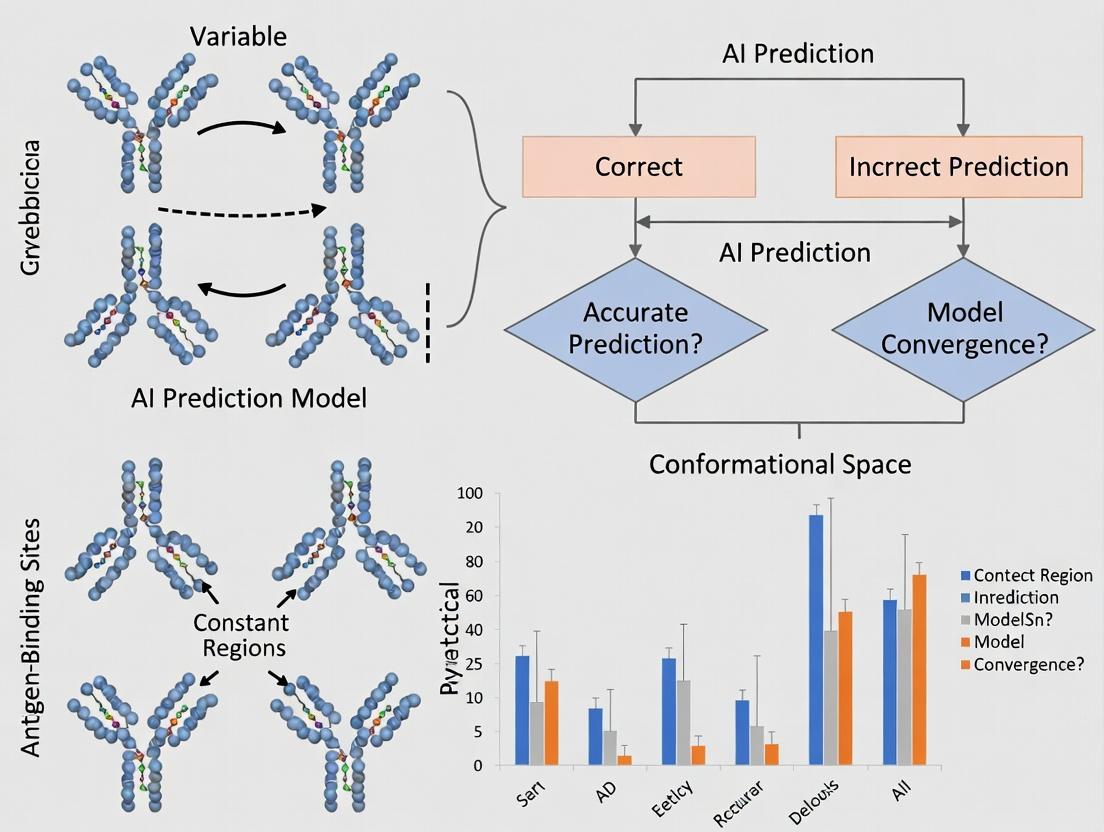
This article critically examines the current capabilities and significant limitations of artificial intelligence (AI) in predicting conformational changes in antibodies, a crucial challenge in computational biology and rational drug design.
Beyond Static Models: Navigating the Limitations of AI in Predicting Antibody Conformational Dynamics
Abstract
This article critically examines the current capabilities and significant limitations of artificial intelligence (AI) in predicting conformational changes in antibodies, a crucial challenge in computational biology and rational drug design. We explore the fundamental biophysical principles that challenge static AI models, review the latest methodological advances attempting to capture antibody flexibility, and provide a troubleshooting guide for researchers encountering inaccuracies. A comparative analysis of leading AI tools against experimental benchmarks highlights persistent gaps. The synthesis offers researchers and drug developers a realistic framework for integrating AI predictions with complementary techniques, outlining future directions to improve the reliability of computational antibody engineering.
Why AI Struggles with Antibody Flexibility: Core Biophysical and Data Challenges
The Critical Role of Conformational Dynamics in Antibody Function and Affinity Maturation
Technical Support Center: Troubleshooting AI-Predicted Conformational States in Antibody Engineering
This support center addresses common experimental challenges when validating or utilizing AI/ML predictions for antibody conformational dynamics and affinity maturation. The content is framed within the thesis that while AI predictions accelerate hypothesis generation, their limitations—particularly in capturing rare, transient, or solvent-sensitive states—require rigorous experimental verification.
FAQs & Troubleshooting Guides
Q1: Our AI-predicted high-affinity antibody variant shows poor antigen binding in SPR/BLI assays. What could be wrong? A: This is a common disconnect between in silico and in vitro results. The AI model may have predicted a stable conformation that is not populated under physiological conditions or may have overlooked colloidal instability.
- Troubleshooting Steps:
- Check Predicted Stability: Use differential scanning calorimetry (DSC) or thermal shift assays. A low Tm (<65°C) suggests protein instability, not a binding defect.
- Assess Aggregation: Perform size-exclusion chromatography (SEC) immediately after purification. Aggregates indicate non-native conformations.
- Probe Conformation: Use hydrogen-deuterium exchange mass spectrometry (HDX-MS) to compare the conformational landscape of your variant with a positive control. Deviations in Fab region dynamics explain lost function.
- Root Cause in AI Limitation: Most AI models are trained on static crystal structures or simulations with simplified solvent models, missing aggregation-prone patches or the role of solvation entropy.
Q2: How do we experimentally validate a predicted rare conformational state involved in antigen recognition? A: AI can propose rare states, but capturing them requires specialized biophysics.
- Recommended Protocol: Double Electron-Electron Resonance (DEER) Spectroscopy
- Objective: Measure distance distributions between spin labels to probe conformational ensembles.
- Methodology:
- Introduce cysteine residues at specific sites in the Fv region (e.g., on adjacent CDR loops) using site-directed mutagenesis.
- Label with a methanethiosulfonate spin label (e.g., MTSSL).
- Purify and confirm labeling via mass spec.
- Acquire DEER data on the labeled antibody (with and without antigen) at cryogenic temperatures.
- Analyze distance distributions. A broad or multi-modal distribution indicates conformational heterogeneity, potentially confirming the predicted rare state's presence in the ensemble.
Q3: During affinity maturation, our library based on AI-flexibility predictions shows no improvement. What's the issue? A: The AI may have correctly identified flexible regions, but your library diversity might be restricted to unfavorable chemical space or disrupt the conformational sampling necessary for binding.
- Troubleshooting:
- Analyze Library Sequences: Use next-generation sequencing (NGS) of the phage/yeast display library input. Check if the designed codon scheme (e.g., NNK) was correctly implemented and if diversity is sufficient.
- Test Conformational Rigidity: Incorporate a proteolytic sensitivity assay. Incubate parental and selected clones with a mild protease (e.g., subtilisin). Increased cleavage indicates AI-suggested mutations inadvertently increased flexibility, destabilizing the binding-competent state.
- Focus on Interface Paratope Dynamics: The AI might have prioritized overall Fab dynamics. Use MD simulations (explicit solvent) on top candidate sequences to specifically analyze paratope conformational entropy before experimental testing.
Q4: AI suggests a conformational selection mechanism, but our ITC data shows enthalpydriven binding. How to resolve this? A: Conformational selection often incurs an entropic penalty. A strong negative ΔH can mask a negative ΔS in ITC. Direct measurement of dynamics is needed.
- Validation Protocol: NMR Relaxation Dispersion
- Objective: Detect millisecond-microsecond timescale dynamics (typical for conformational selection) at atomic resolution.
- Methodology:
- Produce ¹⁵N-labeled antibody Fv fragment.
- Acquire ¹⁵N CPMG relaxation dispersion experiments at multiple magnetic fields.
- Fit data to models of chemical exchange. An increase in exchange parameters (Rex) upon antigen addition indicates that binding modulates dynamics, supporting a conformational selection model where the antigen selects a pre-existing, minor state from the antibody's ensemble.
Table 1: Biophysical Techniques for Validating AI Predictions on Antibody Dynamics
| Technique | Measured Parameter | Timescale Resolution | Throughput | Key Insight for AI Validation |
|---|---|---|---|---|
| HDX-MS | Solvent Accessibility & Dynamics | Seconds to Hours | Medium | Maps regions where AI-predicted & experimental flexibility differ. |
| DEER/EPR | Distance Distributions | Nanoseconds to Microseconds | Low | Quantifies populations of predicted conformations in ensemble. |
| NMR Relaxation | Bond Vector Dynamics | Picoseconds to Seconds | Very Low | Provides atomic-level, timespecific data to benchmark MD/AI predictions. |
| MD Simulations | Atomic Trajectories | Femtoseconds to Milliseconds | Computational | Direct comparison to AI trajectories; use explicit solvent for validation. |
| SR-FTIR | Secondary Structure Kinetics | Milliseconds to Seconds | Medium | Tracks real-time folding/ conformational changes post-AI mutation. |
Table 2: Troubleshooting Correlation: AI Prediction Errors vs. Experimental Outcomes
| AI Prediction Error Type | Likely Experimental Outcome | Confirmatory Experiment |
|---|---|---|
| Over-stabilized CDR loop conformation | Loss of antigen binding (increased KD) | HDX-MS (shows reduced flexibility in CDRs) |
| Underestimation of Fab stability | Low expression yield, aggregation | SEC-MALS, Thermal Shift Assay |
| Mis-predicted rare state energy | No binding improvement in maturation | DEER Spectroscopy, NMR |
| Neglect of solvation effects | Discrepancy in ΔG (predicted vs. ITC) | Computational SAXS/ SANS with explicit solvent |
Experimental Protocols
Protocol 1: HDX-MS to Probe AI-Predicted Conformational Changes
- Objective: Validate regions of predicted flexibility or rigidity changes upon antigen binding or after affinity maturation.
- Materials: ¹⁵N/¹³C-labeled antibody fragment, quench buffer (pH 2.3, 0°C), immobilized pepsin column, UPLC, Mass Spectrometer.
- Steps:
- Dilution & Labeling: Dilute antibody (with/without antigen) into D₂O buffer. Incubate at multiple timepoints (e.g., 10s, 1min, 10min, 1hr).
- Quench: Transfer aliquot to low-pH, ice-cold quench buffer to reduce exchange.
- Digestion & Separation: Rapidly pass over immobilized pepsin column, elute peptides onto a UPLC trap column.
- MS Analysis: Elute peptides into high-resolution MS. Identify peptides via tandem MS/MS.
- Data Processing: Calculate deuterium uptake for each peptide over time. Compare uptake curves between conditions to identify regions with altered dynamics.
Protocol 2: Computational-Experimental Hybrid Workflow for Affinity Maturation
- Objective: Integrate AI predictions with experimental screening to overcome AI's sampling limitations.
- Materials: Parental antibody structure, Rosetta/dAb-initio MD software, yeast display library, FACS sorter, NGS platform.
- Steps:
- AI-Driven Design: Use a method like RFdiffusion or AlphaFold2 with conditioning to generate a diverse set of predicted stable CDR-H3 conformations.
- Library Construction: Design oligos encoding the top 100-1000 variant sequences for synthesis and cloning into a yeast display vector.
- Conformation-Aware Sorting: Use conformation-sensitive dyes (e.g., ANS) or competitive binding with a conformational probe antibody during FACS to select for both stability and antigen binding.
- Deep Mutational Scanning: Sequence output pools via NGS to identify enriched mutations. Cross-reference with AI-generated positional entropy scores.
Visualizations
Title: AI Prediction Validation and Refinement Workflow
Title: Conformational Selection Binding Mechanism
The Scientist's Toolkit: Research Reagent Solutions
Table 3: Essential Reagents for Conformational Dynamics Studies
| Item | Function & Rationale |
|---|---|
| Site-Directed Mutagenesis Kit | To introduce cysteine residues for spin/fluorescence labeling or to test AI-proposed point mutations. |
| Methanethiosulfonate (MTSSL) Spin Label | The standard, minimally perturbing label for DEER/EPR spectroscopy to measure distances. |
| Deuterium Oxide (D₂O) - 99.9% | Essential labeling reagent for HDX-MS experiments to measure backbone amide exchange rates. |
| Immobilized Pepsin Column | Enables rapid, reproducible digestion for HDX-MS under quench conditions (low pH, 0°C). |
| Conformation-Sensitive Dyes (e.g., ANS, Sypro Orange) | Used in thermal shift assays or FACS to detect aggregation or stability changes in antibody variants. |
| ¹⁵N/¹³C Labeling Growth Media | For production of isotopically labeled antibody fragments required for detailed NMR dynamics studies. |
| Biotinylated Antigen | Critical for efficient pulldown during selection in display technologies and for BLI/SPR kinetics. |
| Phosphatase/Protease Cocktail | Added during purification to maintain antibody integrity and native conformation for accurate assays. |
Troubleshooting Guide & FAQs
Q1: Our molecular docking simulation fails to predict the correct binding pose for a flexible antibody CDR loop. The rigid-body docking algorithm places the ligand incorrectly. What is the likely cause and solution?
A: This is a classic symptom of an induced fit mechanism, where the antibody's complementarity-determining region (CDR) loop undergoes a significant conformational change upon ligand binding. Rigid-body docking assumes a pre-formed, static binding site (intrinsic fit), which fails here.
Solution Protocol:
- Switch to Flexible Docking or Ensemble Docking:
- Flexible Docking: Use software like Rosetta FlexPepDock (for peptides) or Schrödinger's Induced Fit Docking module. These allow specific CDR loops to be flexible during the simulation.
- Ensemble Docking: Generate an ensemble of antibody conformations from molecular dynamics (MD) simulations or using a conformational sampling tool. Dock the ligand against this ensemble of receptor structures.
- Experimental Workflow for Validation:
- Express and purify the antibody Fab fragment.
- Perform X-ray crystallography or cryo-EM on both the apo (unbound) and holo (bound) structures.
- Compare the root-mean-square deviation (RMSD) of the CDR loops. An RMSD > 2Å strongly indicates induced fit.
Q2: Our AI/ML model, trained on existing antibody-antigen structures, performs poorly when predicting the conformation of a novel antibody with a long CDR H3 loop. Why?
A: AI models for structure prediction are often trained on databases of solved structures, which are biased toward stable, low-energy states and may underrepresent the rare conformational states sampled by highly flexible loops. The model is likely predicting an average, low-energy state but missing the intrinsic motion dynamics of the loop prior to binding.
Solution Protocol:
- Augment Training Data with Dynamics:
- Run long-timescale Molecular Dynamics (MD) simulations (µs-scale) on the apo antibody to sample its intrinsic conformational landscape.
- Cluster the MD trajectories to identify representative conformational states.
- Use these states as additional input structures for model training or refinement.
- Integrate Experimental Ensemble Data:
- Use Small-Angle X-Ray Scattering (SAXS) to obtain solution-phase scattering data of the apo antibody.
- Compute SAXS profiles from your MD-derived ensemble and refine the ensemble weights to match the experimental profile. This provides a experimentally-validated conformational ensemble.
Q3: How can we quantitatively distinguish between intrinsic fit and induced fit mechanisms in our study?
A: The distinction lies in comparing the conformational populations before and after binding. Use the following experimental data table to guide analysis.
Table 1: Quantitative Distinction Between Intrinsic and Induced Fit Mechanisms
| Metric | Intrinsic Fit (Conformational Selection) | Induced Fit | Key Experimental Method |
|---|---|---|---|
| Apo State Conformational Diversity | High. The bound-like conformation is a minor but pre-existing population. | Low. The bound conformation is not significantly populated in the apo state. | MD Simulation, NMR Relaxation Dispersion |
| ΔRMSD (Bound vs. Apo) | Typically low to moderate (< 2.5 Å). The antibody selects a pre-existing state. | Can be very high (> 3 Å), especially in CDR loops. Ligand induces a new state. | X-ray Crystallography, Cryo-EM |
| Binding Kinetics (k_on) | Often slower, limited by the population of the competent state. | Can be faster, not limited by a rare pre-existing state. | Surface Plasmon Resonance (SPR) |
| NMR Chemical Shift Perturbation | Shifts occur primarily for residues in the pre-organized binding site. | Widespread, allosteric shifts observed as the structure rearranges. | NMR Spectroscopy |
Experimental Protocol for NMR-Based Distinction:
- Isotopically label ([¹⁵N, ¹³C]) the antibody Fab fragment.
- Collect 2D [¹⁵N,¹H]-HSQC NMR spectra of the apo Fab and the Fab-ligand complex.
- Calculate chemical shift perturbations (CSPs) for each backbone amide.
- Analyze the pattern: Intrinsic Fit shows CSPs localized to the binding interface. Induced Fit shows widespread CSPs across multiple secondary structure elements, indicating global rearrangement.
The Scientist's Toolkit: Key Research Reagent Solutions
| Reagent / Material | Function in Studying Conformational Change |
|---|---|
| Fab Fragment Expression System (e.g., mammalian HEK293 or insect cell) | Produces the antigen-binding fragment of the antibody without the Fc region, ideal for crystallography, cryo-EM, and biophysical assays. |
| Size-Exclusion Chromatography (SEC) Column (e.g., Superdex 200 Increase) | Purifies the antibody/Fab and separates monomers from aggregates, ensuring sample homogeneity for structural studies. |
| Crystallization Screen Kits (e.g., JCSG+, Morpheus) | Contains diverse chemical conditions to empirically identify conditions for growing protein crystals of apo and bound states. |
| Biacore Series S Sensor Chip CM5 | Gold-standard surface for immobilizing antibodies/Fabs for Surface Plasmon Resonance (SPR) to measure binding kinetics and affinity. |
| Deuterated Media & Isotopically Labeled Nutrients | Essential for producing [¹⁵N, ¹³C]-labeled proteins for multi-dimensional NMR spectroscopy studies of dynamics. |
Visualizations
Diagram 1: AI Prediction Workflow & Limitations for Antibody Motions
Diagram 2: Experimental Flow to Determine Fit Mechanism
Troubleshooting Guides & FAQs
Q1: Our AI model, trained on static PDB structures, fails to predict the conformational change of an antibody Fab upon antigen binding. The predicted binding energy is highly inaccurate. What went wrong? A: This is a classic symptom of the static data bottleneck. Your training set likely lacks examples of the intermediate or induced-fit states. The model has learned features specific to unbound or a narrow subset of conformations. To troubleshoot:
- Validate: Perform molecular dynamics (MD) simulations (see Protocol A) starting from your predicted complex and the known unbound structure. Compare the RMSD trajectories.
- Check Data: Audit your training set for conformational diversity. Calculate the RMSD distribution within clusters of similar antibodies.
- Solution: Integrate data from accelerated MD (aMD) or conformational sampling experiments into your training pipeline.
Q2: When fine-tuning a pre-trained protein language model for antibody affinity prediction, performance plateaus. We suspect limited dynamic information is the cause. How can we confirm and address this? A: The plateau likely arises from the model's inability to encode allosteric effects or flexibility. Confirm by:
- Ablation Test: Train two models: one on static structures only, and one augmented with ensemble data (e.g., from NMR or multi-temperature crystallography). Compare performance on a hold-out set containing known flexible binders.
- Analyze Attention: Examine the model's attention maps. Are they focused solely on the paratope, or do they highlight distal regions known to be allosteric from biophysical studies?
- Solution: Use fine-tuning data enriched with metrics of dynamics (see Table 1).
Q3: Our ensemble docking using static PDB snapshots yields inconsistent poses, and the top-ranked pose is biologically implausible. How should we refine the protocol? A: Inconsistent poses indicate your ensemble may not represent functionally relevant states. Refine using:
- Cluster Analysis: Cluster your docking results by ligand binding site RMSD. If clusters are equally populated with no clear consensus, your input ensemble is too diverse or irrelevant.
- Experimental Priors: Use hydrogen-deuterium exchange mass spectrometry (HDX-MS) data (see Protocol B) to constrain the regions allowed to move during docking.
- Protocol Refinement: Follow the updated ensemble generation protocol (Protocol C) that prioritizes energy landscape sampling over random dispersion.
Experimental Protocols
Protocol A: Short Molecular Dynamics Simulation for Model Validation Objective: Generate a basic trajectory to assess the stability of a predicted antibody-antigen complex.
- System Preparation: Use the
pdbfixertool to add missing residues/hydrogens to your PDB file. Solvate in an explicit water box (e.g., TIP3P) with 10 Å padding. Add ions to neutralize. - Energy Minimization: Using AMBER or CHARMM force fields, perform 5000 steps of steepest descent minimization to remove steric clashes.
- Equilibration: Heat the system to 300 K over 100 ps under NVT conditions, then equilibrate density for 100 ps under NPT (1 atm).
- Production Run: Run a 50-100 ns simulation under NPT conditions, saving frames every 10 ps.
- Analysis: Calculate Cα root-mean-square deviation (RMSD) and fluctuation (RMSF) using
MDtrajorcpptraj.
Protocol B: Hydrogen-Deuterium Exchange Mass Spectrometry (HDX-MS) for Conformational Insight Objective: Identify regions of increased flexibility or conformational change upon antigen binding.
- Labeling: Dilute antibody (alone and in complex) into D₂O-based buffer. Incubate for five time points (e.g., 10s, 1min, 10min, 1h, 4h) at 25°C.
- Quench & Digestion: Quench by lowering pH to 2.5 and temperature to 0°C. Pass over an immobilized pepsin column for online digestion.
- LC-MS/MS Analysis: Separate peptides via reverse-phase UPLC (at 0°C) and analyze with a high-resolution mass spectrometer.
- Data Processing: Calculate deuterium uptake for each peptide at each time point. Significant differences in uptake between apo and complex states identify dynamic regions involved in binding.
Protocol C: Generating a Relevance-Weighted Conformational Ensemble Objective: Create an ensemble for docking that is biased towards pharmacologically relevant states.
- Seed Collection: Gather all PDB structures for the antibody (or homology models), and structures of related antibodies.
- Normal Mode Analysis (NMA): Use
ProDyto compute low-frequency, collective modes of motion from a representative structure. - Sampling: Displace along the first three low-frequency modes (both directions) to generate a coarse ensemble.
- Filtration & Clustering: Relax each displaced structure with brief MD (see Protocol A, steps 1-3). Cluster based on CDR loop dihedrals. Weigh clusters by their relative free energy estimated from the MD ensemble or by experimental HDX data overlap.
Data Presentation
Table 1: Comparative Performance of AI Models Trained on Static vs. Dynamic-Enhanced Data
| Model Architecture | Training Data Source | Affinity Prediction MAE (kcal/mol) | Conformational Change Accuracy (Recall) | Data Required Volume (Structures) |
|---|---|---|---|---|
| 3D CNN | PDB Static Structures Only | 2.1 ± 0.3 | 0.22 | ~10,000 |
| GNN | PDB + MD Simulation Snapshots | 1.5 ± 0.2 | 0.58 | ~1,000 + 100 MD Trajs |
| Transformer | PDB + NMR Ensemble Data | 1.3 ± 0.2 | 0.71 | ~5,000 + 50 NMR Ensembles |
| Equivariant GNN | PDB + aMD Frames & HDX-MS metrics | 0.9 ± 0.1 | 0.85 | ~2,000 + 20 aMD Trajs + HDX |
Table 2: Resource Requirements for Key Conformational Sampling Methods
| Method | Typical Temporal Resolution | Typical Spatial Resolution | Computational/Experimental Cost | Key Output for AI Training |
|---|---|---|---|---|
| X-ray Crystallography | Static Snapshot | Atomic (1-2 Å) | High (Experimental) | Single, low-energy conformation |
| NMR Spectroscopy | Picosec to Msec | Atomic (Backbone) | Very High (Experimental) | Ensemble of solution-state conformations |
| Molecular Dynamics (MD) | Femtosec to Microsec | Atomic | Extreme (Computational) | High-resolution trajectory of motion |
| Hydrogen-Deuterium Exchange (HDX) | Msec to Hour | Peptide Level (4-20 residues) | Medium (Experimental) | Solvent accessibility/flexibility kinetics |
Visualizations
Diagram 1: Static vs Dynamic Data AI Training Pipeline
Diagram 2: Conformational Ensemble Generation Workflow
The Scientist's Toolkit: Research Reagent Solutions
| Item | Function & Relevance to Dynamic Predictions |
|---|---|
| RosettaAntibody | Software suite for antibody homology modeling and design. Its FlexibleBackbone docking protocol can sample limited CDR loop flexibility. |
| AMBER/CHARMM Force Fields | Parameter sets for MD simulations. Critical for generating physically accurate conformational ensembles from static starting points. |
| ProDy Python API | Tool for protein dynamics analysis, including NMA and ensemble comparison. Used to generate initial conformational samples. |
| HDX-MS Kit (Commercial) | Standardized buffers and columns for reproducible hydrogen-deuterium exchange experiments, providing experimental constraints on dynamics. |
| AlphaFold2 (Multimer) + MD | Use AF2 for initial structure prediction, then feed output as a seed for extensive MD simulation to explore the conformational landscape. |
| Conda/Mamba Environment | For reproducible management of often-incompatible computational chemistry and machine learning software packages. |
| GPU Cluster Access | Essential for running high-throughput MD simulations or training large, dynamics-aware AI models within a practical timeframe. |
| PyMOL/ChimeraX w/ MDPlugin | Visualization software capable of loading and analyzing trajectories, essential for interpreting simulation and ensemble data. |
Technical Support Center: Troubleshooting AI-Driven Conformational Sampling
FAQ 1: The AI model consistently predicts the same dominant conformation and fails to sample rare states. How can I improve sampling diversity? Answer: This is a classic sign of an over-regularized or insufficiently trained model. Implement the following protocol:
- Protocol: Enhanced Sampling via Adversarial Training.
- Train your generative model (e.g., a Variational Autoencoder or Normalizing Flow) with an adversarial component that discriminates between generated and reference rare conformations (e.g., from sparse cryo-EM data or long-timescale MD snippets).
- Loss function:
L_total = L_reconstruction + λ * L_adversarial, where λ is a weighting factor. - Explicitly include metadynamics or adaptive sampling data from MD simulations as part of your training set to bias the model towards higher-energy regions.
- Check: Verify your training data includes heterogeneous structural data (X-ray, cryo-EM, NMR ensembles) and is not biased towards high-resolution, static crystal structures.
FAQ 2: How do I validate that a predicted rare conformation is biophysically plausible and not an artifact of the AI model? Answer: AI predictions are hypotheses and require orthogonal experimental validation.
- Protocol: Computational Cross-Validation Pipeline.
- Step 1: Use the AI-predicted conformation as a starting point for short, all-atom Molecular Dynamics (MD) simulations in explicit solvent (≥ 100 ns). Stability assessment is key.
- Step 2: Perform in-silico mutagenesis or alanine scanning on the predicted conformation. If the predicted interface or allosteric network is critical, computational mutagenesis should disrupt binding affinity predictions.
- Step 3: Design a Disulfide Trapping or FRET experiment based on the predicted conformation (see Toolkit).
- Check: The predicted conformation should have no steric clashes, reasonable bond geometries, and a free energy score (from MD or a scoring function) within a plausible range of the native state.
FAQ 3: When integrating AI predictions with Molecular Dynamics (MD), the system fails to relax or quickly collapses back to the dominant state. What went wrong? Answer: The AI-predicted conformation may be in a high-energy local minimum, or the force field may not be adequately parameterized.
- Protocol: Targeted Meta-Dynamics for Conformational Refinement.
- Use the Collective Variables (CVs) derived from the AI model's latent space (e.g., distance between specific CDR loops) as biasing coordinates in a well-tempered meta-dynamics simulation.
- This explicitly discourages the simulation from revisiting the dominant state and helps explore the free energy basin around the AI prediction.
- Run simulations in replicate (n≥3) to assess consistency.
- Check: Ensure your solvent and ion force field parameters are current. For antibodies, pay special attention to disulfide bond and glycosylation parameterization if present.
FAQ 4: My experimental data (e.g., HDX-MS, FRET) suggests a conformational state, but the AI model assigns it an extremely low probability. Who is likely wrong? Answer: This discrepancy is a critical research opportunity. The model's energy landscape may be inaccurate.
- Protocol: Experimental Data Integration for Model Retraining.
- Frame the experimental data as constraints. For HDX-MS, convert deuterium uptake into soft distance or solvent accessibility constraints.
- Use Bayesian inference or a loss term that penalizes model predictions deviating from these experimental constraints.
- Retrain the AI model with this hybrid experimental/computational loss function. This directly addresses the thesis limitation of AI models lacking experimental landscape information.
- Check: Scrutinize the experimental data quality and its interpretation. Also, review the model's training set for the absence of similar conformational motifs.
Table 1: Comparison of Conformational Sampling Methods
| Method | Typical Timescale | Spatial Resolution | Ability to Capture Rare States | Key Limitation |
|---|---|---|---|---|
| X-ray Crystallography | Static | Atomic (~1 Å) | Very Low (often one state) | Crystal packing forces, static snapshot. |
| Cryo-EM | Static to milli-second | Near-atomic (2-3 Å) | Moderate (can visualize some heterogeneity) | Requires particle classification, resolution of rare states can be low. |
| Long-Timescale MD | Microseconds to seconds | Atomic | High (but computationally expensive) | Extreme computational cost; force field inaccuracies. |
| AI/ML Generative Models | Inference: seconds | Atomic | Very High (in principle) | Dependent on training data quality; validation challenge. |
| Enhanced Sampling MD | Nanoseconds to microseconds (biased) | Atomic | Medium-High | Requires pre-defined Collective Variables (CVs). |
Table 2: AI Model Performance Metrics for Conformational Prediction
| Model Type | Test Set RMSD (Å) (Dominant) | Test Set RMSD (Å) (Rare) | Latent Space Dimension | Training Data Required |
|---|---|---|---|---|
| Variational Autoencoder (VAE) | 1.2 - 2.5 | 3.5 - 6.0 | 10-50 | ~10^4 - 10^5 structures |
| Equivariant Diffusion Model | 1.0 - 2.0 | 2.5 - 4.5 | N/A | ~10^5 - 10^6 structures |
| Normalizing Flow | 1.5 - 3.0 | 3.0 - 5.5 | 20-100 | ~10^4 - 10^5 structures |
| Geometry-Transformer | 1.3 - 2.8 | 3.2 - 5.0 | N/A | ~10^5 - 10^6 structures |
The Scientist's Toolkit: Research Reagent Solutions
Table 3: Essential Materials for Conformational Analysis
| Item | Function in Conformational Research |
|---|---|
| Disulfide Trapping Mutagenesis Kits | Introduce cysteine pairs to "trap" a predicted transient conformation via disulfide bond formation, enabling detection by SDS-PAGE shift or mass spec. |
| Site-Specific Fluorophore Labeling Kits (e.g., for Cysteine, Lysine) | Label engineered antibody sites for FRET or smFRET experiments to measure distances related to conformational changes in solution. |
| HDX-MS (Hydrogen-Deuterium Exchange Mass Spectrometry) Platform | Probes solvent accessibility and dynamics, providing experimental constraints on flexible regions and potential rare state populations. |
| SEC-MALS (Size Exclusion - Multi-Angle Light Scattering) Standards | Validates antibody monodispersity and detects large-scale aggregation or conformational shifts that alter hydrodynamic radius. |
| Membrane Nanoparticles (e.g., Nanodiscs) | Provides a native-like membrane environment for studying conformations of membrane-protein targeting antibodies. |
| Metadynamics-Ready MD Software (e.g., PLUMED) | Enables enhanced sampling simulations to explore free energy landscapes and test AI-predicted rare state stability. |
Visualizations
Diagram 1: Hybrid AI-Experimental Workflow for Conformational Discovery
Diagram 2: Energy Landscape of Antibody Conformations
Technical Support Center
Troubleshooting Guides & FAQs
Q1: My AlphaFold2 or RoseTTAFold model predicts a static, low-energy conformation. How do I investigate biologically relevant, higher-energy states for my antibody?
- A: The model outputs represent a static ground state. To probe dynamics:
- Use Ensemble Generation: Run AlphaFold2 with multiple random seeds (e.g.,
--num-seeds=10). Compare models; regions with high variance (high pLDDT but differing backbone angles) suggest conformational plasticity. - Apply Perturbation: Use tools like
colabfold_batchwith the--num-recycleflag set high (e.g., 20-30) and enable--tunemode. This can sometimes push the model into alternate states. - Downstream MD Simulation: Use the AI-predicted structure as a starting point for Molecular Dynamics (MD) simulation. This is currently the most reliable method to sample dynamics. See Protocol A.
- Use Ensemble Generation: Run AlphaFold2 with multiple random seeds (e.g.,
Q2: I observe poor accuracy (low pLDDT/IpTM) specifically in the CDR H3 loop and elbow hinge regions of my AI-predicted antibody model. What steps should I take?
- A: This is a known limitation due to sparse homologous templates and inherent flexibility.
- Template Detachment: Re-run prediction with
--disable-templatesflag. This forces the model to rely on its inherent physical understanding, which can sometimes improve loop modeling at the cost of overall scaffold accuracy. - Focused Refinement: Use a loop modeling tool (e.g., Rosetta Kinematic Closure (KIC), MODELLER) specifically on the low-confidence regions, using the AI prediction as a starting constraint.
- Experimental Priors: If SAXS or NMR data suggesting a certain radius of gyration or distance constraints are available, use them in MD simulations (see Protocol B) to bias the sampling towards experimentally plausible conformations.
- Template Detachment: Re-run prediction with
Q3: How can I predict the conformational change of an antibody upon antigen binding using current AI structure predictors?
- A: Direct prediction of the binding-induced change is not possible with single-sequence input. You must use a multi-sequence or structural complex approach.
- Complex Prediction: Input the full sequence of the antibody and the antigen into AlphaFold-Multimer or RoseTTAFold. The predicted bound state may differ from the unbound prediction.
- Comparison Analysis: Superimpose the unbound (Ab alone) and bound (Ab-Ag complex) predictions. Measure dihedral angle changes in CDRs and elbow hinge. Caution: The accuracy of the unbound state in this complex context is not guaranteed.
- Dynamics Gap: The pathway and energy barrier between the two predicted states remain unknown. Follow-up with Transition Path Sampling or Steered MD is required to hypothesize a transition mechanism.
Q4: What quantitative metrics should I use to assess predicted conformational diversity versus noise?
- A: Rely on consolidated metrics from multiple runs. See Table 1.
Table 1: Metrics for Assessing AI-Predicted Conformational Diversity
| Metric | Source | Interpretation | Threshold for Significance |
|---|---|---|---|
| pLDDT Std. Dev. (per residue) | Multiple model runs (ensembles) | Low mean pLDDT with low variance indicates stable, low-confidence. High mean pLDDT with high variance indicates confident, multi-state plasticity. | >5-10 points variance |
| Backbone Dihedral Angle Std. Dev. | Multiple model runs (ensembles) | Direct measure of structural variance in φ/ψ angles. High deviation in loops/hinges indicates conformational freedom. | >30° variance |
| Predicted Aligned Error (PAE) Shift | Compare unbound vs. bound complex PAE matrices | Changes in inter-domain error (e.g., VH-VL) suggest a model-predicted rigid-body movement. | >2Å shift in inter-domain error |
Experimental Protocols
Protocol A: Molecular Dynamics as a Post-AI Refinement for Dynamics Objective: Sample the conformational landscape of an AI-predicted antibody structure.
- System Preparation:
- Use the AI-predicted PDB file. Add missing hydrogen atoms using
pdb4amberorCHARMM-GUI. - Solvate the antibody in a cubic TIP3P water box with a 10-12 Å buffer.
- Add physiological ion concentration (e.g., 150mM NaCl) and neutralize system charge.
- Use the AI-predicted PDB file. Add missing hydrogen atoms using
- Simulation Parameters:
- Use AMBER ff19SB or CHARMM36m force field.
- Employ GPU-accelerated engine (e.g., AMBER PMEMD, NAMD, OpenMM).
- Minimize, heat to 310 K, and equilibrate under NPT conditions (1 atm) with harmonic restraints gradually released.
- Production Run & Analysis:
- Run unrestrained production MD for ≥100 ns (µs-scale ideal).
- Analyze: Root Mean Square Fluctuation (RMSF) per residue, radius of gyration, inter-domain distances (VH-VL elbow angle), and dihedral angle clustering (e.g., using
cpptraj).
Protocol B: Integrating Sparse Experimental Data with AI/MD Objective: Bias MD sampling using experimental data to explore correct conformational states.
- Data as Restraints:
- SAXS: Compute theoretical scattering curve from MD snapshots using
CRYSOL. Apply a Bayesian or Maximum Entropy restraint to minimize the χ² between computed and experimental curves. - NMR RDCs/NOEs: Convert experimental measurements into harmonic or flat-bottomed distance/angle restraints added to the simulation force field.
- SAXS: Compute theoretical scattering curve from MD snapshots using
- Enhanced Sampling:
- Use the experimental restraints within an enhanced sampling method (e.g., Metadynamics, Accelerated MD) to drive transitions between states and overcome energy barriers that pure AI or classical MD cannot.
Diagrams
Title: Workflow for AI-Guided Antibody Dynamics Study
Title: AI Prediction Pipeline & Its Dynamics Gap
The Scientist's Toolkit: Research Reagent Solutions
Table 2: Essential Toolkit for Post-AI Antibody Dynamics Research
| Item | Function & Relevance |
|---|---|
| GPU Computing Cluster | Essential for running both deep learning structure prediction (AlphaFold2, etc.) and subsequent microsecond-scale Molecular Dynamics simulations. |
| AMBER/CHARMM/OpenMM Licenses | Software suites providing force fields and simulation engines for classical and enhanced-sampling MD, used to model dynamics beyond AI. |
| Enhanced Sampling Plugins (PLUMED) | Enables advanced sampling techniques (Metadynamics, Steered MD) to overcome high energy barriers and sample rare conformational events. |
| SAXS/NMR Data Collection | Source of sparse experimental data (scattering curves, distance restraints) used to validate and bias MD simulations towards experimentally relevant states. |
| Rosetta or MODELLER Suite | Provides specialized tools (e.g., loop modeling, docking) for focused refinement of AI-predicted low-confidence regions. |
| Analysis Suites (MDTraj, PyMOL, VMD) | For visualization, trajectory analysis (RMSF, clustering), and comparing AI predictions with MD ensembles and experimental data. |
Bridging the Flexibility Gap: Current AI/ML Approaches and Best-Practice Workflows
Technical Support Center
Troubleshooting Guides & FAQs
Q1: AlphaFold2 predicts a single, static structure, but my antibody-antigen research requires understanding conformational changes. How can AlphaFold-MD help bridge this gap? A: AlphaFold2 excels at single-state prediction but has known limitations in modeling conformational ensembles. AlphaFold-MD integrates the AlphaFold2-derived structure as a prior into enhanced sampling Molecular Dynamics (MD) simulations. By using the predicted aligned error (PAE) or pLDDT scores to guide the application of biasing forces (e.g., in Gaussian Accelerated MD or Metadynamics), you can explore alternative conformations beyond the initial prediction, crucial for modeling CDR loop flexibility or induced-fit binding.
Q2: During setup, the AlphaFold-MD simulation becomes unstable and the protein unfolds immediately. What are the primary causes? A: This is often due to clashes or high local strain in the initial AlphaFold2 model when placed in an explicit solvent MD environment.
- Check 1: Protonation States. Ensure histidine protonation states (HID, HIE, HIP) are correct for your simulation pH, especially in the binding pocket.
- Check 2: Missing Atoms. AlphaFold2 models may have incomplete side chains. Use tools like
PDBFixerorModellerto add missing heavy atoms and hydrogens. - Check 3: Relaxation. Perform a steepest-descent energy minimization and a short (50-100 ps) restrained equilibration in explicit solvent before launching the enhanced sampling run. This allows the solvent to adapt and relieves minor clashes.
Q3: How do I quantitatively use AlphaFold2's output (pLDDT or PAE) to define the collective variables (CVs) for enhanced sampling in my antibody simulation? A: Low pLDDT/high PAE regions often indicate intrinsic flexibility. You can define CVs based on these metrics.
- For CDR Loops: Define a CV as the root-mean-square deviation (RMSD) of the low pLDDT (<70) CDR loop residues relative to the AlphaFold2 initial pose. Bias this CV using Metadynamics to encourage exploration.
- For Inter-domain Motions: If PAE is high between the VH and VL domains, define a CV as the distance between their centers of mass or their relative angle.
- Protocol: Extract residue-specific pLDDT scores from the AlphaFold2 output JSON. Use a script to map scores onto your topology file. In your MD engine (e.g., PLUMED), configure the bias to apply force primarily to low-confidence regions.
Q4: My AlphaFold-MD simulation sampled multiple states, but I am unsure how to validate them or identify the most biologically relevant conformation. A: Validation requires integration of experimental and computational data.
- Cross-validate with Experimental Data: Use SAXS (small-angle X-ray scattering) profiles to assess the ensemble's fit to solution data. Compute theoretical SAXS curves from your simulation clusters and calculate the χ² fit.
- Compute Binding Affinity: For each dominant conformation, perform docking or short MD simulations with the antigen and compute relative binding energies (MM-GBSA/PBSA). The conformation that yields a favorable and consistent binding energy is more plausible.
- Check Conserved Interactions: The relevant conformation should maintain conserved intramolecular salt bridges or hydrogen bonds observed in known antibody structures.
Q5: Are there specific CVs or enhanced sampling methods recommended for antibody-specific motions like VH-VL elbow angle variation? A: Yes. The elbow angle between the variable (VH-VL) and constant (CH1-CL) domains is a classic antibody degree of freedom.
- CV Definition: Define four pseudo-atoms representing the centers of mass of VH, VL, CH1, and CL. The CV is the angle between the vector connecting VH-VL and the vector connecting CH1-CL.
- Recommended Method: Use Well-Tempered Metadynamics or Adaptive Sampling biased on this elbow angle CV, combined with RMSD CVs of CDR loops, to capture coupled motions.
Table 1: Common AlphaFold2 Output Metrics and Their Interpretation for MD
| Metric | Range | Interpretation for MD Setup |
|---|---|---|
| pLDDT | 90-100 | Very high confidence. Treat as a well-folded, stable region. |
| 70-90 | Confident. Standard MD parameters are suitable. | |
| 50-70 | Low confidence. Region is flexible/unstructured. Prime candidate for CV-based enhanced sampling. | |
| <50 | Very low confidence. Likely disordered. May require specialized force fields or truncated modeling. | |
| Predicted Aligned Error (PAE) | <5 Å | Confident in relative positioning of residue pairs. |
| 5-15 Å | Moderate uncertainty. Can guide domain-level CV definition. | |
| >15 Å | High uncertainty. Relative orientation is poorly predicted. Key region for conformational exploration. |
Table 2: Comparison of Enhanced Sampling Methods for AlphaFold-MD
| Method | Key Principle | Best Suited for Antibody Research Scenario | Computational Cost |
|---|---|---|---|
| Gaussian Accelerated MD (GaMD) | Adds a harmonic boost potential to smooth the energy landscape. | Initial broad exploration of CDR loop conformational space. | Medium |
| Well-Tempered Metadynamics | Deposits repulsive Gaussian biases in CV space to push system away from visited states. | Quantitatively mapping the free energy landscape of VH-VL elbow angles. | High |
| Adaptive Sampling | Uses short, independent simulations to seed new ones based on uncertainty. | Generating a diverse ensemble of Fab fragment conformations for ensemble docking. | Variable (can be high-throughput) |
| Replica Exchange MD | Runs parallel simulations at different temperatures, allowing exchanges. | Overcoming large energy barriers in domain rearrangements. | Very High |
Experimental Protocols
Protocol 1: From AlphaFold2 Prediction to Equilibrated System for MD
- Prediction: Run AlphaFold2 (via ColabFold recommended for speed) for your antibody sequence. Download the ranked PDB files and the
model_*.pklfiles containing PAE/pLDDT data. - Model Preparation: Select the top-ranked model. Use
PDBFixer(OpenMM suite) to:- Add missing heavy atoms and side chains.
- Add missing hydrogens for pH 7.4.
- Save as a new PDB.
- Solvation & Ionization: Use
gmx pdb2gmx(GROMACS) ortleap(AMBER) to:- Place the protein in a cubic or dodecahedral water box (e.g., TIP3P) with at least 1.2 nm buffer.
- Add ions (e.g., 0.15 M NaCl) to neutralize the system and mimic physiological concentration.
- Minimization & Equilibration:
- Energy Minimization: Perform 5000 steps of steepest descent minimization to remove clashes.
- NVT Equilibration: Heat system to 310 K over 100 ps using a v-rescale thermostat, with heavy restraints on protein atoms.
- NPT Equilibration: Equilibrate pressure at 1 bar over 100 ps using a Parrinello-Rahman barostat, with restraints on protein backbone.
Protocol 2: Implementing pLDDT-Guided Gaussian Accelerated MD (GaMD)
- CV Selection: Parse the pLDDT scores. Define Cα atoms of residues with pLDDT < 70 as your "flexible region".
- GaMD Setup (using AMBER):
- Run a short (2 ns) conventional MD simulation to collect potential statistics.
- Calculate the average and standard deviation of the system's dihedral and total potential energy.
- Use the
gamdcommand in AMBER'spmemd.cudato set the GaMD parameters (e.g.,sigma0D=6.0, sigma0P=6.0for dihedral and total boost).
- Production Run: Execute the GaMD simulation for 100-500 ns. The flexible, low-pLDDT regions will receive a higher boost potential, accelerating their conformational sampling.
- Analysis: Cluster the trajectories (e.g., using
gmx cluster). Analyze the sampled RMSD of CDR loops and compare to the initial AlphaFold2 pose.
Diagrams
The Scientist's Toolkit: Research Reagent Solutions
Table 3: Essential Tools & Materials for AlphaFold-MD Experiments
| Item | Function & Purpose | Example/Note |
|---|---|---|
| ColabFold | Cloud-based, accelerated AlphaFold2 server. Provides quick predictions with MMseqs2 for MSA. | Use for rapid initial structure prediction. Download PAE matrix. |
| GROMACS/AMBER | High-performance MD simulation engines. Required for running energy minimization, equilibration, and production MD. | GROMACS is free; AMBER requires license. Both support enhanced sampling via PLUMED. |
| PLUMED | Plugin for free-energy calculations and enhanced sampling. Essential for implementing Metadynamics, Umbrella Sampling, etc., based on your CVs. | Must be compiled with your MD engine. Use version >2.8. |
| PDBFixer | Tool to prepare protein structures from PDB files for simulation (add missing atoms, protonate). | Part of the OpenMM suite. Critical for fixing AlphaFold2 output. |
| VMD/ChimeraX | Molecular visualization software. Used to analyze trajectories, visualize conformational changes, and prepare figures. | VMD is powerful for analysis scripts; ChimeraX has excellent rendering. |
| PyMOL | Commercial molecular visualization and analysis tool. Widely used for creating publication-quality images of structures. | Useful for aligning and comparing the initial AF2 model with sampled MD frames. |
| PLUMED-INSURE | A tool within PLUMED to analyze the sampling efficiency and convergence of enhanced sampling simulations. | Check if your chosen CVs adequately explore the conformational space. |
| High-Performance Computing (HPC) Cluster | Essential computational resource. AlphaFold-MD simulations are resource-intensive, requiring multiple GPUs/CPUs for days to weeks. | Plan for adequate GPU (for AF2) and CPU/GPU (for MD) node allocation. |
Troubleshooting Guides & FAQs
Q1: My ensemble model generates highly similar conformations instead of a diverse set. What could be the cause and how can I fix it?
A: This is often due to mode collapse in generative models or insufficient sampling diversity.
- Cause 1: Inadequate latent space exploration. The model is stuck in a local minimum.
- Solution: Increase the temperature parameter (e.g., from 1.0 to 1.5) during the sampling phase to encourage broader exploration. Implement or enhance random seed variation across ensemble members.
- Cause 2: Overly restrictive training data. The training set lacks conformational variety.
- Solution: Augment training data with structures from different experimental conditions (pH, temperature) or employ data augmentation techniques like adding Gaussian noise to atomic coordinates during training.
- Protocol: To diagnose, calculate the Root Mean Square Deviation (RMSD) matrix between all generated conformations.
- If the average pairwise RMSD is < 2.0 Å for a flexible CDR loop, diversity is too low.
- Fix Protocol: Retrain with a modified loss function that includes a diversity penalty term, such as maximizing the average pairwise RMSD among a batch of generated samples.
Q2: How do I validate which AI-generated conformation is biologically relevant when experimental structures are unavailable?
A: Employ a multi-pronged computational validation pipeline.
- Step 1: Energetic Filtration. Filter all generated conformations using a physics-based scoring function. Discard high-energy poses.
- Step 2: Consensus Ranking. Use at least three independent metrics to rank conformations.
- Step 3: Dynamic Assessment. For top-ranked conformations, run a short, implicit solvent molecular dynamics (MD) simulation (e.g., 50 ns) to check for stability.
Table 1: Computational Validation Metrics for Generated Antibody Conformations
| Metric | Recommended Threshold | Purpose | Tool Example |
|---|---|---|---|
| Rosetta Energy Units (REU) | < 0 (lower is better) | Assesses thermodynamic stability. | Rosetta refine protocol |
| MolProbity Clashscore | < 10 (lower is better) | Evaluates steric clashes and rotamer outliers. | MolProbity Server |
| PLDDT (from AlphaFold2) | > 70 (higher is better) | Measures local confidence per residue. | ColabFold |
| Normalized B-Factor (from MD) | < 1.0 for CDR loops | Assesses dynamic stability from simulation. | GROMACS gmx rmsf |
Q3: The predicted conformations do not agree with my HDX-MS (Hydrogen-Deuterium Exchange Mass Spectrometry) data. How should I proceed?
A: This indicates a potential discrepancy between AI-predicted static structures and solution-phase dynamics.
- Troubleshooting Steps:
- Map HDX-MS data: Project the deuterium uptake rates onto your generated conformations. Identify regions with high experimental exchange but low predicted solvent accessibility.
- Check for missing ensembles: HDX-MS detects an average over all populated states. A single conformation may be insufficient.
- Protocol: Cluster your AI-generated ensemble into 3-5 representative clusters. Compute the weighted average solvent-accessible surface area (SASA) for each residue across clusters (weighted by cluster population). Compare this ensemble-averaged SASA to HDX-MS data.
- Refine model: Use the HDX-MS data as a soft constraint during a subsequent MD simulation or during the training of a next-generation model to bias sampling toward experimentally consistent states.
Q4: When integrating ensemble predictions with MD, my simulations become unstable or crash. What are common pitfalls?
A: This is frequently due to steric clashes or poor geometry in the initial AI-generated model.
- Pre-MD Repair Protocol:
- Run the PDB file through PDBFixer (OpenMM suite) to add missing atoms (especially hydrogens) and residues.
- Perform energy minimization using an implicit solvent model (e.g., Generalized Born) for 5,000 steps to relieve severe clashes. A steep drop in potential energy (> 10^4 kJ/mol) indicates resolved clashes.
- Check and correct chirality and protonation states of key residues (e.g., HIS, ASP, GLU) according to your intended simulation pH using PROPKA.
- Critical Step: Use LEaP (AmberTools) or pdb2gmx (GROMACS) to properly parameterize the structure for your chosen force field (e.g., CHARMM36, AMBER ff19SB).
The Scientist's Toolkit: Research Reagent Solutions
Table 2: Essential Materials for AI-Driven Conformational Ensemble Studies
| Item / Reagent | Function / Purpose | Example Product / Software |
|---|---|---|
| High-Quality Structural Datasets | Training and benchmarking AI models. Requires diverse, high-resolution antibody-antigen complexes. | SAbDab (The Structural Antibody Database), PDB |
| Generative AI Software | Core platform for generating conformational ensembles. | Omega (OpenEye), Rosetta KIC/Backrub, DiffDock, RFdiffusion |
| Molecular Dynamics Suite | For validation, refinement, and assessing dynamics of generated conformations. | GROMACS, AMBER, NAMD, OpenMM |
| Force Field Parameters | Defines atomic interactions for physics-based simulation and scoring. | CHARMM36m, AMBER ff19SB, DES-Amber |
| Solvent Model | Critical for accurate simulation of aqueous environments and binding interfaces. | TIP3P, TIP4P water models; Generalized Born (GB) implicit solvent |
| Analysis & Visualization Suite | Processing, comparing, and visualizing ensembles and simulation trajectories. | PyMOL, VMD, MDTraj, Bio3D (R) |
| Validation Server | Independent assessment of structural quality and steric soundness. | MolProbity, PDB Validation Server |
Experimental Protocols
Protocol 1: Generating an Ensemble with a Conditional Variational Autoencoder (cVAE)
- Data Preparation: Curate a dataset of antibody Fv region structures from SAbDab. Align all structures to a common framework reference. Convert coordinates into internal representations (e.g., torsion angles).
- Model Training: Train a cVAE where the encoder maps a structure to a latent vector z, and the decoder reconstructs it. Condition the model on antibody sequence features (CDR loop lengths, amino acid profiles).
- Ensemble Generation: For a target sequence, sample multiple latent vectors zi from a Gaussian distribution (N(0, I)). Decode each zi using the conditioned decoder to produce a unique backbone conformation.
- Side-Chain Packing: Use a fast rotamer library (e.g., SCWRL4) to add side chains to each generated backbone.
- Initial Filtering: Discard conformations with severe steric clashes (clashscore > 20) or improbable backbone dihedrals (outside preferred Ramachandran regions).
Protocol 2: Integrating Ensemble Predictions with Molecular Dynamics for Stability Assessment
- Input: Select top 5 conformations from AI ensemble based on composite score (Table 1).
- System Preparation: Solvate each conformation in a cubic water box (10 Å padding). Add ions to neutralize charge and reach 150 mM NaCl concentration.
- Equilibration: Perform stepwise equilibration in NVT and NPT ensembles (100 ps each) with heavy atom positional restraints gradually released.
- Production MD: Run unrestrained MD simulation for 100 ns per conformation. Use a 2-fs timestep. Save coordinates every 10 ps.
- Analysis: Calculate per-residue Root Mean Square Fluctuation (RMSF). Cluster frames from the last 50 ns to identify the dominant stable pose. Compare to the initial AI-generated structure via RMSD.
Workflow & Relationship Diagrams
AI-Driven Conformational Ensemble Prediction & Validation Workflow
Thesis Context: From Single-State Limits to Ensemble Solution
Technical Support Center: Troubleshooting & FAQs
Q1: During a molecular dynamics (MD) simulation of a CDR-H3 loop using AMBER, my simulation "blows up" (becomes unstable) after a few nanoseconds. What are the primary causes and solutions?
A: This is often due to bad contacts or incorrect parameters. Follow this protocol:
- Minimization & Heating Protocol:
- Perform 5,000 steps of steepest descent minimization on only the solvent and ions, restraining the antibody complex (force constant of 10.0 kcal/mol·Å²).
- Minimize the entire system for 10,000 steps (5,000 steepest descent, 5,000 conjugate gradient).
- Heat the system from 0K to 300K over 50 ps in the NVT ensemble, using a weak restraint (1.0 kcal/mol·Å²) on the antibody.
- Equilibrate for 100 ps in the NPT ensemble at 300K and 1 bar before production run.
- Check for Missing Parameters: For non-standard residues or covalent linkages, use the
antechamberandparmchk2modules to generate GAFF2 parameters. Ensure correct disulfide bond definitions in your topology. - Troubleshooting Table:
| Issue | Likely Cause | Diagnostic Step | Solution |
|---|---|---|---|
| Rapid energy increase | Bad steric clash | Visualize the last stable frame (e.g., VMD, PyMOL). | Return to the minimized structure, apply stronger positional restraints during initial heating (5.0 kcal/mol·Å²). |
| Sudden coordinate NaN | Unphysical bond/angle | Check simulation logs for "Coordinate/velocity/force is NaN". | Shorten the initial timestep to 0.5 fs during heating, ensure all hydrogen masses are properly repartitioned (using parmed). |
Q2: When using Rosetta FlexPepDock or CDR loop modeling protocols, my models show unrealistic backbone dihedral angles (Ramachandran outliers) specifically in the grafted loop regions. How can I fix this?
A: This indicates a failure in the loop conformation sampling or refinement step.
- Protocol Enhancement:
- Increase the number of cyclic coordinate descent (CCD) closure attempts from the default (e.g., 1000 to 5000) using the flag
-loops:max_ccd_cycles 5000. - Apply the
-loops:refine_onlyflag combined with-relax:thoroughto the problematic models, focusing refinement on a 9Å region around the CDR loop. - Incorporate backbone dihedral constraints from homologous structures (if available) using the
-constraints:fileflag.
- Increase the number of cyclic coordinate descent (CCD) closure attempts from the default (e.g., 1000 to 5000) using the flag
- Use the
FloppyTailapplication for extreme flexibility prior to docking. - Key Metrics Table for Model Validation:
| Metric | Acceptable Range | Tool for Assessment | Corrective Action if Out of Range |
|---|---|---|---|
| Ramachandran Favored (%) | >98% for grafted loop | MolProbity, PHENIX |
Apply Rosetta's FastRelax with a rama_2b weight map. |
omega angle outliers |
<0.1% | MolProbity |
Use Rosetta's fixbb with -correct flag. |
clashscore (all atom) |
<5 | MolProbity |
Run RosettaDock high-resolution refinement with -docking_local_refine. |
Q3: How do I effectively use AlphaFold2 or AlphaFold3 for predicting the conformation of a CDR loop in the context of a known antibody Fv framework, and what are the limitations?
A: Leverage AlphaFold's strength in template-based modeling while mitigating its stochasticity for hypervariable loops.
- Experimental Protocol (AlphaFold2 with AF2Complex):
- Input Preparation: Supply the full-length heavy and light chain sequences in a FASTA file. For context, include the target antigen sequence separated by a colon.
- Template Guidance: Provide the PDB file of your known Fv framework as a
--template_pdbto bias the framework regions. - Multi-Seed Sampling: Run 5-10 independent predictions with different random seeds (
--model_seed). The relaxed model with the lowest pLDDT in the CDR region is not always the best; cluster all predictions by CDR RMSD. - Analysis: Extract the per-residue pLDDT and predicted aligned error (PAE) focusing on the CDR loops.
- Limitations & Data Summary Table:
| Model Feature | Strength for CDRs | Known Limitation | Quantitative Benchmark (Approx.) |
|---|---|---|---|
| pLDDT Score | High confidence (>90) correlates with accuracy. | Poor discriminator for low-confidence (70-85) loop conformations. | CDR-H3 RMSD can vary by >4Å for models with similar pLDDT. |
| Predicted Aligned Error (PAE) | Identifies flexible/disordered regions. | Underestimates error for conformational rearrangements upon binding. | N/A |
| Sequence Dependency | Excellent for canonical loops. | Struggles with rare lengths (>22 residues) or multiple disulfides in CDR. | Success rate (RMSD <2Å) drops from ~70% to <30% for non-canonical H3 loops. |
Visualization of Protocols
AlphaFold CDR Modeling & Validation Workflow
Stable MD Simulation Protocol for CDR Loops
The Scientist's Toolkit: Research Reagent Solutions
| Item Name | Vendor (Example) | Function in CDR Loop Modeling |
|---|---|---|
| AMBER (ff19SB/GAFF2) | Open Source / UCSF | Force field providing parameters for MD simulations of antibodies, including backbone and side chain energetics. |
| Rosetta Software Suite | University of Washington | Comprehensive suite for de novo loop remodeling, docking, and full-atom refinement, specialized for proteins. |
| ChimeraX / PyMOL | UCSF / Schrödinger | Visualization and analysis tools for model validation, clash detection, and measuring distances/angles. |
| MolProbity Server | Duke University | Critical validation service for checking steric clashes, rotamer outliers, and backbone dihedral angles. |
| AlphaFold2/3 ColabFold | DeepMind / GitHub | Cloud-based implementation for rapid, GPU-accelerated prediction of antibody-antigen complex structures. |
| GROMACS (2023+) | Open Source | High-performance MD engine suitable for large-scale sampling of loop conformational states on HPC clusters. |
| PDB Fixer | OpenMM | Prepares PDB files for simulation by adding missing atoms, loops (crudely), and protonation states. |
| PEP-FOLD3 | Université Paris Cité | De novo peptide folding tool useful for initial modeling of long, independent CDR-H3 loop conformations. |
Incorporating Co-factors and Solvent Effects in AI-Driven Docking Simulations
Technical Support Center
Troubleshooting Guides & FAQs
Q1: Our AI-docking simulation fails when a catalytic metal ion (co-factor) is present in the binding pocket. The predicted binding pose is physically impossible, with the ligand overlapping the ion. What could be the cause and solution?
A: This is a common issue where the AI scoring function lacks explicit parameters for metal-coordination chemistry. The model treats the ion as a generic charged sphere.
Troubleshooting Steps:
- Pre-process the co-factor: Ensure the metal ion has the correct formal charge and is parameterized with a suitable force field (e.g., AMBER, CHARMM) before input into the AI system.
- Use a hybrid approach: Run a classical molecular dynamics (MD) simulation with explicit solvent and the correct ion parameters to generate an ensemble of stable protein-co-factor conformations. Use this ensemble as input structures for the AI docking.
- Post-docking refinement: Subject the top AI-generated poses to a brief MD simulation or energy minimization with explicit ions and solvent to validate and refine the geometry.
Q2: How do we accurately account for explicit water molecules mediating a ligand-protein interaction in an AI docking protocol that uses an implicit solvation model?
A: Key mediating waters are often overlooked by implicit models. They must be treated as part of the receptor.
Experimental Protocol: "Explicit Bridge Water Retention"
- Obtain a high-resolution crystal structure (≤2.0 Å) of the target.
- Run a short (50-100 ns) explicit solvent MD simulation of the apo-protein to identify conserved water molecules within the binding site (occupancy > 0.8).
- Manually inspect the binding site for water molecules forming hydrogen-bond networks between protein and known ligands.
- Incorporate these conserved/structural water molecules as fixed, non-flexible residues in the receptor PDBQT file used for AI docking. The AI model will then treat them as part of the target geometry.
Q3: The AI-predocked conformation of our antibody-antigen complex shows strong complementarity, but subsequent MD shows rapid dissociation in explicit solvent. Why does the AI score not capture this instability?
A: The discrepancy likely arises from the lack of explicit solvation and entropic effects in the AI training data. AI models trained on static crystal structures may favor overly tight, "dry" interfaces that are not solvated correctly.
Diagnosis and Solution:
- Analyze the interface: Use a tool like PISA (Protein Interfaces, Surfaces and Assemblies) to predict the solvation free energy gain upon binding (ΔG). Compare the AI-predicted pose's ΔG to known stable complexes.
- Implement a solvation-shell checkpoint: Before accepting the top AI pose, run a Poisson-Boltzmann/Surface Area (MM/PBSA) calculation on the complex using a short MD snapshot with explicit water. This provides a more rigorous solvation-inclusive binding score.
- Refine with SMD: Use Steered Molecular Dynamics (SMD) in explicit water to test the mechanical stability of the docked pose, which can reveal unrealistic interactions missed by static scoring.
Table 1: Performance Comparison of Docking Methods with Co-factors
| Method | Co-factor Handling | RMSD (Å) <2.0 (Success Rate) | ΔG Prediction Error (kcal/mol) | Computational Cost (GPU hrs) |
|---|---|---|---|---|
| AI Docking (Baseline) | Implicit / Generic Charge | 42% | 3.8 ± 1.2 | 0.5 |
| AI Docking + Pre-Param. Ion | Explicit Parameters | 65% | 2.1 ± 0.9 | 1.0 |
| Hybrid MD/AI Ensemble | Explicit, Dynamic | 78% | 1.5 ± 0.7 | 24.0 |
| Classical Docking (Ref.) | Explicit Parameters | 58% | 2.5 ± 1.0 | 5.0 |
Table 2: Impact of Explicit Solvent Bridges on Binding Affinity Prediction
| System | No. of Bridging Waters | AI Score (pKd) | MM/PBSA Score (pKd) | Experimental (pKd) |
|---|---|---|---|---|
| Antibody A / Antigen X | 0 (Dry) | 8.9 | 6.2 | 7.1 |
| Antibody A / Antigen X | 2 (Conserved) | 7.5 | 7.0 | 7.1 |
| Protease / Inhibitor Y | 1 (Catalytic) | 9.2 | 8.8 | 8.9 |
Experimental Protocols
Protocol: Hybrid MD/AI Docking for Antibody Conformational Changes with Solvent This protocol addresses the thesis context of limitations in predicting antibody paratope flexibility.
- System Preparation:
- Start with the Fv fragment of the antibody (PDB ID).
- Protonate states at pH 7.4 using
PDB2PQR. - Parameterize any co-factors (e.g., catalytic Zn²⁺) with
MCPB.py(for AMBER).
- Conformational Sampling (MD):
- Solvate the system in a TIP3P water box with 150 mM NaCl.
- Minimize, heat to 310 K, and equilibrate under NPT conditions.
- Run a production MD simulation for 200 ns. Save frames every 100 ps.
- Cluster Analysis:
- Cluster the paratope (CDR-H3/L3) residues from the MD trajectory using RMSD-based clustering (e.g., GROMACS
cluster). - Select the top 5 centroid structures as representative conformers.
- Cluster the paratope (CDR-H3/L3) residues from the MD trajectory using RMSD-based clustering (e.g., GROMACS
- AI-Driven Ensemble Docking:
- Prepare each antibody centroid conformer and the antigen as input for the AI docking software (e.g., using
prepare_receptorandprepare_ligandscripts). - Run docking against each conformer. Aggregate and rank all results by the AI's confidence score.
- Prepare each antibody centroid conformer and the antigen as input for the AI docking software (e.g., using
- Solvation & Scoring Validation:
- For the top 20 poses, run a 50 ns explicit solvent MD.
- Calculate the MM/PBSA binding free energy over the last 20 ns.
- The pose with the most favorable MM/PBSA score and stable RMSD is selected.
Visualizations
Title: Hybrid MD-AI Workflow for Antibody Docking
Title: Solvent Effect Troubleshooting Logic
The Scientist's Toolkit: Research Reagent Solutions
| Item | Function in Experiment | Example/Detail |
|---|---|---|
| Force Field Parameters for Ions | Provides accurate bonded/non-bonded terms for metal co-factors (e.g., Zn²⁺, Mg²⁺) in MD simulations. | MCPB.py (for AMBER); CHARMM GUI Metal Center Builder. |
| Explicit Solvent Box | Creates a realistic aqueous environment for MD simulations to model solvent effects. | TIP3P, TIP4P water models; 150 mM NaCl for physiological ionic strength. |
| Trajectory Analysis Suite | Processes MD data to cluster conformations, calculate RMSD, and identify conserved waters. | GROMACS cluster, gmx rms; VMD; MDTraj (Python). |
| AI Docking Software | Performs rapid, deep-learning-based pose prediction and scoring. | AlphaFold 3, DiffDock, EquiBind. |
| MM/PBSA Calculation Tool | Computes solvation-inclusive binding free energies from MD trajectories. | g_mmpbsa (GROMACS), AMBER MMPBSA.py. |
| High-Resolution Structure | Essential starting point to identify structural waters and correct binding site geometry. | RCSB PDB entry with resolution ≤ 2.0 Å. |
Technical Support Center
Troubleshooting Guide & FAQs
Q1: Our AI-predicted antibody conformational changes show unrealistic backbone torsions or clashes in the CDR loops. What are the primary checks and corrections? A: This is a common limitation in AI models trained on static structures. First, run a steric clash check using tools like MolProbity or UCSF Chimera. If clashes are present, apply a short, constrained molecular dynamics (MD) minimization in explicit solvent (e.g., using AMBER or GROMACS) to relax the structure. For torsions, validate predicted angles against statistical distributions from the PDB (e.g., via CDR loop classification). Consider using a refinement step with a physics-based force field to correct energetically unfavorable states before proceeding to experimental validation.
Q2: After generating AI-predicted frames, which biophysical technique is most suitable for initial, rapid validation of a putative conformational change? A: For initial validation, Surface Plasmon Resonance (SPR) or Bio-Layer Interferometry (BLI) is recommended to detect binding kinetics changes. A significant alteration in off-rate (kd) between the antibody and its antigen across different conditions (e.g., pH shift) can indicate a predicted conformational switch. Ensure your experimental buffer conditions match the in silico prediction environment (pH, ionic strength). Negative results here may suggest the AI-predicted state is not populated under tested conditions.
Q3: During Hydrogen-Deuterium Exchange Mass Spectrometry (HDX-MS) validation, we see low deuterium uptake changes compared to our AI-predicted dramatic conformational shift. What does this imply? A: Low HDX-MS signal change can indicate: 1) The predicted conformational state is not significantly populated in solution. 2) The conformational change is highly dynamic and averaged out in the measurement timeframe. 3) The structural change is localized and does not alter backbone solvent accessibility. Revisit the AI model's confidence scores for that region. Consider complementary techniques like time-resolved FRET or MD simulations to probe for transient or subtle changes.
Q4: How do we reconcile a high-confidence AI prediction with negative experimental validation from X-ray crystallography? A: Crystallography captures a single, lowest-energy state, often stabilized by crystal packing. A negative result may mean: 1) The predicted state is transient or has low population in the crystallized condition. 2) Crystal packing forces inhibit the transition. To address this, try co-crystallization under the condition predicted to induce the change (e.g., with antigen, at different pH). If unsuccessful, use solution techniques like Small-Angle X-Ray Scattering (SAXS) to detect populations of alternative conformations.
Q5: Our MD simulation, initiated from an AI-predicted frame, rapidly collapses back to the known ground state. Is the prediction invalid? A: Not necessarily. This could indicate that the AI-predicted state is a metastable intermediate or requires a specific trigger (e.g., antigen binding, post-translational modification) for stabilization. Examine the simulation trajectory for early-stage structural features that match the prediction before collapse—these may be genuine characteristics of an unstable intermediate. Consider running metadynamics or umbrella sampling simulations to compute the free energy landscape between the ground and predicted states.
Key Experimental Protocols
Protocol 1: Constrained MD Refinement of AI-Predicted Structures
- Preparation: Solvate the AI-predicted PDB file in a TIP3P water box with 10 Å padding using
tleap(AMBER) orgmx solvate(GROMACS). Add ions to neutralize the system. - Minimization: Perform 5000 steps of steepest descent minimization, restraining protein heavy atoms with a force constant of 10 kcal/mol·Å².
- Heating & Equilibration: Heat the system from 0 to 300 K over 100 ps in the NVT ensemble, followed by 1 ns equilibration in the NPT ensemble (1 atm), maintaining restraints.
- Production: Run a short (5-10 ns) MD simulation in the NPT ensemble with reduced backbone restraints (1-2 kcal/mol·Å²) or no restraints, using a 2-fs timestep.
- Analysis: Cluster the trajectory and take the centroid of the largest cluster as the refined structure for experimental testing.
Protocol 2: HDX-MS for Conformational Change Validation
- Labeling: Dilute antibody (10 µM) into deuterated buffer (pD 7.4, 25°C) for seven time points (10s to 4 hours). Quench with cold, low-pH buffer (final pH 2.5).
- Digestion & Analysis: Pass quenched sample over an immobilized pepsin column at 0°C. Trap peptides on a C18 cartridge, separate via UPLC, and analyze with a high-resolution mass spectrometer.
- Data Processing: Use software (e.g., HDExaminer) to identify peptides and calculate deuterium uptake for each time point. Compare uptake between the antibody alone and in complex with antigen or under perturbing conditions.
- Mapping: Significantly altered peptides (ΔDa > 0.5, p-value < 0.01) are mapped onto the AI-predicted model to assess regional agreement.
Data Presentation
Table 1: Comparison of Experimental Techniques for Validating AI-Predicted Conformations
| Technique | Resolution | Timescale | Sample Consumption | Key Metric for Validation | Suitability for Transient States |
|---|---|---|---|---|---|
| X-ray Crystallography | Atomic (~1-2 Å) | Static | Low (~µg) | Electron density fit | Poor (captures dominant state) |
| Cryo-EM | Near-Atomic (~3-4 Å) | Static | Moderate (~µg-mg) | 3D reconstruction map | Moderate (can resolve multiple states) |
| HDX-MS | Peptide Level (5-20 residues) | Seconds to Hours | Low (~pmol) | Deuterium Uptake (Da) | Excellent (probes dynamics) |
| SAXS | Global Shape (~10 Å) | Milliseconds | Moderate (~mg) | Pair-distance distribution | Good (detects ensemble changes) |
| FRET | Distance (20-80 Å) | Nanoseconds to Seconds | Very Low | Efficiency (E) | Excellent for kinetics |
Table 2: Example Reagent Table for HDX-MS Validation Experiment
| Item | Function/Description | Example Product (Supplier) |
|---|---|---|
| Deuterium Oxide (D₂O) | Labeling buffer base for HDX exchange. | 99.9% D₂O, Sigma-Aldrich |
| Immobilized Pepsin Column | Rapid, cold digestion of labeled protein into peptides. | Poroszyme Immobilized Pepsin (Thermo Fisher) |
| Vanquish UPLC System | Low-temperature, fast chromatographic separation to minimize back-exchange. | Vanquish Horizon (Thermo Fisher) |
| Q Exactive HF Mass Spectrometer | High-resolution, accurate mass detection for deuterated peptides. | Q Exactive HF (Thermo Fisher) |
| HDExaminer Software | Automated processing, analysis, and visualization of HDX-MS data. | Sierra Analytics |
Visualizations
Title: Hybrid AI-Experimental Validation Pipeline Workflow
Title: HDX-MS Experimental Workflow Steps
The Scientist's Toolkit: Research Reagent Solutions
| Item | Category | Function in Conformational Analysis |
|---|---|---|
| Size Exclusion Chromatography (SEC) Column | Protein Purification | Ensures monodispersity of antibody sample before biophysical assays, removing aggregates that skew data. |
| Anti-His Tag Biosensor (for BLI) | Binding Assay | Enables capture-tag based kinetics measurement for antigen binding to validate predicted affinity changes. |
| SPR Chip (CM5 Series) | Binding Assay | Gold-standard surface for immobilizing antigen/antibody to measure real-time binding kinetics and thermodynamics. |
| SEC-SAXS Buffer Kit | Structural Biology | Provides pre-matched, ultra-pure buffers for SAXS to minimize background scattering and aggregation. |
| Cryo-EM Grids (Quantifoil R1.2/1.3) | Structural Biology | Holey carbon films for vitrifying samples to capture single-particle images for 3D reconstruction. |
| DEER Spectroscopy Labeling Kit (MTSSL) | Spectroscopy | Site-directed spin labeling for pulsed EPR measurements to validate long-range distance predictions. |
| Fluorophore Pair for FRET (e.g., Alexa 488/594) | Spectroscopy | Conjugated to engineered cysteines to measure distances and dynamics between specific sites in solution. |
Troubleshooting Inaccurate AI Predictions: A Researcher's Diagnostic Guide
Troubleshooting Guides & FAQs
Q1: How can I tell if the AI-predicted antibody conformation is physically improbable? A: Key red flags include steric clashes, unrealistic bond lengths/angles, and abnormal torsional angles in the CDR loops. Perform a structural validation using tools like MolProbity. A clash score >10 and Ramachandran outliers >2% strongly indicate an unreliable model.
Q2: The AI model shows high confidence (pLDDT > 90), but the predicted paratope contradicts known epitope mapping data. Which should I trust? A: Trust the experimental data. High pLDDT scores confidence in the local structure accuracy, not functional correctness. A major discrepancy with experimental epitope data (e.g., from alanine scanning or HDX-MS) is a critical red flag. The AI model may have failed to predict the correct conformational state induced by binding.
Q3: What are the signs that the model has failed to predict a critical conformational change? A: Indicators include:
- Rigid-Body Discrepancy: The predicted model cannot be computationally docked to its antigen without severe clashes, suggesting an "unready" pre-binding conformation.
- Missing Key Interactions: Known critical residues (e.g., from conservation analysis) are buried or oriented away from the putative binding interface.
- Comparison to Known Structures: High RMSD (>2.5 Å) in the CDR-H3 loop when compared to experimentally solved antibodies of the same subclass and similar length.
Q4: My AI-generated model has unusual CDR loop lengths. Is this a problem? A: Yes. While AI models can generate novel structures, extreme loop lengths (e.g., CDR-H3 > 25 residues) without high-resolution experimental templates are high-risk. The prediction accuracy plummets for these outlier lengths. Refer to the following table for Kabat classification statistics:
Table 1: CDR Loop Length Distributions in Human Antibodies (Kabat Database)
| CDR Loop | Common Length Range (Residues) | % of Sequences in Range | High-Risk Length Flag |
|---|---|---|---|
| CDR-L1 | 10-17 | 94% | <10 or >17 |
| CDR-L2 | 7 | 99% | !=7 |
| CDR-L3 | 7-11 | 98% | <7 or >11 |
| CDR-H1 | 5-7 | 99% | <5 or >7 |
| CDR-H2 | 16-19 | 95% | <16 or >19 |
| CDR-H3 | 3-25 | 99% | >25 |
Protocol 1: Experimental Validation of AI-Generated Antibody Models via HDX-MS Purpose: To experimentally probe the solvent accessibility and dynamics of the predicted paratope.
- Prepare Samples: Dilute the purified antibody and antigen (separately and in complex) into PBS, pH 7.4.
- Deuterium Labeling: Mix 5 µL of sample with 45 µL of D₂O labeling buffer. Incubate at 25°C for five time points (e.g., 10s, 1min, 10min, 1h, 4h).
- Quench: Lower pH to 2.5 with quench buffer (ice-cold) to stop exchange.
- Digestion & LC-MS/MS: Inject onto an immobilized pepsin column for online digestion. Separate peptides using a C18 UPLC column kept at 0°C. Analyze with a high-resolution mass spectrometer.
- Data Analysis: Process data with specialized software (e.g., HDExaminer). Peptides showing significant protection (reduced deuterium uptake) upon antigen binding map the conformational epitope. Compare this map to the AI-predicted paratope.
Title: HDX-MS Experimental Workflow for Epitope Mapping
Q5: The AI model predicts a rare disulfide bond pattern. How do I verify this? A: Use non-reducing SDS-PAGE coupled with mass spectrometry.
- Non-Reducing SDS-PAGE: Run the antibody under non-reducing conditions. An aberrant migration pattern suggests non-canonical bonding.
- Mass Spec Verification: Perform LC-MS/MS under non-reducing conditions to measure intact mass. Then, use peptide mapping with partial reduction/alkylation to identify the specific cysteines involved in the bond.
Protocol 2: Computational Stability Check via Molecular Dynamics (MD) Simulation Purpose: To assess the thermodynamic stability of the AI-predicted model.
- System Preparation: Place the antibody model in a solvation box (e.g., TIP3P water). Add ions to neutralize charge.
- Energy Minimization: Use a steepest descent algorithm to remove bad contacts.
- Equilibration: Run a short (100 ps) simulation under NVT and then NPT ensembles to stabilize temperature (310 K) and pressure (1 bar).
- Production Run: Perform an unrestrained MD simulation for 50-100 ns using a GPU-accelerated package (e.g., AMBER, GROMACS).
- Analysis: Calculate the Root Mean Square Deviation (RMSD) and Radius of Gyration (Rg) over time. A rapid, sustained rise in RMSD (>3-4 Å) or Rg indicates an unstable, likely unreliable fold.
Title: Molecular Dynamics Simulation Protocol
The Scientist's Toolkit: Research Reagent Solutions
Table 2: Essential Reagents for AI Model Validation
| Item | Function & Relevance |
|---|---|
| High-Purity Antigen | Essential for binding assays (SPR, BLI) and structural studies (co-crystallization, Cryo-EM) to test the AI-predicted interface. |
| HDX-MS Buffer Kits | Standardized, lyophilized buffers for Deuterium Exchange experiments ensure reproducible labeling and quench for epitope mapping. |
| Sequence-Specific Proteases (Pepsin, Fungal XIII) | Used in HDX-MS for digestion under quench conditions (low pH, 0°C) to generate peptides for analysis. |
| Crosslinking Reagents (e.g., BS3, DSSO) | Provide distance restraints to validate spatial relationships in the AI model via crosslinking-MS (XL-MS). |
| Stable Isotope-Labeled Proteins | For NMR validation, allowing direct comparison of chemical shifts between AI-predicted and experimental structures. |
| Crystallization Screening Kits | To obtain high-resolution X-ray diffraction data, the definitive check for an AI-generated atomic model. |
| Negative Stain EM Reagents | Quick, low-resolution check for overall shape and aggregation state of the antibody model. |
Technical Support Center
Troubleshooting Guides
Issue 1: Poor Sampling Efficiency in Molecular Dynamics (MD) Simulations
- Problem: Simulations are computationally expensive but yield few relevant conformational states.
- Root Cause: Inefficient sampling parameters (e.g., timestep too small, sampling rate too high) or inadequate biasing methods.
- Solution: Implement adaptive sampling. Reduce the sampling frequency (e.g., from every 1 ps to every 10 ps) for long equilibration runs and use shorter, targeted production runs triggered by specific collective variable thresholds.
Issue 2: High False Positive Rate in Predicted Binding Poses
- Problem: AI/ML models predict many non-native antibody-antigen complexes as high-confidence.
- Root Cause: The confidence threshold for accepting a pose is set too low, or the training data lacked sufficient negative examples (decoy conformations).
- Solution: Recalibrate the confidence threshold using a hold-out validation set with known negatives. Implement a two-stage filter: first by AI confidence score (>0.7), then by empirical physics-based energy score.
Issue 3: Unphysical Conformational Transitions
- Problem: Simulated antibodies undergo rapid, unrealistic large-scale motions not supported by experimental data.
- Root Cause: Force field inaccuracies for certain residues (e.g., CDR loops), or an excessively large MD timestep causing integration instability.
- Solution: Use a dual-force-field approach for sensitive regions. Reduce the timestep from 2 fs to 1 fs and constrain bonds involving hydrogen. Validate against known crystal structures or SAXS data.
Frequently Asked Questions (FAQs)
Q1: How do I balance confidence threshold and sampling rate for efficient antibody screening? A: This is a trade-off between precision and recall. A high confidence threshold reduces false positives but may miss true weak binders. A high sampling rate captures more dynamics but increases data storage and compute cost. We recommend the protocol in Table 1, starting with a lower threshold and high sampling for exploration, then tightening both for validation.
Q2: My AI-predicted model has a high confidence score but poor experimental validation. What could be wrong? A: This indicates a potential bias or "overfitting" in the AI training data. The model may be confident on artifacts not present in the physical system. Always use the AI prediction as a starting point for MD relaxation and free energy calculation. Cross-validate with an independent method like HDX-MS if possible.
Q3: What is a recommended workflow for tuning these parameters in a real project? A: Follow an iterative loop: 1) Initial prediction/simulation with baseline parameters, 2) Validation against a small set of experimental proxies (e.g., thermal shift assay), 3) Analysis of false positives/negatives, 4) Parameter adjustment (see Table 1), and 5) Repeat. Document all parameter sets and outcomes.
Data Presentation
Table 1: Parameter Tuning Impact on Simulation Outcomes
| Parameter | Typical Range | Low Value Effect | High Value Effect | Recommended Starting Point for Antibodies |
|---|---|---|---|---|
| Confidence Threshold (AI Model) | 0.0 - 1.0 | High recall, many false positives. | High precision, may miss true hits. | 0.65 - 0.75 |
| MD Sampling Rate | 1 ps - 100 ps | High-resolution trajectory, huge data size. | May miss rapid dynamics, efficient storage. | 10 ps (production), 100 ps (equilibration) |
| MD Timestep | 1 fs - 4 fs | Stable integration, high cost. | Risk of instability, "flying ice cube" effect. | 2 fs (with H-bond constraints) |
| Adaptive Sampling Trigger (CV threshold) | System-dependent | Frequent restart, explores local space. | Infrequent restart, may not capture event. | 1.5 x RMSD from initial frame |
Table 2: Comparative Performance of Tuning Strategies (Hypothetical Benchmark)
| Strategy | Computational Cost (CPU-hr) | Conformational States Found | Validation Success Rate (vs. Experiment) |
|---|---|---|---|
| High-Freq Sampling, Low AI Threshold | 10,000 | 15 | 40% |
| Adaptive Sampling, Med Threshold | 3,500 | 12 | 75% |
| Low-Freq Sampling, High AI Threshold | 1,000 | 5 | 90% |
Experimental Protocols
Protocol 1: Calibrating AI Confidence Thresholds
- Input: A dataset of 100 antibody-antigen complexes with known binding affinities.
- Process: Run your AI prediction model on all complexes to generate a confidence score (0-1) for each predicted pose.
- Analysis: For a series of threshold values (0.5, 0.6, 0.7, 0.8, 0.9), calculate the precision (True Positives / (True Positives + False Positives)) and recall (True Positives / (True Positives + False Negatives)).
- Output: A Precision-Recall curve. Select the threshold at the "elbow" or the point that meets your project's required precision (e.g., >80%).
Protocol 2: Establishing an Adaptive Sampling Workflow for MD
- Equilibration: Run a short (10 ns) conventional MD simulation of the solvated antibody system.
- Cluster Analysis: Cluster the frames from step 1 based on Root Mean Square Deviation (RMSD) of the CDR loops.
- Seed Selection: Choose the centroid structure from the top 3 largest clusters as starting points for new production runs.
- Production & Decision: Run three parallel, short (20 ns) production simulations. Monitor a Collective Variable (e.g., distance between paratope and epitope). If the CV changes beyond a set threshold (see Table 1), restart a new simulation from that point.
- Iterate: Repeat steps 2-4 until no new major clusters are observed (convergence).
Mandatory Visualization
Diagram Title: Iterative Parameter Tuning Workflow for Antibody Dynamics
Diagram Title: Sampling Rate Trade-Offs in Dynamics Simulations
The Scientist's Toolkit: Research Reagent Solutions
Table 3: Essential Materials for AI/MD Integration Studies in Antibody Research
| Item | Function & Relevance to Parameter Tuning |
|---|---|
| High-Performance Computing (HPC) Cluster | Enables running multiple, long-timescale MD simulations concurrently to test different sampling rates and collect sufficient statistical data. |
| GPU-Accelerated MD Software (e.g., AMBER, GROMACS, OpenMM) | Drastically increases simulation speed, making iterative parameter tuning and adaptive sampling protocols feasible. |
| Enhanced Sampling Suites (e.g., PLUMED, HTMD) | Provides tools to implement biasing methods and define collective variables, crucial for improving sampling efficiency of rare events. |
| AI/ML Prediction Platform (e.g., AlphaFold2, EquiFold, RoseTTAFold) | Generates initial structural models and confidence metrics; the starting point for dynamics simulations and threshold calibration. |
| Experimental Validation Kit (e.g., HDX-MS, BLI/SPR, Thermal Shift) | Provides ground-truth data to assess the accuracy of AI predictions and MD simulations, informing necessary parameter adjustments. |
| Visualization & Analysis Software (e.g., VMD, PyMOL, MDTraj) | Critical for analyzing simulation trajectories, visualizing conformational changes, and diagnosing issues related to sampling and thresholds. |
The Role of Template Selection and Sequence Similarity in Prediction Quality.
Technical Support Center
Frequently Asked Questions (FAQs) & Troubleshooting Guides
Q1: My antibody homology model shows poor complementarity-determining region (CDR) loop geometry, particularly in the H3 loop, despite using a high-sequence-similarity template. What went wrong? A: High global sequence similarity does not guarantee accurate local loop conformation. The H3 loop is highly variable and often lacks suitable templates. This is a core limitation in AI/ML predictions for conformational changes.
- Troubleshooting Steps:
- Check Template CDR Length: Verify that your selected template has the same CDR loop lengths as your target sequence, especially for H3. Mismatches here are a primary cause of poor geometry.
- Analyze Local Sequence Similarity: Calculate sequence identity specifically for the CDR regions, not the whole Fv. Use BLAST or similar tools.
- Employ Loop Modeling Protocols: Do not rely on the template loop. Use dedicated loop modeling or ab initio protocols (e.g., in Rosetta, MODELLER) for regions with poor template matches.
- Utilize Ensemble Docking: If modeling for docking, generate a small ensemble of alternative loop conformations to account for flexibility.
Q2: How do I choose between multiple potential templates with similar sequence identity scores? A: Sequence identity is the first filter. The next critical filter is structural completeness and relevance.
- Decision Protocol:
- Prioritize Experimental Conditions: Prefer templates solved by X-ray crystallography over NMR ensembles for a single starting conformation. Note the resolution (<2.5 Å is ideal).
- Check Bound State: If predicting a paratope for antigen binding, prioritize templates co-crystallized with an antigen (bound state) over unbound (apo) forms, as significant conformational changes can occur.
- Review Biological Assembly: Ensure the template file represents the biologically relevant quaternary structure (e.g., a monomer vs. the actual dimer).
Q3: My AI-predicted antibody structure (e.g., from AlphaFold2 or IgFold) has high confidence (pLDDT) but clashes with its known antigen in docking. What should I do? A: High pLDDT scores overall confidence but does not guarantee a binding-competent state. AI models often predict an "average" or unbound conformation.
- Troubleshooting Guide:
- Inspect pLDDT by Region: Plot the per-residue pLDDT scores. Low confidence in CDR loops, especially H3, indicates inherent flexibility and uncertainty.
- Induce Fit Considerations: Consider using induced-fit docking protocols or perform molecular dynamics (MD) simulation to relax the antibody-antigen complex and resolve clashes.
- Template Bias Analysis: AI models can be biased by templates in the training set. Cross-reference the predicted CDR conformations with those in the PDB to see if it's mimicking an apo template.
Q4: What quantitative thresholds should I use for template sequence similarity to ensure a reliable framework? A: While not absolute, the following thresholds are widely cited for framework region reliability.
Table 1: Template Selection Guidelines Based on Sequence Identity
| Sequence Identity to Target | Expected Model Quality | Recommended Action |
|---|---|---|
| >90% | Very High (Near-experimental) | Suitable for most applications, including epitope analysis. |
| 70-90% | High | Reliable for framework; CDR loops require careful modeling. |
| 50-70% | Medium | Framework usable; CDR loops likely incorrect. Mandatory refinement. |
| <50% | Low (Risky) | Seek alternative templates or shift to ab initio methods. |
Experimental Protocols Cited
Protocol 1: Template Identification and Alignment for Antibody Modeling
- Query: Input the VH and VL sequence of your target antibody.
- Search: Perform a BLASTP search against the PDB database.
- Filter: Filter results for "Immunoglobulin" or "Antibody" structures. Sort by percent identity and E-value.
- Select: Choose the template with the highest sequence identity that also matches the canonical class of your CDR loops (for L1, L2, L3, H1, H2) where possible.
- Align: Create a structure-based sequence alignment using tools like PROMALS3D or the alignment functions in MODELLER/Chimera, ensuring proper framework residue numbering (e.g., Chothia scheme).
Protocol 2: Refining Low-Similarity CDR Loops Using Molecular Dynamics
- Initial Model: Generate your initial homology model.
- System Preparation: Solvate the antibody Fv region in an explicit water box (e.g., TIP3P). Add ions to neutralize charge.
- Minimization & Equilibration: Perform energy minimization, followed by gradual heating to 300K and equilibration under NVT and NPT ensembles (100 ps each).
- Production Run: Run an unrestrained MD simulation for 50-100 ns. Use an AMBER or CHARMM force field.
- Cluster Analysis: Cluster the trajectories from the production run (e.g., using RMSD on CDR atoms). The centroid of the most populated cluster represents a refined, stable loop conformation.
Visualizations
Title: Homology Modeling & Refinement Workflow for Antibodies
Title: Template Similarity Impact on Model Accuracy
The Scientist's Toolkit: Research Reagent Solutions
Table 2: Essential Reagents & Tools for Antibody Structure Prediction & Validation
| Item | Function/Benefit |
|---|---|
| Structural Database (PDB, SAbDab) | Source of experimental antibody structures for template selection and canonical class identification. |
| Modeling Software (MODELLER, Rosetta, SWISS-MODEL) | Platforms to perform homology modeling, loop building, and ab initio folding. |
| AI Prediction Servers (AlphaFold2, IgFold, OmegaFold) | Provides state-of-the-art ab initio predictions to complement or seed homology models. |
| Molecular Visualization (PyMOL, UCSF Chimera/X) | Critical for visualizing templates, aligning sequences, analyzing models, and preparing figures. |
| Validation Servers (MolProbity, PDB Validation) | Calculates steric clashes (clashscore), Ramachandran outliers, and overall geometry quality. |
| Molecular Dynamics Suite (AMBER, GROMACS, NAMD) | For refining loop conformations, simulating flexibility, and studying induced fit upon binding. |
| Docking Software (HADDOCK, ClusPro, ZDOCK) | To predict and validate antibody-antigen complex structures, informing conformational needs. |
Technical Support Center
Troubleshooting Guides & FAQs
Q1: Our AI-predicted antibody conformation shows poor binding affinity in subsequent SPR assays. What are the first steps to diagnose the issue?
A: This is a common validation challenge. Follow this diagnostic protocol:
- Verify Input Data Quality: Re-check the sequence and initial structural template used for the AI prediction. A single misaligned residue in the CDR input can cascade into major structural errors.
- Assess Prediction Confidence Scores: Most AI tools (like AlphaFold2, RosettaFold) provide per-residue confidence metrics (pLDDT, PAE). Generate a per-residue confidence map for your model. Regions with low scores (pLDDT < 70) are likely unreliable and require experimental interrogation.
- Perform In Silico Mutagenesis: Use a tool like FoldX to perform computational alanine scanning on the predicted paratope. If the calculated ΔΔG of binding does not correlate with known affinity data from related antibodies, the predicted binding interface is likely incorrect.
Q2: How do we experimentally validate the flexible regions (e.g., CDR-H3 loops) flagged as low-confidence by the AI model?
A: Low-confidence regions require orthogonal biophysical techniques. Implement this workflow:
- Hydrogen-Deuterium Exchange Mass Spectrometry (HDX-MS): This is the primary method. Compare the deuteration rates of your expressed antibody with the AI-predicted model. Regions predicted to be flexible/unstructured will show high deuterium uptake. Discrepancies between predicted and observed protected regions indicate a flawed prediction.
- Multi-Angle Light Scattering (MALS) with SAXS: Use Size-Exclusion Chromatography (SEC) coupled with MALS and Small-Angle X-Ray Scattering (SAXS). This validates the solution-state oligomeric state and overall shape. Compare the experimental SAXS profile with the profile computed from the AI model using CRYSOL. A high χ² discrepancy (>3) suggests the global conformation is wrong.
Q3: The AI model suggests a novel conformational state upon antigen binding. How can we design a functional assay to test this hypothesis?
A: You must move from structure prediction to functional testing. Design a Disulfide Trapping or Site-Specific Spin Labeling experiment.
- Disulfide Trapping Protocol:
- Based on the predicted new interface, introduce cysteine pairs (one in the antibody, one in the antigen) that are predicted to be within 5-8 Å in the new conformation but >15 Å apart in the known resting state.
- Express and purify the mutant proteins.
- Mix under oxidizing conditions (e.g., with CuSO₄/phenanthroline catalyst).
- Run non-reducing SDS-PAGE. A higher molecular weight band indicates successful cross-linking, providing physical evidence for the predicted proximity.
Q4: We are getting inconsistent AI predictions when using different initial homology models. How should we proceed?
A: This highlights the sensitivity to starting conditions. Do not average the models. Instead:
- Generate an Ensemble: Run predictions from 3-5 distinct, plausible starting templates (e.g., different germline antibodies).
- Perform Cluster Analysis: Use a tool like GROMACS or MDTraj to cluster the resulting predicted structures based on RMSD, focusing on the CDR regions.
- Identify Conserved & Divergent Elements: Create a table comparing key metrics (see Table 1) across the cluster representatives. The conserved structural cores are higher trust; divergent loops define your experimental search space.
Table 1: Comparative Analysis of AI Prediction Ensembles
| Cluster ID | Representative pLDDT (Avg.) | CDR-H3 RMSD vs. Cluster A (Å) | Predicted ΔG of Binding (kcal/mol) | Recommended Validation Method |
|---|---|---|---|---|
| Cluster A (Major) | 82.1 | 0.0 | -10.2 | HDX-MS, SPR |
| Cluster B (Minor) | 74.5 | 6.8 | -7.1 | Disulfide Trapping, Mutagenesis |
| Cluster C (Minor) | 68.9 | 12.3 | -5.5 | SAXS, Functional Assay |
The Scientist's Toolkit: Research Reagent Solutions
Table 2: Essential Reagents for AI-Guided Antibody Conformation Research
| Item | Function / Application |
|---|---|
| HEK 293F Cells | Mammalian expression system for producing properly folded, glycosylated antibody variants for validation. |
| Anti-His / Anti-Fc Biosensor Chips | For label-free immobilization of recombinant antibodies or antigens in Surface Plasmon Resonance (SPR) affinity assays. |
| Deuterated Buffer (PBS, pD 7.4) | Essential for HDX-MS experiments to measure solvent accessibility and protein dynamics. |
| Site-Directed Mutagenesis Kit | For rapidly creating cysteine or alanine point mutations to test AI-predicted interfaces. |
| Size-Exclusion Column (e.g., Superdex 200 Increase) | For SEC-MALS-SAXS sample preparation, ensuring monodispersity prior to structural analysis. |
| Cross-linking Reagents (BS³, DSSO) | For probing protein-protein interactions and distances as suggested by AI-predicted complexes. |
| Stable Epitope-Tagged Antigen | Critical for functional cell-based assays (e.g., flow cytometry) to test binding of conformationally variant antibodies. |
Experimental Protocol: Validating AI-Predicted Conformations with HDX-MS
Objective: To measure the solvent-accessible regions of an antibody-antigen complex and compare them to the AI-predicted model.
Materials:
- Purified antibody and antigen proteins in PBS, pH 7.4.
- Deuterated PBS buffer, pD 7.4.
- Quenching buffer: 4M Urea, 1% Formic Acid, 0.02% TFA, pre-chilled to 0°C.
- Immobilized Pepsin column.
- UPLC system coupled to high-resolution mass spectrometer.
Methodology:
- Labeling: Dilute the antibody-antigen complex into deuterated buffer to initiate H/D exchange. Incubate at 25°C for timepoints (e.g., 10s, 1min, 10min, 1hr).
- Quench: At each timepoint, mix 50µL of labeling reaction with 50µL of ice-cold quenching buffer to drop pH to ~2.5 and reduce temperature to 0°C, halting exchange.
- Digestion & Analysis: Immediately inject quenched sample over immobilized pepsin column for rapid digestion (~1 min). Separate resulting peptides via UPLC and analyze with MS.
- Data Processing: Identify peptides via MS/MS. Calculate deuteration level for each peptide at each timepoint using dedicated software (e.g., HDExaminer).
- Comparison to Model: Using the AI-predicted structural model, compute the expected deuterium uptake for each identified peptide with a tool like DynamX or HDX Workbench. Statistically compare (t-test) the experimental vs. computed uptake curves. Significant deviations indicate regions where the AI prediction fails to capture the true solution dynamics.
Visualizations
Diagram 1: AI Prediction Validation & Iteration Workflow
Diagram 2: HDX-MS Experimental Data vs. AI Model Logic Flow
Technical Support Center: Troubleshooting AI-Predicted Antibody Conformations
Troubleshooting Guide: Prediction Failures for Membrane-Proximal Epitopes
Issue: AI models (e.g., AlphaFold2, RFdiffusion) frequently produce low-confidence (pLDDT < 70) or inaccurate structural predictions for antibody epitopes located near the cell membrane.
Root Cause Analysis: The primary limitation stems from training datasets biased toward soluble, globular proteins, lacking sufficient high-resolution examples of membrane-proximal antigen-antibody complexes. This data gap is compounded by the dynamic, lipid-influenced conformational states of membrane proteins that are poorly captured in static structures.
Diagnostic Steps:
- Quantify Prediction Confidence: Check per-residue pLDDT scores and predicted aligned error (PAE) plots from AlphaFold2 for the epitope region.
- Cross-Validate with Experimental Data: Compare predicted epitope-paratope interface distances (<4Å for potential contact) with existing mutagenesis or hydrogen-deuterium exchange (HDX-MS) data.
- Assess Membrane Context: Run simulations (e.g., with PPM 3.0 server) to validate the predicted orientation and embedding of the antigen's transmembrane domain relative to the lipid bilayer.
Solution Pathway: Implement a hybrid experimental-computational validation loop. Use low-resolution experimental constraints (e.g., from site-directed spin labeling electron paramagnetic resonance, SDSL-EPR) to guide and refine AI predictions.
Frequently Asked Questions (FAQs)
Q1: Our AlphaFold-Multimer prediction for an antibody bound to a GPCR's extracellular loop shows high pLDDT for the antibody but very low scores for the epitope. Does this invalidate the entire model? A: Not necessarily. It flags the epitope region as unreliable. Proceed by isolating the low-confidence region for targeted testing. Use the high-confidence antibody Fv framework as a fixed scaffold and explore alternative conformations for the target loop using loop modeling tools (e.g., RosettaLoop) guided by any available biological constraints.
Q2: What experimental techniques are most effective for providing distance restraints to refine a failed membrane-proximal epitope prediction? A: Techniques that work in near-native membrane environments are key.
- For distances 1.8–8 nm: SDSL-EPR with double electron-electron resonance (DEER) spectroscopy.
- For proximity labeling (<10-20 nm): Enzymes like TurboID or APEX2 fused to the antibody can tag nearby antigen residues in live cells for mass spec identification, providing topological constraints.
- For low-resolution envelope fitting: Negative stain electron microscopy (nsEM) of Fab-antigen nanodisc complexes can validate gross orientation.
Q3: How can we adjust AI prediction pipelines specifically for membrane protein targets? A: Incorporate membrane-specific preprocessing and post-processing:
- Pre-modeling: Use bioinformatics tools (e.g., CCTOP, DeepTMHMM) to define transmembrane domains and enforce them as structural priors.
- During sampling: For diffusion-based models, consider using a membrane scaffold as a conditioning context.
- Post-prediction: Filter models using energetics-based scoring functions designed for membrane environments (e.g., from molecular dynamics simulations in a lipid bilayer).
Table 1: Comparison of AI Model Performance on Soluble vs. Membrane-Proximal Epitopes
| Model / Metric | Average pLDDT (Soluble Epitope) | Average pLDDT (Membrane-Proximal Epitope) | Interface RMSD (Å) to Experimental* | Recommended Use Case |
|---|---|---|---|---|
| AlphaFold2-Multimer | 85.2 | 58.7 | 12.5 | Initial scaffold generation for soluble domains. |
| RFdiffusion | N/A | 65.1 (designed binder) | 8.7 (on designed interface) | De novo binder design when provided constraints. |
| IgFold (Antibody-Specific) | 88.5 (Fv region) | 72.4 (Fv only) | 15.2 (to full complex) | High-accuracy antibody structure prediction. |
| Model Refined with EPR Restraints | 86.0 | 78.9 | 4.3 | Final high-confidence model for membrane targets. |
*Where experimental data available from PDB entries 7TVI, 8F7B, and unpublished SDSL-EPR data.
Experimental Protocols
Protocol 1: Site-Directed Spin Labeling Double Electron-Electron Resonance (SDSL-DEER) for Distance Restraint Generation
Purpose: To obtain medium-resolution (≈0.3-0.5 nm) distance distributions between labeled sites in a membrane protein-antibody complex in a native-like lipid environment.
Methodology:
- Cysteine Engineering: Introduce unique cysteine residues via site-directed mutagenesis into the epitope region of the membrane antigen and the CDR3 of the antibody. Use a background with all native cysteines mutated.
- Spin Labeling: Purify the protein/antibody. Incubate with a 10-fold molar excess of methanethiosulfonate spin label (MTSSL) for 12-16 hours at 4°C in labeling buffer. Remove excess label via size-exclusion chromatography.
- Reconstitution: Reconstitute the labeled membrane antigen into liposomes or nanodiscs of defined lipid composition.
- Complex Formation & Purification: Incubate with labeled antibody. Purify the complex via affinity and size-exclusion chromatography.
- DEER Spectroscopy: Measure the four-pulse DEER experiment on the complex at cryogenic temperatures (50 K). Analyze time-domain data using DeerAnalysis software to extract distance distributions.
Protocol 2: Hybrid Modeling with Rosetta Using DEER Restraints
Purpose: To refine an AI-generated structural model by satisfying experimentally-derived distance restraints.
Methodology:
- Prepare Restraint File: Convert the DEER distance distribution (peak distance ± uncertainty) into Rosetta-compatible restraint files (
.cstformat). - Prepare Starting Model: Use the failed AI prediction as the starting PDB file.
- Run Relax with Constraints: Execute the Rosetta
relaxprotocol with the-constraints:cst_fa_fileflag, allowing backbone and side-chain flexibility to minimize energy while fitting the restraints. - Sampling & Scoring: Generate an ensemble of models (e.g., 500). Filter models based on total Rosetta energy and the satisfaction of experimental restraints (low
cst_score).
Research Reagent Solutions Toolkit
Table 2: Essential Reagents for Validating Membrane-Proximal Epitopes
| Item | Function & Application | Example Product / Specification |
|---|---|---|
| DOPC Lipids | Form stable, neutral liposomes for membrane protein reconstitution, creating a native-like bilayer environment. | 1,2-dioleoyl-sn-glycero-3-phosphocholine, >99% purity (Avanti Polar Lipids). |
| MSP1E3D1 Nanodisc Scaffold | Membrane scaffold protein to form uniform, soluble nanodiscs for reconstituting monodisperse membrane protein complexes for biophysical analysis. | Recombinant, His-tagged (Sigma-Aldrich). |
| MTSSL Spin Label | Small, covalent spin label for SDSL-EPR. Attaches to engineered cysteine residues to report on distance and dynamics. | (1-oxyl-2,2,5,5-tetramethyl-Δ3-pyrroline-3-methyl) Methanethiosulfonate (Toronto Research Chemicals). |
| Anti-His Tag Biosensor | For capturing His-tagged antigen or nanodisc complexes in label-free binding assays (e.g., BLI, SPR) to measure antibody kinetics. | Series S NTA Biosensor (ForteBio). |
| TurboID Enzymes | For proximity-dependent biotinylation in live cells. Fuse to antibody to tag and identify antigen residues within ~10 nm. | pcDNA3.1-TurboID (Addgene plasmid #107171). |
Visualization: Experimental Validation Workflow
Diagram Title: Hybrid AI-Experimental Refinement Workflow
Visualization: Key Signaling Pathway for Context
Diagram Title: Membrane Protein Signaling & Antibody Inhibition
Benchmarking AI Tools: How Do Predictions Stack Up Against Experimental Reality?
Technical Support Center: Troubleshooting Guides & FAQs
This support center provides guidance for researchers evaluating computational models of antibody conformational dynamics, framed within the thesis: Addressing Limitations of AI Predictions for Conformational Changes in Antibodies. The focus is on moving beyond static Root-Mean-Square Deviation (RMSD) to assess predicted ensembles and dynamic properties.
FAQs & Troubleshooting
Q1: My AI-predicted antibody model has a low RMSD to the crystal structure, but my molecular dynamics (MD) simulation shows it is unstable. Why? A: A low RMSD validates only a single, static snapshot against a reference, often the lowest-energy state. It does not assess the conformational ensemble's thermodynamic stability or the energy landscape. An unstable MD simulation suggests the predicted conformation may reside in a high-energy minimum or lack crucial stabilizing interactions not captured by the RMSD metric.
Q2: What metrics should I use to compare the ensemble of conformations from my AI prediction versus an MD simulation? A: Use ensemble-based metrics. Key options include:
- RMSD-based Clustering: Quantify population distributions of different conformational states.
- Dihedral Angle Correlation: Compare the distribution of key torsion angles (e.g., in CDR loops).
- Radius of Gyration (Rg) Distribution: Assess compactness across the ensemble.
- Distance Distribution Metrics: Analyze the variability of specific inter-residue distances.
Table 1: Quantitative Comparison of Ensemble Metrics
| Metric | What it Measures | Ideal Value (for agreement) | Computational Cost |
|---|---|---|---|
| Cluster Population Jensen-Shannon Divergence | Similarity of state populations between two ensembles. | 0 (identical distributions) | Low-Medium |
| Average Pairwise RMSD within/between Ensembles | Internal diversity & inter-ensemble similarity. | Low between-ensemble RMSD relative to internal diversity. | Medium |
| Dihedral Angle Kullback-Leibler Divergence | Difference in torsion angle probability distributions. | 0 (identical distributions) | Low |
Q3: How do I validate the dynamic properties (e.g., flexibility, transition paths) of my predicted model? A: Dynamic validation requires time-series or path-based analysis. Key methods include:
- Comparison of Essential Dynamics: Perform Principal Component Analysis (PCA) on both predicted and reference (e.g., MD) trajectories. Compare the subspaces defined by the top principal components using metrics like the Root-Mean-Square Inner Product (RMSIP). An RMSIP > 0.7 suggests good overlap in collective motions.
- Markov State Model (MSM) Validation: Build MSMs for both systems and compare the implied timescales or transition pathways between metastable states.
- Order Parameter Correlation: Calculate experimental proxies like NMR S² order parameters or hydrogen-deuterium exchange (HDX) rates from your simulation and compare to experimental data, if available.
Q4: My AI model predicts a large-scale conformational change in the Fc region. How can I experimentally validate this computationally? A: Follow this protocol to computationally test the feasibility of the predicted transition:
Protocol: Computational Validation of a Predicted Conformational Transition
- Initial Structure: Use the AI-predicted starting conformation.
- Target Structure: Use the AI-predicted final conformation.
- Path Sampling: Employ a path-finding algorithm (e.g., FRODA, Nudged Elastic Band) to generate a plausible transition pathway.
- Path Refinement & Sampling: Run short, restrained MD simulations along the proposed path.
- Energetic & Kinetic Analysis:
- Calculate the free energy profile along the reaction coordinate using methods like Umbrella Sampling or Metadynamics.
- Check for unreasonably high energy barriers (> 20-25 kT) that would make the transition non-physiological on relevant timescales.
- Analyze the structural intermediates for steric clashes or broken essential interactions (e.g., disulfide bonds).
- Comparison: If possible, compare the transition path and barrier to those derived from a long, unbiased MD simulation or experimental kinetic data.
Q5: What are common pitfalls when using correlation functions to assess dynamics, and how can I avoid them? A:
- Pitfall 1: Insufficient Sampling. Correlation decays may be inaccurate if the simulation/prediction is shorter than the slowest relaxation time.
- Solution: Use block averaging or check for convergence of correlation times as a function of trajectory length.
- Pitfall 2: Comparing Incomparable Units. Directly comparing NMR relaxation (ns-ps) to MD (μs-ms) can be misleading.
- Solution: Focus on the ranking of flexible residues or use normalized correlation functions.
- Pitfall 3: Ignoring Anharmonic Motion. Simple harmonic or isotropic models may poorly fit complex loop motions.
- Solution: Use directional analysis (e.g., via PCA) or 2D-RMSD correlation maps to capture anharmonicity.
Visualizations
(Title: Workflow for Multi-Level Model Validation)
(Title: Comparing AI and MD Generated Ensembles)
The Scientist's Toolkit: Key Research Reagent Solutions
Table 2: Essential Computational Tools for Advanced Validation
| Tool/Reagent | Category | Primary Function in Validation |
|---|---|---|
| MDAnalysis / MDTraj | Software Library | Framework for analyzing ensembles and trajectories (calculating RMSD, Rg, distances, etc.). |
| PyEMMA / MSMBuilder | Software Library | Building and validating Markov State Models to study kinetics and metastable states. |
| Bio3D | Software Library | Comparative analysis of protein structure ensembles, including PCA and dynamics. |
| Plumed | Software Plugin | Enhanced sampling and free energy calculations to validate transition pathways. |
| AMBER/CHARMM/GROMACS | Force Field & MD Engine | Generating reference molecular dynamics trajectories for comparison. |
| HDX-MS Data | Experimental Data | Experimental benchmark for validating predicted protein flexibility and solvent accessibility. |
| NMR Relaxation Data | Experimental Data | Experimental benchmark for validating ps-ns timescale backbone and sidechain dynamics. |
This technical support center is framed within a thesis addressing the limitations of AI-predicted structures for modeling conformational changes in antibodies, particularly in complementarity-determining region (CDR) loops and VH-VL domain orientations. While tools like AlphaFold2, AlphaFold3, and RoseTTAFold have revolutionized structural biology, their use in antibody-specific applications requires careful troubleshooting to avoid pitfalls related to dynamic flexibility and antigen-bound states.
Troubleshooting Guides & FAQs
Q1: AlphaFold2/3 predicts my antibody Fv region with unusually high pLDDT scores (>95) in the framework but very low scores (<50) in the H3 CDR loop. Are these predictions unreliable? A: This is a common limitation. High pLDDT in frameworks and low in H3 is typical due to the H3 loop's inherent flexibility and lack of homologous templates. Troubleshooting Steps:
- Run multiple seed variations: Use different
model_seedparameters (e.g., 0, 1, 2) to generate an ensemble of H3 conformations. Do not rely on a single prediction. - Check MSA depth: For AlphaFold2/RoseTTAFold, examine the
jackhmmerlogs. A shallow MSA for the H3 sequence leads to poor predictions. Consider enriching the input with homologous antibody sequences (from OAS, AbYsis) before generating the MSA. - Use specialized refinement: Take the best AlphaFold2/RoseTTAFold Fv framework and use loop modeling tools (e.g., Rosetta
KinematicLoopModeling,Modeller) or antibody-specific tools (like ABodyBuilder) for H3 refinement.
Q2: AlphaFold3 successfully predicts my antibody-antigen complex, but the paratope-epitope interface has high "predicted aligned error" (PAE). How should I interpret this for binding affinity analysis? A: High PAE (>10 Å) at the interface indicates low confidence in the relative orientation of the antibody and antigen chains. Actionable Protocol:
- Generate complex ensembles: Run 25+ predictions with different seeds. Cluster the resulting models (e.g., using RMSD on interface residues).
- Filter by confidence: Select models with the lowest average interface PAE and highest interface pLDDT.
- Cross-validate with docking: Use the predicted antibody structure as input for local refinement docking with tools like HADDOCK or ClusPro, using the predicted epitope region as a restraint.
- Experimental correlate: Design mutagenesis experiments (e.g., alanine scanning) targeting high-PAE residue contacts to validate critical interactions.
Q3: RoseTTAFold All-Atom predicts incorrect disulfide bond geometries in my antibody constant domain. How can I fix this? A: Deep learning models may not always respect stereochemical constraints. Protocol for Correction:
- Identify the bonds: Check cysteines at positions (H22-H92, H22-H92 in IgG1; L23-L88, L134-L194).
- Apply restraints: If using a local installation, add explicit distance restraints (Cα-Cα ~5.8Å, Sγ-Sγ ~2.0Å) during the structure generation phase.
- Post-prediction refinement: Use a molecular mechanics tool (e.g.,
AMBER,CHARMM, orRosetta Relax) with disulfide bond constraints to refine the local geometry without altering the overall fold.
Q4: ABodyBuilder gives a warning about "non-canonical CDR L1 length" and defaults to a templated conformation. How can I get a de novo prediction for my unusual loop? A: ABodyBuilder relies on a database of canonical clusters. For non-canonical loops:
- Protocol A (Template-free): Run RoseTTAFold All-Atom or AlphaFold3 in "protein only" mode specifically on the Fv sequence. These are less constrained by canonical databases.
- Protocol B (Hybrid): Use the ABodyBuilder framework, but extract the problematic loop region. Perform de novo loop modeling using the
RosettaRemodelprotocol with the grafted loop sequence, then refine the whole model.
Quantitative Comparison of AI Structure Prediction Tools
Table 1: Core Model Capabilities & Outputs
| Tool | Developer | Input Requirements | Key Outputs | Typical Run Time (CPU/GPU) |
|---|---|---|---|---|
| AlphaFold2 | DeepMind | Protein Sequence(s) (MSA recommended) | pLDDT, PAE, ranked structures, MSA | 30-90 min (GPU) |
| AlphaFold3 | DeepMind Isomorphic Labs | Protein, DNA, RNA, Ligand (SMILES) sequences | pLDDT, PAE, predicted structures, interface scores | 2-5 min (GPU via server) |
| RoseTTAFold All-Atom | Baker Lab | Protein, nucleic acid sequences (optional small molecule) | Confidence scores, PAE, B-factors, structure | 10-30 min (GPU) |
| ABodyBuilder2 | Oxford Protein Informatics | Antibody VH & VL sequences (paired) | Predicted Fv, canonical cluster IDs, grafting warnings | < 2 min (CPU) |
Table 2: Performance on Antibody-Specific Challenges
| Challenge | AlphaFold2 | AlphaFold3 | RoseTTAFold AA | ABodyBuilder2 |
|---|---|---|---|---|
| Long H3 CDR Loop (>15 residues) | Low confidence, diverse seeds | Moderate improvement, higher interface confidence | Similar to AF2, benefits from de novo design | May fail, uses long-loop database |
| VH-VL Orientation Prediction | Can be inaccurate (high PAE) | Improved via complex training | Moderate, can use symmetry | Uses canonical elbow angle database |
| Antibody-Antigen Complex | Not designed for this | Primary strength, direct prediction | Can predict, requires multi-chain input | Not designed for this |
| Disulfide Geometry | Generally correct | Generally correct | May have errors | Enforces correct geometry |
Experimental Protocols for Cited Key Experiments
Protocol 1: Validating AI-Predicted Conformations via Hydrogen-Deuterium Exchange Mass Spectrometry (HDX-MS)
- Objective: Compare solvent accessibility of CDR loops in AI-predicted vs. experimentally solved antibody structures.
- Materials: Purified antibody (≥0.5 mg/mL), deuterated buffer (PBS in D₂O, pD 7.4), quench buffer (low pH, low temperature).
- Method:
- Labeling: Dilute antibody into deuterated buffer (1:10 v/v) at 25°C. Aliquot at time points (e.g., 10s, 1min, 10min, 1h).
- Quenching: Mix aliquot 1:1 with quench buffer (final pH 2.5, 0°C).
- Digestion: Pass quenched sample over immobilized pepsin column.
- LC-MS/MS: Analyze peptides by reverse-phase LC-MS. Monitor deuteration uptake for peptides covering CDRs.
- Analysis: Compare experimental deuteration rates with in silico predicted solvent accessibility from AI models (calculated using
FreeSASAorDSSP).
Protocol 2: Cross-Validation of Complex Predictions using Bio-Layer Interferometry (BLI)
- Objective: Test if residues flagged with high PAE in an AI-predicted antibody-antigen interface are critical for binding.
- Materials: His-tagged antigen, anti-His biosensors, purified wild-type and mutant antibodies (Ala mutants of high-PAE interface residues).
- Method:
- Load: Load antigen onto anti-His biosensor.
- Baseline: Establish baseline in kinetics buffer.
- Association: Dip sensor into well with antibody (200 nM) for 300s to measure
k_on. - Dissociation: Transfer sensor to kinetics buffer well for 600s to measure
k_off. - Analysis: Calculate
K_D. A >10-fold increase inK_Dfor a mutant versus wild-type validates the AI-predicted interface contact.
Visualizations
Diagram 1: Antibody AI Prediction Validation Workflow
Diagram 2: Key AI Tools in Antibody Research Thesis Context
The Scientist's Toolkit: Research Reagent Solutions
Table 3: Essential Materials for AI-Driven Antibody Research
| Item | Function / Application | Example Source / Note |
|---|---|---|
| Paired VH/VL Sequence Datasets | Training & benchmarking AI models; generating targeted MSAs. | OAS, SAbDab, AbYsis databases. |
| Stable Cell Line for Expression | Producing purified antibody for experimental validation (BLI, HDX-MS). | HEK293F or CHO cells with expression vector. |
| Anti-Human Fc Biosensors | Label-free kinetic analysis of antibody-antigen binding (BLI). | Octet/Sartorius (AHC, AHQ tips). |
| Deuterium Oxide (D₂O) | Solvent for HDX-MS experiments to measure backbone amide exchange. | >99.9% isotopic purity. |
| Immobilized Pepsin Column | Rapid, low-pH digestion of antibody for HDX-MS peptide analysis. | Thermo Scientific, Waters. |
| Structure Refinement Software | Correcting local geometry (disulfides, loops) post-AI prediction. | Rosetta, Schrodinger Maestro, Modeller. |
| High-Performance Computing (HPC) Access | Running local instances of AlphaFold2/RoseTTAFold for large-scale predictions. | Local cluster or cloud (AWS, GCP). |
Technical Support Center: Troubleshooting AI-Driven Conformational Analysis
FAQs & Troubleshooting Guides
Q1: Our AI model for antibody CDR loop prediction shows high confidence, but subsequent X-ray crystallography reveals a different dominant conformation. What went wrong? A: This is a classic symptom of training on sparse, static structural data. The AI learned a statistically common "average" state from the PDB, missing rare but biologically relevant conformational sub-states.
- Troubleshooting Steps:
- Validate Training Set Diversity: Check the sequence and structural similarity of your training examples. High homology leads to overfitting.
- Incorporate Dynamics Data: Use molecular dynamics (MD) simulation snapshots to augment training, even if short, to sample neighboring states.
- Implement Uncertainty Quantification: Use models that output epistemic (model) and aleatoric (data) uncertainty. High epistemic uncertainty indicates regions beyond the training data.
Q2: How can we experimentally validate AI-predicted conformational states when they are low-population or transient? A: Direct methods like X-ray crystallography often fail for low-population states. Use solution-phase, ensemble-sensitive techniques.
- Protocol: Validation via Native Mass Spectrometry with Ion Mobility (nMS-IM)
- Sample Prep: Buffer exchange the antibody (≥5 µM) into 200 mM ammonium acetate (pH 7.0) using centrifugal filters.
- Data Acquisition: Inject sample into a nMS-IM instrument (e.g., Waters SYNAPT). Acquire data under native conditions (low cone voltage, ~20-40 V).
- Analysis: Derive Collision Cross Section (CCS) distributions. Compare the experimental CCS distribution with CCS values calculated for AI-predicted models. A multimodal CCS profile can indicate coexisting conformers.
Q3: What computational methods can bridge the gap between sparse experimental data and more robust AI predictions? A: Integrate generative and physics-based models to explore the conformational landscape.
- Protocol: Integrating MD with Deep Generative Models
- Seed with AI: Use a diffusion model (e.g., RFdiffusion) to generate an ensemble of possible CDR loop conformations.
- Physics-Based Refinement: Subject the top 100-1000 generated models to short (10-50 ns) all-atom explicit solvent MD simulations for energetic refinement.
- Cluster & Validate: Cluster the MD trajectories by RMSD. Select centroid structures from each major cluster for targeted experimental validation (e.g., using mutagenesis to stabilize a specific predicted state).
Quantitative Data Summary
Table 1: Experimental Methods for Conformational State Detection
| Method | Time Resolution | State Population Detection Limit | Key Output for AI Training |
|---|---|---|---|
| X-ray Crystallography | Static | >~25% (in crystal) | High-resolution atomic coordinates |
| Cryo-Electron Microscopy | Static (ensembled) | ~5-10% | 3D density maps, flexible fitting models |
| Hydrogen-Deuterium Exchange MS (HDX-MS) | Seconds to Hours | ~5% | Regional solvent accessibility & dynamics |
| Native MS with Ion Mobility | Milliseconds | ~1-5% | Collision Cross Section (CCS) distribution |
| Double Electron-Electron Resonance (DEER) | Nanoseconds-Microseconds | ~0.5% | Distance distributions (15-60 Å) |
Table 2: Performance Metrics of AI Models Trained on Sparse vs. Augmented Data
| Training Data Regime | Model Type | RMSD on Novel Loop Prediction (Å) | Ability to Predict Alternate States |
|---|---|---|---|
| PDB Static Structures Only | Convolutional Neural Network | 1.5 - 2.5 | Low (Single-state prediction) |
| PDB + MD Trajectory Snapshots | Graph Neural Network | 1.0 - 1.8 | Medium (Limited ensemble) |
| PDB + MD + Sparse Experiment (DEER/HDX) | Diffusion Model (Conditioned) | 0.8 - 1.5 | High (Diverse ensemble generation) |
Visualizations
Title: Bridging the Gold Standard Gap in Conformational Prediction
Title: Multi-Technique Experimental Validation Workflow
The Scientist's Toolkit: Research Reagent Solutions
Table 3: Essential Reagents & Materials for Conformational Studies
| Item | Function in Experiment | Example/Notes |
|---|---|---|
| Ultra-Pure Buffers (Ammonium Acetate) | For native mass spectrometry; maintains non-covalent interactions, volatile for clean ionization. | Must be MS-grade, prepared fresh from stock, pH adjusted with ammonium hydroxide. |
| Deuterated Buffer Salts | Required for Hydrogen-Deuterium Exchange (HDX-MS) experiments to initiate labeling. | e.g., D₂O-based PBS, precise pD measurement is critical. |
| Spin Labels for DEER | Site-specific attachment of probes (like MTSSL) to measure nanoscale distances. | Requires cysteine mutations at desired sites; purity >95% for efficient labeling. |
| Size-Exclusion Columns | Critical sample polishing step for nMS, HDX-MS, and crystallography to remove aggregates. | Use superose or similar columns pre-equilibrated in desired volatile buffer. |
| Stabilization Additives | To potentially trap low-population conformational states for analysis. | e.g., Substrate analogs, allosteric modulators, or engineered disulfide bonds ("Y00K"). |
| High-Affinity Capture Tips | For automated HDX-MS workflows to improve reproducibility and timepoint accuracy. | Immobilized pepsin/aspergillopepsin tips for rapid, online digestion. |
Integrating SAXS, HDX-MS, and Cryo-EM Data to Constrain and Validate AI Models
Troubleshooting Guides & FAQs
Q1: Our SAXS data shows poor signal-to-noise at low angles, compromising distance distribution calculations. What could be the cause? A: This is often due to aggregation or improper sample preparation. Ensure your antibody sample is monodisperse.
- Step 1: Check sample purity via SDS-PAGE and analytical SEC immediately before the SAXS run.
- Step 2: Perform an inline SEC-SAXS setup to separate aggregates from monomers during measurement.
- Step 3: Verify buffer matching between sample and blank. Use a dialysis buffer for the blank.
Q2: HDX-MS shows consistently low deuteration levels across all peptides, even for flexible loops predicted by AI. What should I check? A: This indicates insufficient quenching or back-exchange.
- Step 1: Verify quenching solution: Final concentration should be 0.8% Formic Acid, pH ~2.5, at 0°C.
- Step 2: Ensure the total time from quenching to freezing in liquid N₂ is under 90 seconds.
- Step 3: Measure back-exchange by including a fully deuterated control sample. Acceptable back-exchange is typically <30%.
Q3: After integrating multi-scale data, our AI model fails to converge on a stable low-energy conformation. How can we adjust the constraints? A: The weighting of experimental constraints may be imbalanced.
- Step 1: Start with a single strong constraint, like a Cryo-EM density map at low resolution (e.g., 8-10 Å), to guide the initial fold.
- Step 2: Incrementally add SAXS-derived Dmax and Rg as harmonic restraints. Use a narrow force constant initially (k=10).
- Step 3: Finally, add HDX-MS data as per-residue or per-peptide protection factor constraints, focusing only on regions with high confidence (>95% sequence coverage, high signal).
Q4: Cryo-EM 2D class averages of the antibody-antigen complex appear blurry, preventing high-resolution 3D reconstruction. A: This is typically caused by sample movement or ice thickness.
- Step 1: Check ice quality. Optimal ice is vitreous, not crystalline, and just thicker than the particle.
- Step 2: Increase the number of particles collected. Aim for >1 million particles for a ~150 kDa complex.
- Step 3: Use a grid with smaller holes (e.g., 1.2/1.3 μm) and optimize blotting time to reduce particle movement.
Q5: When validating an AI-predicted conformational change, the SAXS Rg and Cryo-EM map are inconsistent. Which dataset should be prioritized? A: Neither should be blindly prioritized. Perform a discrepancy analysis.
- Step 1: Re-process the SAXS data to check for concentration-dependent effects.
- Step 2: Generate a simulated SAXS profile from the Cryo-EM map using CRYSOL or FoXS and compare it to the experimental SAXS curve. A high χ² indicates a genuine conflict.
- Step 3: Consider the solution (SAXS) vs. frozen-state (Cryo-EM) nature of the data. The AI model may need to be refined to an intermediate state that satisfies both data sources within error margins.
Table 1: Typical Data Outputs from Key Experimental Techniques
| Technique | Key Output Parameters | Typical Value Range for IgG Antibodies | Required Sample Concentration | Approximate Time per Sample |
|---|---|---|---|---|
| SAXS | Radius of Gyration (Rg)Maximum Dimension (Dmax)χ² (Fit Quality) | Rg: 4-6 nmDmax: 12-18 nm | 1-5 mg/mL | 1-5 minutes (synchrotron) |
| HDX-MS | Deuteration Level (%D)Protection Factor (PF)Sequence Coverage | %D: 10-90%Coverage: >95% (target) | 10-50 μM | 1-2 days (incl. analysis) |
| Cryo-EM | Global Resolution (Å)Map Resolution (Local, Å)Particle Count | 2.5 - 8.0 Å (for complexes)>100k particles | 0.5-3 mg/mL | 1-3 days (data collection) |
Table 2: Recommended Constraint Weighting for AI Model Training
| Data Type | Constraint Form in AI Model | Initial Weight (k) | Purpose in Validation |
|---|---|---|---|
| Cryo-EM Map | Cross-Correlation (CC) or Density Potential | High (k=100-500) | Define global fold and quaternary structure. |
| SAXS Profile | χ² Minimization | Medium (k=50) | Ensure solution-state size and shape agreement. |
| HDX-MS (%D) | Per-residue Harmonic Restraint | Low to Medium (k=1-20) | Validate local backbone dynamics and folding. |
Detailed Experimental Protocols
Protocol 1: SEC-SAXS for Monomeric Antibody Sample Analysis
- Equipment Setup: Connect a high-performance liquid chromatography (HPLC) system to the SAXS flow cell. Use a size-exclusion column (e.g., Superdex 200 Increase 3.2/300).
- Buffer Preparation: Use phosphate-buffered saline (PBS) filtered through a 0.22 μm membrane and degassed.
- Sample Injection: Inject 50 μL of antibody sample at 5 mg/mL. Set flow rate to 0.075 mL/min.
- Data Collection: Start SAXS data collection simultaneously with UV (280 nm) and light scattering detection. Collect 3-second exposures every 5 seconds.
- Data Reduction: Isolate frames corresponding to the monomer peak. Subtract buffer signals from frames before and after the peak. Average frames across the peak to obtain the final scattering profile I(q).
Protocol 2: Standard HDX-MS Protocol for Antibody Dynamics
- Labeling: Dilute antibody (or complex) 10-fold into D₂O-based labeling buffer (PBS pD 7.4). Incubate at 25°C for nine time points (e.g., 10s, 1m, 10m, 1h, 4h).
- Quenching: At each time point, mix 50 μL of labeling reaction with 50 μL of quench solution (4 M GuHCl, 0.8% FA, 0°C). Final pH must be ~2.5.
- Digestion & Analysis: Inject quenched sample onto a cooled (0°C) pepsin column for online digestion (2 min). Trap and separate peptides on a C18 UPLC column with a 5-40% acetonitrile gradient over 7 minutes, coupled directly to a high-resolution mass spectrometer.
- Data Processing: Use software (e.g., HDExaminer, DynamX) to identify peptides, correct for back-exchange, and calculate deuteration levels and uptake rates.
Protocol 3: Integrative Modeling with HADDOCK or Rosetta
- Data Preparation: Convert all experimental data into spatial restraints.
- Cryo-EM: Convert map to MRC format and generate a density map potential.
- SAXS: Calculate a theoretical scattering profile from the atomic model (CRYSOL).
- HDX-MS: Convert protection factors or deuteration differences into ambiguous distance restraints for protected residues.
- Modeling Setup: Input the antibody Fv/Antigen structure as a starting template. Define flexible regions (e.g., CDR loops, hinge) based on HDX-MS data.
- Sampling & Refinement: Run a multi-stage protocol: (1) Rigid-body docking guided by Cryo-EM density, (2) Semi-flexible simulated annealing with SAXS and HDX restraints, (3) Final refinement in explicit solvent.
- Validation: Cluster results. Select the top cluster that satisfies the majority of experimental restraints (Cryo-EM CC > 0.7, SAXS χ² < 2, HDX restraint violation < 5%).
Visualization Diagrams
Title: Integrative Modeling & Validation Workflow
Title: SAXS-CryoEM Discrepancy Resolution Path
The Scientist's Toolkit: Research Reagent Solutions
Table 3: Essential Materials for Integrated Structural Biology Workflow
| Item | Function & Role in Integration | Example Product/Supplier |
|---|---|---|
| Size-Exclusion Chromatography (SEC) Column for SAXS | Purifies monodisperse sample immediately before measurement, crucial for clean SAXS data. | Superdex 200 Increase 3.2/300 (Cytiva) |
| Deuterium Oxide (D₂O) Labeling Buffer | Provides the deuterium label for HDX-MS experiments to measure hydrogen exchange rates. | 99.9% D₂O, pD-adjusted (Cambridge Isotope Labs) |
| Cryo-EM Grids (Ultrafoil/Holey Carbon) | Supports vitrified sample for Cryo-EM. Grid type affects ice uniformity and particle distribution. | Quantifoil R1.2/1.3 300 mesh copper grids |
| Integrative Modeling Software Suite | Platform to combine AI models with experimental restraints from SAXS, HDX-MS, and Cryo-EM. | HADDOCK, Rosetta, IMP (Open Source) |
| Pepsin Immobilized Column | Provides rapid, reproducible digestion for HDX-MS under quenched conditions (low pH, 0°C). | Immobilized Pepsin Cartridge (Thermo Scientific) |
| Multi-Angle Light Scattering (MALS) Detector | Coupled with SEC-SAXS to obtain absolute molecular weight, confirming oligomeric state. | DAWN HELEOS II (Wyatt Technology) |
Technical Support Center: Troubleshooting AI-Powered Antibody Structure Prediction
FAQs & Troubleshooting Guides
Q1: My AI-predicted antibody Fv model shows high overall confidence (pLDDT > 90) but has unrealistic CDR loop clashes with the framework. What are the primary causes and fixes? A: This is a common failure mode, often due to training data bias or insufficient conformational sampling. First, verify the input sequence alignment. For the problematic CDR (often CDR-H3), employ a multi-step protocol:
- Isolate and re-predict: Extract the problematic loop sequence (including 2 flanking residues on each side) and use a dedicated loop modeling tool (e.g., RosettaAntibody, ABlooper) to generate an ensemble of conformations.
- Graft and refine: Graft the top-ranked loop decoys back onto the Fv framework. Perform energy minimization and side-chain repacking using a force field (e.g., in Rosetta or AMBER) to relieve clashes.
- Validate with constraints: Incorporate known structural constraints (e.g., disulfide bonds, hydrogen-bonding networks from homologous structures) during refinement.
Q2: When predicting an antibody-antigen complex, the AI model places the CDRs correctly but misorients the relative VH-VL orientation. How can I assess and correct this? A: VH-VL orientation errors significantly impact paratope topology. Implement this diagnostic and correction workflow:
- Diagnosis: Calculate the VH-VL elbow angle and inter-domain distances of your predicted model. Compare against distributions from the SAbDab database (see Table 1).
- Correction Protocol: Use a docking-based approach. Treat VH and VL as separate rigid bodies and perform a local docking search using FTDock or ZDOCK, guided by the predicted CDR contacts as attractive constraints. Follow with rigid-body optimization in HADDOCK using the CDR-CDR interface residues as "active" residues.
Q3: For a conformationally flexible CDR-H3, my static AI model fails. What experimental benchmarks from CASP inform methods for modeling such dynamics? A: CASP has highlighted the need for ensemble-based predictions for flexible regions. The recommended protocol is:
- Generate an Ensemble: Use a molecular dynamics (MD) simulation starting from the AI-predicted model. Solvate the system, neutralize it, and run a >100ns simulation in explicit solvent (e.g., using GROMACS or OpenMM). Cluster the trajectory to capture dominant CDR-H3 conformational states.
- Validate with Experimental Data: If available, use sparse experimental data (e.g., NMR chemical shifts, hydrogen-deuterium exchange mass spectrometry) to score and filter the ensemble. Tools like
PALES(for NMR) orHDXercan be used for back-calculation and comparison. - Select Representative Models: Select the top 3-5 models that best explain the experimental data and represent the conformational diversity.
Q4: How do I interpret the per-residue and confidence metrics (pLDDT, pTM, ipTM) from leading AI tools like AlphaFold2 or AlphaFold3 for antibody-specific cases? A: Use these metrics with antibody-aware scrutiny (see Table 1).
Table 1: Interpretation of AI Confidence Metrics for Antibody Modeling
| Metric | Typical Range | High Score Indication (>85) | Caveat for Antibodies |
|---|---|---|---|
| pLDDT | 0-100 | High backbone accuracy for the residue. | Can be misleading for surface-exposed CDR loops; high pLDDT may reflect confidence in a conformation, not necessarily the correct one. |
| pTM | 0-1 | High confidence in the overall tertiary structure topology. | Less sensitive to errors in relative VH-VL orientation if the individual domains are well-folded. |
| ipTM | 0-1 | High confidence in the interface prediction (e.g., VH-VL, Ab-Ag). | The most critical metric for complex prediction. ipTM < 0.6 often indicates major orientation/interface errors. |
Key Experimental Protocols Cited
Protocol 1: Benchmarking AI Predictions Using CASP Metrics Objective: Quantitatively assess the accuracy of an AI-generated antibody model against a recently solved experimental structure. Methodology:
- Target Selection: Obtain the sequence and experimental structure (PDB) of an antibody from a recent CASP/CAPRI target or SAbDab.
- Blind Prediction: Input the sequence into your AI prediction pipeline (e.g., AlphaFold2, AlphaFold3, IgFold, OmegaFold) without using the target structure as a template. Disable any homologous template features if possible.
- Model Analysis: Align the predicted model to the experimental structure using PyMOL or
biopython. Calculate key metrics:- Global: RMSD (all Cα), TM-score.
- CDR Loops: RMSD for each CDR (Chothia definition).
- Interface: VH-VL elbow angle deviation, buried surface area difference.
- Validation: Compare your calculated metrics to the published CASP results for that target to gauge performance relative to the community.
Protocol 2: Integrating SAXS Data to Constrain AI Ensemble Generation Objective: Refine an ensemble of antibody conformations using low-resolution Small-Angle X-ray Scattering (SAXS) data. Methodology:
- Initial Ensemble Generation: Produce a diverse set of 10,000+ antibody conformations using coarse-grained or all-atom MD, or by sampling VH-VL orientations.
- SAXS Data Acquisition: Collect experimental SAXS profile for the antibody in solution.
- Forward Calculation: Compute the theoretical SAXS profile for each model in the ensemble using
CRYSOLorFoXS. - Scoring and Re-weighting: Calculate the χ² fit between each theoretical profile and the experimental data.
- Ensemble Refinement: Use the
EOM(Ensemble Optimization Method) orBME(Bayesian Maximum Entropy) approach to select or re-weight a minimal ensemble of conformations whose averaged SAXS profile best fits the experimental data. The final output is a set of conformations representative of the solution state.
Diagrams
Diagram 1: Antibody AI Prediction Validation Workflow
Diagram 2: Conformational Ensemble Refinement with SAXS
The Scientist's Toolkit: Research Reagent Solutions
Table 2: Essential Resources for Antibody Structure Prediction & Validation
| Item | Function & Application | Example/Source |
|---|---|---|
| Structure Databases | Source of experimental templates, training data, and benchmarking targets. | SAbDab (Thera-SAbDab), PDB, CASP/CAPRI Target Lists |
| AI Prediction Servers | Generate initial 3D models from sequence. | AlphaFold2/3 (ColabFold), RoseTTAFold, IgFold, OmegaFold |
| Specialized Modeling Suites | Antibody-specific modeling, docking, and refinement. | RosettaAntibody, SnugDock, ABangle, PyIgClassify |
| Molecular Dynamics Software | Simulate dynamics and generate conformational ensembles. | GROMACS, AMBER, OpenMM, CHARMM |
| Biophysical Validation Tools | Compute theoretical data from models for comparison with experiments. | CRYSOL/FOXS (SAXS), PALES (NMR), HDXer (HDX-MS), PISA (Interfaces) |
| Visualization & Analysis | Model inspection, alignment, and metric calculation. | PyMOL, ChimeraX, BioPython, MDAnalysis |
Conclusion
AI has revolutionized static antibody modeling but faces inherent limitations in predicting the complex conformational dynamics essential for function. A pragmatic approach recognizes AI as a powerful, yet incomplete, tool within a broader experimental and computational workflow. The path forward requires developing next-generation models trained on dynamic experimental data, better integration of physics-based simulations, and community-wide benchmarks focused on flexibility. For researchers, this means adopting a critical, integrative mindset—using AI predictions to generate testable hypotheses about antibody dynamics, which must then be rigorously validated. Overcoming these limitations is key to accelerating the design of next-generation biologics, bispecifics, and therapeutics targeting elusive, conformation-dependent epitopes.