Decoding TCR-pMHC Interactions: From Fundamental Principles to Therapeutic Applications in Adaptive Immunity
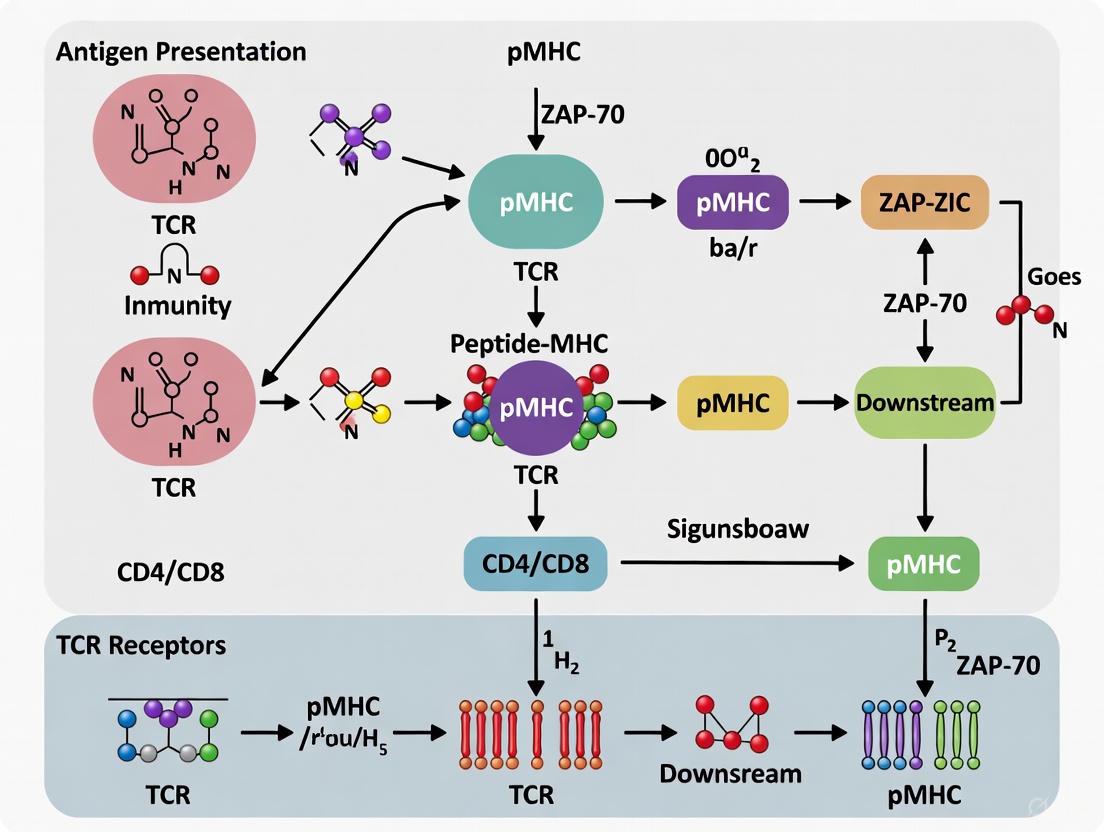
This article provides a comprehensive examination of T-cell receptor (TCR) and peptide-major histocompatibility complex (pMHC) interactions, the cornerstone of adaptive cellular immunity.
Decoding TCR-pMHC Interactions: From Fundamental Principles to Therapeutic Applications in Adaptive Immunity
Abstract
This article provides a comprehensive examination of T-cell receptor (TCR) and peptide-major histocompatibility complex (pMHC) interactions, the cornerstone of adaptive cellular immunity. We explore the fundamental thermodynamic, kinetic, and mechanical principles governing these interactions, highlighting how they confer both incredible specificity and necessary cross-reactivity. The content details state-of-the-art computational and experimental methodologies, including AlphaFold and TCR engineering, for predicting and manipulating these interactions. A significant focus is placed on troubleshooting challenges in immunotherapy development, such as off-target toxicity and affinity-optimization pitfalls. Finally, we present a comparative analysis of preclinical validation frameworks for TCR-based therapies, offering researchers and drug development professionals a structured guide to navigating this complex field from basic science to clinical translation.
The Structural and Energetic Blueprint of TCR-pMHC Recognition
Adaptive immunity provides vertebrates with the remarkable ability to recognize and remember a vast array of pathogens, offering long-lasting protection against reinfection. This sophisticated defense system is fundamentally rooted in the specific interactions between T cell receptors (TCRs) and peptide-major histocompatibility complexes (pMHCs). TCRs, generated through somatic recombination of genomic DNA segments during T cell development, confer a unique antigen specificity to each T cell clone, establishing its clonal identity [1]. These receptors continuously survey the body for antigenic ligands—short peptide fragments bound to MHC class I or II molecules presented on the surface of antigen-presenting cells [1]. The exquisite sensitivity and specificity of this interaction enables T cells to discriminate with remarkable precision between foreign peptides derived from pathogens and similar self-peptides derived from host tissues, a crucial capability for maintaining both effective immunity and self-tolerance [1] [2]. This discriminative power is particularly astonishing given the relatively small differences in affinity between agonist pMHC (typically 1-10 μM) and self-pMHC (typically only 10-fold weaker) [1]. Understanding the mechanisms governing TCR-pMHC interactions therefore represents a cornerstone of immunology, with profound implications for vaccine development, cancer immunotherapy, and the treatment of autoimmune disorders.
Quantitative Fundamentals of TCR-pMHC Interactions
The interaction between a TCR and its cognate pMHC ligand can be quantitatively described through thermodynamic, kinetic, and mechanical parameters. These properties collectively determine the outcome of T cell recognition, influencing whether a T cell becomes activated, remains inert, or enters a state of anergy.
Table 1: Key Quantitative Parameters of TCR-pMHC Interactions
| Parameter | Definition | Biological Significance | Typical Range for Agonists |
|---|---|---|---|
| Affinity (KD) | Equilibrium dissociation constant; measure of binding strength [2] | Determines thermodynamic stability of the TCR-pMHC complex [2] | 1-10 μM [1] |
| Association Rate (kon) | Rate constant for complex formation [2] | Influences speed of initial recognition and serial engagement [1] | Variable |
| Dissociation Rate (koff) | Rate constant for complex dissociation [2] | Determines complex lifetime (residence time); critical for kinetic proofreading [2] | Variable |
| Residence Time (τ) | Average lifetime of the TCR-pMHC complex; τ = 1/koff [2] | Dictates duration of signaling; allows accumulation of downstream signals [2] | Sufficient for kinetic proofreading steps |
| 3D Affinity | Binding strength in solution [1] | Governs initial binding event | 1-10 μM [1] |
| 2D Affinity | Binding strength at the cell-cell interface [2] | More physiologically relevant for T cell activation in the immune synapse | Dependent on membrane environment |
The discrimination between agonist and self-pMHC ligands cannot be explained by affinity alone, as the free energy differences are often minimal [2]. This paradox is resolved by incorporating kinetic selectivity and the concept of kinetic proofreading. Kinetic selectivity (Sk) is defined as the ratio of association rates for competing ligands (Sk = konpMHC1/konpMHC2), while kinetic proofreading describes a mechanism where a series of signaling events must accumulate before TCR-pMHC dissociation occurs [1] [2]. This multi-step process consumes energy at each step and amplifies the small initial differences in binding properties, enabling the T cell to distinguish between closely related ligands with high fidelity [2].
Structural Dynamics and Allosteric Mechanisms
The structural basis of TCR-pMHC recognition involves considerable conformational dynamism, with both proteins existing as ensembles of interconverting states rather than single static structures [3]. X-ray crystallography has provided foundational high-resolution snapshots of TCR-pMHC complexes, but these static images often conceal the extensive flexibility inherent to these molecules [3]. For instance, comparisons of identical molecules in different crystal lattices have suggested a "scanning" motion of the TCR on pMHC, a phenomenon further supported by molecular dynamics (MD) studies [3].
Recent structural and computational studies have revealed an allosteric mechanism for TCR triggering, wherein pMHC binding induces conformational changes that propagate through the receptor complex. The TCRβ FG loop serves as a critical "gatekeeper," preventing accidental triggering, while the connecting peptide region acts as a hinge for essential conformational changes [4]. Upon pMHC engagement, the TCR extracellular domain tilts away from the CD3 proteins, transitioning from a bent conformation (approximately 104°) to a more extended conformation (approximately 150°) [4]. This structural rearrangement reduces contacts between the TCRβ variable domain and the CD3γε dimer, thereby increasing CD3 mobility—a key step in signal initiation [4].
Table 2: Key Structural Elements in TCR-pMHC Signaling
| Structural Element | Location/Composition | Function in TCR Signaling |
|---|---|---|
| ITAM Motifs | Cytoplasmic tails of CD3 and ζ chains [1] | Phosphorylated by Lck to create docking sites for Zap70 [1] |
| CD4/CD8 Coreceptors | T cell surface [1] | Recruit Lck to the TCR-pMHC complex [1] |
| TCRβ FG Loop | TCRβ chain [4] | Acts as gatekeeper; transmits force from pMHC binding site [4] |
| Connecting Peptide | Between extracellular and transmembrane domains [4] | Serves as hinge for conformational changes upon pMHC binding [4] |
| CDR3 Regions | Hypervariable loops of TCR α and β chains [5] | Primary determinants of peptide specificity [5] |
TCR Signaling Pathways: From Membrane to Nucleus
TCR signaling initiation involves a carefully orchestrated sequence of molecular events that translate extracellular binding into intracellular activation. When a TCR engages an agonist pMHC, the CD4 or CD8 coreceptors recruit the Src family kinase Lck to the TCR complex [1]. Lck then phosphorylates tyrosine residues within the immunoreceptor tyrosine-based activation motifs (ITAMs) on the CD3 and ζ chains [1]. Each ITAM contains two tyrosines that, when phosphorylated, create docking sites for the ζ-chain-associated protein kinase 70 (Zap70) [1].
Zap70, which resides in the cytoplasm in an autoinhibited state prior to TCR engagement, is recruited to the phosphorylated ITAMs where its conformation is disrupted and activated through phosphorylation by Lck [1]. Once activated, Zap70 phosphorylates the linker for activation of T cells (LAT), which serves as a central signaling hub [1]. Phosphorylated LAT recruits several key effectors, including phospholipase Cγ1 (PLCγ1), which is responsible for hydrolyzing phosphatidylinositol 4,5-bisphosphate (PIP2) to generate the second messengers inositol 1,4,5-trisphosphate (IP3) and diacylglycerol (DAG) [1]. IP3 triggers calcium release from the endoplasmic reticulum and subsequent influx of extracellular calcium, activating proteins such as the transcription factor NFAT, while DAG activates protein kinase C (PKC) and RasGRP, leading to MAP kinase pathway activation and ultimately T cell activation and differentiation [1].
The following diagram illustrates the core TCR signaling pathway:
Experimental and Computational Methodologies
Molecular Dynamics Simulations
Molecular dynamics (MD) simulations have emerged as powerful tools for investigating TCR-pMHC interactions at atomic resolution, providing insights that complement structural biology approaches. All-atom MD simulations probe system flexibility by computing iterative solutions of Newton's equations of motion over time, generating trajectories that describe atomic positions throughout the simulation [3]. While computationally demanding and typically limited to microsecond timescales—shorter than biologically relevant seconds-to-minutes signaling timescales—advanced sampling techniques have enhanced their utility [3].
Several specialized MD approaches are particularly valuable for studying TCR-pMHC interactions:
- Replica Exchange MD (REMD): Simulates multiple copies of the same molecule at different temperatures, improving conformational sampling for relatively small systems [3].
- Steered MD (SMD): Applies external force to study mechanical responses, analogous to atomic force microscopy; useful for investigating TCR-pMHC dissociation and catch bond formation [3] [6].
- Coarse-Grained (CG) Methods: Replaces atom groups with beads to enable longer simulations of larger complexes, such as TCR-pMHC in membrane environments [3].
These computational approaches have revealed that mutations to peptides in the MHC binding groove alter MHC conformation at equilibrium and impact TCR-pMHC bond strength under constant load, with physiochemical features such as hydrogen bonds and Lennard-Jones contacts correlating with immunogenic responses [6].
Table 3: Research Reagent Solutions for TCR-pMHC Studies
| Research Tool | Composition/Type | Application and Function |
|---|---|---|
| pMHC Tetramers | Multiple pMHC complexes linked to fluorescent tag [7] | Identification and isolation of antigen-specific T cells via flow cytometry |
| pMHC-Targeted Viruses | Retroviruses pseudotyped with pMHC and fusogen [7] | Antigen-specific gene delivery to CD8+ T cells; simultaneous activation and genetic modification |
| TCR Cloning Reagents | Vectors for TCR α and β chain expression [8] | Generation of TCR-engineered T cells for adoptive immunotherapy |
| Immune Repertoire Databases | IEDB, VDJdb, McPAS-TCR [9] [5] | Catalog experimentally validated TCR-pMHC interactions; training data for predictive algorithms |
| CDR3β-Specific Antibodies | Antibodies targeting variable CDR3 regions [5] | Detection and characterization of specific TCR clonotypes |
TCR Repertoire Analysis
High-throughput sequencing of TCR repertoires has enabled comprehensive characterization of T cell diversity, providing insights into immune responses in health and disease. Key metrics for analyzing TCR repertoire composition include:
- Richness: The number of unique TCR sequences in a sample [8].
- Evenness: The equality in clonal abundances of TCR sequences [8].
- Shannon/Simpson Diversity: Metrics that account for both richness and evenness, with Simpson diversity being particularly sensitive to clonal dominance [8].
- Clonality: A measure of the degree of oligoclonal expansion within a repertoire [8].
These analytical approaches have revealed that tumors can be classified as "hot" or "cold" based on their T cell infiltration, with "hot" tumors (e.g., melanoma, bladder cancer, non-small cell lung cancer) typically showing more favorable responses to immunotherapies [8]. Furthermore, TCR repertoire analysis can guide the selection of TCRs for therapeutic engineering, even when their target antigens remain unknown [8].
Computational Prediction of TCR-pMHC Interactions
Machine learning and deep learning approaches have been increasingly applied to predict TCR-pMHC binding, addressing a critical challenge in immunology. These methods can be broadly categorized into structure-based approaches that utilize TCR-pMHC crystal structures, and sequence-based methods that rely solely on TCR and peptide sequence information [9]. Popular methods include neural networks, convolutional networks, and more recently, transformer-based models and autoencoders [9].
A significant challenge in this domain is data imbalance, as publicly available databases contain far more non-binding TCR-pMHC pairs than confirmed binding pairs [5]. This imbalance can lead to biased predictive models, necessitating specialized approaches such as generative models for data augmentation to restore balance and improve prediction accuracy for rare but biologically important specificities [5].
Therapeutic Applications and Future Directions
The profound understanding of TCR-pMHC interactions has paved the way for groundbreaking immunotherapies, particularly in oncology. Adoptive cell therapy approaches harness the power of T cells redirected to recognize and eliminate cancer cells. While chimeric antigen receptor (CAR) T cells have demonstrated remarkable success against hematological malignancies by targeting surface antigens, TCR-engineered T cells offer the distinct advantage of recognizing intracellular antigens presented on MHC molecules, potentially expanding the targetable cancer proteome to include neoantigens and cancer-testis antigens [8].
Recent advances include the development of pMHC-targeted viral vectors that enable in vivo engineering of tumor-specific T cells. These vectors, which display specific pMHC complexes, can selectively transduce and activate cognate T cells while delivering therapeutic transgenes such as immunostimulatory molecules [7]. This approach has demonstrated promising results in immunocompetent mouse models, improving overall survival in B16F10 melanoma-bearing mice while simultaneously activating and expanding antitumor T cells [7].
The future of TCR-pMHC research will likely focus on integrating multidimensional data—including structural information, kinetic parameters, mechanical properties, and repertoire sequencing data—to develop predictive models of T cell activation and function. Such integrated approaches will accelerate the rational design of next-generation immunotherapies with enhanced specificity and efficacy, while minimizing off-target toxicities. As single-cell technologies continue to advance and computational models become increasingly sophisticated, our understanding of the fundamental principles governing TCR-pMHC interactions will deepen, unlocking new possibilities for manipulating the adaptive immune system against cancer, infectious diseases, and autoimmune disorders.
The precise molecular interaction between the T-cell receptor (TCR) and peptide-major histocompatibility complex (pMHC) constitutes the fundamental recognition event in adaptive cellular immunity, governing immune responses to pathogens, cancer, and self-tissues. Understanding the structural basis of this interaction is paramount for advancing TCR-based therapeutics and immunology research. The conserved nature of protein structure provides a significantly less diverse perspective on TCRs and peptides compared to sequence-based approaches, offering potential pathways to overcome the challenge of predicting specificity for unseen pMHC complexes [10]. This technical guide examines the core structural databases and architectural principles that form the foundation of TCR-pMHC research, providing researchers with essential resources and methodologies for structural immunology investigations.
Essential Structural Databases for TCR-pMHC Research
Database Comparisons and Capabilities
Table 1: Core Structural Databases for TCR-pMHC Research
| Database Name | Primary Focus | Key Features | Data Types | Update Status |
|---|---|---|---|---|
| TCR3d [11] | TCR structures with antigen recognition focus | TCR docking angles, interface parameters, CDR loop clustering, germline gene usage | Structures, sequences, interface analysis | Weekly updates |
| STCRDab [11] | Structural TCR data | Collection of TCR structural data | Structures, sequences | Active |
| TRAIT [12] | Comprehensive TCR-antigen interactions | Integrates sequences, structures, affinities; includes mutations and clinical trials | Sequences, structures, binding affinities, non-interactive pairs, mutations | Active |
| Protein Data Bank (PDB) | Primary repository for 3D structural data | Raw experimental structures from X-ray crystallography, Cryo-EM, NMR | 3D atomic coordinates | Continuous updates |
| ATLAS [11] | Altered TCR ligand affinities and structures | Links binding affinities with structures for wild-type and mutant TCR-pMHC complexes | Structures, binding affinities | No longer updated after 2017 |
| BATCAVE [13] | TCR cross-reactivity via mutational scans | Database of TCR activation data from mutational scan assays | TCR activation data, peptide mutations, binding affinities | Active |
Specialized Database Features and Applications
The TCR3d database automatically identifies TCR complex structures from the PDB on a weekly basis using hidden Markov models representing TCR variable domain sequences [11]. It provides calculated TCR docking angles based on the approach of Rudolph et al., interface buried surface area using NACCESS, and shape complementarity using Sc from the CCP4 suite [11]. TCR3d's primary interface consists of browsable tables of all TCR-antigen complexes classified by TCR restriction (Class I MHC, Class II MHC, CD1d, MR1), as well as γδ TCRs, containing key features of TCRs and targeting [11].
The recently developed TRAIT database distinguishes itself through comprehensive integration of multiple data types, including millions of experimentally validated TCR-antigen pairs and non-interactive TCR sequences verified by single-cell omics [12]. TRAIT systematically collects binding affinity data measured by surface plasmon resonance (SPR) or isothermal titration calorimetry (ITC), and uniquely includes mutation data with 641 TCR mutants and 628 antigen mutants, each linked to binding affinity [12]. This integrated approach provides researchers with a holistic view of TCR-antigen interactions.
Experimental Methodologies for Structural Determination
Structural Determination Protocols
X-ray Crystallography Workflow:
- Protein Complex Production: Express and purify TCR, peptide, and MHC components separately
- Complex Formation: Mix components in appropriate molar ratios to form stable TCR-pMHC complexes
- Crystallization: Screen crystallization conditions using vapor diffusion or micro-batch methods
- Data Collection: Collect X-ray diffraction data at synchrotron facilities
- Structure Determination: Solve structure using molecular replacement with existing TCR or MHC structures as search models
- Model Refinement: Iteratively refine the model against diffraction data
The most precise method to dissect TCR-pMHC interactions involves experimentally generating X-ray crystallography structures, though this remains a time-consuming and technically demanding process [14] [15]. As of 2025, approximately 223 TCR-antigen complex structures were available in the PDB according to the TRAIT database [12].
Binding Affinity Measurement: Surface plasmon resonance (SPR) protocols for TCR-pMHC interactions:
- Immobilize pMHC complexes on sensor chips via amine coupling or capture methods
- Flow TCR samples at varying concentrations over immobilized pMHC
- Measure association and dissociation phases to determine kinetic parameters (ka, kd)
- Calculate equilibrium dissociation constant (Kd) from kinetic parameters
- Include reference cell subtraction to control for nonspecific binding
Advanced Functional Assays
Recent methodologies incorporate mechanical force considerations into TCR-pMHC interaction analysis. Single-molecule biophysical approaches demonstrate that natural TCRs exploit mechanical force to form optimal catch bonds with cognate antigens, relying on a mechanically flexible TCR-pMHC binding interface [16]. This process enables force-enhanced CD8 coreceptor binding to MHC-α1α2 domains through sequential conformational changes induced by force in both the MHC and CD8 [16].
Mutational scan databases like BATCAVE provide comprehensive experimental data on TCR cross-reactivity, containing continuous-valued TCR activation data for both single- and multi-amino acid peptide mutations [13]. These resources help establish the relationship between peptide sequence variations and TCR responsiveness, addressing critical gaps in negative example data that are essential for model discrimination.
Computational Approaches and AI-Driven Structure Prediction
AlphaFold-Based TCR-pMHC Modeling
AlphaFold 3 (AF3) has demonstrated significant capability in modeling TCR-pMHC interactions, distinguishing valid epitopes from invalid ones with increasing accuracy [14] [15]. The standard AF3 protocol for TCR-pMHC prediction utilizes the model without retraining or fine-tuning, employing default hyperparameters including three cycles of recycling, a multiple sequence alignment (MSA) depth of 256, and a template dropout rate of 15% [14] [15].
Critical findings indicate that peptide presence is essential for accurate TCR-pMHC predictions. AF3 predictions of TCR binding in the presence of peptide-MHC complexes closely mirror crystal structures, while predictions without peptides show significantly reduced accuracy [14] [15]. This is reflected in interface template modeling (ipTM) scores, with presence of peptide resulting in ipTM = 0.92 compared to ipTM = 0.54 without peptide in NY-ESO-1 specific TCR examples [14] [15].
Advanced Structural Analysis pipelines
The NetTCR-struc approach addresses limitations in AlphaFold-Multimer's confidence scoring, which in certain cases correlates poorly with DockQ quality scores, leading to overestimation of model accuracy [10]. Their graph neural network (GNN) solution achieves a 25% increase in Spearman's correlation between predicted quality and DockQ (from 0.681 to 0.855) and improves docking candidate ranking [10].
The structural modeling pipeline involves:
- Feature Generation: Creating MSA and template features with approaches that model pMHC as a single chain
- Perturbation Methods: Applying random mutation in MSA, column-wise MSA mutation, MSA hit masking, and Gaussian noise addition to template coordinates
- Model Selection: Using GNN-based quality scoring to select optimal structural models from multiple predictions
Diagram 1: Structural modeling workflow for TCR-pMHC complexes
Core Architectural Principles of TCR-pMHC Complexes
Structural Organization and Binding Interfaces
The TCR-pMHC complex architecture follows conserved principles across diverse TCR specificities. The TCR variable domains position complementarity determining regions (CDRs) to engage the pMHC surface, with CDR3 loops primarily interacting with the peptide antigen, while CDR1 and CDR2 regions contact the MHC α-helices [12]. This organization allows the hypervariable CDR3 loops, which exhibit exceptional diversity, to determine fine specificity for peptide recognition, while the more conserved CDR1 and CDR2 domains maintain binding orientation to the MHC molecule.
Structural analyses reveal that TCR docking angles relative to the pMHC surface fall within a characteristic range, despite significant sequence diversity [11]. The binding interface typically buries 1,200-2,000 Ų of surface area, with shape complementarity statistics indicating optimized interface packing [11]. These conserved architectural features enable the structural classification of CDR loop conformations, with TCR3d providing clustering of CDR loop structures using backbone φψ conformational distances and affinity propagation [11].
Mechanochemical Properties and CD8 Coreceptor Function
Recent research highlights the critical importance of mechanical properties in TCR-pMHC interactions. Naturally evolved TCRs exhibit mechanically flexible binding interfaces that enable optimal catch bond formation under force, which stabilizes interactions with agonistic pMHCs [16]. This flexibility permits force-induced conformational changes that enhance CD8 coreceptor binding to MHC domains, creating a cooperative mechanism that amplifies antigen discrimination.
Diagram 2: Force-induced enhancement of TCR specificity
Engineering high-affinity TCRs often creates rigid, tightly bound interfaces with cognate pMHCs that prevent the force-induced conformational changes necessary for optimal catch-bond formation [16]. Paradoxically, these high-affinity TCRs can form moderate catch bonds with non-stimulatory pMHCs, leading to off-target cross-reactivity and reduced specificity [16]. This explains why 3D binding affinity alone does not consistently predict TCR specificity and functional effectiveness.
Research Reagent Solutions for TCR-pMHC Studies
Table 2: Essential Research Reagents and Resources
| Reagent/Resource | Function/Application | Key Features |
|---|---|---|
| AlphaFold 3 [14] [15] | TCR-pMHC structure prediction | Trained on >120M protein sequences; models ternary complexes |
| NetTCR-struc [10] | Docking quality assessment | GNN-based DockQ regression; 25% improvement in quality correlation |
| TCRmodel [11] | TCR 3D modeling from sequence | Generates 3D models from TCR sequences |
| BATCAVE [13] | TCR cross-reactivity prediction | Mutational scan database; balanced positive/negative examples |
| CD8 Coreceptor [16] | Mechanochemical studies | Enhances catch bonds; force-sensitive engagement |
| pMHC Mutants [13] | Specificity mapping | Single/multi-aa variants for TCR recognition rules |
| Surface Plasmon Resonance [12] [16] | Binding affinity measurement | Kinetic parameter determination (ka, kd, Kd) |
The structural foundations of TCR-pMHC research continue to evolve with advancing database technologies, experimental methodologies, and computational approaches. Integration of structural data with binding affinities, mutational scans, and functional outcomes provides increasingly comprehensive understanding of the molecular determinants of TCR specificity. Future directions include improving zero-shot prediction capabilities for novel TCR-pMHC pairs, enhancing understanding of the role of mechanical forces in immune recognition, and developing more accurate models for predicting immunogenicity and cross-reactivity. The continued development of integrated databases like TRAIT that combine sequences, structures, affinities, and clinical annotations will further accelerate therapeutic applications in T-cell-based immunotherapies.
The recognition of peptide-major histocompatibility complexes (pMHC) by T-cell receptors (TCR) represents a fundamental interaction in adaptive immunity. While historically characterized by binding affinity (ΔG), emerging research demonstrates that a comprehensive understanding of TCR-pMHC interactions requires integration of thermodynamic, kinetic, and mechanical perspectives. This whitepaper synthesizes current findings revealing how enthalpy-entropy compensation governs binding thermodynamics, how two-dimensional kinetics more accurately predict T-cell responsiveness than three-dimensional measurements, and how mechanical forces and allosteric mechanisms regulate signal propagation. The integration of these dimensions provides a refined framework for predicting T cell specificity and developing novel immunotherapies.
T cell receptors initiate adaptive immune responses through specific engagement with peptide-MHC complexes, an interaction characterized by remarkable sensitivity and discrimination. While earlier research focused primarily on binding affinity, contemporary studies reveal this approach provides an incomplete picture. The TCR-pMHC interaction occurs in a complex two-dimensional membrane environment where mechanical forces and dynamic kinetics play crucial roles in determining functional outcomes [3] [17]. This review examines the integrated roles of thermodynamics, kinetics, and mechanics in shaping TCR signaling, highlighting how these dimensions collectively enable T cells to discriminate between self and non-self antigens with extraordinary fidelity, and how this understanding informs therapeutic development in immunotherapy.
Core Principles: The Triad of TCR-pMHC Recognition
Thermodynamic Compensation and Conformational Flexibility
The thermodynamics of TCR-pMHC binding defies simple characterization. Isothermal titration calorimetry and van't Hoff analyses reveal no universal thermodynamic signature for TCR recognition, with substantial diversity in enthalpy (ΔH) and entropy (ΔS) changes across different TCR-pMHC pairs [18]. Rather, these parameters exhibit compensatory variation, maintaining binding free energy (ΔG) within a narrow window despite considerable interface diversity [18].
Table 1: Thermodynamic Parameters of Representative TCR-pMHC Interactions
| TCR | pMHC | ΔH (kcal/mol) | -TΔS (kcal/mol) | ΔG (kcal/mol) | Conformational Changes |
|---|---|---|---|---|---|
| JM22 | HLA-A2-M1 | Favorable | Unfavorable | ~ -7 to -10 | CDR loop reorganization |
| F5 | HLA-A2-M1 | Favorable | Unfavorable | ~ -7 to -10 | CDR loop reorganization |
| A6 | HLA-A2-Tax | Variable | Compensatory | ~ -7 to -10 | CDR loop flexibility |
| LC13 | HLA-B8-FLR | Variable | Compensatory | ~ -7 to -10 | CDR loop flexibility |
This enthalpy-entropy compensation reflects underlying conformational dynamics within TCR complementarity-determining region (CDR) loops. Early assumptions that unfavorable binding entropy universally indicated conformational flexibility loss have been challenged by observations of entropically favorable TCR-pMHC interactions [18]. Structural analyses indicate that TCR CDR loops frequently populate different conformations in free versus bound states, with this pre-existing flexibility enabling TCRs to engage diverse pMHC ligands [18].
Kinetic Parameters in Two versus Three Dimensions
The cellular context of TCR-pMHC interactions necessitates distinction between solution-based (3D) and membrane-anchored (2D) kinetics. Remarkably, 2D measurements reveal kinetic parameters with dramatically expanded dynamic ranges that better correlate with T-cell responsiveness compared to their 3D counterparts [17].
Table 2: Comparison of 2D and 3D Kinetic Parameters for OT1 TCR
| Peptide | Activation Profile | 2D AcKa (μm⁴) | 2D koff (s⁻¹) | 3D KD (μM) | 3D koff (s⁻¹) |
|---|---|---|---|---|---|
| OVA | Antigen | 2.4 × 10⁻⁴ | 7.2 | ~1-10 | 0.01-0.1 |
| A2 | Agonist | 2.8 × 10⁻⁴ | 3.3 | ~1-10 | 0.01-0.1 |
| G4 | Weak agonist/antagonist | 1.4 × 10⁻⁵ | 3.4 | ~100 | ~1 |
| R4 | Antagonist | 1.1 × 10⁻⁶ | 1.8 | >100 | >1 |
Critical differences emerge from this comparison: 2D affinities for agonist pMHCs are significantly higher than 3D measurements suggest, and 2D off-rates are up to 8,300-fold faster than 3D off-rates, with agonist pMHCs dissociating most rapidly [17]. This indicates that T cells employ rapid antigen sampling in physiological conditions, with the broadest discrimination achieved through 2D on-rates (Ackon) spanning five orders of magnitude [17].
Mechanical Regulation and Allosteric Signaling
Forces in the range of 10-20 pN generated during T cell-APC conjugation introduce critical mechanical components to TCR recognition [19]. Recent models propose that TCRs function as allosteric mechanosensors, where pMHC binding induces conformational changes transmitted to CD3 components through the TCRβ subunit [4].
Molecular dynamics simulations of complete TCR-CD3-pMHC complexes reveal that pMHC engagement shifts the TCR extracellular domain from bent (104°) to extended (150°) conformations, reducing contacts between TCRβ variable domain and CD3εγ dimer [4]. This conformational rearrangement increases CD3 mobility, potentially facilitating ITAM phosphorylation by releasing spatial constraints on CD3 cytoplasmic domains [4].
Diagram 1: TCR Mechanosensing Pathway
Simulations further demonstrate that peptide identity alters MHC binding groove conformation, influencing TCR-pMHC bond stability under force [19]. Agonist peptides promote bond lifetimes through specific hydrogen bond and hydrophobic contact patterns that persist under physiological loads (10-20 pN), providing a mechanical proofreading mechanism for antigen discrimination [19].
Experimental Approaches: Methodologies for Multidimensional Analysis
Thermodynamic Measurement Techniques
Isothermal Titration Calorimetry (ITC) provides direct measurement of binding enthalpy (ΔH), stoichiometry (n), and association constant (Ka) through incremental injections of one binding partner into another while measuring heat changes. When combined with van't Hoff analysis across multiple temperatures, ITC enables determination of heat capacity changes (ΔCp) and decomposition of free energy into enthalpic and entropic components [18]. For TCR-pMHC systems, these measurements reveal the substantial enthalpic-entropic compensation governing interactions, though care must be taken to account for linked protonation equilibria and buffer effects that can complicate interpretation [18].
Two-Dimensional Binding Assays
Micropipette Adhesion Frequency Assay utilizes a red blood cell (RBC) functionalized with pMHC monomers as an adhesion sensor. A T cell is manipulated to repeatedly contact the RBC with controlled contact area and duration, with adhesion events detected by RBC membrane elongation upon retraction [17]. Measuring adhesion frequency (Pa) across varying contact times (tc) enables extraction of 2D kinetic parameters through fitting with a probabilistic model: Pa = 1 - exp(-mrmlAcKa(1 - e^(-koff*tc))) where mr and ml are receptor and ligand densities, Ac is contact area, Ka is 2D affinity, and koff is off-rate [17].
Biomembrane Force Probe (BFP) Thermal Fluctuation Assay employs a RBC and bead system with enhanced sensitivity to detect single bond formation and dissociation events through monitoring bead position fluctuations [17]. Bond formation restricts bead movement, enabling direct measurement of bond lifetime distributions and confirmation of first-order dissociation kinetics through exponential decay fitting [17].
Molecular Dynamics Simulations
All-Atom Molecular Dynamics (MD) simulations compute Newton's equations of motion for TCR-pMHC-CD3 systems embedded in lipid bilayers, typically using CHARMM36 or similar force fields [20] [19]. These simulations reveal atomic-scale interactions and conformational dynamics on microsecond timescales, though this remains shorter than biologically relevant signaling timescales [3].
Steered Molecular Dynamics (SMD) applies external forces to simulate mechanical loading on TCR-pMHC bonds, mimicking physiological forces (10-20 pN) experienced at the immune synapse [19]. Multi-replicate SMD simulations quantify force-dependent bond lifetimes and identify critical hydrogen bonds and hydrophobic contacts that stabilize interactions under load [19].
Essential Dynamics (Principal Component Analysis) reduces trajectory complexity by identifying collective atomic motions corresponding to largest positional fluctuations, distinguishing key conformational changes from irrelevant background vibrations [20].
Diagram 2: Computational Workflow
Kinetic Proofreading Models
Sequential Proofreading models propose TCR signaling requires progression through sequential biochemical steps (ITAM phosphorylation, ZAP70 recruitment, etc.), with rapid ligand dissociation terminating the process [21]. This model predicts signaling probability proportional to (kp/(kp + koff))^n where kp is forward rate, koff is dissociation rate, and n is step number [21].
Multithread Proofreading incorporates ITAM multiplicity, with parallel reaction threads on ten TCR-CD3 ITAMs integrated through LAT condensation [21]. This model significantly enhances discrimination fidelity by multiplying effective proofreading steps without requiring fine-tuned kinetic parameters for chemically distinct reactions [21].
Integrated Signaling Model: From Binding to Functional Response
The integration of thermodynamic, kinetic, and mechanical perspectives yields a coherent model of TCR triggering. Initial pMHC binding, governed by 2D on-rates and conformational selection, induces extended TCR conformation that increases CD3 mobility [4]. Mechanical forces stabilize agonist bonds through specific interaction patterns, enabling phosphorylation of multiple ITAM domains [19] [21]. Parallel proofreading threads integrate through LAT condensation, producing digital signaling outputs that discriminate agonists based on bond lifetime under force [21].
This multithreaded proofreading explains how T cells achieve high fidelity discrimination despite small dwell time differences (~10-fold) between agonist and self-pMHCs amid large abundance differences (>1,000-fold) [21]. The combination of multiple ITAM threads with LAT condensation creates a robust proofreading mechanism that amplifies discrimination capacity while maintaining sensitivity to rare agonist ligands [21].
Research Reagent Solutions
Table 3: Essential Research Tools for TCR-pMHC Studies
| Reagent / Method | Function | Key Features |
|---|---|---|
| Soluble TCR/pMHC Ectodomains | Binding studies | Enables thermodynamic and 3D kinetic measurements |
| Streptavidin-based pMHC Tetramers | T cell staining | Multivalent presentation for flow cytometry |
| Di-streptavidin (Di-SA) | Monomeric pMHC presentation | Ensures 1:1 binding in 2D assays [17] |
| Micropipette Adhesion Assay | 2D kinetics | Measures low-affinity interactions in membrane context [17] |
| Biomembrane Force Probe (BFP) | Single-bond kinetics | Detects individual bond formation/dissociation [17] |
| CHARMM36 Force Field | MD simulations | All-atom parameters for membrane-protein systems [20] [19] |
| Coarse-Grained MD | Longer timescales | Reduced complexity for large assembly dynamics [3] |
The multidimensional perspective on TCR-pMHC recognition reveals why affinity-based models alone fail to predict T cell responsiveness accurately. The integration of thermodynamic compensation, expanded 2D kinetic discrimination, and mechanical regulation provides a more comprehensive framework for understanding T cell specificity. These insights are already informing therapeutic design, with engineered TCRs incorporating kinetic and mechanical optimization alongside affinity enhancement [19] [22]. Future research should further elucidate allosteric communication pathways and develop integrated models that simultaneously incorporate thermodynamic, kinetic, and mechanical parameters to predict T cell responses across diverse biological contexts.
The adaptive immune system of higher chordates faces a formidable challenge: it must reliably distinguish between self and non-self-antigens to provide protection without provoking autoimmunity. Central to this capability is the interaction between the T-cell receptor (TCR) and peptide-bound major histocompatibility complex (pMHC). This interaction exhibits a paradoxical combination of extreme sensitivity and remarkable specificity, enabling T cells to detect even a single foreign pMHC among thousands of structurally similar self-ligands [2] [23]. The kinetic proofreading model provides a robust theoretical framework to explain this extraordinary discriminatory capability. Originally proposed to explain fidelity in biomolecular processes such as protein synthesis, this model has been successfully adapted to T cell signaling, where it explains how small differences in binding dwell times can be amplified into all-or-nothing activation decisions [2] [24] [25]. For researchers and drug development professionals, understanding kinetic proofreading is essential for advancing immunotherapies, including the engineering of chimeric antigen receptors (CARs) and TCR-engineered T cells, where optimal signaling architectures must balance sensitivity with specificity to maximize therapeutic efficacy and minimize off-target effects [2].
Core Principles of the Kinetic Proofreading Model
Thermodynamic Limitations of Affinity-Based Discrimination
The most intuitive parameter for assessing TCR-pMHC interaction specificity is affinity, a thermodynamic characteristic representing binding strength. Affinity is expressed as the association constant (Kₐ), which is the ratio of the association (kₒₙ) and dissociation (kₒff) rate constants [2]. The underlying assumption is that complementarity between TCR and pMHC drives discrimination, where the free energy (ΔG) of binding determines specificity [2]. However, the difference in free energy between correct (agonist) and incorrect (self) pMHC ligands is often insignificant or absent, severely limiting the explanatory power of purely affinity-based models [2]. This paradox mirrors other biological processes; during protein synthesis, for example, the difference in free energy between correct and incorrect codon-anticodon pairs is too small to account for the observed error rate of approximately 1 in 20,000 [2]. This fundamental limitation prompted the development of models that incorporate the kinetic dimensions of molecular interactions.
The Kinetic Proofreading Solution
The kinetic proofreading model, initially proposed by Hopfield and Ninio, resolves this paradox by accounting for the multistage nature of ligand-receptor interactions [2] [25]. The model posits that a series of irreversible, energy-consuming steps occur after the initial ligand binding. Each step acts as a verification point, increasing the overall specificity of the process [2]. In the context of TCR-pMHC interactions, this means that for a signaling outcome to be triggered, the ligand must remain bound long enough for the receptor to progress through a sequence of intermediate biochemical steps, such as phosphorylation events [2] [24]. If the ligand dissociates at any point before completion of this sequence, the process is aborted, and no signal is produced [24]. This mechanism allows the system to discriminate based on ligand residence time (τ = 1/kₒff), rather than binding affinity alone [2]. Consequently, a ligand with a longer dwell time has a exponentially higher probability of completing the proofreading chain and triggering T cell activation [2].
Table 1: Key Parameters in TCR-pMHC Interaction Models
| Parameter | Definition | Role in Specificity | Limitations |
|---|---|---|---|
| Affinity (Kₐ) | Thermodynamic binding strength (kₒₙ/kₒff) | Determines initial binding probability | Poor at discriminating small free energy differences |
| Residence Time (τ) | Lifetime of the TCR-pMHC complex (1/kₒff) | Determines probability of completing proofreading steps | Does not account for mechanical and spatial context |
| Kinetic Selectivity (Sₖ) | Ratio of association rates for competing ligands (kₒₙpMHC1/kₒₙpMHC2) | Provides kinetic dimension to discrimination | Highly dependent on experimental conditions |
| Proofreading Steps (n) | Number of irreversible intermediate steps | Amplifies discrimination; fidelity increases with n | Requires finely tuned kinetics in sequential models |
From Sequential to Multithreaded Proofreading: Evolving Models
Traditional kinetic proofreading models have conceptualized the process as a linear, sequential Markov process [21]. Upon ligand binding, the TCR progresses through a series of 'proofreading steps' (such as ITAM phosphorylation and ZAP70 recruitment) before reaching a signaling-active state [21]. The number of steps is a key determinant of discrimination fidelity in this model. However, this sequential scheme faces physical implementation challenges, as it requires multiple chemically distinct reactions to have finely matched kinetics to be effective [21].
Recent research has revealed that the molecular mechanism of TCR activation diverges significantly from a simple sequential process. A groundbreaking 2025 study proposes a "multithread" kinetic proofreading scheme that incorporates two key features of TCR biology [21]:
- ITAM Multiplicity: The TCR:CD3 complex contains ten immunoreceptor tyrosine-based activation motif (ITAM) domains in its cytoplasmic tails, each capable of recruiting and activating a ZAP70 molecule. These represent parallel reaction sequences initiated on a single ligated TCR [21].
- LAT Condensation: The outputs from multiple ITAM threads are integrated into a binary, all-or-nothing output through the formation of a LAT condensate, which serves as a quantal signaling unit [21].
In this revised model, multiple parallel reaction threads (corresponding to individual ITAM domains) are synchronously initiated upon TCR engagement. These threads progress independently, and their outputs are reintegrated at the LAT condensation step [21]. This architecture dramatically improves discrimination fidelity by nearly multiplying the effective number of proofreading steps by the number of parallel threads. Since the threads are chemically identical copies, their kinetics are intrinsically uniform, overcoming a major hurdle of the sequential model [21]. This suggests that ITAM multiplicity, rather than a long chain of sequential steps, may be the primary source of proofreading fidelity in T cells [21].
Quantitative Analysis of Proofreading Fidelity
The performance of kinetic proofreading models can be quantitatively assessed by their ability to discriminate between agonist and self-ligands based on dwell times. The discrimination fidelity is defined as the ratio of the signaling probability for an agonist ligand to that of a self-ligand [21]. Computational comparisons between sequential and multithread schemes reveal distinct performance characteristics.
In a sequential scheme with n steps, the probability that a ligand with dwell time t completes all steps and produces a signal is proportional to (kₚt)ⁿ, where kₚ is the rate of progression through each step [21]. This relationship creates an exponentially steep dependence on dwell time. However, if the individual steps have heterogeneous rates, the slowest step (the rate-limiting step) dominates, effectively reducing the number of productive proofreading steps [21]. For instance, a 10-step sequential reaction with 20-fold rate heterogeneity provides only about three effective proofreading steps [21].
In contrast, the multithread scheme with m threads, each consisting of n steps, can achieve a fidelity similar to a sequential scheme with n × m steps [21]. The parallelism provided by multiple identical ITAM domains relieves the need for fine-tuned kinetics among chemically distinct reactions. This makes the multithread scheme a more evolutionarily accessible and robust solution for achieving high-fidelity antigen discrimination [21]. Mechanistically, this implies that as few as one rate-limiting step occurring on several ITAMs may be sufficient to describe the experimentally measured antigen discrimination fidelity of T cells [21].
Table 2: Comparison of Sequential vs. Multithread Proofreading Models
| Feature | Sequential Model | Multithread Model |
|---|---|---|
| Architecture | Linear sequence of n steps |
m parallel threads, each with n steps, integrated at output |
| Key Determinant of Fidelity | Number of steps (n) |
Number of threads (m) × steps per thread (n) |
| Kinetic Requirement | Finely matched rates for distinct chemical reactions | Intrinsically uniform rates across identical threads |
| Physical Basis | Hypothetical sequence of distinct biochemical events | ITAM multiplicity and LAT condensation |
| Robustness to Rate Heterogeneity | Low; slowest step dominates | High; parallelism mitigates single-step limitations |
| Effective Number of Steps | Limited by rate-limiting step | Multiplied by thread count |
Experimental Approaches and Methodologies
Quantifying Molecular Forces in the Immunological Synapse
Mechanical forces have been implicated in T cell antigen recognition and ligand discrimination, yet their magnitude, frequency, and impact remain debated. A 2025 study quantitatively assessed forces across various TCR:pMHC pairs using a Molecular Force Sensor (MFS) platform at single-molecule resolution [23]. The experimental workflow is as follows:
- Sensor Construction: A FRET-based molecular force sensor is constructed using a peptide backbone from flagelliform spider silk protein. Two fluorophores constituting a FRET pair are attached to this entropic spring. The sensor is conjugated to the base of a pMHC ligand [23].
- Platform Preparation: The pMHC-conjugated MFS is anchored to a glass-supported lipid bilayer (SLB), which is also decorated with adhesion molecules (ICAM-1) and costimulatory molecules (B7-1) to mimic an antigen-presenting cell [23].
- Microscopy and Data Acquisition: T cells are introduced to the SLB under either scanning conditions (low MFS density, no activation) or activating conditions (high density of unlabeled stimulatory pMHC). Single-molecule time traces of FRET donor and acceptor molecules are recorded using total internal reflection fluorescence (TIRF) microscopy with alternating laser excitation [23].
- Force Analysis: In the absence of force, the sensor is collapsed, resulting in high FRET efficiency. Force application extends the spring, increasing the inter-dye distance and reducing FRET yield. A FRET efficiency threshold is established from cell-free measurements, and data points below this threshold are classified as the "high-force fraction" [23]. Force probability density functions are estimated by comparing FRET efficiency distributions with and without T cell contact [23].
This methodology revealed that CD4+ T cells exert significantly lower forces on TCR:pMHC bonds than previously estimated, with only a small fraction of engaged TCRs subjected to measurable forces. Furthermore, these rare, minute forces did not impact the global lifetime distribution of the TCR:ligand bond, suggesting that the immunological synapse may function as a "force-shielded" environment to ensure stable antigen recognition [23].
Computational Modeling of Proofreading Schemes
Computational models are indispensable for comparing the performance of different proofreading architectures. The following methodology is used to simulate and compare sequential and multithread schemes:
- Sequential Scheme Modeling: The ligated receptor is modeled as progressing through
nreaction steps with a forward ratekₚ. Ligand unbinding can occur at any time with an off-ratek. A signal is produced only if the final step is reached before unbinding [21]. - Multithread Scheme Modeling: Upon ligand binding,
mindependent reaction threads (representing ITAM domains) are synchronously initiated. Each thread progresses throughnsteps with ratekₚ. The state of the receptor is the ensemble of all thread states. The firing rate for the binary output (representing LAT condensation) is a function of the number of completed threads [21]. - Stochastic Simulation: Both schemes are implemented in a stochastic setting (e.g., using Gillespie algorithms) to account for the inherent randomness of biochemical reactions, especially given the low numbers of agonist pMHCs involved in real T cell activation [21].
- Performance Evaluation: The signaling probability is computed for ligands with different dwell times (e.g., agonist vs. self-pMHC). The discrimination fidelity is calculated as the ratio of these probabilities. The performance is analyzed as a function of the number of steps (
n), number of threads (m), and heterogeneity in reaction rates [21].
The Scientist's Toolkit: Key Research Reagents and Solutions
Table 3: Essential Research Tools for Investigating TCR Kinetic Proofreading
| Reagent / Tool | Function/Description | Application in Proofreading Research |
|---|---|---|
| Molecular Force Sensors (MFS) | FRET-based peptide spring conjugated to pMHC; quantifies piconewton-scale forces. | Direct measurement of TCR-imposed mechanical forces within the synapse [23]. |
| Glass-Supported Lipid Bilayers (SLB) | Synthetic membrane system presenting mobile pMHC, adhesion, and costimulatory ligands. | Reconstitution of a controllable APC surface for live-cell TIRF microscopy [23]. |
| TIRF Microscopy | Total Internal Reflection Fluorescence microscopy. | High-resolution, single-molecule imaging of events at the T cell-SLB interface [23]. |
| ePytope-TCR Framework | A unified computational framework integrating 21 pre-trained TCR-epitope prediction models. | Benchmarking and applying machine learning models to predict TCR-pMHC binding [26]. |
| ITAM Mutant TCRs | TCR constructs with mutated immunoreceptor tyrosine-based activation motifs. | Dissecting the role of ITAM multiplicity and parallel processing in proofreading [21]. |
| LAT Condensation Reporters | Fluorescent reporters for visualizing the formation of LAT signaling condensates. | Monitoring the binary, quantal output of TCR signaling as an endpoint for proofreading [21]. |
Visualizing Kinetic Proofreading Mechanisms
Sequential Proofreading Scheme
Diagram 1: Sequential proofreading model with N steps.
Multithread Proofreading Scheme
Diagram 2: Multithread proofreading with LAT integration.
Molecular Force Sensor Workflow
Diagram 3: Molecular force sensor operation principle.
The kinetic proofreading model provides a powerful conceptual and quantitative framework for understanding the exquisite specificity of T cell antigen recognition. The evolution of this model from a simple sequential cascade to a sophisticated multithreaded system reflects our growing appreciation of the complexity of TCR signaling. The incorporation of ITAM multiplicity and LAT condensation offers a more plausible and robust mechanistic basis for the observed fidelity of antigen discrimination, resolving key physical implementation challenges of purely sequential models [21]. Furthermore, advanced experimental techniques, such as single-molecule force spectroscopy, are refining our understanding of the biophysical context in which proofreading occurs, suggesting that the immunological synapse may be designed to minimize mechanical perturbations rather than rely on them [23].
For translational research and drug development, these insights are critical. Engineering next-generation CAR-T cells or TCR-engineered T cells could benefit from incorporating design principles inspired by the multithreaded proofreading architecture, such as multiple independent signaling domains, to enhance specificity and reduce off-target activation [2] [21]. Meanwhile, computational prediction tools for TCR-epitope specificity, while rapidly advancing, still face challenges in generalizing to unseen epitopes and overcoming dataset biases [26] [27]. Future work integrating quantitative biophysical parameters, such as binding kinetics and force sensitivity, with sequence-based machine learning models may lead to more accurate predictions and accelerate the development of safer, more effective T cell-based therapies.
T-cell cross-reactivity, the ability of a single T-cell receptor (TCR) to recognize multiple peptide-MHC (pMHC) complexes, represents a fundamental immunological paradox. From an evolutionary perspective, this phenomenon is essential for providing heterologous immunity between pathogens and maximizing the antigenic coverage of a limited TCR repertoire. However, in the context of T-cell-based immunotherapies, this same biological feature becomes a significant therapeutic liability, potentially leading to severe off-target toxicities. This whitepaper examines the dual nature of T-cell cross-reactivity through the lens of adaptive cellular immunity principles and TCR-pMHC interaction research, synthesizing recent advances in computational prediction, structural biology, and clinical validation. By integrating mechanistic insights with emerging mitigation strategies, we provide a framework for leveraging cross-reactivity's benefits while minimizing its risks in therapeutic development.
The adaptive immune system faces a formidable challenge: deploying a finite repertoire of T-cell receptors—estimated at 10¹⁵ unique specificities—to recognize a virtually infinite universe of potential antigens [28]. Cross-reactivity resolves this fundamental constraint through molecular mimicry, enabling individual TCRs to engage multiple structurally similar pMHC complexes. This biological imperative provides crucial heterologous immunity between pathogens, allowing pre-existing memory T cells to respond to novel infections [29].
Paradoxically, this same mechanism underpins significant clinical risks in immunotherapy. The most notable example occurred in a melanoma trial where MAGEA3-specific engineered T-cells cross-reacted with a TITIN-derived peptide expressed in cardiac tissue, causing lethal cardiotoxicity [29]. This tragedy underscored cross-reactivity's therapeutic liability and ignited efforts to predict and prevent such events.
Understanding cross-reactivity requires examining TCR-pMHC interactions at atomic resolution. The binding interface involves complementarity-determining regions (CDRs), with CDR3 exhibiting the highest variability and playing a crucial role in epitope recognition [28]. Cross-reactivity emerges when biophysical similarities enable a single TCR to engage multiple peptides, often through shared structural motifs or TCR hotspots [29].
Computational Approaches for Predicting Cross-reactivity
AI/ML-Enabled Structural Prediction
Recent breakthroughs in artificial intelligence have revolutionized TCR-pMHC interaction modeling. AlphaFold 3 (AF3) demonstrates remarkable accuracy in predicting TCR-pMHC complexes by leveraging deep neural networks trained on over 120 million protein sequences and 2.2 million experimental structures [14]. As shown in Table 1, AF3's predictive performance significantly depends on peptide presence, with interface template modeling (ipTM) scores dropping from 0.92 with peptides to 0.54 without peptides (p-value = 6e-04) [14].
Table 1: Performance Comparison of Computational Tools for TCR-pMHC Prediction
| Tool | Approach | Key Features | Performance Metrics | Limitations |
|---|---|---|---|---|
| AlphaFold 3 [14] | Structural prediction | Deep neural networks, ipTM scoring | ipTM = 0.92 with peptide vs. 0.54 without | Overestimates model accuracy in some cases |
| CrossDome [29] | Multi-omics toxicity prediction | Peptide-centered & TCR-centered protocols | 82% enrichment with TCR-centered approach | Relies on HLA-binding prediction algorithms |
| TRAP [28] | Contrastive learning | Structural & sequence feature alignment | AUC=0.92 (random), AUC=0.75 (unseen epitopes) | Limited to CDR3β and epitope sequences |
| NetTCR-struc [10] | Graph neural network | DockQ quality scoring | 25% increase in Spearman's correlation | Struggles with low-quality structural models |
| TCR-TRANSLATE [30] | Sequence-to-sequence generation | Adapts machine translation techniques | Successfully designed functional TCR against novel target | Generates polyspecific TCR sequences |
The TRAP framework introduces contrastive learning to enhance generalizability to unseen epitopes, achieving an AUC of 0.75 in challenging unseen epitope scenarios—almost 11% higher than the second-best model [28]. This approach aligns structural and sequence features of pMHC with TCR sequences, addressing a critical limitation in previous models that suffered performance declines when encountering novel epitopes.
Cross-reactivity Specific Prediction Tools
CrossDome represents a specialized approach for predicting off-target toxicity risk, offering both peptide-centered and TCR-centered prediction protocols [29]. In validation studies using 16 known cross-reactivity cases, the TCR-centered approach demonstrated 82% enrichment of validated cases among the top 50 best-scored peptides, substantially improving upon the peptide-centered protocol (63%) [29]. The tool employs a penalty system based on TCR hotspots (contact map) to refine predictions, moving the TITIN-derived peptide from 27th to 6th position out of 36,000 ranked candidates in the MAGEA3 screening [29].
Experimental Validation and Mechanistic Insights
Structural Workflows for TCR-pMHC Modeling
Accurate structural modeling requires sophisticated computational pipelines. NetTCR-struc utilizes an AlphaFold-Multimer-based approach with modified feature generation: template features for pMHC are generated as a single chain to enable use of docked pMHC templates, while TCR multiple sequence alignment (MSA) and template features are generated from a reduced database of immunoglobulin proteins [10]. The pipeline incorporates MSA and template perturbation methods—including random mutation, column-wise mutation, MSA masking, and Gaussian noise addition to template coordinates—to increase modeling diversity [10].
Table 2: Experimental Methods for Assessing Cross-reactivity
| Method | Application | Key Measurements | Advantages | Limitations |
|---|---|---|---|---|
| X-ray crystallography [14] | Structure determination | Atomic coordinates, binding interfaces | High resolution reference data | Time-consuming, technically demanding |
| Molecular Force Sensor (MFS) [23] | Force quantification | FRET efficiency, force probability density | Single-molecule resolution in near-physiological conditions | Technically challenging, low throughput |
| Basophil Activation Test (BAT) [31] | Functional response | CD63 expression on basophils | Direct functional readout | Limited to IgE-mediated reactions |
| Alanine/X-scans [29] | Epitope mapping | Residue contribution to binding | Identifies critical interaction residues | Does not directly identify off-targets |
Diagram 1: Molecular Force Sensor Workflow for Quantifying TCR-Imposed Forces
Biophysical Characterization of TCR-pMHC Interactions
Single-molecule force measurements using Molecular Force Sensor (MFS) platforms reveal that CD4+ T-cells experience significantly lower forces than previously estimated, with only a small fraction of ligand-engaged TCRs subjected to mechanical forces during antigen scanning [23]. These rare, minute forces (median <2 pN on fluid-phase bilayers) do not impact global TCR:ligand bond lifetime distributions, suggesting the immunological synapse creates a biophysically stable environment that prevents pulling forces from disturbing antigen recognition [23].
Surprisingly, binding affinity does not correlate with TCR-imposed mechanical forces across different TCR-pMHC pairs, challenging conventional models of force-dependent binding enhancement [23]. This has important implications for understanding cross-reactivity, as it suggests that structural complementarity rather than binding strength per se may dominate cross-reactive recognition.
Clinical Implications and Therapeutic Applications
Risks in T-cell-Based Immunotherapies
Cross-reactivity presents significant safety challenges across multiple immunotherapy modalities, including engineered TCR therapies, adoptive T-cell transfer with tumor-infiltrating lymphocytes, peptide-based vaccines, and TCR-mimic antibodies [29]. The MAGEA3-TITIN case exemplifies how molecular mimicry between tumor and healthy tissue antigens can lead to on-target, off-tumor toxicity, with fatal consequences [29]. Similar cross-reactivity events have been reported with other tumor-associated antigens, including MART-1, NY-ESO-1, and AFP [29].
Mitigation Strategies and Safety Engineering
Emerging computational tools enable proactive risk assessment during therapeutic development. CrossDome's toxicity prediction leverages multi-omics data integration, combining sequence analysis with expression data from healthy tissues to identify potential off-target peptides [29]. Similarly, TRAP demonstrates capability to diagnose potential cross-reactivity issues between TCRs and similar epitopes, providing a screening mechanism for identifying problematic cross-reactive TCRs before clinical application [28].
TCR-TRANSLATE represents a forward-looking approach for generating antigen-specific TCR sequences against unseen epitopes [30]. However, the framework faces challenges with polyspecific TCR generation, as multitask models preferentially sample CDR3β sequences with reactivity to multiple unrelated peptides [30]. This highlights the tension between generating broadly reactive TCRs and ensuring specificity.
The Scientist's Toolkit: Essential Research Reagents
Table 3: Key Research Reagent Solutions for TCR-pMHC Research
| Reagent/Tool | Function | Application Examples | Key Features |
|---|---|---|---|
| AlphaFold-Multimer [14] [10] | TCR-pMHC structure prediction | Complex modeling, interface analysis | ipTM scoring, MSA integration |
| CrossDome R package [29] | Off-target toxicity prediction | Therapy safety assessment | Peptide-centered and TCR-centered protocols |
| Molecular Force Sensors [23] | Single-molecule force measurement | Biophysical characterization | FRET-based, pN resolution |
| TRAP framework [28] | TCR-pMHC binding prediction | Cross-reactivity diagnosis | Contrastive learning, structural features |
| TCR-TRANSLATE [30] | TCR sequence generation | Novel TCR design | Sequence-to-sequence modeling |
Cross-reactivity embodies a fundamental trade-off in adaptive immunity: the evolutionary advantage of maximal pathogen recognition versus the therapeutic requirement for precise target specificity. This duality necessitates a sophisticated approach that respects cross-reactivity's biological importance while developing strategies to mitigate its risks.
The integration of AI-driven structural prediction with experimental validation creates a powerful framework for advancing the field. Tools like AlphaFold 3 and CrossDome provide unprecedented capability to model and predict cross-reactive potential, while single-molecule techniques like MFS offer mechanistic insights into the biophysical principles governing TCR-pMHC interactions.
For therapeutic development, the path forward lies in embracing cross-reactivity as a design constraint rather than an obstacle. This requires developing comprehensive safety assessment protocols that leverage computational prediction, multi-omics data integration, and rigorous experimental validation. By applying these principles, researchers can harness the evolutionary power of cross-reactivity while ensuring the safety and efficacy of T-cell-based immunotherapies.
As the field progresses, the ultimate goal remains the development of intelligent design principles that achieve the ideal balance: preserving the protective benefits of cross-reactivity while eliminating its dangerous consequences—truly transforming liability back into feature.
The interaction between the T cell receptor (TCR) and peptide-major histocompatibility complex (pMHC) is a cornerstone of adaptive cellular immunity. While traditionally viewed as a reversible, noncovalent binding event, recent research has uncovered that covalent TCR-pMHC interactions represent a potent and physiologically relevant mechanism. These interactions, mediated by disulfide bonds between complementary cysteine residues on the TCR and its peptide antigen, induce exceptionally strong TCR signaling that profoundly alters T cell fate decisions during thymic development. This whitepaper examines the mechanisms, functional consequences, and methodological approaches for studying these unconventional interactions, providing a framework for their potential application in basic immunology and immunotherapy development.
Conventional TCR-pMHC interactions are characterized by moderate affinity and rapid dissociation kinetics, enabling T cells to efficiently scan antigen-presenting cells while maintaining specificity. This paradigm has been enriched by the discovery that covalent TCR-pMHC interactions can form through disulfide bonding between a cysteine residue at the apex of the TCR complementarity-determining region 3 (CDR3) and a cysteine within the presented peptide [32]. This covalent mechanism represents a fundamental shift in our understanding of antigen recognition, demonstrating that bond stability, rather than solely initial affinity, can dictate T cell signaling outcomes.
The implications of this discovery extend across adaptive immunity, particularly in thymic development where TCR signal strength directs lineage commitment. This covalent modality redirects T cell fate by inducing strong Zap70-dependent TCR signaling, triggering either thymocyte deletion or agonist selection in the thymic cortex [32] [33]. Understanding these interactions provides new insights into immune regulation and opens novel avenues for therapeutic intervention.
Mechanisms of Covalent TCR-pMHC Interactions
Structural Basis of Disulfide Bond Formation
Covalent TCR-pMHC interactions require specific structural configurations that allow disulfide bond formation:
- Strategic cysteine positioning: A free cysteine residue must be present at the apex of either the TCRα or TCRβ CDR3 loop, positioned to interact with a complementary cysteine in the peptide antigen [32]. This configuration occurs naturally in some TCRs and can be engineered into known TCR-pMHC combinations.
- Minimal structural rearrangement: Disulfide bond formation does not require significant structural rearrangement of either the TCR or the peptide, indicating that these interactions can occur within existing binding geometries [32] [33].
- Independence from initial affinity: Remarkably, these covalent bonds can form even when the initial noncovalent affinity of the TCR-pMHC interaction is low, suggesting a two-phase binding mechanism [32].
Table 1: Characteristics of Covalent vs. Noncovalent TCR-pMHC Interactions
| Characteristic | Noncovalent Interactions | Covalent Interactions |
|---|---|---|
| Bond Type | Hydrogen bonds, van der Waals forces, electrostatic | Disulfide bridge (Cysteine-Cysteine) |
| Interaction Lifetime | Typically short (seconds) | Exceptionally long (minutes to hours) |
| Dependence on Initial Affinity | Signaling correlates with affinity/dissociation rate | Effective even with low initial affinity |
| Impact on Antigen Specificity | High specificity | Reduced antigen specificity |
| T Cell Activation | Dependent on multiple rebinding events | Efficient with single binding events |
Biophysical and Signaling Consequences
The formation of a covalent TCR-pMHC complex has profound biophysical and signaling implications:
- Extended complex lifetime: The disulfide bond creates exceptionally long-lived TCR-pMHC complexes that resist mechanical disruption and prevent unbinding-rebinding cycles [32].
- Enhanced signal propagation: These stable complexes facilitate sustained recruitment and activation of ZAP-70 kinase, leading to potent downstream TCR signaling that exceeds thresholds required for specific T cell fate decisions [32].
- Altered force sensitivity: Unlike conventional TCR-pMHC bonds that can exhibit catch-bond behavior under force, covalent complexes are relatively force-insensitive, creating a stable signaling platform [32] [23].
- Broadened antigen recognition: By overcoming affinity limitations, covalent binding enables T cells to respond to pMHC ligands across a wide affinity spectrum, though at the cost of reduced antigen specificity [32].
Diagram 1: Covalent TCR-pMHC Signaling Pathway
Functional Consequences in T Cell Biology
Impact on Thymic Selection and T Cell Fate
Covalent TCR-pMHC interactions play a decisive role in thymic development, where signal strength determines T cell fate:
- Redirected thymocyte development: Engineered TCRs with cysteine residues at the CDR3α or CDR3β apex (6218αC and 6218βC) demonstrated dramatically altered development compared to their non-covalent counterpart (6218 TCR), skewing fate away from conventional CD8αβ+ T cell development [32].
- Induction of deletion and agonist selection: Cys-containing TCRs triggered strong TCR signaling that resulted in thymocyte deletion in the thymic cortex or promoted differentiation toward specialized lineages like CD8αα intestinal intraepithelial lymphocytes (IELs) [32].
- ZAP-70 dependence: The fate skewing induced by cysteine-containing CDR3 requires intact ZAP-70 signaling. In ZAP-70 deficient mice (Zap70mrd/mrt), thymocytes with cysteine-containing CDR3s that would normally be deleted undergo aberrant development into conventional T cells [32].
Table 2: T Cell Fate Outcomes Induced by Covalent TCR-pMHC Interactions
| T Cell Population | Effect of Covalent Interaction | Functional Outcome |
|---|---|---|
| Pre-selection Thymocytes | Induction of strong TCR signaling | Apoptotic deletion or agonist selection |
| CD8αβ+ Conventional T Cells | Reduced development | Depletion from peripheral repertoire |
| CD8αα Intestinal Intraepithelial Lymphocytes (IELs) | Enhanced development | Enrichment in intestinal epithelium |
| Regulatory T Cells (T-regs) | Potential for enhanced development | Possible application in autoimmunity |
Implications for Peripheral T Cell Responses
Beyond thymic development, covalent TCR-pMHC interactions influence peripheral T cell function:
- Enhanced antigen sensitivity: TCR-peptide disulfide bonds facilitate T cell activation by pMHC ligands with a wide spectrum of affinities, potentially lowering the threshold for activation [32] [33].
- Altered antigen specificity: While covalent binding increases sensitivity, it reduces the fine specificity of antigen recognition, potentially leading to cross-reactivity [32].
- Mechanical stability: The immunological synapse normally creates a biophysically stable environment with limited mechanical forces on TCR-pMHC bonds [23]. Covalent complexes provide inherent stability that may be particularly advantageous in specific microenvironments.
Methodological Approaches for Studying Covalent Interactions
Experimental Models and Reagents
The investigation of covalent TCR-pMHC interactions employs specialized experimental systems:
- TCR-retrogenic mouse models: Bone marrow from Rag1-/- or Tcra-/- mice is transduced with retroviruses encoding engineered TCRs (e.g., 6218, 6218αC, 6218βC) and transferred into irradiated recipients to study T cell development in vivo [32].
- Structural biology techniques: Surface plasmon resonance (SPR) analysis reveals two-phase TCR-pMHC interaction kinetics with noncovalent and covalent components, while X-ray crystallography provides atomic-level structural details [32].
- Single-molecule force spectroscopy: Molecular force sensors (MFS) incorporating FRET pairs quantify TCR-imposed molecular forces within immunological synapses, though studies show CD4+ T cells exert surprisingly low forces [23].
Computational and Structural Prediction Advances
Computational methods are increasingly valuable for studying these interactions:
- AlphaFold-Multimer applications: Advanced structural modeling pipelines predict TCR-pMHC complex structures, though confidence scores may overestimate docking accuracy [10].
- Graph neural network enhancements: GNN-based solutions improve docking quality scoring and structural model selection, achieving a 25% increase in correlation with DockQ quality scores [10].
- NMR solution mapping: SMART A*02:01, a designed single-chain MHC-I protein with reduced molecular weight, enables solution NMR mapping of TCR docking orientations in physiologically relevant conditions [34].
Diagram 2: Experimental Workflow for Covalent Interaction
The Scientist's Toolkit: Research Reagent Solutions
Table 3: Essential Research Reagents for Investigating Covalent TCR-pMHC Interactions
| Reagent / Tool | Function / Application | Example / Specification |
|---|---|---|
| Engineered TCR-Retrogenic Mice | In vivo assessment of T cell development and fate decisions | Rag1-/- BM transduced with cysteine-modified TCRs (e.g., 6218αC, 6218βC) [32] |
| SMART MHC-I Proteins | Solution NMR mapping of TCR docking orientations | Single-chain design (e.g., SMART A*02:01) with reduced molecular weight [34] |
| Molecular Force Sensors (MFS) | Single-molecule quantification of TCR-imposed forces | FRET-based sensors on SLBs; measures 1-10 pN range [23] |
| AlphaFold-Multimer Pipeline | Computational prediction of TCR-pMHC complex structures | Includes MSA/template perturbation for model diversity [10] |
| Graph Neural Network Scorer | Improved quality assessment of predicted TCR-pMHC models | DockQ regression; 25% improvement in correlation [10] |
| Tetramerized pMHC Complexes | Flow cytometric detection of antigen-specific T cells | Biotinylated pMHC + streptavidin-fluorophore [32] |
Implications and Future Directions
Therapeutic Applications
The unique properties of covalent TCR-pMHC interactions present compelling therapeutic opportunities:
- T-reg cell therapy for autoimmunity: The finding that diverse cysteine-containing pMHC self-antigens can drive strong TCR signaling suggests applications in generating antigen-specific regulatory T cells for treating autoimmune conditions [32] [35].
- Cancer immunotherapy: Engineering covalent TCRs could enhance T cell responses to tumor antigens with low inherent affinity, potentially improving the efficacy of TCR-based cancer therapies [32] [33].
- Vaccine development: Strategic incorporation of cysteine residues in vaccine antigens could promote stronger T cell responses through covalent interactions with responding TCRs.
Fundamental Research Applications
From a basic science perspective, covalent TCR-pMHC interactions provide:
- Simplified experimental system: With fewer variable parameters than noncovalent interactions, covalent complexes help isolate the contribution of binding lifetime to TCR signaling [32].
- Insight into thymic selection: These interactions help explain the enrichment of cysteine-containing CDR3 in specific T cell lineages, particularly CD8αα IELs [32].
- Mechanistic probe for signaling thresholds: Covalent complexes enable precise control over TCR stimulation duration, facilitating tests of kinetic proofreading models of T cell activation [32].
Covalent TCR-pMHC interactions represent a significant expansion of the conventional paradigm of antigen recognition in adaptive cellular immunity. By forming stable disulfide bonds between complementary cysteine residues, these interactions induce sustained TCR signaling that profoundly alters T cell fate decisions during thymic development and potentially enhances T cell responses in the periphery. The study of these interactions requires specialized methodological approaches, including engineered mouse models, advanced biophysical techniques, and computational prediction tools. As research in this area advances, covalent TCR-pMHC interactions offer promising avenues for therapeutic development in autoimmunity, cancer, and vaccine design, while continuing to provide fundamental insights into the principles governing T cell recognition and activation.
Computational and Engineering Breakthroughs in Predicting and Harnessing TCR Specificity
The interaction between the T cell receptor (TCR) and peptide-major histocompatibility complex (pMHC) constitutes the keystone of adaptive cellular immunity, enabling the precise detection of pathogens and malignant cells [2] [36]. This process exhibits remarkable specificity and sensitivity, allowing T lymphocytes to recognize a minimal number of foreign pMHC complexes among a vast excess of self-pMHCs [36]. For over three decades, elucidating the structural basis of this discriminatory power has represented one of the great enigmas in immunology [37]. The experimental determination of TCR-pMHC complex structures through methods like X-ray crystallography and cryo-electron microscopy (cryo-EM) has been constrained by technical challenges, limiting the throughput necessary for comprehensive immunological studies [37] [38]. This landscape has been fundamentally transformed by the advent of artificial intelligence (AI)-driven structure prediction tools, particularly AlphaFold, which offer unprecedented capabilities for modeling these critical immunological complexes at scale [39] [40].
AlphaFold's Computational Breakthrough in Structural Biology
Evolution of Protein Structure Prediction
The protein structure prediction field has evolved through three major paradigms: homology modeling, de novo modeling, and machine learning-based approaches [38]. Homology modeling, which relies on known template structures, dominated for decades but failed for targets without homologs. De novo methods based on physical principles faced insurmountable computational barriers for all but the smallest proteins. The breakthrough arrived with deep learning systems that learned the fundamental mapping between amino acid sequences and their three-dimensional folds [38].
AlphaFold 2 (AF2) marked a watershed moment at CASP14 in 2020, achieving atomic-level accuracy in protein structure prediction through a novel architecture incorporating an Evoformer module that co-evolves multiple sequence alignments with spatial constraints [38]. Its successor, AlphaFold 3, extends these capabilities to predict the structures and interactions of biomolecular complexes involving proteins, DNA, RNA, ligands, and post-translational modifications [40]. The system employs a diffusion-based process that starts with a cloud of atoms and iteratively refines them into the most probable molecular structure, generating joint 3D structures that reveal how molecules fit together holistically [40].
Technical Architecture for Complex Prediction
AlphaFold 3's predictive prowess for TCR-pMHC complexes stems from several architectural innovations. The model utilizes a next-generation Evoformer that has been enhanced to process a broader spectrum of biomolecules beyond proteins [40]. It incorporates a simplified "Pairformer" module that focuses exclusively on pair and single representations, eliminating the need for multiple sequence alignment (MSA) representation in certain contexts. The diffusion module directly handles raw atom coordinates, streamlining prediction by removing complex rotational adjustments [40]. Through a unique "recycling" process, the system recursively applies the final loss to outputs, feeding them back into the network for continuous refinement and development of highly accurate structures with precise atomic details [40].
Comparative Performance of TCR and TCR-pMHC Prediction Tools
Systematic Benchmarking of Prediction Methods
A comprehensive 2025 comparative analysis evaluated seven tools for predicting isolated TCR structures and six tools for TCR-pMHC complex structures using a standardized dataset of 40 αβ TCRs and 27 TCR-pMHC complexes (21 Class I and 6 Class II) [39]. The assessment evaluated model accuracy at global, local, and interface levels using multiple metrics, providing the first standardized benchmark for these specialized prediction tools [39].
Table 1: Performance Comparison of TCR Structure Prediction Tools
| Tool Category | Representative Tools | Overall Accuracy | Framework Region | CDR3 Loop Prediction |
|---|---|---|---|---|
| General Purpose AI | AlphaFold2, AlphaFold3 | High | High | Moderate |
| TCR-Specific Tools | TCRmodel2, tFold-TCR | High | Lower than homology-based | Moderate to Challenging |
| Homology-Based | Traditional approaches | Moderate | High | Challenging |
Table 2: Performance Comparison of TCR-pMHC Complex Prediction Tools
| Tool Category | Representative Tools | Overall Docking Accuracy | TCR-Peptide Interface | Class II MHC Prediction |
|---|---|---|---|---|
| General Purpose AI | AlphaFold3 | High | Moderate | Challenging |
| TCR-Specific Tools | TCRmodel2 | High | Moderate | Challenging |
| Traditional Methods | Physics-based docking | Lower than AI | Challenging | Challenging |
Key Findings and Limitations
The benchmarking revealed that AlphaFold2, AlphaFold3, and tFold-TCR excel in overall accuracy of TCR structure prediction, while TCRmodel2 and AlphaFold2 perform well in TCR-pMHC complex prediction [39]. However, significant challenges remain across all tools, particularly in modeling the hypervariable CDR3 loops responsible for antigen recognition, docking orientations between TCR and pMHC, and TCR-peptide interfaces [39]. TCR-specific tools derived from AlphaFold2 showed lower accuracy in framework regions than both homology-based methods and general-purpose tools like AlphaFold [39]. Class II MHC-peptide interfaces also proved particularly challenging for all prediction methods [39].
Experimental Protocols for TCR-pMHC Structure Determination
Cryo-EM Workflow for Complex Structure Validation
Experimental validation of predicted TCR-pMHC structures often employs cryo-electron microscopy (cryo-EM), which has recently enabled determination of fully assembled tumor-specific TCR complexes bound to pMHC at near-atomic resolution (3.08 Å) [37]. The protocol involves:
Diagram 1: Cryo-EM Structure Determination Workflow
Step 1: Complex Preparation - Utilize high-affinity, tumor-reactive TCRαβ (e.g., GPa3b17 with KD = 13 pM) bound to disease-specific pMHC (e.g., melanoma-derived gp100 peptide with HLA-A∗02:01) [37]. Step 2: Cell Surface Expression - Express TCR subunits separated by viral 2A ribosome-skipping sites across multiple lentiviral vectors in CHO cells for homogeneous complex assembly [37]. Step 3: Complex Isolation - Tag surface-expressed TCRs with soluble pMHC monomers containing C-terminal affinity epitopes. After cell lysis, solubilize assembled TCR complexes with glyco-diosgenin (GDN) and isolate using immunoaffinity chromatography and size-exclusion chromatography [37]. Step 4: Cryo-EM Analysis - Apply complexes to all-gold supports with hydrophilized graphene monolayer. Use Fab fragments (e.g., UCHT1) to increase particle stability. Collect data and process through reference-free 2D classification, 3D reconstruction, and refinement [37].
Computational Validation Protocols
Molecular dynamics (MD) simulations provide essential validation for predicted TCR-pMHC structures by assessing their stability and conformational landscapes [37]. Simulations are typically conducted for 100-500 nanoseconds in explicit solvent, monitoring root-mean-square deviation (RMSD), interfacial hydrogen bonds, and CDR loop flexibility [37]. Comparisons between simulated and experimental B-factors offer additional validation of predicted flexibility. Binding energy calculations through methods like MM-GBSA can further verify the thermodynamic plausibility of predicted interfaces [37].
Thermodynamic and Kinetic Principles of TCR-pMHC Recognition
Beyond Affinity: Integrated Recognition Models
Traditional models of TCR-pMHC interaction emphasized binding affinity as the primary determinant of specificity, calculated from the association (kon) and dissociation (koff) rate constants [2]. However, accumulating evidence reveals that the kinetic and mechanical aspects of antigen recognition exert even greater influence on T cell activation selectivity than affinity alone [2]. The kinetic proofreading (KPR) model accounts for the multistage nature of ligand-receptor interactions, where multiple irreversible steps, each consuming energy, increase specificity [2] [36].
Diagram 2: Kinetic Proofreading with Differential Stabilization
Mechanosensing in TCR Activation
Recent structural and biophysical studies indicate that TCRs function as mechanosensors, where tangential forces applied during directional scanning of antigen-presenting cells displace TCRαβ relative to CD3 subunits, initiating signaling [2] [37]. The fully assembled TCR complex comprises 11 subunits stabilized by multivalent interactions across three structural layers, with clustered membrane-proximal cystines stabilizing CD3 heterodimers [37]. Cryo-EM structures have revealed sterol lipids sandwiched between transmembrane helices, contributing to TCR assembly and potentially facilitating force transmission [37]. This mechanical perspective explains how TCR signaling can be triggered in the absence of spontaneous structural rearrangements, with force-induced conformational changes exposing CD3 cytoplasmic domains for phosphorylation [37].
The Scientist's Toolkit: Essential Research Reagents and Solutions
Table 3: Key Research Reagents for TCR-pMHC Structural Studies
| Reagent/Solution | Function/Application | Technical Considerations |
|---|---|---|
| High-Affinity TCR Variants (e.g., GPa3b17) | Enables stable complex formation for structural studies | Affinity maturation may alter signaling kinetics; KD = 13 pM suitable for cryo-EM [37] |
| HPC-4 Immunoaffinity Matrix | Purification of assembled TCR complexes | Calcium-dependent antibody epitope enables gentle elution [37] |
| Glyco-Diosgenin (GDN) | Membrane protein solubilization | Presents native-like lipid environment superior to DDM [37] |
| UCHT1 Fab Fragments | Complex stabilization for cryo-EM | Increases particle stability and resolution despite weak density in final reconstruction [37] |
| Hydrophilized Graphene Grids | Cryo-EM sample support | Reduces particle movement and improves ice thickness uniformity [37] |
| Supported Lipid Bilayers | Reconstitution of membrane proximal signaling | Enables real-time observation of TCR triggering dynamics [37] |
Applications in Drug Discovery and Therapeutic Development
Accelerating Immunotherapy Design
AlphaFold's capacity to predict TCR-pMHC structures has transformative implications for cancer immunotherapy, vaccine development, and autoimmune disease treatment [40]. In TCR-engineered T-cell therapies, accurate structural models enable rational design of receptors with enhanced specificity and reduced cross-reactivity [2] [40]. For chimeric antigen receptors (CAR-T), understanding the mechanical principles of TCR activation informs the optimization of signaling domains [2]. AlphaFold 3's ability to model protein-ligand interactions facilitates virtual screening of small molecules that modulate TCR-pMHC interactions, potentially leading to novel immunomodulators [40].
Addressing Data Imbalance Through Generative Models
A significant challenge in computational immunology is the extreme data imbalance between known specific TCR-antigen pairs and non-binding sequences [5]. To address this, researchers have developed generative unsupervised models that create augmented datasets of specific TCR sequences, restoring balance for training supervised prediction models [5]. This approach has demonstrated improved performance in predicting peptide-specific TCRs and binding pairs, particularly for rare epitopes where experimental data is scarce [5].
Future Directions and Concluding Perspectives
The AlphaFold revolution has fundamentally transformed our approach to TCR-pMHC structural biology, shifting the paradigm from purely experimental structure determination to integrative hybrid approaches that combine AI prediction with experimental validation [39] [40]. Future developments will likely focus on improving CDR3 loop prediction accuracy, modeling Class II MHC complexes, and simulating the full membrane-embedded receptor complex with associated signaling molecules [39]. The integration of molecular dynamics with AlphaFold-predicted structures offers promising avenues for understanding the conformational ensembles and allosteric mechanisms underlying TCR triggering [37].
As these computational tools continue to evolve, they will deepen our understanding of the fundamental principles governing adaptive immunity and accelerate the development of precise immunotherapeutic interventions [41]. The combination of structural insights from AlphaFold with kinetic and mechanical principles of TCR activation will ultimately enable researchers to decipher the enigmatic nature of antigen discrimination that forms the foundation of cellular immunity [2] [36].
The interaction between T-cell receptors (TCRs) and peptide-major histocompatibility complexes (pMHCs) constitutes a fundamental process in adaptive cellular immunity, enabling the specific detection of pathogenic and malignant cells. Accurate prediction of these interactions remains a formidable challenge in immunology and immunotherapy development. This technical guide examines NetTCR-struc, an advanced computational pipeline that integrates structural modeling with graph neural networks (GNNs) to address critical limitations in TCR-pMHC interaction prediction. By implementing a GNN-based docking quality scoring system, NetTCR-struc achieves a 25% increase in Spearman's correlation with docking quality metrics compared to AlphaFold-Multimer's confidence scores and completely avoids selection of failed structural models. While demonstrating promising capability in distinguishing binding from non-binding complexes in zero-shot settings, the pipeline's performance remains constrained by difficulties in generating consistently high-quality structural models, highlighting the need for continued refinement in TCR-pMHC modeling accuracy.
T cells drive the adaptive immune response by recognizing and eliminating cells displaying foreign peptides through major histocompatibility complexes (MHC). This process is facilitated by the specific interaction between the T cell receptor (TCR) and the peptide-MHC complex (pMHC), which serves as a crucial checkpoint for immune activation [42]. The TCR-pMHC interaction exhibits extraordinary specificity and sensitivity, allowing the immune system to quickly recognize and efficiently respond to foreign and altered self-antigens, which is crucial for anti-infectious and antitumor immunity as well as maintaining self-tolerance [43].
Computational prediction of TCR-pMHC interactions presents an effective avenue for greatly accelerating immunotherapy development. However, this task is complicated by the staggering diversity of the immune repertoire - an estimated 10^8 unique TCRβ sequences may exist in a single individual that, through cross-reactivity and alternative binding modes, may interact with the combinatorially vast number of possible peptide combinations (20^9 for 9-mer amino acid sequences) [42] [10]. Given that approximately only 50,000 paired chain TCR-pHLA class I interactions have been described in major databases like IEDB and VDJdb, the poor zero-shot performance (inference on completely unseen TCRs and peptides) observed in current state-of-the-art models is unsurprising [42].
Recent advances in protein structure prediction, particularly AlphaFold-Multimer (AF-M), have enabled more accurate structural modeling of TCR-pMHC complexes, providing a new avenue for tackling the TCR specificity prediction task [42]. However, the confidence metric provided by AF-M correlates poorly with the modeling quality of TCR-pMHC interfaces when quantified with the DockQ metric, leading to overestimation of model accuracy and complicating the selection of high-quality models from the pool of predicted structures [44]. The NetTCR-struc pipeline addresses this fundamental limitation through a novel graph neural network approach that significantly improves docking quality assessment and model selection.
Structural and Biophysical Foundations of TCR-pMHC Recognition
Thermodynamic, Kinetic, and Mechanical Principles
TCR-pMHC recognition is governed by a complex interplay of thermodynamic, kinetic, and mechanical factors that collectively determine the specificity and sensitivity of immune recognition. While affinity (a thermodynamic characteristic) has been the most common parameter used for assessing TCR-pMHC interaction specificity, increasing evidence reveals that kinetic and mechanical aspects may have even greater influence on the selectivity of the process and T lymphocyte activation than affinity alone [43].
The kinetic proofreading model suggests that the duration of TCR-pMHC engagement is critical for T cell activation, with longer interactions allowing for more complete signaling cascade initiation. Mechanical forces acting on ligand-engaged TCRs have been implicated in T cell antigen recognition and ligand discrimination through various mechanisms, including catch-bond behavior where bond lifetime increases with applied force within specific ranges [43]. However, recent quantitative assessments using molecular force sensors challenge the pervasiveness of these mechanical effects, suggesting that CD4+ T-cells create a stable mechanical environment that minimizes force disturbance on antigen recognition [23].
Table 1: Key Biophysical Parameters in TCR-pMHC Recognition
| Parameter | Description | Biological Significance |
|---|---|---|
| Affinity | Thermodynamic binding strength | Determines binding equilibrium but correlates imperfectly with T cell activation |
| Kinetics | Binding on- and off-rates | Off-rate (k_off) particularly important for signaling through kinetic proofreading |
| Catch Bonds | Bonds that strengthen under force | May enhance discrimination between agonist and antagonist peptides |
| Mechanical Force | Piconewton-scale forces applied to bonds | Magnitude and frequency remain controversial; may be minimized in synapse |
Structural Determinants of TCR-pMHC Interactions
The TCR-pMHC complex consists of the TCR heterodimer (typically α and β chains) bound to the MHC molecule with its presented peptide. The MHC class I molecule is a heterodimeric glycoprotein consisting of an α chain and β2-microglobulin, with the α chain containing the highly polymorphic peptide-binding groove that accommodates peptides of varying sequences [45]. Each TCR chain contains a variable (V) and constant (C) domain, with three complementarity determining region (CDR) loops in the variable domains responsible for the main interaction with the pMHC [45].
While the CDR3 loops demonstrate exceptional diversity generated through somatic recombination, most CDRs adopt a limited number of main chain conformations known as canonical structures, which can often be identified by specific sequence features [45]. This structural conservation enables template-based modeling approaches despite sequence diversity. The overall binding orientation between TCR and pMHC is typically conserved, with the TCR positioned diagonally across the peptide-binding groove, though substantial variations occur that complicate structural prediction [45].
NetTCR-struc: Architectural Framework and Methodological Innovations
AlphaFold-Multimer Modeling Pipeline with Enhanced Featurization
NetTCR-struc employs an AlphaFold-Multimer version 2.3-based pipeline for structural modeling of TCR-pMHC class I complexes. The pipeline incorporates specific modifications to enhance modeling accuracy for TCR-pMHC complexes, building on approaches described by Yin et al. [10]. Key innovations include modified template feature generation that models the pMHC as a single chain, enabling the use of docked pMHC templates, and TCR multiple sequence alignment (MSA) and template features generated from a reduced database of immunoglobulin proteins to improve relevance and reduce noise [10] [44].
To increase modeling throughput on high-performance compute clusters, the pipeline decouples featurization and modeling steps, allowing featurization for a batch of sequences to run in parallel with modeling once features for the first entry in the batch are completed [44]. This architectural optimization enables larger-scale screening applications that would otherwise be computationally prohibitive.
The pipeline incorporates several feature perturbation strategies to increase structural diversity, including:
- Random mutation in the MSA
- Column-wise mutation in the MSA
- Masking of MSA hits (resembling MSA subsampling)
- Addition of Gaussian noise to structural template atomic coordinates
- Dropout of AF modules [44]
These perturbations generate a more diverse set of candidate structures for subsequent quality assessment, increasing the likelihood of obtaining high-quality models.
Graph Neural Network Architecture for Docking Quality Assessment
The core innovation of NetTCR-struc is a geometric vector perceptron graph neural network (GVP-GNN) for DockQ regression and model quality assessment [44]. The model constructs a graph representation of protein complexes where nodes represent amino acid residues and edges are created based on Euclidean distances between these nodes. This representation captures both geometric and relational information critical for assessing docking quality.
The GVP-GNN architecture specifically addresses limitations in AlphaFold-Multimer's confidence metrics, which demonstrate poor correlation with DockQ quality scores for TCR-pMHC interfaces [42] [44]. By learning directly from structural features and their spatial relationships, the GNN achieves a 25% increase in Spearman's correlation between predicted quality and DockQ (from 0.681 to 0.855) and significantly improves docking candidate ranking compared to native AF-M confidence scores [42].
Table 2: NetTCR-struc Performance Metrics on Benchmark Dataset
| Metric | AlphaFold-Multimer | NetTCR-struc GNN | Improvement |
|---|---|---|---|
| Spearman Correlation with DockQ | 0.681 | 0.855 | +25% |
| Failed Structure Selection | Present | Completely avoided | Significant |
| Binding vs. Non-binding Discrimination | Limited | Effective with high-quality models | Context-dependent |
Training Data Curation and Benchmarking
The training dataset for the GVP-GNN DockQ regressor was constructed from a set of 80 solved TCR-pMHC class I complex structures obtained from RCSB, filtered to human complexes with α:β TCRs and applying a resolution cutoff of 3.5Å [44]. The dataset was partitioned using time-based splits (structures released after AF-M 2.3 training dataset cutoff) and similarity-based clustering to ensure proper evaluation of generalization performance.
To increase modeling quality diversity for training, the pipeline implemented multiple modeling configurations:
- No restriction on template selection, 30 candidates per AF model (150 total)
- No template information (except pMHC) with 60% MSA masking and mutation
- No template information with 20% MSA masking and mutation
- Restricted template date with 15% MSA masking and mutation, 60 candidates per AF model (300 total) [44]
This comprehensive approach generated 750 candidate structural models for each input TCR-pMHC entry, creating robust training data across the quality spectrum.
Experimental Protocols and Implementation
Structural Modeling and Quality Assessment Workflow
The NetTCR-struc pipeline implements a sequential workflow for structural modeling and quality assessment:
- Input Featurization: Generate MSA and template features using modified approaches described by Yin et al. [10] with TCR-specific databases
- Feature Perturbation: Apply MSA and template perturbations to increase structural diversity
- AlphaFold-Multimer Modeling: Generate structural models using multiple configurations and random seeds
- Clash Filtering: Remove models with excessive backbone clashes (defined as backbone atoms within 3Å)
- GNN Quality Scoring: Apply trained GVP-GNN to predict DockQ scores for all candidate models
- Model Selection: Rank models by predicted quality scores and select top candidates
The pipeline is implemented to run on high-performance computing clusters with parallelization of featurization and modeling steps to optimize throughput [44].
NetTCR-struc Structural Modeling and Quality Assessment Workflow
Binding Prediction Protocol
For TCR-pMHC binding prediction, NetTCR-struc employs a structure-based approach that distinguishes binding from non-binding pairs based on predicted structural quality:
- Generate structural models for both binding and non-binding TCR-pMHC pairs using the standard pipeline
- Score all models using the trained GVP-GNN DockQ regressor
- Compare quality score distributions between binding and non-binding complexes
- Apply threshold-based classification or ranking based on predicted quality scores
The method demonstrates particular effectiveness in zero-shot settings where sequence-based methods typically struggle, though performance remains dependent on the ability to generate sufficiently accurate structural models [42].
Research Reagent Solutions
Table 3: Essential Research Reagents and Computational Resources
| Resource | Type | Function in Pipeline |
|---|---|---|
| AlphaFold-Multimer 2.3 | Software | Core structural modeling engine |
| GVP-GNN | Algorithm | Docking quality scoring and model selection |
| TCR-pMHC Structure Database | Data | Training and benchmarking (80 structures) |
| Custom TCR Template Database | Data | Enhanced TCR template selection |
| Molecular Force Sensors | Experimental Tool | Validation of mechanical properties [23] |
| Glass-supported Lipid Bilayers | Experimental Platform | Mimic APC membrane for force measurement [23] |
Performance Benchmarking and Comparative Analysis
Docking Quality Assessment Performance
The GNN-based quality scoring in NetTCR-struc demonstrates significant improvements over native AlphaFold-Multimer confidence metrics. In addition to the 25% improvement in Spearman correlation with DockQ scores, the GNN approach completely avoids selection of failed structures that AF-M confidence scores might incorrectly rank highly [42]. This improvement in quality assessment reliability addresses a critical bottleneck in structural pipeline utility for binding prediction tasks.
The benchmarking analysis revealed that while AF-M can generate high-quality models for some TCR-pMHC complexes, the confidence scores provide unreliable guidance for identifying these models from the candidate pool. The GNN solution effectively learns structural features that correlate with genuine docking quality rather than the internal confidence metrics of the folding algorithm [44].
Binding Prediction Capabilities
NetTCR-struc demonstrates promising performance in distinguishing binding from non-binding TCR-pMHC interactions, particularly when high-quality structural models can be generated. The method operates effectively in zero-shot settings where sequence-based methods typically fail, leveraging the conserved nature of protein structure as a less diverse perspective on TCRs and peptides compared to sequence representations [42].
However, the study also highlighted fundamental limitations in current structural modeling capabilities. The pipeline struggled to generate sufficiently accurate TCR-pMHC models for reliable binding classification across diverse targets, particularly for complexes with highly variable CDR3 loops that challenge accurate conformational prediction [42] [44]. This underscores that improved quality assessment, while valuable, cannot compensate for fundamental limitations in structural modeling accuracy.
Comparison with Alternative Docking Platforms
Earlier benchmarking studies of general-purpose docking platforms for TCR-pMHC complexes provide context for NetTCR-struc's performance. A comprehensive evaluation of four docking platforms (ClusPro, LightDock, ZDOCK, and HADDOCK) on an expanded benchmark of 44 TCR-pMHC docking cases found HADDOCK to be the best performer, particularly when incorporating varying levels of binding interface information [46].
These traditional docking approaches differ fundamentally from AF-M-based methods like NetTCR-struc in their use of existing structures of unbound TCR and pMHC components rather than ab initio prediction from sequence. The information-driven docking strategies employed by platforms like HADDOCK can leverage known interface residues (typically CDR loops and peptide residues) to constrain the search space and improve model accuracy [46].
Implications for TCR-pMHC Research and Immunotherapy Development
The integration of advanced machine learning with structural modeling in NetTCR-struc provides a powerful framework for advancing TCR-pMHC research. The improved docking quality assessment enables more reliable utilization of computational structural models for interpreting existing experimental data and generating testable hypotheses about TCR specificity.
For immunotherapy development, particularly TCR-engineered T-cell therapies and chimeric antigen receptor (CAR-T) engineering, accurate structural models can guide the selection and optimization of TCRs with desired specificity profiles [43]. The ability to better assess model quality reduces the risk of relying on inaccurate structural predictions during the design process.
The zero-shot prediction capabilities of structure-based approaches like NetTCR-struc are particularly valuable for addressing the enormous diversity of potential TCR-pMHC interactions that cannot be adequately covered by experimental training data. As structural modeling accuracy continues to improve, these approaches may increasingly enable reliable prediction of TCR specificity for novel antigens, accelerating the development of targeted immunotherapies.
Future directions for structural TCR-pMHC interaction prediction will likely focus on improving modeling accuracy for challenging CDR3 loop conformations, integrating biophysical parameters beyond static structures (such as flexibility and dynamics), and combining sequence and structural information in multi-modal approaches. The success of GNNs for quality assessment in NetTCR-struc suggests similar approaches may benefit other challenging protein-protein interaction prediction tasks where confidence estimation remains a limitation.
T cell receptor-engineered T cell (TCR-T) therapy represents a paradigm shift in adoptive cell therapy, leveraging the fundamental principles of adaptive immunity to target intracellular tumor antigens. Unlike chimeric antigen receptor (CAR)-T cells that target surface antigens, TCR-T cells are engineered to recognize peptide fragments derived from intracellular proteins that are presented on the cell surface by major histocompatibility complex (MHC) molecules [47] [48]. This mechanism exploits the natural biology of T-cell recognition, allowing for targeting of a vastly broader repertoire of antigens, including mutation-derived neoantigens that are truly tumor-specific [49].
The interaction between the TCR and peptide-MHC (pMHC) complex is the keystone of adaptive cellular immunity, providing remarkable specificity, sensitivity, and discrimination [36]. T cells achieve this through a recognition process capable of responding to very low levels of foreign pMHC while ignoring abundant self-pMHC complexes [36]. This discriminatory power is critical for cancer immunotherapy, as it enables engineered T cells to distinguish malignant from healthy cells based on intracellular changes. The αβTCR heterodimer recognizes short peptides produced by endogenous antigen processing and bound within the binding groove of MHC molecules [50]. The most variable complementarity determining region 3 (CDR3) loops of the TCR interact directly with the peptide, determining antigen specificity [50].
Target Antigen Selection for TCR-T Therapy
The therapeutic success of TCR-T cell therapy critically depends on selecting appropriate target antigens that enable specific tumor recognition while minimizing off-tumor toxicity. Ideal target antigens demonstrate tumor-restricted expression, correlation with key oncogenic processes, and sufficient immunogenicity to trigger potent T-cell responses [48].
Table 1: Categories of Target Antigens for TCR-T Cell Therapy
| Antigen Category | Description | Examples | Advantages | Limitations/Risks |
|---|---|---|---|---|
| Tumor-Specific Antigens (TSAs/Neoantigens) | Proteins arising from somatic mutations unique to cancer cells | KRAS mutants, TP53 mutants [49] | High tumor specificity; minimal risk of on-target, off-tumor toxicity [49] [47] | Patient-specific; requires personalized identification [49] |
| Cancer-Testis Antigens | Expressed in immune-privileged sites and various tumors | NY-ESO-1, MAGE-A4 [47] [51] | Restricted expression pattern; shared across patients [47] | Potential toxicity if expressed in normal tissues [47] |
| Tumor-Associated Antigens (TAAs) | Overexpressed in tumors but present at low levels in normal tissues | MART-1, gp100 [47] [48] | Shared across patients; well-characterized [47] | Risk of on-target, off-tumor toxicity [47] |
| Viral Oncoproteins | Viral proteins driving oncogenesis in virus-associated cancers | HPV16 E7 [52] | Foreign origin; high immunogenicity; tumor-restricted [52] | Limited to virus-associated malignancies [52] |
The unique capacity of TCR-T cells to target intracellular antigens via pMHC presentation significantly expands the targetable cancer proteome compared to CAR-T approaches [49] [47]. Recent clinical successes include TCR-T cells targeting HPV16 E7 in HPV-associated cancers, demonstrating objective responses in heavily pretreated patients with metastatic disease [52].
TCR Discovery and Validation Platforms
High-Throughput TCR Discovery Platforms
Advanced TCR discovery platforms have been developed to efficiently identify tumor-reactive TCRs from limited clinical specimens, including core-needle biopsies frozen in non-viable formats [53]. These platforms combine next-generation sequencing with synthetic biology to create comprehensive TCR and antigen libraries for functional screening.
Figure 1: High-Throughput TCR Discovery Workflow. This functional genetic screening approach enables identification of antigen-reactive TCRs from complex libraries with sensitivity down to 1:1,000,000 [53].
This platform demonstrates pan-cancer potential, having successfully identified neoantigen-specific TCRs from both high mutational burden melanomas and low mutational burden microsatellite-stable colorectal carcinomas [53]. The approach uses immortalized autologous B cells as antigen-presenting cells (APCs), engineered to efficiently present both HLA class I and II restricted antigens through optimized tandem minigene (TMG) constructs [53].
Experimental Protocols for TCR Validation
Protocol: Functional Genetic Screening for TCR Identification
Library Preparation: Create combinatorial TCR libraries containing all possible combinations of identified TCRα and TCRβ chains using multiplex primer-based amplification from tumor RNA/DNA [53].
Reporter Cell Engineering: Transduce TCR-knockout Jurkat reporter T cells expressing CD8 co-receptor with the combinatorial TCR library. These cells are engineered with activation reporters (e.g., CD69) [53].
Antigen Presentation: Generate autologous antigen-presenting cells (APCs) by immortalizing B cells with BCL-6/BCL-xL transduction and expanding with CD40L support. Express tandem minigene (TMG) arrays encoding candidate neoantigens in these APCs [53].
Coculture and Selection: Coculture TCR library-expressing reporter cells with antigen-presenting APCs for 24-48 hours. Isolate activated (CD69-high) and non-activated (CD69-low) populations using fluorescence-activated cell sorting (FACS) [53].
TCR Identification: Recover TCR sequences from sorted populations using PCR and quantify by next-generation sequencing (NGS). Identify enriched TCRs in CD69-high versus CD69-low populations using bioinformatic analysis [53].
Functional Validation: Confirm specificity and functional avidity of identified TCRs through secondary assays including cytokine production, cytotoxicity assays, and cross-reactivity screening against human tissue panels [47].
Table 2: Essential Research Reagents for TCR Discovery and Validation
| Research Reagent | Function/Application | Key Features |
|---|---|---|
| TCR-KO Jurkat Reporter Cells | Platform for TCR library expression and functional screening | CD8 co-expression; CD69 activation reporter; deficient in endogenous TCR [53] |
| Immortalized Autologous B Cells | Antigen-presenting cells for TCR screening | BCL-6/BCL-xL transduced; CD40L-supported expansion; efficient HLA class I/II presentation [53] |
| Tandem Minigene (TMG) Constructs | Expression of neoantigen libraries in APCs | LAMP1 sequences for enhanced HLA class II presentation; optimized antigen processing [53] |
| Oxford Nanopore Technologies (ONT) Sequencing | Identification of TCRα-TCRβ pairs from combinatorial libraries | Long-read sequencing enabling paired chain identification; high-throughput capability [53] |
| Unique Molecular Identifiers (UMIs) | Correction of PCR amplification bias in TCR sequencing | Molecular barcodes for accurate quantification of TCR clonality [50] |
TCR-T Cell Manufacturing and Engineering Strategies
Manufacturing Process and Optimization
The manufacturing process for TCR-T cells shares similarities with CAR-T cell production but requires additional considerations for MHC-restricted recognition [51]. The standard workflow involves leukapheresis, T-cell activation, genetic modification using viral vectors (typically retroviral or lentiviral) to introduce TCR genes, ex vivo expansion, and quality control testing before reinfusion [51].
Advanced engineering strategies focus on enhancing TCR-T cell function and persistence:
TCR Affinity Optimization: While natural TCRs typically have low affinity (KD ~1-100 μM), engineered TCRs can be optimized for higher affinity to improve antigen recognition. However, this requires careful balancing to avoid cross-reactivity with self-antigens [43].
Armoring Strategies: To counteract the immunosuppressive tumor microenvironment (TME), TCR-T cells are "armored" through:
"Off-the-Shelf" Allogeneic Approaches: Development of allogeneic TCR-T products from healthy donors to increase scalability and accessibility, though this requires additional engineering to prevent graft-versus-host disease [49].
Preclinical Evaluation and Safety Assessment
Comprehensive Preclinical Testing Framework
Before clinical application, TCR-T cell products undergo rigorous preclinical evaluation to assess efficacy and safety, with particular emphasis on preventing off-target toxicity [47].
Table 3: Preclinical Assessment Framework for TCR-T Cell Therapies
| Testing Stage | Methodologies | Key Parameters Assessed |
|---|---|---|
| In Silico Analysis | HLA-peptide binding prediction algorithms; Cross-reactivity screening against human proteome databases | Target antigen specificity; Potential off-target recognition; HLA restriction [47] |
| In Vitro Functional Assays | Cytokine release assays (IFN-γ, IL-2); Cytotoxicity assays (incucyte, LDH release); Artificial antigen-presenting cells (aAPCs) | Functional avidity; Potency; Antigen-specific activation [47] |
| Safety Screening | Human tissue cross-reactivity panels; Organoid models; HLA-mismatched target cells | On-target, off-tumor toxicity; Cross-reactivity with healthy tissues [47] |
| In Vivo Models | Immunodeficient mice engrafted with human tumors; Humanized mouse models | Biodistribution; Tumor control; Persistence; Potential toxicity in physiological context [47] |
Addressing TCR-T Specific Challenges
Historical safety incidents highlight the critical importance of comprehensive preclinical assessment. Notable examples include:
- Cardiotoxicity: TCR-T cells targeting MAGE-A3 cross-reacted with titin in cardiac muscle, causing fatal outcomes [47]
- Autoimmune Toxicity: TCRs targeting MART-1 caused vitiligo and skin toxicity due to recognition of normal melanocytes [47]
- Inflammatory Colitis: CEA-targeting TCR-T cells induced severe colitis requiring immunosuppressive intervention [47]
These incidents underscore the necessity of implementing robust cross-reactivity screening protocols using human tissue panels and specialized algorithms to predict potential off-target interactions [47].
Clinical Translation and Future Perspectives
Clinical Evidence and Approvals
The clinical potential of TCR-T cell therapy is increasingly being realized. Notable developments include:
- Afamitresgene autoleucel: Received FDA accelerated approval in 2024 for unresectable or metastatic synovial sarcoma, targeting MAGE-A4 antigen with a 39% overall response rate in the SPEARHEAD-1 trial [51]
- HPV-targeting TCR-T cells: Ongoing phase 2 trials demonstrating objective responses, including complete responses in patients with metastatic HPV-associated cancers refractory to prior therapies [52]
- NY-ESO-1 targeting TCR-T cells: Clinical activity observed across multiple solid tumors including melanoma, synovial sarcoma, and liposarcoma [48]
Future Directions and Innovation
The next generation of TCR-T therapies is focusing on several key areas:
In Vivo Engineering: Direct administration of gene-editing components to generate TCR-T cells in vivo, potentially bypassing complex ex vivo manufacturing [51]
Multi-specific Approaches: Engineering T cells with multiple TCRs to target several tumor antigens simultaneously, reducing the risk of antigen escape [49]
Integration with AI and Automation: Implementing AI-powered tools to advance target screening and detection, alongside automated manufacturing processes to enhance scalability [49]
Combination Therapies: Strategic combinations with checkpoint inhibitors, chemotherapy, and radiotherapy to overcome immunosuppressive barriers and enhance efficacy [51]
Figure 2: Challenges and Engineering Strategies for TCR-T Cell Therapy in Solid Tumors. The immunosuppressive tumor microenvironment presents multiple barriers that require sophisticated engineering solutions [49] [51].
TCR-T cell therapy represents a sophisticated integration of fundamental immunology principles with cutting-edge genetic engineering technologies. By harnessing the natural biology of TCR-pMHC interactions, this approach expands the targetable cancer proteome to include intracellular antigens, particularly neoantigens that offer optimal tumor specificity. While challenges remain in ensuring safety, overcoming immunosuppressive barriers, and scaling manufacturing, the continued refinement of TCR discovery platforms, engineering strategies, and preclinical assessment frameworks is rapidly advancing the field. The recent clinical approvals and promising trial results herald a new era in cellular immunotherapy for solid tumors, positioning TCR-T therapy as a transformative modality in the ongoing quest to effectively treat refractory cancers.
The paradigm of antibody-based cancer therapy has been fundamentally transformed by the emergence of T-cell receptor-mimic (TCRm) antibodies. Conventional therapeutic antibodies are limited to targeting extracellular or cell surface antigens, which represent a relatively small fraction of the cancer proteome [54]. In contrast, TCRm antibodies represent a groundbreaking class of biologics that combine the exceptional specificity of T-cell receptors (TCRs) for intracellular targets with the favorable pharmacological properties and versatile formatting capabilities of traditional antibodies [55]. These molecules achieve this by targeting short peptide fragments derived from intracellular proteins that are presented on the cell surface by major histocompatibility complex (MHC) class I molecules, thereby dramatically expanding the repertoire of targetable cancer antigens to include previously "undruggable" intracellular oncoproteins [54] [56].
The scientific premise of TCRm antibodies is elegantly rooted in the fundamental principles of adaptive cellular immunity. In normal immune surveillance, cytotoxic T lymphocytes (CTLs) recognize and eliminate abnormal cells through the specific interaction between their TCRs and peptide-MHC (pMHC) complexes on target cells [57]. TCRm antibodies effectively hijack this natural recognition system but are engineered as antibody-based molecules that can recognize pMHC complexes with similar specificity yet higher affinity than natural TCRs [58] [56]. This unique combination of attributes positions TCRm antibodies as a powerful modality in the expanding arsenal of cancer immunotherapies, with the potential to address significant unmet needs in oncology, particularly for solid tumors that have proven resistant to conventional approaches.
Technical Foundations: Molecular Recognition of pMHC Complexes
Comparative Structural Biology of TCRm and TCR Binding
The molecular interaction between TCRm antibodies and their pMHC targets reveals both similarities and crucial differences when compared to natural TCR-pMHC engagement. Structurally, antibodies and TCRs share common features—both consist of two polypeptide chains (heavy/light for antibodies; α/β for TCRs) that form six complementarity-determining region (CDR) loops constituting most of the binding interface [56]. However, detailed computational profiling of available TCRm:pMHC complexes has quantified key distinctions in how these molecular classes engage their targets.
Table 1: Structural and Biophysical Comparison of TCRm vs. TCR pMHC Engagement
| Parameter | TCRm Antibodies | Natural TCRs | Implications |
|---|---|---|---|
| Interface Buried Surface Area | 2015.7 Ų (sd: 183.9) | 1852.6 Ų (sd: 243.8) | Broader interface for TCRms |
| Immunoglobulin BSA | 1015.8 Ų (sd: 111.0) | 934.4 Ų (sd: 127.2) | Larger antibody footprint |
| CDR-H3/RB3 Length Range | 10-16 amino acids | 10-17 amino acids | Similar constraints for pMHC engagement |
| Total Interactions | 27.0 (sd: 3.4) | 23.2 (sd: 6.2) | More numerous interactions for TCRms |
| Peptide Residues Buried | Variable (3-7) | Consistent (5-7) | Potential for reduced peptide specificity in some TCRms |
Data derived from computational profiling of multiple TCRm:pMHC and TCR:pMHC complexes [56]
The binding interface analysis reveals that TCRm antibodies create atypically broad interfaces compared to general antibody-antigen complexes, with properties that align more closely with natural TCRs [56]. The flat pMHC topology appears to constrain CDR3 loop lengths in both TCRms and TCRs, with TCRm CDR-H3 lengths (10-16 residues) falling within the relatively narrow band observed for TCR CDR-β3 loops, and biased toward the lower end of the range sampled by natural antibodies [56]. This suggests that shorter CDR3 lengths may be insufficient for productive pMHC engagement, while longer lengths could cause destabilizing clashes with the pMHC surface.
A critical distinction emerges in how the binding energy is distributed across the pMHC complex. All-atom molecular dynamics simulations indicate that while TCRs reliably exploit energy hotspots on the peptide surface, some TCRms engage more extensively with the MHC molecule itself [56]. This fundamental difference in energetic focusing may explain why early-generation TCRms sometimes demonstrated reduced peptide selectivity compared to TCRs, potentially leading to off-target recognition.
TCRm Binding Mechanism Visualization
The following diagram illustrates the key molecular interactions in TCRm-pMHC engagement, highlighting the comparative binding features between TCRm antibodies and natural TCRs:
Target Antigen Landscape for TCRm Therapeutics
The target repertoire for TCRm antibodies encompasses two broad categories of intracellular antigens: tumor-associated antigens (TAAs) and tumor-specific antigens (TSAs). The selection of optimal targets for TCRm development requires careful consideration of multiple factors, including epitope abundance, cancer specificity, functional role in tumor growth, MHC presentation stability, and HLA allele frequency in target populations [54].
Table 2: Promising Intracellular Antigen Classes for TCRm Development
| Antigen Class | Representative Examples | Tumor Associations | Therapeutic Rationale |
|---|---|---|---|
| Overexpressed Proteins | WT1, AFP, PRAME, MAGE, NY-ESO-1 | Leukemia, HCC, melanoma, breast cancer | Limited expression in normal adult tissues |
| Oncofetal Antigens | AFP, GPC3 | Hepatocellular carcinoma | Embryonic development proteins re-expressed in tumors |
| Cancer-Testis Antigens | PRAME, NY-ESO-1, MAGE family | Melanoma, lymphoma, various carcinomas | Restricted to testes in normal tissues |
| Fusion Proteins | BCR-ABL, PML-RARα | CML, APL | Tumor-specific fusion products |
| Oncogenic Viral Antigens | EBV proteins, HPV 16 E6/E7 | Lymphoma, nasopharyngeal carcinoma, cervical cancer | Foreign viral antigens absent in normal cells |
| Mutated Oncoproteins | Ras, p53, Myc | Pancreatic, lung, colorectal, various cancers | Direct targeting of driver mutations |
HCC: hepatocellular carcinoma; CML: chronic myeloid leukemia; APL: acute promyelocytic leukemia [54]
Tumor-associated antigens (TAAs) include intracellular proteins that are preferentially expressed in cancer cells but may have limited expression in normal tissues. This category includes oncofetal antigens like Wilms' tumor 1 (WT1) and alpha-fetoprotein (AFP) that are expressed during embryonic development but substantially restricted in healthy adults, as well as cancer-testis antigens such as PRAME and NY-ESO-1 that are highly expressed in various tumors but mainly restricted to immune-privileged sites like testes in normal tissue [54]. These antigens have been validated as targets for cytotoxic T cells, TCR-T therapy, and TCRm antibodies in numerous preclinical and clinical studies.
Tumor-specific antigens (TSAs) represent particularly attractive targets due to their exclusive expression in tumor cells, which theoretically should minimize on-target, off-tumor toxicities. This category includes fusion proteins like BCR-ABL in chronic myeloid leukemia, oncogenic viral antigens from viruses such as Epstein-Barr virus (EBV) and human papillomavirus (HPV), and mutated self-antigens including Ras, p53, and Myc that drive oncogenesis across multiple cancer types [54]. The neoantigens generated from mutated oncogenes are especially promising because they are completely absent from normal cells, though their patient-specific nature presents development challenges.
TCRm Development Platforms and Methodologies
TCRm Generation Workflow
The development of therapeutic TCRm antibodies follows a structured workflow that integrates target validation, antibody generation, and thorough specificity screening. The following diagram outlines this comprehensive process:
Key Experimental Protocols and Reagents
The successful development of TCRm antibodies relies on specialized experimental approaches and reagents designed to address the unique challenges of pMHC targeting.
pMHC Complex Production: Generation of properly folded, stable pMHC complexes is a foundational requirement for TCRm development. These complexes typically consist of the MHC heavy chain, β₂-microglobulin, and the peptide antigen of interest, which can be produced through refolding from inclusion bodies or cell-based expression systems [54]. The complexes are often biotinylated to enable tetramer formation or immobilization for screening assays. Quality control using analytical size exclusion chromatography and surface plasmon resonance (SPR) with conformation-sensitive antibodies ensures proper folding and peptide binding.
TCRm Isolation Platforms: Two primary platforms dominate TCRm generation:
- Humanized RenTCR-mimic Transgenic Mice: These mice are engineered to express humanized components of the TCR signaling complex or specific human MHC alleles, enabling a robust in vivo immune response against human pMHC complexes [58]. This platform can generate fully human TCRm antibodies with native pairing of heavy and light chains.
- Phage Display Libraries: Large synthetic or immune-derived antibody fragment libraries displayed on phage surfaces can be screened against immobilized pMHC complexes through multiple rounds of biopanning with positive selection on target pMHC and negative selection against non-target pMHC or empty MHC [56]. This approach allows thorough control of selection pressures to enhance specificity.
Specificity Screening: Rigorous specificity assessment is critical for TCRm development due to the potential severe consequences of off-target recognition. Comprehensive screening includes:
- Peptide cross-reactivity profiling: Testing against panels of related peptides, particularly those with single amino acid substitutions or known homologous sequences from human proteome [59] [56].
- Structural analysis: X-ray crystallography of TCRm:pMHC complexes provides atomic-level insight into binding interactions and peptide engagement [59] [56].
- Cell-based functional screens: Assessment of TCRm reactivity against cell lines expressing different peptide sequences or HLA alleles.
Table 3: Essential Research Reagents for TCRm Development
| Reagent Category | Specific Examples | Research Application | Technical Considerations |
|---|---|---|---|
| pMHC Complexes | Recombinant MHC monomers, Tetramers, Dextramers | Antibody screening, validation, and characterization | Proper folding confirmed by SEC, peptide binding validation |
| Antigen-Presenting Cells | T2 cells, Designer cell lines (e.g., SK-HEP-1-MG) | Functional assays, target expression validation | Endogenous antigen processing vs. peptide loading |
| Detection Reagents | Anti-F(ab')₂ antibodies, Conformation-sensitive anti-MHC | Flow cytometry, immunofluorescence, ELISA | Differentiate bound vs. unbound pMHC complexes |
| Molecular Force Sensors | FRET-based spider silk peptide sensors | Biophysical force measurement in synaptic interfaces | Single-molecule sensitivity, pN force range detection [23] |
| Crystallography Tools | TCRm:Fab fragments, Solubilized pMHC complexes | Structural determination of binding interfaces | Optimization of complex stability for crystallization |
SEC: Size exclusion chromatography [54] [23] [59]
Addressing the Specificity Challenge in TCRm Development
The paramount challenge in TCRm therapeutic development is achieving sufficient specificity to discriminate between the target pMHC and closely related complexes, thereby ensuring patient safety. Early-generation TCRms demonstrated that antibodies can be raised against pMHC targets, but many showed inadequate peptide specificity for therapeutic application [56]. Recent advances in selection strategies and engineering have led to TCRms with dramatically improved specificity profiles.
Structural studies have revealed that TCRm antibodies engage pMHC complexes through diverse binding modes. The most promising clinical candidates demonstrate binding orientations that directly interface with the full length of the peptide and position their CDR loops to make extensive peptide contacts [59] [56]. For instance, crystallographic analysis of an AFP-targeting TCRm in clinical development showed that it binds directly over the HLA protein and interfaces with the complete length of the AFP peptide, maximizing discriminatory contacts [59].
Computational profiling of TCRm:pMHC complexes has identified molecular features associated with enhanced specificity. TCRms that engage a higher number of peptide residues (5-7 residues) and achieve a more balanced distribution of interactions between peptide and MHC components tend to demonstrate improved discrimination capabilities [56]. Additionally, TCRms with binding footprints that more closely mimic the diagonal orientation characteristic of natural TCR engagement generally show superior peptide sensitivity.
Advanced screening methodologies now incorporate computational prediction of cross-reactive peptide sequences using in silico profiling of known off-target sequences or entire human peptidome databases [58]. This enables proactive elimination of candidates with potential cross-reactivity risks early in the development process. Experimental validation then confirms specificity against the highest-risk potential off-target peptides, creating a comprehensive safety profile before clinical advancement.
Clinical Translation and Therapeutic Applications
Clinical-Stage TCRm Programs and Formats
The clinical potential of TCRm antibodies is being explored through multiple therapeutic formats, each offering distinct mechanisms of action:
AbTCR Format: In this approach, the heavy and light chains of the TCRm F(ab) domain are fused to the constant and transmembrane domains of a γδ TCR, creating a chimeric antigen receptor that combines antibody specificity with TCR signaling capabilities [59]. This format has demonstrated potent activity in preclinical models of hepatocellular carcinoma targeting an AFP peptide/HLA-A*02:01 complex, with undetectable activity against AFP-negative cells [59].
T-cell Engagers: TCRm antibodies can be formatted as bispecific molecules with one arm targeting the pMHC complex and the other engaging T-cell surface proteins such as CD3. This redirects polyclonal T cells to recognize and eliminate target cells presenting the specific pMHC complex, creating a potent cytotoxic response without requiring genetic modification of patient T cells [58].
CAR-T Format: TCRm-derived single-chain variable fragments (scFvs) or nanobodies can be incorporated into chimeric antigen receptors for T-cell therapy, enabling recognition of intracellular antigens presented by MHC [60]. This approach combines the specificity of TCRm technology with the potent and persistent anti-tumor activity of CAR-T cell therapy.
Clinical Progress and Outcomes
The most advanced clinical validation of TCRm technology comes from a study of an AFP-targeting AbTCR for hepatocellular carcinoma (HCC). In this program, researchers developed a highly specific TCRm against an AFP peptide presented by HLA-A*02 and combined it with a co-stimulatory molecule targeting glypican-3 (GPC3) to enhance efficacy and function as a coincidence detector [59]. In a human safety assessment, no significant adverse events or cytokine release syndrome were observed, and evidence of clinical activity was documented [59]. Remarkably, one patient with metastatic HCC achieved complete remission after nine months and ultimately qualified for a liver transplant [59].
This clinical success demonstrates the therapeutic potential of TCRm platforms and provides important validation of their safety profile when adequate specificity screening is implemented. The market outlook reflects growing confidence in this modality, with the global TCR-based antibody market projected to reach USD 14,821.1 million by 2033, growing at a compound annual growth rate of 15.2% [61].
The field of TCRm therapeutics continues to evolve rapidly, with several key areas representing future innovation frontiers. The integration of advanced computational modeling and artificial intelligence will enhance our ability to predict TCRm:pMHC interactions and identify potential cross-reactivity risks before experimental validation [56]. Additionally, the expansion of target antigens to include neoantigens derived from individual patient tumors will enable truly personalized TCRm approaches, though this will require development of accelerated production platforms.
The application of TCRm technology beyond oncology represents another promising direction. While current development focuses predominantly on cancer, the ability to target specific pMHC complexes could be leveraged in infectious diseases (targeting pathogen-derived peptides), autoimmune disorders (modulating autoreactive T cells), and regenerative medicine [61].
In conclusion, TCRm antibodies represent a transformative modality that effectively bridges the specificity of TCRs with the versatility and developability of antibody therapeutics. By unlocking the vast intracellular proteome as a source of therapeutic targets, TCRm technology dramatically expands the potential of precision immuno-oncology. Continued advances in specificity engineering, therapeutic formatting, and patient selection will further establish TCRm antibodies as a cornerstone of next-generation cancer immunotherapy.
Bispecific T-cell Engagers (BiTEs) represent a revolutionary class of immunotherapy that leverages the fundamental principles of adaptive cellular immunity, particularly T cell receptor (TCR)-peptide-major histocompatibility complex (pMHC) interactions, to redirect T cell cytotoxicity against malignant cells. These artificial bispecific monoclonal antibodies function as soluble bridging molecules that physically connect T cells with tumor cells, effectively creating an artificial immunological synapse that bypasses natural MHC restriction [62] [63]. The foundational concept of T cell redirection for cancer therapy dates to the 1970s, recognizing T cells as optimal therapeutic effectors due to their copious numbers, rapid expansion upon activation, robust cytotoxic responses, and capacity to generate immunologic memory [62].
Within the framework of adaptive immunity, BiTEs ingeniously circumvent the natural TCR-pMHC interaction mechanism while harnessing the same downstream cytotoxic pathways. The exquisite specificity of TCR-pMHC engagement, which normally ensures targeted immune responses against pathogens and altered self-cells, presents a limitation in cancer immunotherapy where tumor antigens may be poorly presented or recognized [43] [41]. BiTEs address this limitation by creating a force-dependent, MHC-independent recognition system that maintains the precision of adaptive immunity while expanding its target repertoire [19]. This whitepaper examines the structural, mechanistic, and experimental dimensions of BiTE technology, positioning it within the broader context of TCR-pMHC research and its applications in therapeutic drug development.
Molecular Architecture and Structural Classification
BiTEs belong to a broader class of bispecific antibodies (BsAbs) but possess distinct structural characteristics that define their therapeutic profile. According to current classification systems, BsAbs are categorized into three groups: (i) antibodies targeting two different tumor antigens; (ii) antibodies targeting one tumor antigen and one immune-related molecule; (iii) antibodies targeting two immune-related molecules [64]. BiTEs belong to the second category, as they typically target a tumor-associated antigen and the CD3 component of the TCR complex simultaneously [64].
Fundamental BiTE Structure
The canonical BiTE structure is a tandem single-chain variable fragment (scFv) construct comprising approximately 55 kilodaltons with a length of approximately 11 nm [62] [63]. Each scFv is generated by connecting the variable regions of immunoglobulin heavy (VH) and light (VL) chains with serine-glycine linkers (typically consisting of three or more SGGGG repeats) that provide sufficient length and flexibility for proper chain association [62]. The two distinct scFvs are connected via a similar flexible peptide linker, with the entire molecule constituting one continuous polypeptide chain [62].
Table 1: Structural Components of BiTE Molecules
| Component | Description | Function |
|---|---|---|
| Anti-CD3 scFv | Single-chain variable fragment targeting CD3ε | Binds to TCR complex on T cells |
| Linker | Flexible peptide (SGGGG repeats) | Connects two scFvs with optimal flexibility |
| Anti-TAA scFv | Single-chain variable fragment targeting tumor-associated antigen | Binds to specific tumor cell surface marker |
| Molecular Weight | ~55 kDa | Affects pharmacokinetics and tissue penetration |
Structural Platforms for Bispecific Antibodies
Beyond the classic BiTE format, several structural platforms exist for producing T cell-engaging bispecific antibodies:
- IgG-based formats (DuoBody, CrossMab, XmAb, knobs-into-holes): Maintain traditional antibody architecture with Fc regions, resulting in longer half-lives but reduced tumor penetration [64].
- Fv-based formats (BiTE, DART, TandAb): Smaller molecules with enhanced tissue penetration but shorter half-lives, often requiring continuous infusion [64].
The selection between these platforms involves trade-offs between half-life, tissue penetration, manufacturing complexity, and effector functions. IgG-based constructs benefit from Fc-mediated functions like antibody-dependent cell-mediated cytotoxicity (ADCC) but may exhibit reduced tumor tissue permeability [64].
Mechanism of Action: From Molecular Engagement to Cytotoxic Synapse
The BiTE mechanism of action represents a sophisticated hijacking of natural T cell cytotoxicity pathways, creating an artificial yet highly specific effector-target cell interaction that parallels physiological TCR-pMHC engagement.
Initial Binding and Synapse Formation
BiTE function initiates with simultaneous binding of the anti-CD3 scFv to the CD3 complex on T cells and the anti-tumor antigen scFv to a specific surface marker on tumor cells [62] [63]. This dual binding is strictly required for T cell activation—single-sided binding to either cell type alone is insufficient to trigger activation or induce anergy [62]. The physical linkage facilitates the formation of an immunological synapse between the T cell and tumor cell, exhibiting both central and peripheral supramolecular activation clusters comparable to natural TCR-pMHC-mediated synapses [62].
Diagram 1: BiTE Mechanism of Action
T Cell Activation and Cytotoxic Effector Mechanisms
Upon synapse formation, T cells undergo activation characterized by upregulated expression of CD69 and CD25, promoting proliferation independent of costimulatory signals such as CD28 or interleukin-2 [64] [62]. This unique feature distinguishes BiTEs from other bispecific formats and is attributed to both the extensive TCR clustering within the induced synapse and the predominant involvement of memory T cells that require less stimulation for full activation [62] [64]. Activated T cells then reorient their cytoskeleton and release cytotoxic granules containing perforin and granzymes through the immunological synapse [64].
The cytotoxic proteins are endocytosed by target cells through membrane repair processes, with perforin subsequently forming pores in endosomal membranes to release granzymes that initiate caspase-mediated apoptosis [64] [41]. This directed cytotoxicity occurs without the MHC restriction inherent to natural TCR-pMHC interactions, enabling targeting of tumor cells that evade immune recognition through MHC downregulation [63].
BiTE Action in the Context of TCR-pMHC Mechanobiology
The BiTE mechanism shares fundamental principles with natural TCR-pMHC interactions, particularly regarding the importance of mechanical forces in immune recognition. Research demonstrates that TCR-pMHC binding occurs under physiological forces of 10-20 pN, and bond lifetime under these mechanical loads correlates with immunogenicity [19]. Molecular dynamics simulations reveal that force-dependent kinetic proofreading mechanisms govern TCR discrimination, with transient hydrogen bonds and Lennard-Jones contacts determining bond stability under tensile force [19]. BiTEs essentially create an analogous mechanical system where the scFv connections must withstand similar forces during T cell-tumor cell interactions.
Advanced simulation studies show that TCR binding restricts the conformational space of pMHC complexes, reducing dynamic flexibility in central peptide residues and MHC α-helices while altering hydrogen bonding patterns between peptide and MHC [65]. This induced structural stabilization parallels the BiTE-mediated synapse formation, where the bispecific bridge enforces a specific orientation between effector and target cells to optimize signaling conditions.
Quantitative Profiling of BiTE Therapeutics
The development of BiTE therapeutics has progressed rapidly, with multiple constructs in clinical trials and several receiving regulatory approval. The quantitative parameters of these agents provide insights into their therapeutic potential and clinical applications.
Table 2: Clinically Approved and Investigational BiTE Agents
| BiTE Agent | Target Antigens | Indication(s) | Development Status | Key Clinical Findings |
|---|---|---|---|---|
| Blinatumomab | CD19 x CD3 | Philadelphia chromosome-negative R/R B-ALL | FDA/EMA Approved (2014) | First BiTE approved; established efficacy in R/R ALL [64] |
| Tebentafusp | gp100 peptide x CD3 | HLA-A*02:01+ metastatic uveal melanoma | FDA Approved (2022) | First TCR-based BiTE; demonstrates solid tumor activity [63] |
| Solitomab | EpCAM x CD3 | EpCAM+ solid tumors (colon, gastric, etc.) | Phase I Trials | Dose-limiting toxicities observed (transaminitis, diarrhea) [66] |
| AMG 330 | CD33 x CD3 | Acute Myeloid Leukemia | Preclinical/Clinical | Shows enhanced efficacy with PD-1/PD-L1 blockade [64] |
| ASP2138 | CLDN18.2 x CD3 | Gastric/GEJ adenocarcinoma | Phase I (ESMO 2025) | 68% ORR with FOLFOX/pembrolizumab in 1L [67] |
R/R ALL: Relapsed/Refractory Acute Lymphoblastic Leukemia; ORR: Overall Response Rate; 1L: First-line
Response Rates Across Malignancies
Clinical efficacy of BiTE therapy varies significantly between hematologic and solid malignancies, reflecting fundamental differences in tumor microenvironment and antigen expression patterns. In hematologic cancers like acute lymphoblastic leukemia, blinatumomab demonstrates remarkable efficacy, leading to its accelerated approval [64] [63]. However, pooled analysis reveals an overall response rate of 71% in hematological malignancies versus 29% in solid tumors, highlighting the unique challenges in extramedullary disease [66].
Recent developments show promise for solid tumor applications. ASP2138, a CLDN18.2-targeting BiTE, demonstrates a 10% monotherapy response rate in pretreated gastric/GEJ adenocarcinoma patients, improving to 38% when combined with paclitaxel/ramucirumab in second-line, and 68% when combined with FOLFOX/pembrolizumab in first-line treatment [67]. This dose-response and combination effect pattern illustrates the evolving strategy for enhancing BiTE efficacy in challenging tumor types.
Experimental Methodology and Technical Approaches
The evaluation of BiTE function employs sophisticated experimental protocols that assess both molecular interactions and cellular responses. These methodologies provide critical data for lead optimization and mechanistic studies.
Molecular Dynamics Simulation Protocols
Advanced computational approaches, particularly molecular dynamics (MD) simulations, provide atomic-scale insights into TCR-pMHC interactions relevant to BiTE mechanism. The following protocol exemplifies current best practices:
System Setup:
- Begin with crystal structure of complex (e.g., PDB ID: 3QDJ for DMF5 TCR-MART1-pMHC)
- Employ explicit solvation models with transferable intermolecular potential 3-point (TIP3P) water molecules
- Add physiological ion concentration (150 mM NaCl)
- Utilize molecular mechanics force fields (CHARMM36, AMBER)
Equilibration Phase:
- Perform energy minimization using steepest descent algorithm
- Apply positional restraints on protein heavy atoms gradually released over 1 ns
- Conduct 100+ ns simulations under constant temperature (310 K) and pressure (1 bar) using Nosé-Hoover thermostat and Parrinello-Rahman barostat
- Employ particle mesh Ewald method for long-range electrostatic interactions
- Use LINCS algorithm to constrain bond lengths involving hydrogen atoms
Production Analysis:
- Perform steered molecular dynamics (SMD) with constant velocity (0.01 nm/ns) or constant force (10-20 pN) pulling simulations
- Conduct triplicate simulations from different equilibrated structures (90, 95, 100 ns) to account for stochastic ensemble
- Analyze hydrogen bonds (H-Bonds), Lennard-Jones contacts (distance < 0.35 nm), root mean square fluctuations (RMSF), and solvent accessible surface area (SASA)
- Calculate interaction energies using molecular mechanics Poisson-Boltzmann surface area (MM-PBSA) methods [19] [65]
In Vitro Cytotoxicity Assays
Standardized cytotoxicity assays evaluate BiTE function in physiological relevant systems:
Peripheral Blood Mononuclear Cell (PBMC) Co-culture:
- Isolate PBMCs from healthy donors by density gradient centrifugation
- Culture target tumor cells expressing antigen of interest with fluorescent labeling (e.g., CFSE, calcein-AM)
- Incubate target cells with effector PBMCs at varying effector-to-target ratios (E:T = 1:1 to 10:1)
- Add BiTE at concentration range (0.1-1000 pM) for 24-48 hours
- Quantify cytotoxicity by flow cytometry (annexin V/PI staining), LDH release, or luciferase-based viability assays
- Measure cytokine production (IFN-γ, TNF-α, IL-6, IL-10) by ELISA or multiplex assays [62] [66]
Immunological Synapse Analysis:
- Co-culture T cells and tumor cells with BiTE molecules on glass coverslips
- Fix and stain for supramolecular activation clusters (SMACs)
- Label peripheral SMAC (p-SMAC) with CD11A/LFA-1 antibodies
- Label central SMAC (c-SMAC) with CD3, PKCθ, Lck, perforin antibodies
- Image by confocal immunofluorescence with super-resolution capability
- Quantify synapse formation efficiency and protein polarization [62]
Research Reagent Solutions Toolkit
The following table details essential research tools and reagents for investigating BiTE mechanisms and developing novel constructs.
Table 3: Essential Research Reagents for BiTE Investigations
| Reagent/Category | Specific Examples | Research Application |
|---|---|---|
| Recombinant BiTEs | Blinatumomab, Solitomab, AMG330, ASP2138 | Positive controls for mechanism studies |
| scFv Cloning Systems | pET-based vectors, mammalian expression systems | BiTE construction and optimization |
| Target Antigen Proteins | Recombinant CD3ε/δ/γ, tumor antigens (CD19, EpCAM, CLDN18.2) | Binding affinity measurements (SPR, BLI) |
| Model Cell Lines | CD3+ Jurkat T cells, antigen-positive tumor lines (NALM-6, Raji) | In vitro potency and cytotoxicity assays |
| Cytokine Detection | Multiplex ELISA (IFN-γ, TNF-α, IL-6, IL-10) | Functional response assessment |
| Flow Cytometry Panels | CD3, CD69, CD25, annexin V, perforin, granzyme B | Immune activation and apoptosis measurement |
| MD Simulation Software | GROMACS, NAMD, AMBER, CHARMM | Molecular interaction analysis |
Current Challenges and Research Frontiers
Despite promising clinical results, BiTE therapy faces several significant challenges that represent active research frontiers.
Resistance Mechanisms
Tumor resistance to BiTE therapy occurs through several established mechanisms:
- Antigen escape: Loss of target antigen expression observed in 8% of R/R ALL cases after blinatumomab therapy [64]
- Immunosuppressive microenvironment: Upregulation of PD-L1 on tumor cells and recruitment of regulatory T cells [64] [68]
- T cell exhaustion: Chronic exposure to antigen leading to dysfunctional T cell state [64] [65]
Solid Tumor Limitations
BiTE efficacy in solid tumors faces additional obstacles:
- On-target, off-tumor toxicity: Recognition of target antigen expressed at low levels on normal tissues (e.g., HER2 in lungs, CEA in colon) [66]
- Limited T cell infiltration: Physical and chemical barriers preventing T cell access to tumor core [66]
- Metabolic suppression: Acidic, nutrient-poor microenvironment inhibiting T cell function [66] [63]
Engineering Solutions
Next-generation BiTE constructs address these limitations through innovative engineering:
- Half-life extension: Fc fusion or albumin binding for reduced dosing frequency [64]
- Conditional activation: Protease-cleavable masks or affinity tuning for improved safety [67]
- Combination strategies: PD-1/PD-L1 blockade to overcome inhibitory signaling [64]
- Delivery optimization: Subcutaneous administration to reduce cytokine release syndrome [67]
Bispecific T-cell Engagers represent a sophisticated translation of TCR-pMHC immunology principles into targeted cancer therapy. By creating an MHC-independent bridge between T cells and tumor cells, BiTEs leverage the inherent power of adaptive cellular immunity while overcoming its limitations in cancer recognition. The continued refinement of BiTE technology—informed by structural biology, molecular dynamics, and mechanistic immunology—promises to expand the therapeutic reach of this platform across increasingly challenging malignancies. As research unravels the complex interplay between mechanical forces, molecular interactions, and cellular responses, next-generation BiTEs will likely exhibit enhanced specificity, safety, and efficacy profiles, potentially unlocking their full potential in solid tumors and overcoming current resistance mechanisms.
T-cell receptor (TCR) engineering has marked important milestones in developing precise and personalized cancer immunotherapies, revolutionizing treatment through adoptive T-cell transfer. The foundational principle of adaptive cellular immunity revolves around specific TCR recognition of peptide epitopes presented by major histocompatibility complexes (pMHC). This interaction triggers intracellular signaling cascades that initiate T-cell activation, proliferation, and effector functions, enabling robust immune responses against pathogens and malignant cells. However, natural TCRs against tumor-associated antigens (TAAs) are typically of low affinity due to thymic negative selection of highly autoreactive clones, limiting their therapeutic potential. Affinity maturation—the process of enhancing TCR binding strength to pMHC—has thus emerged as a critical strategy for developing potent TCR-based therapies. The success of this approach depends on understanding the intricate balance between TCR affinity, avidity, and functional avidity, and how these parameters influence T-cell activation and therapeutic efficacy while maintaining safety profiles.
Fundamental Parameters Governing TCR-PMHC Interactions
Defining Affinity, Avidity, and Functional Avidity
Three distinct yet interconnected parameters govern TCR-pMHC recognition and subsequent T-cell activation:
- TCR Affinity: Defined as the strength of interaction between a single TCR and its cognate pMHC ligand, quantified by the equilibrium dissociation constant (K_D). Physiological TCR affinities typically range from 1-100 μM, with studies indicating an optimal threshold for maximal T-cell activity at 5-10 μM [69].
- TCR Avidity: Represents the overall binding strength resulting from multiple TCR-pMHC engagements, incorporating the effects of TCR co-receptors (CD4/CD8) and other accessory molecules that stabilize interactions.
- Functional Avidity: Measures the sensitivity of T-cell responses to peptide epitope concentration, typically expressed as the EC50 value—the peptide dose required for half-maximal T-cell population activation. This parameter reflects the integrated efficiency of TCR signaling and downstream cellular responses [69].
The Impact of Epitope Density on T-Cell Activation
T-cell activation is critically dependent on epitope density—the number of pMHC complexes presented on the target cell surface. Naturally processed TAA peptide epitopes are typically presented at low densities (10-150 copies per cell), yet evidence suggests that even a single specific pMHC complex can initiate T-cell activation, with cytotoxic T-cell killing triggered by as few as three pMHC complexes [69]. The relationship between TCR affinity and epitope density follows an inverse correlation: higher-affinity TCRs can sense lower antigen densities, potentially overcoming one key limitation in tumor recognition. However, this relationship exhibits threshold behavior, where affinity improvements beyond approximately 5 μM provide diminishing returns in activation potential [69].
Table 1: Key Biophysical Parameters in TCR-pMHC Interactions
| Parameter | Definition | Typical Range | Measurement Approach |
|---|---|---|---|
| TCR Affinity (K_D) | Equilibrium dissociation constant for single TCR-pMHC interaction | 1-100 μM | Surface plasmon resonance, isothermal titration calorimetry |
| TCR Avidity | Integrated strength of multiple TCR-pMHC interactions | N/A (context-dependent) | Flow cytometry binding assays, tetramer staining |
| Functional Avidity (EC50) | Peptide concentration for half-maximal T-cell response | nM-μM range | IFN-γ ELISpot, cytokine secretion assays |
| Epitope Density | Number of pMHC complexes per cell | 10-150 copies for TAAs | Mass spectrometry, soluble TCR staining |
| Bond Lifetime (t1/2) | Duration of TCR-pMHC interaction | Variable (optimal >10s) | Single-molecule fluorescence microscopy |
Computational and AI-Driven Approaches for TCR Affinity Optimization
Structure-Based Machine Learning Models
Recent advances in computational methods have revolutionized TCR affinity optimization strategies. Structure-based machine learning models now enable accurate prediction of TCR-pMHC binding affinities and T-cell activities across diverse viral and cancer epitopes. The HERMES model, though not directly trained on TCR-pMHC data, leverages implicit physical reasoning to achieve correlation values up to 0.72 with experimental data [70]. This approach facilitates de novo design of immunogenic peptides, with experimentally validated success rates of up to 50% in activating T-cells even with up to five amino acid substitutions from native sequences [70].
NetTCR-struc represents another significant advancement, employing graph neural networks (GNNs) to improve docking quality scoring and structural model selection. This method addresses a critical limitation of AlphaFold-Multimer, whose confidence scores sometimes correlate poorly with actual docking quality, leading to overestimation of model accuracy. The GNN implementation achieves a 25% increase in Spearman's correlation between predicted quality and DockQ scores (from 0.681 to 0.855) and completely avoids selection of failed structures [10].
Contrastive Learning for Enhanced Generalizability
The TRAP framework introduces contrastive learning to align structural and sequence features of pMHC with TCR sequences, significantly improving model performance particularly for unseen epitopes—a longstanding challenge in TCR prediction. TRAP achieves an AUPR of 0.84 (22% improvement over second-best models) and AUC of 0.92 in random scenarios, and maintains an AUC of 0.75 (11% higher than alternatives) in unseen epitope scenarios [71]. This enhanced generalizability makes TRAP particularly suitable for real-world applications where TCRs encounter novel epitopes.
AlphaFold-Based Structural Modeling
AlphaFold 3 (AF3) has emerged as a powerful tool for predicting TCR-pMHC interactions, with demonstrated capability to distinguish valid from invalid epitopes through accurate structural modeling. Comparative analyses show that AF3 predictions closely mirror experimental crystal structures, with interface template modeling (ipTM) scores significantly higher when peptides are present in the model (ipTM = 0.92 with peptides vs. 0.54 without peptides) [14]. This highlights the critical importance of proper peptide-MHC complex formation for accurate TCR binding predictions and reinforces the role of computational approaches in high-throughput immunogenic epitope identification.
Diagram 1: AI-driven TCR affinity optimization workflow. Multiple computational approaches integrate structural and sequence information for enhanced binding prediction.
Experimental Methodologies for Affinity Enhancement
In Vitro Affinity Maturation Techniques
Experimental approaches for TCR affinity maturation typically employ phage display, yeast display, or mammalian cell surface display systems to select enhanced TCR variants from mutagenized libraries. These techniques have demonstrated up to 700-fold affinity improvements when applied to therapeutic TCRs [69]. Critical considerations in library design include:
- Targeted mutagenesis: Focused on complementarity-determining regions (CDRs), particularly CDR3 loops which primarily govern antigen specificity.
- Balanced diversity: Maintaining natural TCR structural constraints while exploring sequence space sufficient for significant affinity enhancements.
- Functional selection: Implementing multi-step screening processes that select not only for binding but also for proper folding and absence of autoreactivity.
The following experimental workflow provides a standardized approach for TCR affinity maturation:
Diagram 2: Experimental workflow for in vitro TCR affinity maturation using display technologies.
Binding Kinetics Assessment
Comprehensive characterization of optimized TCR variants requires detailed analysis of binding kinetics parameters:
- Surface plasmon resonance (SPR): Provides quantitative measurements of association (kon) and dissociation (koff) rates, and equilibrium dissociation constants (K_D).
- Tetramer binding assays: Assess staining intensity and dissociation rates under flow conditions, better reflecting physiological interactions.
- Thermal stability assays: Evaluate structural integrity of TCR variants, as mutations sometimes compromise folding stability.
Critical to this process is the recognition that excessively long TCR-pMHC half-lives (ranging from 10^2 to 10^3 seconds) can paradoxically reduce T-cell sensitivity, likely due to TCR downregulation or impaired serial triggering [69]. Thus, the optimal target for affinity maturation is not simply the highest possible affinity, but rather an affinity that falls within the therapeutic window of 5-10 μM K_D [69].
The Scientist's Toolkit: Key Research Reagents
Table 2: Essential Research Reagents for TCR Affinity Optimization Studies
| Reagent/Category | Specific Examples | Research Application | Key Considerations |
|---|---|---|---|
| Viral Vectors | Lentivirus, Gamma-retrovirus | TCR gene delivery | Integration efficiency, safety profile, tropism |
| Display Systems | Yeast display, Phage display | Library screening | Throughput, eukaryotic processing (yeast) |
| Cytokines | IL-2, IL-7, IL-15 | T-cell culture maintenance | Influence on differentiation, exhaustion |
| MHC Multimers | Streptamer, Tetramer | Binding assessment | Off-rate measurements, sensitive detection |
| Signal Reporters | NFAT-luciferase, Ca2+ dyes | Functional avidity | Pathway-specific vs. global activation |
| Flow Cytometry | CD69, CD137 activation markers | Activation status | Early vs. late activation markers |
Functional Validation of Enhanced TCRs
Potency Assays and Functional Profiling
Comprehensive functional validation of affinity-matured TCRs requires a multi-parameter approach assessing both immediate effector functions and long-term persistence characteristics. Established potency assays for T-cell therapies include:
- Cytotoxicity assays: Measurement of target cell killing using real-time platforms like xCELLigence or flow cytometry-based approaches.
- Cytokine secretion profiling: Multiplex quantification of IFN-γ, TNF-α, IL-2, and other cytokines following antigen stimulation.
- Activation marker expression: Analysis of CD69, CD25, and 4-1BB upregulation following TCR engagement.
- Proliferation capacity: Assessment of longitudinal expansion potential through CFSE dilution or similar methods.
Advanced analytical approaches now incorporate multi-omics profiling—including transcriptomics, epigenomics, and proteomics—at both bulk and single-cell resolution to comprehensively characterize TCR-enhanced T cells [72]. These methods provide insights into differentiation states, metabolic fitness, and persistence potential that correlate with therapeutic efficacy.
Addressing the Specificity-Sensitivity Balance
A critical aspect of functional validation is confirming that affinity enhancement does not compromise specificity. Comprehensive screening should include:
- Cross-reactivity assessment: Testing against human peptidome libraries or primary tissues to identify potential off-target reactivities.
- Altered peptide ligands: Evaluating responses to peptide variants with minimal sequence modifications.
- Stress antigen recognition: Assessing reactivity against induced self-peptides under cellular stress conditions.
Recent studies implementing these comprehensive safety screens have demonstrated that not all affinity-enhancing mutations introduce autoreactivity, and careful screening can identify TCR variants with improved potency while maintaining specificity [69].
Implementation Considerations in Therapeutic Development
Viral Transduction Optimization
Successful clinical translation of affinity-matured TCRs requires efficient gene transfer into primary T cells. Lentiviral and gamma-retroviral vectors remain the most common delivery platforms, with critical process parameters including:
- Transduction efficiency: Typically ranging from 30-70% in clinical CAR-T cell manufacturing [73].
- Vector copy number (VCN): Carefully controlled below 5 copies per cell to balance expression and safety [73].
- Cell viability and function: Preservation of T-cell fitness through optimized culture conditions, including cytokine supplementation (IL-2, IL-7, IL-15) [73].
Enhancement strategies such as spinoculation, reagent addition (e.g., poloxamers), and careful multiplicity of infection (MOI) titration significantly impact transduction outcomes and require process-specific optimization [73].
Biomechanical Considerations in TCR Signaling
Emerging research highlights the importance of biomechanical forces in TCR-pMHC interactions, with implications for affinity optimization strategies. Recent single-molecule studies using molecular force sensors reveal that CD4+ T-cell TCRs experience significantly lower forces than previously estimated, with only a small fraction of ligand-engaged TCRs subjected to mechanical forces during antigen scanning [23]. This "force-shielding" phenomenon, potentially mediated by adhesion molecules like CD2 and LFA-1, creates a biophysically stable environment that prevents pulling forces from disturbing antigen recognition [23].
These findings suggest that optimal affinity maturation strategies should consider not only intrinsic binding parameters but also the mechanical context within the immunological synapse, where force sensitivity might be tuned rather than maximized.
TCR affinity maturation represents a powerful strategy for enhancing therapeutic T-cell potency, with optimized approaches now integrating computational design, experimental selection, and comprehensive functional validation. The field is evolving from simple affinity maximization toward precision engineering that balances multiple parameters including affinity, avidity, specificity, and biomechanical compatibility. Future directions will likely include:
- Integration of structural predictions with machine learning models to guide library design and reduce experimental screening burden.
- Personalized affinity tuning based on target antigen density and tumor microenvironment factors.
- Dynamic control systems incorporating regulatable elements to mitigate potential toxicity risks.
As these technologies mature, affinity optimization will continue to expand the therapeutic window of TCR-based therapies, ultimately improving outcomes for patients with cancer, infectious diseases, and autoimmune disorders.
Table 3: Troubleshooting Guide for Common Challenges in TCR Affinity Optimization
| Challenge | Potential Causes | Solutions |
|---|---|---|
| Poor Expression | Unstable TCR structure, mismatched chain pairing | Introduce stabilizing mutations, employ covalent linking strategies |
| Inadequate Affinity | Limited library diversity, suboptimal selection | Iterative maturation, combined CDR mutagenesis |
| Cross-reactivity | Inadequate counter-screening | Comprehensive peptidome screening, structural analysis |
| Reduced Function | Over-maturation, impaired signaling | Balance kon/koff rates, optimize CD8 coreceptor dependence |
| Manufacturing Issues | Low VCN, poor viability | Optimize transduction protocols, cytokine combinations |
Navigating Challenges: From Off-Target Toxicity to Affinity-Potency Disconnects
For decades, the affinity of the T-cell receptor (TCR) for its peptide-Major Histocompatibility Complex (pMHC) ligand has been a central focus in cellular immunology, underpinning both basic research and therapeutic development. TCR-pMHC affinity is quantitatively defined as the equilibrium dissociation constant (KD), calculated as the ratio of the kinetic off rate (koff) to the on rate (k_on) [69] [74]. The prevailing assumption has been straightforward: stronger binding equals stronger T-cell activation. This paradigm has driven cancer immunotherapy approaches, particularly the engineering of high-affinity TCRs for adoptive cell transfer. However, both clinical outcomes and sophisticated modeling reveal a more complex reality—the relationship between binding strength and immune response is neither linear nor predictable [75] [76].
This article examines the affinity paradox through multiple lenses: theoretical models that challenge simplistic correlations, the kinetic nuances of TCR-pMHC interactions, and the critical influence of contextual factors like epitope density. We integrate findings from 12 phenotypic models, structural biology, and machine learning to explain why TCR-pMHC affinity alone is an inadequate predictor of T-cell responsiveness and how a new, systems-level understanding is reshaping immunology research and therapeutic design.
Theoretical Foundations: Evidence from Phenotypic Models
Computational phenotypic models provide a powerful tool to isolate and study the relationship between affinity and T-cell response, free from confounding experimental variables. A systematic analysis of 12 such models reveals a critical limitation of affinity as a predictive metric [75] [76].
Table 1: Predictions of T-Cell Response from 12 Phenotypic Models
| Model Name | Key Assumptions | Predicted Correlation between Affinity and Response |
|---|---|---|
| Occupancy | Simple binding equilibrium | Direct, positive correlation |
| Kinetic Proofreading (KPR) | Requires sustained binding for signaling | Depends on individual kon/koff values, not their quotient |
| KPR with Limited Signaling | Signaling competence time-limited | Weak or no correlation |
| KPR with Sustained Signaling | Signaling continues after pMHC unbinding | Weak or no correlation |
| KPR with Negative Feedback | Feedback loops modulate signaling | Weak or no correlation |
| KPR with Induced Rebinding | Rebinding events enhance signaling | Weak or no correlation |
| 7 Other Combined Models | Various combinations of above mechanisms | Weak or no correlation |
The table illustrates a crucial finding: among the 12 models, only the simplest Occupancy Model predicts a direct, positive correlation where increased affinity invariably leads to a stronger T-cell response [75]. The 11 more sophisticated and biologically realistic models incorporate elements like kinetic proofreading, feedback mechanisms, and limited signaling windows. In these models, the cellular response depends on the individual values of kon and koff rather than their quotient (K_D). This allows for scenarios where systems with identical affinities can produce vastly different T-cell responses, and systems with lower affinity can paradoxically generate stronger responses than those with higher affinity [75] [76].
The following diagram illustrates the fundamental divergence in how simple versus complex models process TCR-pMHC binding into a signaling output.
Diagram 1: Modeling TCR-pMHC Signal Interpretation
The Kinetic Dimension: Why kon and koff Matter More Than K_D
The fundamental mathematical definition of affinity (KD = koff / kon) is the source of its predictive limitation. A single KD value can result from infinitely different combinations of kon and koff rates, and these individual kinetic parameters independently influence T-cell activation pathways [75].
- The Kinetic Proofreading (KPR) Principle: The KPR model posits that a TCR must remain bound to its pMHC ligand for a minimum time to initiate successful signaling. This creates a direct dependency on koff (dissociation rate), as a rapidly dissociating ligand (high koff) will fail to trigger downstream events, regardless of the overall affinity [75].
- Sustained vs. Limited Signaling: More advanced models incorporate the concept that signaling competent TCRs may continue signaling for a prescribed period after pMHC unbinding (sustained signaling) or, conversely, may only signal for a limited time before being tagged for removal (limited signaling) [76]. These mechanisms further decouple the simple K_D from the integrated signaling output.
The following workflow summarizes a key experimental method for quantifying these critical kinetic parameters.
Diagram 2: SPR Kinetic Analysis Workflow
Contextual Factors Overriding Affinity
Epitope Density and Functional Avidity
The density of pMHC complexes on the antigen-presenting cell (APC) surface is a critical factor that can override TCR-pMHC affinity. Functional avidity (or functional sensitivity) describes the responsiveness of a T cell to different concentrations of peptide epitope and is often reported as the EC_50—the peptide dose required for half-maximal T-cell activation [69]. A T cell with a low-affinity TCR can exhibit high functional avidity if the epitope density is high, and conversely, a high-affinity TCR may fail to activate a T cell if the epitope density falls below a critical threshold. Studies show that tumor cells can present tumor-associated antigens (TAAs) at very low densities (10-150 copies per cell), which is sufficient for activation by some T cells but not others, independent of intrinsic TCR affinity [69].
Co-receptors and Synaptic Stability
The CD8 and CD4 co-receptors, which bind to invariant regions of MHC class I and II molecules respectively, enhance TCR-pMHC binding avidity and contribute to signal transduction. The CD8 co-receptor alone can modify the measured affinity of the TCR by up to ten-fold [74]. Furthermore, the stability of the immunological synapse, influenced by integrins and other adhesion molecules, determines the duration of TCR-pMHC interaction and the efficiency of signal integration.
Table 2: Key Contextual Factors Modulating T-Cell Response
| Factor | Mechanism of Influence | Experimental/Clinical Implication |
|---|---|---|
| pMHC Epitope Density | Determines number of engaged TCRs; must surpass activation threshold. | Low density on tumor cells can cause high-affinity TCRs to fail [69]. |
| CD8/CD4 Co-receptor | Stabilizes TCR-pMHC interaction; contributes to signaling. | Can boost effective affinity 10-fold; essential for response to low-affinity antigens [74]. |
| Immunological Synapse | Confines signaling components; allows sustained signaling. | Dysregulation can prevent T-cell activation even with high-affinity binding. |
| TCR Expression Level | Determines total number of available receptors per cell. | Engineered T-cells with high TCR expression can overcome low affinity [69]. |
| Negative Regulators (CD5, PTPN22) | Set intracellular activation thresholds. | Modulate response from low-affinity interactions; knockouts increase sensitivity [74]. |
Experimental Evidence and Clinical Ramifications
Lessons from TCR-Engineered T-Cells
The drive to create high-affinity TCRs for cancer therapy has yielded critical insights into the affinity paradox. In vitro affinity maturation can produce TCRs with up to a 700-fold increase in affinity for tumor antigens [69]. However, these supraphysiological affinities can be detrimental. Several clinical trials have reported severe adverse effects, including lethal off-target toxicities, when T-cells engineered with very high-affinity TCRs recognized unexpected peptides presented on healthy tissues [75] [74]. This demonstrates that excessive affinity can break the natural specificity of TCRs, leading to autoimmunity.
Furthermore, there appears to be an optimal affinity window for TCRs targeting tumor-associated antigens (TAAs), which are often self-antigens. Due to central tolerance, T cells with very high affinity for self-antigens are deleted, leaving a repertoire of T cells with low to moderate affinity (K_D in the 1-100 μM range) [74]. Pushing affinity beyond a certain threshold (e.g., below 1 μM) does not improve anti-tumor efficacy and can trigger apoptosis in the engineered T-cells or lead to the selection of T-cell clones with inferior fitness and persistence in vivo [69].
The Scientist's Toolkit: Essential Reagents and Methods
Table 3: Key Research Reagent Solutions for TCR-pMHC Interaction Analysis
| Reagent / Method | Function | Key Utility & Consideration |
|---|---|---|
| pMHC Multimers (Tetramers) | Flow cytometric detection of antigen-specific T cells. | Can bias detection toward high-affinity T cells; staining intensity is a proxy for functional avidity, not pure affinity [74]. |
| Surface Plasmon Resonance (SPR) | Label-free in vitro measurement of binding kinetics (kon, koff) and affinity (K_D). | Gold-standard for affinity/kinetics; uses purified TCR/pMHC proteins; lacks cellular context [77]. |
| Biolayer Interferometry (BLI) | Label-free analysis of biomolecular interactions. | Orthogonal method to SPR; used for affinity/kinetics characterization in cGMP-compliant settings [77]. |
| Altered Peptide Ligands (APLs) | Peptide variants with modified TCR contact residues. | Systematically probe how specific kinetic parameters (e.g., k_off) influence T-cell activation [74]. |
| Nur77-GFP Reporter Mice | Endogenous reporter of TCR signal strength in vivo. | Correlates with TCR-pMHC affinity in thymic selection; useful for studying low-affinity interactions [74]. |
Emerging Computational and Structural Approaches
The limitations of affinity have spurred the development of new computational paradigms that bypass simple affinity metrics.
Machine Learning for TCR-Epitope Prediction
Machine learning (ML) models trained on large-scale TCR sequencing data and epitope specificity databases (e.g., IEDB, VDJdb) are increasingly used to predict TCR-epitope interactions. These models leverage features beyond affinity, including amino acid physicochemical properties, k-mer composition, and sequence motifs in the Complementarity Determining Regions (CDRs), particularly CDR3 [78] [79]. A key finding is that both TCR alpha and beta chains contribute to MHC class restriction, and models incorporating both chains show significantly improved accuracy [78]. However, a recent benchmark of 21 TCR-epitope prediction models (e.g., NetTCR, ERGO, ImRex) revealed that while they perform well on frequently observed epitopes, generalization to unseen epitopes remains a major challenge [26].
Structural Modeling with AlphaFold and Graph Neural Networks
Advances in structural modeling, particularly AlphaFold-Multimer (AF-M), enable the prediction of TCR-pMHC complex structures. However, the confidence scores from AF-M often correlate poorly with the actual docking quality (DockQ score) of the TCR-pMHC interface [10]. To address this, novel Graph Neural Network (GNN) solutions have been developed to better score and select structural models. These GNNs achieve a 25% increase in correlation with DockQ scores and can help discriminate between binding and non-binding TCR-pMHC complexes in a zero-shot setting, though generating accurate models for highly variable CDR3 loops remains challenging [10]. This structural approach represents a move towards a mechanism-based understanding of TCR recognition that transcends simple affinity measurements.
T cell receptor-engineered T (TCR-T) cell therapy stands at the forefront of cancer immunotherapy, offering a transformative approach for treating solid tumors by enabling T cells to recognize intracellular antigens presented by major histocompatibility complex (pMHC) molecules [80]. Unlike chimeric antigen receptor (CAR)-T cells limited to surface antigens, TCR-T cells can target a broader spectrum of tumor-associated antigens (TAAs), including cancer-testis antigens (CTAs) that exhibit restricted expression in immune-privileged sites [80] [81]. However, this therapeutic promise is tempered by significant safety challenges, primarily on-target, off-tumor toxicity—unintended damage to healthy tissues expressing the target antigen [47]. This review examines three seminal case studies—MAGE-A3, MART-1, and CEA—that critically inform our understanding of these adverse events, framing them within the broader context of adaptive immunity principles and TCR-pMHC interaction dynamics. The delicate balance between TCR affinity, antigen specificity, and thymic selection underpins both the efficacy and safety of these powerful therapeutic agents [82].
Fundamental Principles: TCR-pMHC Interactions and Immune Recognition
Structural and Signaling Dynamics of TCR Activation
The TCR complex, composed of TCRαβ heterodimers and CD3 signaling subunits, recognizes antigenic peptides presented by MHC molecules [80] [82]. Antigen recognition involves three complementarity-determining regions (CDRs) on α and β chains, with the highly variable CDR3 region playing a pivotal role in determining specificity [80]. TCR-pMHC binding initiates a sophisticated signaling cascade: Lck kinase phosphorylates immunoreceptor tyrosine-based activation motifs (ITAMs) on CD3 chains, recruiting and activating Zap70 kinase, which subsequently phosphorylates linker for activation of T cells (LAT), serving as a signaling hub for downstream pathways including calcium flux, NFAT activation, and MAPK signaling [1] [82].
The exquisite sensitivity of T cells enables detection of as few as 1-10 agonist pMHC complexes amidst thousands of self-pMHC complexes [1]. This discriminatory capability operates within an astonishingly narrow affinity window, as TCR affinities for agonist pMHC (typically 1-10 μM) may be only ten-fold stronger than for self-pMHC [1]. This narrow margin underscores the vulnerability to off-target effects when targeting self-antigens, even those with relatively restricted expression profiles.
Classification of Tumor Antigens and Their Safety Profiles
- Tumor-Specific Antigens (TSAs): Neoantigens arising from somatic mutations with ideal specificity but often patient-specific limitation [81]
- Tumor-Associated Antigens (TAAs): Self-antigens with two subcategories:
Table: Tumor Antigen Classification and Safety Considerations
| Antigen Category | Definition | Examples | Safety Considerations |
|---|---|---|---|
| Tumor-Specific Antigens (TSAs) | Neoantigens from tumor-specific mutations | KRAS, BRAF mutants | Ideal safety profile; no expression in healthy tissues |
| Differentiation Antigens | Expressed in tumor and normal tissue of origin | MART-1, gp100 | "On-target, off-tumor" toxicity against normal tissues |
| Cancer-Testis Antigens (CTAs) | Expressed in immune-privileged sites and tumors | MAGE-A3, NY-ESO-1 | Theoretical safety; risks with ectopic expression or cross-reactivity |
The selection of target antigens represents a critical risk determinant in TCR-T therapy development. While CTAs like MAGE-A3 offer theoretical safety due to restricted expression in immune-privileged sites, the clinical experience has revealed unanticipated challenges, including low-level ectopic expression in critical tissues and cross-reactivity with related antigens [83] [47].
Clinical Case Studies: Analysis of Adverse Events
MAGE-A3: Neurological Toxicity and Fatal Outcomes
In a pivotal clinical trial (NCT01273181), nine patients received adoptive cell therapy with autologous anti-MAGE-A3 TCR-engineered T cells [83]. While five patients experienced cancer regression, the trial was marred by severe neurological toxicity:
- Clinical Presentation: Within 1-2 days post-infusion, three patients developed mental status changes, with two patients lapsing into comas and subsequently dying [83]
- Pathological Findings: Postmortem examination revealed necrotizing leukoencephalopathy with extensive white matter defects associated with infiltration of CD3+/CD8+ T cells [83]
- Mechanistic Insight: The therapeutic TCR recognized epitopes in MAGE-A3/A9/A12. Subsequent investigation identified previously unrecognized MAGE-A12 expression in human brain tissue, initiating a TCR-mediated inflammatory response and neuronal destruction [83]
This case exemplifies the critical challenge of incomplete antigen expression profiling, as the assumed restricted expression of MAGE family members failed to account for low-level expression in neurologically critical tissues.
MART-1: Autoimmunity Against Differentiated Tissues
MART-1 (Melanoma Antigen Recognized by T Cells) represents a differentiation antigen expressed in melanocytes and melanoma cells:
- Clinical Presentation: Patients receiving MART-1-targeted TCR-T cells developed autoimmune reactions against melanocytes, resulting in vitiligo and other skin-related adverse effects [47]
- Mechanistic Insight: As a differentiation antigen, MART-1 is naturally expressed in normal melanocytes, making them vulnerable to T cell-mediated attack [47] [81]
- Therapeutic Context: Interestingly, vitiligo occurrence during anti-PD-1 therapy for melanoma serves as a positive prognostic indicator, highlighting the complex balance between efficacy and toxicity [81]
This case underscores the predictable yet unavoidable nature of on-target toxicity when targeting differentiation antigens, where the therapeutic index depends on differential expression levels rather than absolute specificity.
CEA: Inflammatory Pathology in Normal Organs
Carcinoembryonic antigen (CEA) represents an overexpressed TAA targeted in colorectal and other carcinomas:
- Clinical Presentation: Patients receiving CEA-targeted TCR-T cells developed inflammatory colitis, requiring systemic immunosuppression with high-dose steroids and anti-cytokine antibodies [47]
- Mechanistic Insight: CEA exhibits significant expression in normal gastrointestinal epithelium, resulting in T cell-mediated inflammation at these sites despite higher expression in tumor tissue [47]
This case illustrates the challenges of antigen density thresholds, where even relatively higher expression in tumors fails to prevent significant on-target damage to normal tissues expressing the antigen at lower levels.
Table: Comparative Analysis of Clinical Toxicity Cases
| Target Antigen | Antigen Class | Clinical Toxicity | Underlying Mechanism | Outcome |
|---|---|---|---|---|
| MAGE-A3 | Cancer-testis antigen | Neurological toxicity, leukoencephalopathy | Cross-reactivity with MAGE-A12 expressed in brain | Patient deaths |
| MART-1 | Differentiation antigen | Vitiligo, skin toxicity | Recognition of MART-1 in normal melanocytes | Manageable toxicity |
| CEA | Overexpressed TAA | Inflammatory colitis | Recognition of CEA in normal GI epithelium | Managed with immunosuppression |
Experimental Approaches for Predictive Safety Assessment
Comprehensive Antigen Expression Profiling
Thorough investigation of target antigen expression patterns represents the foundational step in safety assessment:
- Methodology: Employ multimodal analysis including quantitative RT-PCR, RNA sequencing, immunohistochemistry, and mass spectrometry to map antigen distribution across human tissues [83] [84]
- Case Application: In the MAGE-A3 tragedy, retrospective analysis identified MAGE-A12 expression in brain using Q-RT-PCR, NanoString quantitation, and deep sequencing [83]
- Technical Considerations: Focus on protein-level validation rather than transcript detection alone, and assess expression patterns across diverse demographic and genetic backgrounds
High-Throughput TCR Validation Platforms
Recent advances enable functional validation of TCR reactivity at unprecedented scale:
- Platform Development: Scalable synthetic systems for TCR assembly and characterization allow evaluation of large TCR libraries using standardized functional readouts [85]
- Quality Concerns: Strikingly, functional validation of database-deposited TCR-pMHC interactions confirmed reactivity for only 50% of evaluated entries, highlighting data quality issues in public repositories [85]
- Application: Robotic TCR assembly combining high accuracy with oligonucleotide pool scalability enables testing of thousands of TCRs at reasonable cost (approximately €2.40/TCR) [85]
Cross-Reactivity Screening and Toxicity Prediction
- In Silico Prediction: Structure-based models using tools like AlphaFold3 show promise in distinguishing functionally validating and non-validating TCRs, even without specific training on this task [85]
- Experimental Validation: Co-culture assays with primary human cells from diverse tissues (cardiac myocytes, neuronal cells, epithelial cells) to detect off-target reactivity [47]
- Animal Models: Humanized mouse models incorporating relevant human tissue systems, though limited in fully recapitulating human immune responses [47]
The Scientist's Toolkit: Essential Research Reagents and Methodologies
Table: Key Reagents for TCR-T Safety Assessment
| Research Tool | Function/Application | Technical Considerations |
|---|---|---|
| HLA Tetramers | TCR specificity validation; detection of low-frequency reactive T cells | Requ careful MHC matching; may miss low-affinity interactions |
| Artificial Antigen-Presenting Cells (aAPCs) | Standardized T cell activation platforms; high-throughput screening | Enable controlled co-stimulation; customizable antigen presentation |
| Primary Human Tissue Panels | Direct assessment of on-target, off-tumor toxicity | Maintain tissue-specific biology; limited availability and variability |
| Cytokine Release Assays | Quantification of T cell activation and functional potency | Multiplex platforms provide comprehensive cytokine profiles |
| High-Throughput Sequencing | TCR repertoire analysis; tracking of engineered T cells in vivo | Single-cell methods link specificity with functional states |
| Humanized Mouse Models | In vivo assessment of TCR-T cell distribution and toxicity | Limited in fully recapitulating human tissue microenvironment |
The clinical experiences with MAGE-A3, MART-1, and CEA underscore the critical importance of comprehensive safety assessment throughout TCR-T therapy development. These cases highlight several fundamental principles:
- Beyond Transcriptomics: Protein-level validation of antigen expression patterns across comprehensive tissue panels is essential, as demonstrated by the fatal neurological toxicity from unexpected MAGE-A12 expression in brain tissue [83]
- Affinity-Awareness: While higher affinity TCRs may enhance anti-tumor efficacy, they also increase the risk of recognizing lower density antigens in healthy tissues and cross-reacting with structurally similar peptides [80] [1]
- Predictive Modeling: Advanced computational approaches, including structure-based prediction and machine learning, show increasing promise in identifying potential off-target reactivities before clinical application [85]
The future of safer TCR-T cell therapy lies in the integration of multidimensional safety assessment—spanning in silico prediction, high-throughput in vitro screening, and physiologically relevant in vivo models—alongside continued investigation into the fundamental principles governing TCR-pMHC interactions and immune recognition. As the field advances toward targeting neoantigens with truly tumor-restricted expression [81], the lessons from these early clinical experiences will continue to inform target selection, TCR engineering, and comprehensive safety evaluation strategies.
The interaction between a T-cell receptor (TCR) and its peptide-major histocompatibility complex (pMHC) ligand constitutes the fundamental mechanism of antigen recognition in adaptive cellular immunity. This process enables the immune system to identify and eliminate pathogen-infected or malignant cells with remarkable specificity. However, tumor cells develop sophisticated strategies to evade this immune surveillance, with downregulation of Human Leukocyte Antigen (HLA) class I molecules emerging as a predominant mechanism of immune escape. HLA class I molecules are essential for presenting tumor-associated antigens to CD8+ cytotoxic T lymphocytes (CTLs). Their loss or downregulation prevents effective antigen presentation, allowing tumor cells to avoid detection and destruction by the immune system [86].
The clinical significance of HLA class I alterations is profound, as these defects correlate strongly with reduced CD8+ T cell infiltration into tumors, disease progression, and poor patient survival outcomes across multiple cancer types [87] [88]. Furthermore, HLA class I abnormalities present a major obstacle to the efficacy of T-cell-based immunotherapies, including immune checkpoint inhibitors and adoptive T-cell therapies [89] [86]. Understanding the molecular mechanisms underlying HLA downregulation and antigen escape is therefore paramount for developing next-generation cancer immunotherapies capable of overcoming these evasion strategies.
Molecular Mechanisms of HLA Class I Downregulation and Antigen Escape
Tumor cells employ diverse molecular strategies to disrupt HLA class I antigen presentation, ranging from structural gene defects to epigenetic regulation and dysregulation of antigen processing machinery. The major mechanisms are summarized below and illustrated in Figure 1.
Genetic and Structural Defects
- β2-microglobulin (β2m) mutations: Loss-of-function mutations in the β2m gene represent one of the most common causes of total HLA class I loss. β2m is essential for the structural stability and surface expression of HLA class I complexes. Biallelic β2m mutations, often involving loss of one allele and mutation of the other, prevent proper assembly and trafficking of HLA class I molecules to the cell surface [86].
- HLA heavy chain abnormalities: Genomic alterations affecting HLA heavy chain genes, including total loss of HLA haplotypes, point mutations, and gene rearrangements, can lead to complete or selective HLA antigen loss [86].
Epigenetic Regulation
- DNA methylation of HLA loci: Recent evidence identifies promoter hypermethylation of specific HLA genes as a key regulatory mechanism. In cervical cancer, DNA methylation of the HLA-A gene directly correlates with reduced HLA class I surface expression and diminished CD8+ T cell infiltration [87]. This epigenetic modification represents a reversible mechanism of HLA downregulation.
- Histone modifications: Alterations in histone acetylation and methylation patterns can also silence HLA gene expression, though this mechanism is less well-characterized in the context of tumor immune evasion.
Dysregulation of Antigen Processing Machinery (APM)
- Transporter associated with Antigen Processing (TAP) defects: TAP proteins transport proteasomally-generated peptides into the endoplasmic reticulum for loading onto HLA class I molecules. Downregulation or mutation of TAP subunits impairs peptide loading and consequently reduces surface expression of stable HLA class I complexes [86].
- Proteasome subunit alterations: Tumor cells can alter the composition of proteasomal subunits, favoring the production of suboptimal peptides for HLA class I binding. The replacement of standard proteasome subunits with immunoproteasome components (LMP2, LMP7) can influence the repertoire of peptides presented [88].
- Tapasin dysfunction: As a critical component of the peptide loading complex, tapasin facilitates the selection of high-affinity peptides for HLA class I binding. Reduced tapasin expression can diminish HLA class I surface expression and diversity of presented antigens [86].
Transcriptional and Post-Transcriptional Regulation
- Transcriptional dysregulation: Aberrant expression or function of transcription factors regulating HLA class I gene expression (such as NLRC5) can lead to coordinated downregulation of multiple HLA class I components.
- Post-translational mechanisms: Impaired glycosylation, phosphorylation, or other post-translational modifications can affect HLA class I stability and surface expression.
Table 1: Molecular Mechanisms of HLA Class I Downregulation in Cancer
| Mechanism Category | Specific Defects | Functional Consequences | Reversibility |
|---|---|---|---|
| Genetic Alterations | β2-microglobulin mutations, HLA haplotype loss | Complete or partial loss of surface HLA class I expression | Irreversible |
| Epigenetic Modifications | HLA gene promoter hypermethylation, Histone modifications | Transcriptional silencing of HLA genes | Potentially reversible with epigenetic drugs |
| APM Dysregulation | TAP1/TAP2 downregulation, Tapasin deficiency, LMP alterations | Impaired peptide loading and reduced HLA stability | Partially reversible |
| Transcriptional Control | Dysregulated transcription factors (e.g., NLRC5) | Coordinated downregulation of HLA class I pathway | Potentially reversible |
Quantitative Patterns of HLA Alterations Across Human Cancers
The frequency and pattern of HLA class I defects vary significantly across different cancer types and histological subtypes. Comprehensive analysis of clinical specimens has revealed distinct associations between HLA expression patterns and disease characteristics.
In cervical cancer, HLA class I expression and CD8+ T cell infiltration patterns show remarkable histological subtype specificity. Squamous cell carcinomas (SCC) most frequently exhibit the "Infiltrated" pattern (73.6%), characterized by high CD8+ T cell infiltration and preserved HLA class I expression. In contrast, gastric-type adenocarcinoma (GAS) and small cell carcinoma (Small) predominantly display the "Absent" pattern, with minimal T cell infiltration and significantly reduced HLA class I expression [87]. These patterns correlate strongly with patient survival, with the "Absent" pattern associated with significantly poorer outcomes [87].
In gastric cancer, downregulation of HLA class I antigens, particularly at the B/C locus, is frequently observed. Normal gastric mucosa shows high HLA class I (B/C locus) expression (72.7% positive), while gastric carcinomas exhibit significantly reduced expression (35% positive), with further reduction in lymphatic metastases (25% positive) [88]. This downregulation correlates with pathological grade, with poorly differentiated adenocarcinomas showing the lowest HLA class I expression levels [88].
The heterogeneity of HLA class I defects extends beyond complete loss to include allele-specific and locus-specific downregulation. Selective loss of particular HLA alleles or haplotypes allows tumors to evade T cell responses targeting specific antigens while maintaining other immune functions. Additionally, tumors often exhibit heterogeneous HLA expression patterns within individual lesions and between primary and metastatic sites, further complicating immune recognition and therapeutic targeting [86].
Table 2: HLA Class I Expression Patterns Across Cancer Types
| Cancer Type | HLA Expression Pattern | Frequency of Downregulation | Association with Clinical Parameters |
|---|---|---|---|
| Cervical Cancer (SCC) | Mostly preserved | Lower frequency of downregulation | Better survival, increased CD8+ T cell infiltration |
| Cervical Cancer (GAS) | Significantly downregulated | High frequency of downregulation | Poor survival, absent CD8+ T cell infiltration |
| Gastric Adenocarcinoma | Downregulated (B/C locus) | 65% of cases | Correlation with poor differentiation |
| Melanoma | Heterogeneous losses | 40-90% of lesions (varies by stage) | Increased frequency in metastatic lesions |
| Colorectal Carcinoma | Focal losses common | 20-50% of cases | Association with metastatic progression |
Experimental Approaches for Investigating HLA Defects and Antigen Escape
Immunohistochemical Analysis of HLA Expression
Protocol Overview: Tissue specimens are fixed in formaldehyde and embedded in paraffin following standard pathological procedures. Sections (4μm thick) are mounted on slides, deparaffinized with xylene, and rehydrated through a graded ethanol series. Endogenous peroxidase activity is blocked with 3% H2O2. Antigen retrieval is performed by microwave irradiation in citrate buffer (750W for 10 minutes). Sections are incubated with 2% normal horse serum to block nonspecific binding, followed by overnight incubation at 4°C with primary antibodies specific for HLA class I components [88].
Key Reagents:
- Primary antibodies: HC-A2 (anti-HLA A locus), HC-10 (anti-HLA B/C locus), L368 (anti-β2m), SY-1 (anti-LMP2)
- Detection: Biotinylated secondary antibodies, ABC reagent, Diaminobenzidine (DAB) substrate
- Counterstain: Hematoxylin
Scoring System: Staining is evaluated by assessing both the percentage of positive tumor cells (>75%=3+, 25-75%=2+, <25%=1+) and intensity (intense=3+, weak=2+, absent=1+). Final scores are combined: + (positive), ± (heterogeneous), - (negative) [88].
Molecular Force Sensing in TCR-pMHC Interactions
Experimental Design: This approach quantifies piconewton-scale mechanical forces exerted on TCR-pMHC bonds during T cell activation. The platform consists of glass-supported lipid bilayers (SLB) decorated with ICAM-1, B7-1, and monovalent streptavidin to anchor biotinylated molecular force sensors (MFS) [23].
MFS Construction: The sensor incorporates a flagelliform spider silk peptide as an entropic spring, flanked by FRET donor and acceptor fluorophores. The distal end is conjugated to MHC class II molecules (e.g., IEk loaded with MCC peptide). Force application increases the inter-dye distance, reducing FRET efficiency in a quantifiable manner [23].
Imaging and Analysis: Single-molecule time traces of FRET efficiency are recorded using alternating laser excitation total internal reflection fluorescence (TIRF) microscopy. Data are filtered and analyzed to determine the proportion of sensors experiencing forces and to estimate force probability density functions [23].
Diagram Title: Molecular Force Sensing Platform for TCR-pMHC Mechanics
DNA Methylation Analysis of HLA Loci
Methodology: DNA is extracted from tumor tissues and normal controls. Bisulfite conversion is performed to deaminate unmethylated cytosine residues to uracil, while methylated cytosines remain unchanged. Target regions of HLA gene promoters are amplified by PCR and sequenced using next-generation sequencing platforms [87].
Analysis: Methylation levels are quantified at individual CpG sites and across regions of interest. Correlation analysis is performed between methylation density, HLA surface expression (determined by flow cytometry), and CD8+ T cell infiltration (determined by immunohistochemistry) [87].
The Scientist's Toolkit: Essential Research Reagents and Solutions
Table 3: Key Research Reagents for Studying HLA Biology and Immune Evasion
| Reagent Category | Specific Examples | Application | Technical Notes |
|---|---|---|---|
| HLA-Specific Antibodies | HC-A2 (anti-HLA-A), HC-10 (anti-HLA-B/C), EMR8-5 (anti-HLA class I) | Immunohistochemistry, Flow Cytrometry | Validate for specific applications; different clones recognize distinct epitopes |
| Molecular Force Sensors | FRET-based spider silk peptide sensors | Single-molecule force measurements | Requires TIRF microscopy and specialized analysis software |
| Epigenetic Modulators | DNA methyltransferase inhibitors (5-aza-2'-deoxycytidine), HDAC inhibitors | Reversal of epigenetic silencing | Titrate carefully to avoid pleiotropic effects |
| Antigen Processing Probes | TAP inhibitors, Proteasome inhibitors (epoxomicin) | Functional assessment of APM | Use concentration ranges established in literature |
| MHC Multimers | Peptide-MHC tetramers, pentamers | Antigen-specific T cell detection | Quality critical; validate peptide binding efficiency |
| CRISPR Screening Libraries | Whole-genome KO libraries, HLA-specific sgRNAs | Identification of HLA regulatory genes | Include appropriate controls for immune selection |
Therapeutic Implications and Future Directions
The documented impact of HLA class I defects on immune recognition and patient outcomes has stimulated the development of therapeutic strategies to overcome these evasion mechanisms. Epigenetic therapies targeting DNA methylation represent a promising approach for reversing HLA downregulation. Preclinical studies demonstrate that DNA methyltransferase inhibitors can restore HLA class I expression in tumor cells, potentially sensitizing them to T cell-mediated killing [87] [89].
Combination strategies that address multiple immune evasion mechanisms simultaneously show particular promise. For instance, combining epigenetic modulators with immune checkpoint inhibitors may restore both antigen presentation and overcome T cell exhaustion [90] [89]. Similarly, γ-secretase inhibitors have been employed to increase BCMA surface density on multiple myeloma cells, enhancing the efficacy of anti-BCMA CAR T cell therapy in clinical trials [89].
The growing understanding of TCR-pMHC interaction dynamics, including the roles of mechanical forces and kinetic proofreading, informs the design of next-generation cellular therapies. Engineering TCRs with optimized binding properties or developing CAR T cells that function effectively in low-antigen environments may help overcome the challenge of antigen escape [2] [89].
Advanced computational approaches are also contributing to this field. Machine learning algorithms trained on TCR-pMHC interaction datasets are improving our ability to predict immunogenic epitopes and design synthetic TCRs with enhanced specificity [9]. These tools, combined with single-cell technologies that capture the heterogeneity of HLA expression within tumors, will enable more personalized immunotherapeutic approaches.
As research advances, the integration of multi-omics data, artificial intelligence, and mechanistic studies of TCR-pMHC interactions will be essential for developing effective strategies to counter tumor immune evasion. The complex interplay between HLA expression, antigen presentation, and T cell recognition necessitates sophisticated approaches that address the dynamic nature of tumor-immune interactions across the disease continuum.
In Silico and Experimental Methods for Assessing and Mitigating Cross-Reactivity
The specific interaction between T-cell receptors (TCRs) and peptide-Major Histocompatibility Complex (pMHC) molecules forms the cornerstone of adaptive cellular immunity. A single TCR can recognize a variety of peptides, a property known as TCR cross-reactivity [13]. This intrinsic feature enables the finite TCR repertoire, estimated to comprise up to 10¹⁵ unique specificities, to achieve sufficient immune coverage against a vast array of potential pathogenic and endogenous antigens [28] [91]. While essential for effective immune surveillance, this same property poses significant challenges in therapeutic contexts, where off-target recognition can lead to severe adverse effects, including autoimmunity and organ damage [92] [9].
The prediction of cross-reactivity patterns represents a formidable challenge due to several factors: limited experimental TCR cross-reactivity assay data, few experimentally validated negative examples, and a sparse number of available ground-truth TCR-pMHC structures [13]. Furthermore, TCR cross-reactivity can occur between epitopes with highly distinct sequences, making prediction based on sequence similarity alone insufficient [92]. Recent advances in computational immunology and artificial intelligence (AI) have catalyzed the development of innovative methods to address these challenges, enabling more accurate assessment and mitigation of cross-reactive potential in both basic research and therapeutic development.
Computational Prediction Methods
Database-Driven and Machine Learning Approaches
BATCAVE (benchmark for activation of T cells with cross-reactive avidity for epitopes) addresses the critical lack of balanced training sets by providing a comprehensive database of experimentally validated positive and negative TCR-pMHC interactions from mutational scan assays [13]. This resource includes continuous-valued TCR activation data for both single- and multi-amino acid peptide mutations, encompassing 35 fully sequenced CD8+ and 43 CD4+ mouse TCR clones tested against 100,000 single-aa mutant peptides, plus 1,800 multi-aa mutant peptides. The accompanying BATMAN method utilizes this database to predict how peptide mutations affect TCR activation and incorporates an active learning framework to minimize the number of experimental assays needed to characterize novel TCR specificity [13].
The TRAP (TCR-pMHC binding prediction) framework leverages contrastive learning to enhance model generalizability, particularly for unseen epitopes [28]. This approach aligns structural and sequence features of pMHC with TCR sequences through a deep learning architecture that incorporates both sequence embeddings from protein language models (ESM2) and structural information from AlphaFold Multimer-predicted pMHC complexes. TRAP implements a balanced negative sampling strategy to prevent model shortcut learning, where models might otherwise learn to base predictions on TCR distribution per epitope rather than actual binding principles. This approach has demonstrated an area under the precision-recall curve (AUPR) of 0.84 in random splits and an AUC of 0.75 in unseen epitope scenarios, representing an 11% improvement over previous models [28].
Structure-Based and AI-Driven Prediction Platforms
ARDitox represents a specialized computational pipeline designed specifically for predicting and analyzing potential TCR off-target toxicities [92]. This method employs a five-step process: (1) identification of all putative off-target sequences sharing at least 5 amino acids with the target epitope; (2) incorporation of single-nucleotide variant epitopes from population genomic databases; (3) filtration for epitopes with predicted HLA binding affinity; (4) structural modeling of TCR-pMHC interactions; and (5) final prioritization of off-target candidates. ARDitox has been validated on TCRs with known clinical immunotoxicity profiles, successfully confirming previously identified off-target epitopes while identifying novel cross-reactive peptides that would not have been detected using conventional mouse models [92].
NetTCR-struc addresses the challenges of structural modeling for TCR-pMHC complexes by implementing a graph neural network (GNN) approach to improve docking quality scoring and structural model selection [10]. This method achieves a 25% increase in Spearman's correlation between predicted quality and DockQ scores (from 0.681 to 0.855) compared to AlphaFold-Multimer's native confidence metrics, while completely avoiding selection of failed structures. However, this approach also highlights the ongoing challenges in generating sufficiently accurate TCR-pMHC models for reliable binding classification, particularly for the highly variable CDR3 loops that dominate TCR-pMHC interactions [10].
TCR-TRANSLATE adopts a sequence-to-sequence framework that adapts low-resource machine translation techniques to generate antigen-specific TCR sequences against unseen epitopes [30]. Based on T5 and BART transformer architectures, this method represents a shift from classification-based prediction to generative design. The flagship model, TCRT5, has demonstrated practical utility through experimental validation of a computationally designed TCR against Wilms' tumor antigen, a therapeutically relevant target excluded from training and validation sets. While the identified TCR showed some cross-reactivity with pathogen-derived peptides, this work represents a significant step toward computational design of functional TCR constructs [30].
Table 1: Comparison of Computational Methods for TCR Cross-Reactivity Prediction
| Method | Approach | Key Innovations | Performance Metrics |
|---|---|---|---|
| BATMAN | Database-driven with active learning | Comprehensive mutational scan database (BATCAVE); active learning to reduce experimental cost | Predicts effect of peptide mutations on TCR activation |
| TRAP | Contrastive learning with structural features | Aligns structural and sequence features; balanced negative sampling | AUPR: 0.84 (random), AUC: 0.75 (unseen epitopes) |
| ARDitox | Structural modeling & AI pipeline | Specialized for off-toxicity prediction; incorporates SNP variants | Validated on TCRs with known clinical immunotoxicity |
| NetTCR-struc | Graph neural networks on structural models | GNN-based docking quality scoring; improved model selection | 25% increase in Spearman correlation with DockQ |
| TCR-TRANSLATE | Sequence-to-sequence generation | Adapts machine translation for TCR design; conditional generation | Experimentally validated TCR against novel tumor antigen |
Experimental Validation Techniques
High-Throughput Functional Assays
Yeast display coupled with deep sequencing enables affinity-based interrogation of over one hundred million peptides against a query TCR [91]. In this platform, each yeast cell expresses a unique random peptide, allowing for selection through multiple rounds where yeast libraries are enriched for clones that bind bead-multimerized TCR. Subsequent deep sequencing of yeast DNA from final selection rounds produces enrichment counts for peptides selected by the query TCR, with peptides exhibiting the highest read counts representing cross-reactive candidates. This approach has been successfully used to generate robust datasets for benchmarking in silico prediction methods, providing both binders and non-binders at scale [91].
Mutational scan assays represent another high-throughput approach for characterizing TCR specificity [13]. These assays systematically test TCR activation against single- and multi-amino acid mutant versions of index peptides, generating continuous-valued activation data that reveals fine specificity patterns. The resulting data provides critical information about which peptide positions are essential for recognition and which tolerate substitution, enabling the derivation of TCR-specific recognition rules. When combined in comprehensive databases like BATCAVE, these mutational scans facilitate the development of more accurate prediction algorithms and provide insight into the biophysical constraints governing TCR cross-reactivity [13].
Biophysical and Structural Characterization
SMART MHC-I (Single-chain MHC with Adjusted Resource and Technology) proteins represent an innovative solution to challenges in structural characterization of TCR-pMHC interactions [34]. These computationally designed MHC-I proteins incorporate a single-chain peptide-binding groove with the light chain (β2m) and α3 domains replaced by a helical stabilizer domain. This design reduces molecular weight (29 vs. 45 kDa) while maintaining native properties of the peptide-binding groove, enabling application of NMR-based solution mapping to determine TCR docking orientations at scale. Validation studies demonstrate that SMART A02:01 preserves the structural and conformational characteristics of native HLA-A02:01, allowing rapid detection of TCR docking orientation in a physiologically relevant, aqueous environment [34].
Single-molecule force spectroscopy using molecular force sensors (MFS) has revealed important insights into the mechanical forces acting on TCR-pMHC bonds during antigen recognition [23]. This platform employs glass-supported lipid bilayers presenting pMHC conjugated to a spider silk protein-based entropic spring with attached FRET pair fluorophores. Force application increases inter-dye distance, reducing FRET efficiency in a quantifiable manner. Surprisingly, recent studies indicate that CD4+ T-cell TCRs experience significantly lower forces than previously estimated, with only a small fraction of ligand-engaged TCRs subjected to mechanical forces during antigen scanning. These findings suggest the immunological synapse creates a biophysically stable environment that prevents pulling forces from disturbing antigen recognition [23].
Table 2: Experimental Platforms for Cross-Reactivity Assessment
| Platform | Methodology | Throughput | Key Applications |
|---|---|---|---|
| Yeast Display + Deep Sequencing | Peptide library display on yeast surface; FACS selection | >100 million peptides | Epitope deconvolution; specificity profiling |
| Mutational Scan Assays | Systematic single/multi-aa mutant testing | 100,000+ mutant peptides | Fine specificity mapping; specificity determinants |
| SMART MHC-I + NMR | Solution NMR with engineered MHC; chemical shift mapping | Medium throughput | TCR docking orientation; allosteric effects |
| Single-Molecule Force Spectroscopy | FRET-based molecular force sensors | Single molecule | Mechanical force quantification; catch/slip bond behavior |
| Surface Plasmon Resonance | Real-time binding kinetics | Medium throughput | Affinity and kinetics measurements |
Integrated Workflows and Visualization
Experimental and Computational Pipelines
The following diagram illustrates the integrated workflow for computational prediction and experimental validation of TCR cross-reactivity:
Computational and Experimental Cross-reactivity Assessment Workflow
TCR-pMHC Interaction and Cross-reactivity Concepts
The following diagram illustrates the structural basis of TCR-pMHC interactions and the molecular concepts underlying cross-reactivity:
TCR-pMHC Interaction and Cross-reactivity Concepts
The Scientist's Toolkit: Essential Research Reagents
Table 3: Key Research Reagents for TCR Cross-Reactivity Studies
| Reagent / Platform | Function | Key Features | Reference |
|---|---|---|---|
| BATCAVE Database | Benchmark dataset for TCR specificity | 35 CD8+ and 43 CD4+ mouse TCR clones; 100,000+ mutant peptides | [13] |
| SMART MHC-I | Engineered MHC for structural studies | Single-chain design; reduced molecular weight; enhanced stability | [34] |
| Molecular Force Sensors (MFS) | Quantify piconewton forces at TCR-pMHC bonds | FRET-based entropic spring; single-molecule sensitivity | [23] |
| Yeast Display Libraries | High-throughput peptide binding screens | >100 million unique peptides; deep sequencing readout | [91] |
| AlphaFold-Multimer | TCR-pMHC structure prediction | Deep learning-based modeling; no experimental structure required | [28] [10] |
The integration of computational prediction and experimental validation represents the most promising path toward comprehensive assessment and mitigation of TCR cross-reactivity. Database-driven approaches like BATCAVE, combined with advanced machine learning frameworks such as TRAP and ARDitox, are progressively enhancing our ability to predict cross-reactive potential before therapeutic deployment. Meanwhile, experimental platforms including yeast display, mutational scans, and novel structural biology tools like SMART MHC-I provide essential validation and generate high-quality data for further algorithm refinement.
Future advances will likely come from improved structural modeling accuracy, larger and more diverse training datasets, and better integration of biophysical principles into machine learning frameworks. Additionally, the emerging capability to generate antigen-specific TCRs computationally, as demonstrated by TCR-TRANSLATE, points toward a future where cross-reactivity can be designed against rather than merely assessed. As these methods continue to mature, they will play an increasingly critical role in ensuring the safety and efficacy of T-cell-based immunotherapies while advancing our fundamental understanding of adaptive immunity.
Balancing Affinity, Kinetics, and Mechanobiology for Optimal T Cell Activation
T cell activation represents a cornerstone of adaptive immunity, initiating protective responses against pathogens and malignant cells. For decades, the paradigm for T cell receptor (TCR) recognition of peptide-Major Histocompatibility complexes (pMHC) centered primarily on binding affinity, measured through equilibrium constants. However, emerging research reveals that optimal T cell activation is not governed by a single parameter but rather emerges from the intricate balance between three critical dimensions: binding affinity, kinetic properties, and mechanobiological forces [93] [94] [95]. This tripartite framework enables T cells to achieve remarkable sensitivity, capable of detecting even a single foreign pMHC among thousands of self-ligands, while maintaining the specificity necessary to avoid autoimmunity [94] [95].
Contemporary research has progressively shifted from affinity-centric models toward a more integrated view. While early quantitative models treated TCR-pMHC interactions as simple energy-based pairing between amino acid strings [94], recent investigations have uncovered the profound influence of mechanical forces and dissociation dynamics on T cell signaling efficacy [93] [96]. This whitepaper synthesizes current understanding of how these parameters collectively determine T cell activation outcomes, providing researchers with a comprehensive technical framework for investigating and manipulating TCR-pMHC interactions in both basic research and therapeutic development.
Quantitative Parameters Governing TCR-pMHC Interactions
The Affinity Landscape
Binding affinity, quantified by the dissociation constant (KD), represents the thermodynamic foundation of TCR-pMHC interactions. Traditional affinity-driven models calculate the total binding energy as the sum of individual amino acid pair interactions between the TCR's complementarity-determining regions and the peptide-MHC complex [94]. These interactions can be represented mathematically as:
[E(t,q) = \sum{i,j} W{ij}J(ti,qj)]
Where (E(t,q)) is the free energy of interaction between TCR (t) and antigen (q), (W{ij}) represents contact weights from structural maps, and (J(ti,q_j)) denotes the interaction energy between amino acids [94]. This framework has demonstrated how thymic selection favors TCR amino acids with moderate interaction strengths to avoid deletion due to high-energy interactions with self-peptides [94].
However, a significant limitation of affinity-based predictions is their frequently poor correlation with T cell functional potency, particularly in distinguishing between iso-affinity TCRs with different activation profiles [93]. This discrepancy has driven the investigation of additional parameters that collectively determine signaling outcomes.
Kinetic Parameters as Predictive Biomarkers
Recent evidence establishes that the kinetic properties of TCR-pMHC dissociation serve as robust predictors of T cell activation efficacy, often surpassing the predictive value of binding affinity alone [93]. Peak rupture force and total unbinding work – profiled through steered molecular dynamics (SMD) – effectively resolve iso-affinity TCRs and correctly rank ligands across the functional spectrum from antagonist to super-agonist [93].
Notably, these mechanical metrics exhibit a stage-specific signaling signature: a near-perfect linear correlation with intermediate signaling events that transitions to a strong exponential correlation with final cellular potency (EC50) [93]. This linear-to-exponential shift suggests that high-fidelity mechanical signals at the membrane interface undergo substantial amplification by downstream enzymatic cascades, ultimately determining the functional outcome of T cell activation.
Table 1: Key Parameters in TCR-pMHC Interactions and Their Correlation with T Cell Activation
| Parameter | Measurement Approach | Predictive Value | Technical Limitations |
|---|---|---|---|
| Binding Affinity (KD) | Surface plasmon resonance, tetramer binding | Moderate correlation with activation; poor at distinguishing iso-affinity TCRs | 3D solution measurements may not reflect 2D membrane interactions |
| Peak Rupture Force | Steered molecular dynamics, single-molecule force spectroscopy | Strong predictor; resolves iso-affinity TCRs | Requires specialized equipment and computational resources |
| Total Unbinding Work | Steered molecular dynamics, force integration | Robust correlation with cellular potency | Complex implementation; computationally intensive |
| 2D Binding Lifetime | Single-molecule microscopy, molecular tension sensors | Accounts for cellular environment and force effects | Technically challenging; may be influenced by accessory molecules |
| Catch/Slip Bond Behavior | Dynamic force spectroscopy, force clamp measurements | Explains force-enhanced discrimination | Context-dependent; may vary with experimental conditions |
The Mechanical Dimension: Forces as Regulatory Signals
The immune synapse constitutes a mechanically active environment where T cells exert and experience physical forces that significantly influence antigen discrimination [96] [95]. Two broad classes of mechanisms have been proposed to explain immune recognition fidelity: kinetic proofreading, which reduces error rates through serial amplification of small differences via biochemical cascades, and mechanical proofreading, which employs piconewton-scale molecular forces to enhance information transfer fidelity [96].
The latter mechanism can manifest through several force-sensitive behaviors:
- Catch bonds: Bonds whose lifetime increases under applied force (typically 10-15 pN for CD8+ T cells)
- Slip bonds: Conventional bonds that dissociate more rapidly under force
- Dynamic catch bonding: Force-dependent enhancement of binding lifetimes observed in specific TCR-pMHC pairs [96] [23]
B cells employ active tugging forces (10-20 pN) to physically extract antigens from antigen-presenting cells, implementing a molecular "tug of war" that compares the mechanical strength of BCR-antigen bonds versus antigen-APC tethers [96]. This force-dependent extraction efficiency directly maps binding quality to reproductive fitness, creating a selection pressure that drives affinity maturation.
Experimental Approaches and Methodologies
Quantifying Mechanical Forces in Immune Recognition
Molecular Force Sensors (MFS) represent a cutting-edge approach for quantifying TCR-imposed forces at single-molecule resolution within immunological synapses [23]. The standard protocol employs:
Platform Preparation: Glass-supported lipid bilayers (SLB) are decorated with ICAM-1, B7-1, and monovalent streptavidin to anchor biotinylated MFS constructs.
Sensor Design: MFS incorporates a flagelliform spider silk peptide as an entropic spring flanked by FRET donor and acceptor fluorophores. The distal end is attached to the base of a TCR ligand (e.g., MHC class II molecule IEk loaded with antigen).
Force Measurement: Under applied force, the peptide extends, increasing inter-dye distance and reducing FRET efficiency. The relationship between FRET efficiency and force is calibrated beforehand.
Imaging: Single-molecule time traces of FRET donor and acceptor molecules are recorded using alternating laser excitation in total internal reflection fluorescence (TIRF) microscopy.
Data Analysis: FRET efficiency probability density functions from cell-free conditions are subtracted from those obtained during T cell contact, with the resulting distribution transformed to force values using calibration parameters [23].
This approach has revealed that only a small fraction of ligand-engaged TCRs experience discernible forces during antigen scanning, and these forces are significantly lower than previously estimated [23].
Computational Approaches: Steered Molecular Dynamics
Steered Molecular Dynamics (SMD) simulations provide atomic-level insights into TCR-pMHC dissociation dynamics under mechanical stress [93]. The methodology involves:
System Preparation: TCR-pMHC complex structures are embedded in a solvated lipid bilayer environment with appropriate ion concentration.
Equilibration: The system undergoes energy minimization and equilibration through molecular dynamics simulations (typically using GROMACS or similar packages).
Force Application: Constant velocity or constant force pulling is applied to the TCR relative to the pMHC complex, simulating mechanical extraction.
Trajectory Analysis: Rupture forces, unbinding work, and structural rearrangements during dissociation are quantified across multiple simulations.
Correlation with Function: Mechanical parameters are correlated with experimental measures of T cell activation, revealing the linear-to-exponential relationship between unbinding work and cellular potency [93].
Engineering Mechanical Microenvironments
To systematically study T cell responses to mechanical cues, researchers have developed engineered environments with controlled elasticity [97]. A recent advanced approach involves creating mechanically biphasic surfaces:
Fabrication: Silicon wafers are patterned with a hexagonal array of SiO₂ discs (3 μm diameter, 6 μm periodicity) using photolithography and electron beam evaporation.
Transfer: Stiff discs are mechanically transferred to soft polydimethylsiloxane (PDMS) substrates.
Functionalization: Surfaces are coated with anti-CD3 and anti-CD28 antibodies to activate T cells.
Activation Assessment: T cells are plated on biphasic or homogeneous control surfaces, with activation measured through CD69 expression, cytokine production, and proliferation tracking [97].
This approach has demonstrated that T cells exposed to simultaneous stiff and soft mechanical signals do not average these inputs but rather exhibit responses comparable to homogeneous soft surfaces, revealing non-linear integration of mechanical information [97].
Integrated Signaling Pathways and Mechanotransduction
T cell activation requires the integration of multiple signaling layers that convert TCR-pMHC engagement into functional responses. The diagram below illustrates the core signaling pathway and the points where mechanical forces influence activation.
Diagram 1: Integrated TCR Signaling and Force Transduction Pathway
Three-Signal Model in Mechanical Context
The canonical three-signal model of T cell activation gains additional complexity when considering mechanical influences:
Signal 1 (Antigen Recognition): TCR-pMHC binding provides antigen specificity, with mechanical forces potentially enhancing discrimination through catch bond behavior and force-dependent lifetime modulation [96] [95]. The recent discovery that CD4+ T cells may create a "force-shielded" environment adds nuance to this paradigm, suggesting mechanical protection rather than force application might dominate in certain contexts [23].
Signal 2 (Costimulation): CD28 engagement with B7 molecules (CD80/CD86) provides critical secondary signals that activate PI3K-AKT and ERK/MAPK pathways, reinforcing T cell activation and preventing anergy [98]. Mechanical microenvironment stiffness influences costimulatory requirement thresholds [97].
Signal 3 (Cytokine Differentiation): APC-derived cytokines (e.g., IL-2, IL-6, IL-12) direct T cell differentiation into specific effector subsets, with mechanical forces potentially influencing cytokine receptor expression and responsiveness [98] [97].
The Scientist's Toolkit: Essential Research Reagents
Table 2: Key Research Reagents for TCR Mechanobiology Studies
| Reagent/Category | Specific Examples | Function/Application | Technical Notes |
|---|---|---|---|
| Molecular Force Sensors | FRET-based spider silk peptides, DNA tension probes | Quantify piconewton-scale forces at single-molecule resolution | Requires TIRF microscopy and specialized analysis algorithms |
| Engineered Surfaces | Tunable PDMS substrates, stiffness pattern arrays | Present controlled mechanical environments to cells | Biphasic surfaces reveal non-linear mechanical integration |
| Computational Tools | GROMACS, Steered MD simulations, TCR-pMHC predictors | Model dissociation dynamics and predict binding | TULIP transformer models show promise but lack interpretability |
| Single-Molecule Imaging | TIRF microscopy, alternating laser excitation | Visualize molecular interactions in live cells | Enables FRET efficiency quantification over time |
| Activation Markers | CD69, CD25, calcium dyes (Fura-2), phospho-specific antibodies | Assess T cell activation status | Multiparameter flow cytometry enables high-throughput screening |
| TCR Engineering Tools | Retroviral vectors, CRISPR-Cas9 (TRAC locus insertion) | Modulate TCR expression and specificity | Fifth-generation CAR-T cells integrate additional signaling domains |
Implications for Therapeutic Development
TCR Engineering for Immunotherapy
The balance between affinity, kinetics, and mechanobiology has profound implications for developing next-generation T cell therapies. Conventional TCR engineering often prioritizes high-affinity receptors, but this approach may yield suboptimal results if kinetic and mechanical properties are neglected [93] [99]. The physics-based framework incorporating dissociation dynamics provides a predictive tool for designing TCRs with optimized functional potency rather than maximal binding strength [93].
In CAR-T cell development, the integration of costimulatory domains (CD28, 4-1BB) directly applies principles from native T cell activation, enhancing persistence and function [98] [99]. Fifth-generation CAR-T cells further incorporate cytokine receptor signaling domains (e.g., IL-2R) to enable antigen-dependent JAK/STAT activation, promoting memory formation and sustained activity [99]. CRISPR-mediated CAR insertion into the TRAC locus suppresses endogenous TCR expression while enhancing stability and reducing exhaustion [99].
Affinity Maturation and Repertoire Design
The immune system maintains a balance between specificity and cross-reactivity in B cell memory populations, with memory B cells being more diverse and less specific than antibody-producing plasma cells [100]. This strategy potentially protects against rapidly evolving pathogens that might escape highly specific but narrow memory responses. Theoretical frameworks suggest distinct maturation regimes—monoclonal memory, polyclonal memory, and de novo responses—emerge as trade-offs between immune coverage and metabolic costs [100].
Original antigenic sin (immunological imprinting) can be rationalized within this framework as a strategy to minimize metabolic costs while maintaining reasonable protection against related strains, though it may limit responses to novel epitopes [100].
The multidimensional framework balancing affinity, kinetics, and mechanobiology provides a more complete understanding of T cell activation than any single parameter could offer. The emerging picture reveals sophisticated physical optimization where dissociation dynamics serve as kinetic gatekeepers [93], mechanical forces enhance discrimination through nonequilibrium bond testing [96], and the immunological synapse may create specialized mechanical environments to regulate force sensitivity [23].
Future research directions should focus on:
- Resolving contradictions between force application and force-shielding models across T cell subsets
- Developing integrated computational models that simultaneously predict affinity, kinetics, and mechanical responses
- Engineering therapeutic T cells with optimized tripartite parameter balance rather than maximal affinity
- Exploring mechanical manipulation as a strategy to enhance cancer immunotherapy efficacy
The principles outlined in this technical guide provide a foundation for advancing both basic understanding of adaptive immunity and developing enhanced immunotherapeutic approaches that fully leverage the sophisticated physical mechanisms underlying T cell recognition.
Preclinical safety assessment represents a critical gateway in drug development, tasked with identifying potential human toxicities before clinical trials. Traditional approaches have relied heavily on animal models, which, despite their widespread use, show significant limitations in predictive accuracy. Attrition rates in drug development remain high, with approximately 70% concordance between adverse findings in clinical studies and preclinical toxicology models [101]. The poorest correlations occur in hepatic effects and hypersensitivity/cutaneous reactions, which often lead to development termination [101]. This discrepancy stems from fundamental species differences in physiology, metabolism, and immune responses that limit the translational value of animal data for human risk assessment.
The evolving landscape of drug development, particularly advanced therapies targeting immune oncology and autoimmune diseases, demands a more sophisticated understanding of adaptive immunity principles. The T cell receptor-peptide-major histocompatibility complex (TCR-pMHC) interaction serves as the central recognition event in adaptive cellular immunity, governing T cell activation, specificity, and downstream effector functions [102]. This foundational biology creates both challenges and opportunities for improving preclinical safety assessment, as compounds that inadvertently disrupt or inappropriately engage these精密 interactions may cause significant immune-related toxicity.
Current Limitations in Traditional Toxicity Biomarkers
Gaps in Organ-Specific Toxicity Prediction
Conventional biomarkers used in preclinical studies often lack the sensitivity and specificity needed for accurate human risk prediction. Liver injury assessment primarily relies on enzymes like alanine aminotransferase (ALT) and aspartate aminotransferase (AST), which show poor correlation with observable histopathological damage [101]. Similarly, skeletal muscle injury depends on creatinine kinase (CK) measurements, which lack both specificity and sensitivity. These limitations in biomarker performance contribute to the high failure rates observed in drug development, particularly for compounds with potential hepatotoxicity or myotoxicity.
Table 1: Limitations of Conventional Safety Biomarkers
| Target Organ | Conventional Biomarkers | Key Limitations |
|---|---|---|
| Liver | ALT, AST | Poor correlation with histopathology; lack of predictive value for function |
| Skeletal Muscle | Creatinine kinase (CK) | Low specificity and sensitivity; non-specific elevation |
| Kidney | BUN, Creatinine | Insensitive to early injury; reflect function rather than damage |
| Heart | Troponins (in preclinical species) | Species-specific considerations in interpretation |
The Translational Challenge in Immunotoxicity
The adaptive immune system presents particular challenges for preclinical safety assessment due to its exquisite specificity and species-restricted elements. TCR-pMHC interactions exhibit remarkable specificity, enabling T cells to detect even a single antigenic pMHC among thousands of non-stimulatory ligands [23]. This precision creates species-specific recognition barriers that limit the predictive value of animal models for immunotoxicity. Furthermore, the structural basis of TCR-pMHC engagement involves complex molecular interactions that may differ significantly between humans and preclinical species, particularly for biologics such as monoclonal antibodies that often target human-specific epitopes [103].
The Regulatory Shift: Embracing New Approach Methodologies (NAMs)
FDA Roadmap and Modernization Initiatives
A transformative shift in regulatory science emerged in 2025 with the U.S. Food and Drug Administration's (FDA) landmark "Roadmap to Reducing Animal Testing in Preclinical Safety Studies" [103] [104]. This initiative aims to make animal studies "the exception rather than the norm" within three to five years by promoting New Approach Methodologies (NAMs) grounded in human biology. The roadmap leverages advanced technologies including AI-based computational modeling, human organ-model laboratory testing, and real-world human data to improve predictive accuracy while reducing animal use [103].
The regulatory foundation for this transition was established through the FDA Modernization Act 2.0 (2022), which authorized non-animal alternatives for investigational new drug applications [104]. The forthcoming FDA Modernization Act 3.0 is expected to establish a formal qualification process for nonclinical testing methods, ensuring comprehensive implementation [103]. This regulatory evolution reflects growing recognition that animal immunogenicity often fails to predict human immune responses, particularly for monoclonal antibodies and other biologics [103].
Key Components of the NAMs Framework
New Approach Methodologies encompass three principal technological domains that collectively enable more human-relevant safety assessment:
- Human-relevant in vitro assays: Utilizing human cells and tissues in standardized testing platforms
- Advanced physiological models: Including three-dimensional organoids and microphysiological systems (organs-on-chips)
- In silico tools and computational modeling: Leveraging AI and machine learning for toxicity prediction [105]
These approaches offer significant advantages over traditional animal testing, including improved translational accuracy, faster results through high-throughput capabilities, reduced costs, and enhanced ethical standards [105]. The integration of omics-based analyses, in silico modeling, and advanced tissue engineering enables comprehensive evaluation of immunogenicity, toxicity, and pharmacodynamics in human-relevant systems [105].
Emerging Biomarkers and Technologies for Improved Risk Assessment
Novel Biomarkers for Organ-Specific Toxicity
Substantial research efforts have focused on identifying and qualifying novel biomarkers with improved sensitivity and specificity for organ toxicity. The Predictive Safety Testing Consortium (PSTC) has facilitated collaboration between pharmaceutical companies and global health authorities to characterize and qualify several biomarkers for detecting kidney injury, including albumin, KIM-1, cystatin, total protein, β2-microglobulin, clusterin, and trefoil factor-3 [101]. Similar efforts are underway for other organ systems:
- Liver: Glutamate dehydrogenase (GLDH), malate dehydrogenase (MDH), paraoxonase/arylesterase 1 (PON-1), purine nucleoside phosphorylase (PNP), arginase (ARG-1), sorbitol dehydrogenase (SDH), and glutathione S-transferase (GST-α) [101]
- Skeletal Muscle: Skeletal troponin I (Tnni1, Tnni2), skeletal troponin T (Tnnt1, Tnnt3), creatinine kinase protein M, parvalbumin (Pvalb), myosin light chain 3 (Myl3), fatty acid-binding protein 3 (Fabp3), aldolase A (Aldoa), and myoglobin [101]
- Vascular Injury: VEGF, GRO/CINC-1, TIMP-1, vWGpp, NGAL, TSP-1, smooth muscle alpha actin, calponin, and transgelin [101]
Table 2: Emerging Biomarkers for Organ-Specific Toxicity Assessment
| Target Organ | Emerging Biomarkers | Potential Advantages |
|---|---|---|
| Kidney | KIM-1, Clusterin, Cystatin | Early detection of injury; better correlation with damage |
| Liver | GLDH, PON-1, GST-α | Improved specificity for hepatocyte compartments |
| Skeletal Muscle | Skeletal troponins, Fabp3 | Tissue-specific markers; reduced false positives |
| Vascular System | NGAL, TIMP-1, calponin | Sensitive indicators of endothelial damage |
Structural Biology and Computational Approaches
Advances in structural modeling of TCR-pMHC complexes have created new opportunities for predicting immune-related toxicities. Methods like TCRpMHCmodels enable accurate structural modeling of TCR-pMHC class I complexes with a median Cα RMSD of 2.31 Å, significantly outperforming previous docking methods [45]. These computational approaches help elucidate the structural basis of TCR recognition and identify potential off-target interactions that might lead to autoimmunity or hypersensitivity.
Recent innovations include NetTCR-struc, which utilizes graph neural networks (GNN) to improve docking quality scoring and structural model selection for TCR-pMHC class I complexes [10]. This approach achieves a 25% increase in Spearman's correlation between predicted quality and DockQ scores (from 0.681 to 0.855) and improves docking candidate ranking [10]. Such computational advances are particularly valuable for addressing the zero-shot prediction challenge – predicting interactions for completely unseen TCRs and peptides – which remains largely unsolved due to the enormous diversity of potential TCR-pMHC interactions [10].
Figure 1: Structural Modeling Workflow for TCR-pMHC Complexes. Graph neural networks (GNN) enhance model quality assessment after AlphaFold-Multimer generation [10].
Experimental Frameworks for TCR-pMHC Research in Safety Assessment
Molecular Force Sensor Platform for TCR Mechanobiology
Understanding the biophysical principles governing TCR-pMHC interactions provides crucial insights for predicting immune-related toxicities. Recent research has quantified mechanical forces acting on ligand-engaged TCRs using a molecular force sensor (MFS) platform [23]. This system employs glass-supported lipid bilayers (SLB) presenting pMHC conjugated to a FRET-based force sensor, along with adhesion factors (ICAM-1) and costimulatory molecules (B7-1) to approaching T-cells.
The experimental methodology involves:
- Sensor Design: A flagelliform spider silk peptide acts as an entropic spring with attached fluorophores constituting a FRET pair
- Platform Configuration: SLBs are prepared in either gel-phase (immobilized ligands) or fluid-phase (mobile ligands) to model different pMHC mobility states on antigen-presenting cells
- Imaging Modality: Total internal reflection fluorescence (TIRF) microscopy with alternating laser excitation enables single-molecule sensitivity
- Force Quantification: FRET efficiency measurements correlate with applied force, with low efficiency corresponding to high force [23]
Contrary to previous estimates, CD4+ T-cell TCRs experience significantly lower forces than anticipated, with only a small fraction of ligand-engaged TCRs subjected to mechanical forces during antigen scanning [23]. These findings suggest the immunological synapse creates a biophysically stable environment that prevents pulling forces from disturbing antigen recognition, implying that toxicities arising from disrupted TCR mechanobiology may be more subtle than previously assumed.
Single-Molecule Force Measurement Protocol
Detailed Experimental Workflow:
- SLB Preparation: Create glass-supported lipid bilayers with defined composition (DOPC:DOPS 85:15 molar ratio supplemented with 0.5% biotin-cap-DPPE)
- Protein Functionalization: Decorate SLBs with murine ICAM-1 and B7-1, plus monovalent streptavidin as anchor for biotinylated MFSs
- MFS Conjugation: Attach biotinylated molecular force sensors to streptavidin anchors at low density (<0.1/μm²) for single-molecule experiments
- T Cell Preparation: Isivate and label TCR-transgenic CD4+ T-cells (5c.c7 or AND strains) with Fura-2 for calcium imaging
- Data Acquisition: Image single-molecule time traces using TIRF microscopy with alternating laser excitation (488 nm and 561 nm lasers)
- Force Analysis: Determine FRET efficiency from donor and acceptor intensities, apply thresholding to identify high-force fractions, and calculate force probability density functions [23]
This methodology enables precise quantification of TCR-imposed molecular forces at single-molecule resolution, providing insights into how mechanical perturbations might contribute to altered T cell activation and potential immunotoxicity.
Figure 2: Molecular Force Sensor Experimental Workflow. This platform quantifies TCR-pMHC interaction forces at single-molecule resolution [23].
The Scientist's Toolkit: Essential Research Reagents and Platforms
Table 3: Essential Research Tools for Advanced Preclinical Safety Assessment
| Tool Category | Specific Technologies/Platforms | Research Applications |
|---|---|---|
| Structural Modeling | TCRpMHCmodels, NetTCR-struc, AlphaFold-Multimer | TCR-pMHC complex prediction; interaction analysis |
| In Vitro Functional Assays | Maestro MEA systems, impedance-based analyzers, live-cell imaging | Cardiotoxicity and neurotoxicity screening; functional response assessment |
| Microphysiological Systems | Organ-on-chip platforms, 3D organoids, bioprinted tissues | Human-relevant tissue modeling; disease mechanism studies |
| Single-Molecule Imaging | TIRF microscopy, molecular force sensors, FRET-based platforms | TCR mechanobiology; molecular force quantification |
| Cell Culture Models | iPSC-derived cardiomyocytes/neurons, primary human cells, organoid cultures | Human-specific toxicity assessment; mechanistic studies |
Integrated Roadmap: Implementing a Modernized Safety Assessment Framework
Tiered Testing Strategy for Immunotoxicity
A comprehensive preclinical safety assessment framework should implement a tiered testing strategy that prioritizes human-relevant systems and progressively incorporates complexity:
Level 1: In Silico Profiling
- TCR-pMHC interaction prediction using structural modeling tools
- Off-target binding assessment through similarity searching
- Immune epitope mapping using established databases
Level 2: In Vitro Screening
- High-throughput toxicity screening using 2D human cell cultures
- Functional assessment of immune cell activation using primary human lymphocytes
- Specific TCR engagement studies using engineered reporter systems
Level 3: Complex System Evaluation
- Microphysiological system testing (organs-on-chips)
- 3D organoid and tissue model assessment
- Integrated multi-tissue interaction studies
Level 4: Targeted Animal Studies
- Limited, hypothesis-driven studies in relevant animal models
- Focus on integrated physiology questions not addressable with in vitro systems
- Use of humanized mouse models where appropriate [105]
Qualification of Novel Safety Biomarkers
Successful implementation of modernized safety assessment requires systematic biomarker qualification through collaborative consortia like the Predictive Safety Testing Consortium (PSTC). The qualification process should demonstrate:
- Analytical Validation: Assay precision, sensitivity, specificity, and reproducibility
- Biological Verification: Correlation with histopathological findings across species
- Context of Use: Defined circumstances for appropriate biomarker application
- Regulatory Alignment: Consensus among multiple regulatory agencies [101]
The FDA biomarker qualification process is evolving to accommodate novel biomarkers identified through advanced technologies, though a clear and efficient path to regulatory acceptance remains needed to fully utilize breakthroughs in the biomarker toolkit for nonclinical drug safety assessment [101].
The standardization of preclinical safety assessment requires fundamental transformation from animal-dependent testing to human-focused predictive toxicology. This evolution leverages advances in three interconnected domains: (1) structural immunology insights from TCR-pMHC interaction studies, (2) engineering innovations in microphysiological systems, and (3) computational approaches for toxicity prediction. The FDA's 2025 roadmap provides crucial regulatory impetus for this transition, with initial focus on monoclonal antibodies and planned expansion to other biologics and new chemical entities [103] [104].
Successful implementation demands continued development and qualification of novel biomarkers with improved sensitivity and specificity for organ toxicity, particularly for the liver and immune system where current biomarkers show poorest translational concordance [101]. Furthermore, advancing our understanding of TCR-pMHC interactions in both physiological and toxicological contexts will enhance prediction of immune-related adverse events. By embracing this integrated, human-focused approach, the drug development community can achieve more predictive safety assessment, reduce late-stage attrition, and deliver safer therapeutics to patients while aligning with ethical imperatives to replace, reduce, and refine animal testing.
Bench to Bedside: Preclinical Models and Comparative Analysis of TCR-Based Modalities
The interaction between the T-cell receptor (TCR) and peptide-Major Histocompatibility Complex (pMHC) constitutes the fundamental mechanism underlying adaptive cellular immunity, initiating precise immune responses against pathogens and malignant cells while maintaining tolerance to self-antigens [106] [107]. The predictive modeling and experimental validation of these interactions have become indispensable for advancing cancer immunotherapy, autoimmune disease treatment, and infectious disease management. The inherent cross-reactivity of TCRs—estimated that a single TCR can recognize up to 10⁶ different peptide epitopes—presents both a therapeutic opportunity and a significant safety challenge [107]. This dual nature of TCR recognition was tragically highlighted in clinical trials where engineered TCRs targeting cancer antigens caused fatal off-target toxicities by cross-recognizing unrelated peptides presented on healthy tissues [107].
To address these challenges, a rigorous, multi-stage preclinical evaluation framework has emerged, integrating complementary computational, biochemical, and biological validation approaches. This whitepaper delineates a comprehensive cascade for TCR-pMHC evaluation, spanning from initial in silico predictions through in vitro characterization and culminating in in vivo functional validation. By establishing standardized methodologies and decision gates, this framework aims to accelerate the development of safer, more effective T-cell-based therapies while mitigating the risks of unintended immune reactions.
In Silico Prediction: Computational Modeling of TCR-pMHC Interactions
Sequence-Based Machine Learning Approaches
Sequence-based computational methods leverage growing databases of experimentally validated TCR-pMHC interactions to train machine learning models for specificity prediction. These approaches utilize TCR sequence features—particularly complementarity-determining region 3 (CDR3) amino acid sequences and V/J gene usage—to predict binding to specific pMHC complexes.
Key Tools and Databases: MixTCRpred represents a recent advancement in this category, trained on a curated dataset of 17,715 αβTCRs interacting with dozens of class I and class II epitopes [106]. This deep learning model accurately predicts TCRs recognizing several viral and cancer epitopes and has demonstrated utility in identifying epitope-specific chains in dual alpha T cells and pinpointing putative contaminants in public databases [106]. Other established algorithms include NetTCR, GLIPH, and TCRDist, which employ various strategies from deep neural networks to sequence similarity clustering [108].
Experimental Protocol for Sequence-Based Prediction:
- Data Curation: Collect paired TCRα/β sequences with known pMHC specificities from public databases (VDJdb, IEDB, McPAS)
- Feature Extraction:
- Extract CDR3α and CDR3β sequences and their flanking regions
- Encode V and J gene usage
- Calculate physicochemical properties of CDR3 regions
- Model Training:
- Implement cross-validation strategies to prevent overfitting
- Balance training datasets to address epitope-specific TCR representation bias
- Optimize hyperparameters for specific epitope prediction tasks
- Validation:
- Benchmark against held-out test datasets
- Compare performance with alternative algorithms
- Assess generalizability to unseen epitopes
Table 1: Key Sequence-Based TCR-pMHC Prediction Tools
| Tool | Methodology | Input Requirements | Strengths | Limitations |
|---|---|---|---|---|
| MixTCRpred [106] | Deep learning | Paired αβTCR sequences | High accuracy for epitopes with sufficient training data; identifies epitope-specific chains in dual α T cells | Limited accuracy for rare epitopes |
| NetTCR [108] | Convolutional neural network | TCRβ CDR3 sequence | Good performance with single-chain data | Excludes α chain contributions |
| GLIPH [108] | Sequence similarity clustering | TCR CDR3 sequences | Groups TCRs with shared specificity; no requirement for epitope sequence | Limited resolution for precise epitope mapping |
| TCRDist [108] | Distance-based clustering | Paired αβTCR sequences | Visual representation of TCR similarity networks | Computational intensive for large datasets |
Structure-Based Modeling Approaches
Structure-based methods leverage biophysical principles and protein structural information to model TCR-pMHC interactions at atomic resolution, offering potential advantages for predicting cross-reactivity to novel epitopes.
AlphaFold-TCR Pipeline: Recent adaptations of AlphaFold specifically optimized for TCR-pMHC modeling demonstrate promising capability to discriminate correct from incorrect peptide epitopes [109]. This specialized pipeline employs hybrid structural templates that combine individual chain templates based on sequence similarity with diverse TCR-pMHC docking geometries, significantly outperforming standard AlphaFold-Multimer on TCR-pMHC benchmarks [109].
Experimental Protocol for Structure-Based Prediction:
- Template Selection:
- Identify structural templates for TCRα, TCRβ, and MHC components via sequence similarity
- Curate diverse TCR-pMHC docking geometries from the Protein Data Bank
- Model Generation:
- Construct hybrid template complexes using representative docking geometries
- Run multiple independent AlphaFold simulations with different template combinations
- Select highest confidence model as final prediction
- Interaction Analysis:
- Calculate binding energy estimates using molecular mechanics
- Identify key interfacial residues and hydrogen bonding patterns
- Assess structural complementarity between TCR CDR loops and pMHC surface
- Specificity Assessment:
- Model TCR against target peptide and decoy peptides
- Compare binding metrics to discriminate true binders
Table 2: Structure-Based TCR-pMHC Modeling Approaches
| Method | Principle | Requirements | Accuracy Metrics | Computational Demand |
|---|---|---|---|---|
| AF_TCR pipeline [109] | Deep learning-based structure prediction | TCRα/β sequences, peptide sequence, MHC allele | Discriminates correct vs. incorrect peptides with substantial accuracy | High (specialized hardware recommended) |
| TCRmodel | Template-based modeling | TCR sequences, optional templates | ~2Å CDR loop RMSD when templates available | Moderate |
| RosettaTCR | Physics-based docking | TCR and pMHC structures | Interface RMSD <2.5Å for favorable cases | Very high |
| Molecular dynamics simulations | Empirical force fields | Initial TCR-pMHC structure | Binding free energy estimates | Extremely high |
Figure 1: In Silico TCR-pMHC Prediction Workflow - Integrating sequence-based and structure-based computational approaches to predict TCR specificity and cross-reactivity profiles.
In Vitro Validation: Experimental Characterization of TCR-pMHC Interactions
Tetramer-Based Binding Assays
pMHC multimer staining represents the gold standard for experimental validation of TCR-pMHC interactions, allowing direct detection of antigen-specific T cells based on TCR binding affinity.
High-Throughput Tetramer Production Using TAPBPR: Recent advances in pMHC-I tetramer library production utilize the molecular chaperone TAPBPR for peptide exchange, enabling high-throughput generation of tetramers displaying diverse peptide epitopes [110]. This methodology involves capturing stable, empty MHC-I/TAPBPR complexes that can be readily multimerized and loaded with peptides of interest, bypassing the need for UV-cleavable peptides [110].
Experimental Protocol: TAPBPR-Mediated Tetramer Production
- Empty MHC-I Generation:
- Refold MHC-I heavy chain with β-2-microglobulin using destabilizing "goldilocks" placeholder peptides
- Incubate with TAPBPR and glycyl-phenylalanine (GF) dipeptide to promote placeholder peptide dissociation
- Purify empty MHC-I/TAPBPR complexes via size exclusion chromatography
- Peptide Loading:
- Incubate empty complexes with 10-fold molar excess of target peptide
- Remove TAPBPR and exchange buffer using concentrator columns
- Verify peptide loading via LC-MS or thermal stability assays
- Tetramerization:
- Conjugate pMHC monomers with fluorophore-labeled streptavidin at 4:1 molar ratio
- Purify tetramers via size exclusion chromatography
- Quality control using native PAGE and staining with conformation-specific antibodies
Multiplexed Tetramer Staining with ECCITE-seq: The integration of DNA-barcoded pMHC multimers with single-cell RNA sequencing (ECCITE-seq) enables simultaneous analysis of TCR repertoires, pMHC specificities, and transcriptional profiles [110]. This approach allows profiling of numerous antigen specificities in a single experiment, dramatically increasing throughput for TCR validation.
Biophysical Characterization of Binding Interactions
Surface plasmon resonance (SPR) and similar biophysical techniques provide quantitative measurements of TCR-pMHC binding kinetics, supplying critical parameters for understanding functional avidity and potential cross-reactivity.
Experimental Protocol: Surface Plasmon Resonance
- Immobilization:
- Covalently couple anti-His antibody to CMS sensor chip
- Capture His-tagged pMHC complexes onto sensor surface
- Kinetic Measurements:
- Inject serial dilutions of soluble TCR over pMHC surface
- Use multi-cycle kinetics with regeneration between injections
- Include reference flow cell for background subtraction
- Data Analysis:
- Fit sensorgrams to 1:1 Langmuir binding model
- Calculate association rate (kₐ), dissociation rate (kd), and equilibrium dissociation constant (KD)
- Perform statistical analysis of replicate measurements
Functional T Cell Activation Assays
Experimental Protocol: TCR Signaling Reporter Assays
- Reporter Cell Engineering:
- Transduce Jurkat or primary T cells with TCR of interest
- Introduce NFAT-GFP or IL-2 luciferase reporter constructs
- Stimulation:
- Co-culture TCR-expressing cells with antigen-presenting cells displaying target pMHC
- Titrate peptide concentration to assess sensitivity (0.001-10 μM range)
- Include control peptides to assess specificity
- Response Measurement:
- Quantify GFP expression via flow cytometry (NFAT reporter)
- Measure luminescence after substrate addition (luciferase reporter)
- Calculate EC₅₀ values from dose-response curves
Table 3: Key In Vitro Validation Assays for TCR-pMHC Interactions
| Assay Type | Measured Parameters | Information Gained | Throughput | Key Limitations |
|---|---|---|---|---|
| pMHC multimer staining [110] | Binding frequency, avidity | Direct measurement of TCR-pMHC interaction; identifies antigen-specific T cells | High (with barcoding) | Does not assess signaling competence |
| Surface plasmon resonance | Binding kinetics (KD, kon, k_off) | Quantitative binding affinity; predicts functional avidity | Medium | Requires soluble TCR; artificial membrane-free environment |
| Signaling reporter assays | NFAT activation, IL-2 production | Functional consequences of TCR engagement; sensitivity assessment | Medium to high | May not capture full T cell activation complexity |
| Calcium flux assays | Intracellular Ca²⁺ mobilization | Early TCR signaling events; kinetic parameters | Medium | Technically challenging; requires specialized equipment |
Advanced Mechanistic Studies: Elucidating Biophysical Principles
Single-Molecule Force Measurements
Recent investigations into the mechanical forces acting on TCR-pMHC bonds have revealed unexpected subtleties in T cell antigen recognition. Contrary to earlier hypotheses suggesting significant mechanical force application, CD4+ T-cells appear to create a remarkably stable mechanical environment where only a small fraction of TCR-pMHC bonds experience minimal forces that do not substantially impact bond lifetimes [23].
Experimental Protocol: Molecular Force Sensor (MFS) Platform
- Sensor Assembly:
- Construct FRET-based force sensors using flagelliform spider silk peptide
- Conjugate sensors to pMHC complexes via C-terminal linkage
- Anchor sensors to glass-supported lipid bilayers (SLBs) via biotin-streptavidin
- Microscopy Setup:
- Functionalize SLBs with ICAM-1 and B7-1 at physiological densities
- Establish TIRF microscopy with alternating laser excitation
- Optimize imaging conditions for single-molecule FRET detection
- Data Acquisition:
- Record time traces of FRET efficiency during T cell scanning and activation
- Correlate force measurements with immunological synapse formation
- Analyze force probability density functions from FRET efficiency distributions
Cross-Reactivity Profiling
Comprehensive assessment of TCR cross-reactivity represents a critical safety evaluation in the preclinical cascade, particularly for engineered TCRs intended for clinical application.
Experimental Protocol: Yeast Display pMHC Library Screening
- Library Construction:
- Generate pMHC yeast display library with >10⁸ peptide diversity
- Include positional scanning mutagenesis for hotspot identification
- Selection:
- Incubate library with TCR-Fc fusion proteins
- Perform magnetic-activated cell sorting for TCR-binding clones
- Conduct multiple rounds of enrichment with increasing stringency
- Analysis:
- Sequence enriched peptide pools via high-throughput sequencing
- Identify consensus motifs and positional amino acid preferences
- Validate top hits using orthogonal binding and functional assays
Figure 2: In Vitro TCR-pMHC Validation Cascade - Comprehensive experimental approaches for characterizing TCR binding, functional potency, and cross-reactivity safety profiles.
In Vivo Validation: Biological Context and Therapeutic Potential
Animal Models for TCR Functional Validation
In vivo models provide essential assessment of TCR function within physiological contexts, accounting for factors such as tissue distribution, immune cell competition, and tolerization mechanisms that cannot be fully recapitulated in vitro.
Experimental Protocol: Adoptive T Cell Transfer
- T Cell Preparation:
- Isolate naive T cells from donor mice or expand in vitro
- Engineer with TCR of interest using retroviral transduction
- Label with tracking dyes (CFSE, CellTrace Violet) for fate mapping
- Recipient Preparation:
- Utilize immunocompromised hosts (NSG, NOG) for human TCR validation
- Employ lymphodepletion with radiation or chemotherapy to enhance engraftment
- Implement humanized mouse models for HLA-restricted TCR assessment
- Analysis:
- Monitor T cell expansion via flow cytometry of peripheral blood
- Assess tissue homing and tumor infiltration via immunohistochemistry
- Evaluate antitumor efficacy using tumor volume measurements and survival endpoints
Integration with Adoptive Cell Therapy Platforms
The ultimate validation of therapeutic TCRs occurs in the context of engineered T cell products for adoptive cell therapy (ACT). TCR-engineered T cell (TCR-T) therapy has demonstrated promising clinical outcomes across multiple cancer types, including solid tumors that are refractory to conventional treatments [111].
Key Considerations for Therapeutic TCR Validation:
- Affinity Optimization: Balance between enhanced antitumor potency and increased cross-reactivity risk
- HLA Restriction: Verify specificity for intended HLA alleles and assess alloreactivity potential
- Exhaustion Profiling: Evaluate propensity for T cell exhaustion under chronic antigen exposure
- Tumor Control: Demonstrate efficacy against endogenously processed antigens in addition to exogenous peptides
Integrated Validation Cascade and Decision Gates
A robust preclinical evaluation framework incorporates sequential decision gates that must be successfully passed before advancing therapeutic TCR candidates to clinical development.
Stage-Gated Preclinical Assessment:
- In Silico Prioritization:
- Predict binding to target pMHC with high confidence
- Identify potential off-target cross-reactivity risks
- Decision Gate: Select candidates with favorable computational profiles
In Vitro Binding Validation:
- Confirm specific binding to target pMHC via tetramer staining
- Demonstrate appropriate binding kinetics (typically K_D = 1-100 μM)
- Decision Gate: Advance candidates with specific, moderate-affinity binding
Functional Potency Assessment:
- Verify T cell activation with physiological sensitivity (EC₅₀ < 1 μM)
- Demonstrate target cell killing in antigen-specific manner
- Decision Gate: Progress candidates with potent, specific functionality
Comprehensive Safety Profiling:
- Evaluate cross-reactivity against human peptidome
- Assess potential autoreactivity against healthy tissues
- Test in relevant humanized mouse models
- Decision Gate: Approve only candidates with acceptable safety margins
In Vivo Efficacy Demonstration:
- Show tumor control in immunocompetent or humanized models
- Verify appropriate tissue trafficking and persistence
- Decision Gate: Advance to clinical development with compelling efficacy evidence
Research Reagent Solutions
Table 4: Essential Research Reagents for TCR-pMHC Preclinical Evaluation
| Reagent Category | Specific Examples | Applications | Key Features | Commercial Sources |
|---|---|---|---|---|
| pMHC Multimers [110] | DNA-barcoded tetramers, TAPBPR-exchanged tetramers | High-throughput specificity screening, single-cell sequencing | Stable empty complexes, multiplexing capability | Tetramer Shop, MBL International |
| TCR Sequencing Platforms | 10x Genomics Immune Profiling, Smart-Seq2 | Paired αβTCR sequence acquisition | Single-cell resolution, high throughput | 10x Genomics, Takara Bio |
| Structural Biology Tools | AlphaFold-TCR pipeline, TCRmodel | Computational structure prediction | Specialized for TCR-pMHC interfaces | Open source, Rosetta Commons |
| Binding Assay Systems | Biacore SPR, Octet BLI | Kinetic parameter measurement | Label-free interaction analysis | Cytiva, Sartorius |
| T Cell Engineering | Retroviral vectors, CRISPR-Cas9 | TCR insertion, gene editing | High efficiency, stable expression | Addgene, commercial vendors |
| Animal Models | NSG, NOG, humanized mice | In vivo functional validation | Immune-deficient, human immune system reconstitution | Jackson Laboratory, Taconic |
The preclinical evaluation framework for TCR-pMHC interactions represents an essential safeguard in the development of T cell-based immunotherapies. By integrating complementary in silico, in vitro, and in vivo approaches, this cascaded validation strategy maximizes the probability of identifying therapeutic TCR candidates with optimal efficacy and safety profiles. As computational prediction methods continue to improve—particularly structure-based approaches using specialized AlphaFold implementations—and high-throughput experimental platforms become more accessible, the efficiency and predictive power of this framework will continue to advance.
The critical challenge remains the accurate prediction and comprehensive assessment of TCR cross-reactivity, which requires ongoing refinement of both computational and experimental methods. Future iterations of this framework will likely incorporate more sophisticated artificial intelligence approaches, enhanced structural modeling capabilities, and increasingly complex humanized model systems to better recapitulate the human immune environment. Through rigorous application of this comprehensive preclinical evaluation cascade, researchers can accelerate the development of next-generation T cell therapies while minimizing the risks of unintended immune reactions.
Chimeric Antigen Receptor T-cell (CAR-T) and T-cell Receptor-engineered T-cell (TCR-T) therapies represent two pillars of adoptive cell immunotherapy. While both involve genetically modifying a patient's own T cells to combat cancer, they diverge fundamentally in their mechanisms of antigen recognition and their associated capabilities [51]. Although these therapies have revolutionized the treatment of hematological malignancies, their application to solid tumors remains a formidable challenge [51] [112]. Solid tumors present a complex battlefield characterized by an immunosuppressive tumor microenvironment (TME), heterogeneous antigen expression, physical barriers to T-cell infiltration, and the risk of on-target, off-tumor toxicity [113] [112]. This review provides a comprehensive technical comparison of TCR-T and CAR-T cell therapies within the context of solid tumors, with a specific emphasis on the foundational principles of TCR-pMHC interactions that underpin adaptive cellular immunity.
Fundamental Mechanisms of Action
Core Structural and Functional Differences
The primary distinction between CAR-T and TCR-T therapies lies in their mechanism of antigen recognition. CAR-T cells are engineered with a synthetic receptor that combines an antibody-derived single-chain variable fragment (scFv) for antigen binding with intracellular T-cell signaling domains [112] [99]. This design allows them to recognize native surface antigens in a Major Histocompatibility Complex (MHC)-independent manner [51]. Conversely, TCR-T cells are engineered to express a naturally occurring or engineered T-cell receptor that recognizes intracellular peptide antigens processed and presented on the cell surface by MHC molecules [51] [114].
Table 1: Core Structural and Functional Differences Between CAR-T and TCR-T Cells
| Feature | CAR-T Cell Therapy | TCR-T Cell Therapy |
|---|---|---|
| Target Antigens | Surface antigens (e.g., CD19, BCMA, HER2, MSLN) [51] [113] | Intracellular peptide antigens presented on MHC (e.g., NY-ESO-1, MAGE-A4) [51] [114] |
| Antigen Recognition Structure | Chimeric Antigen Receptor (CAR) [51] | Engineered T-cell Receptor (TCR) [51] |
| MHC Dependency | MHC-independent [51] | MHC-dependent [51] |
| Antigen Pool | Limited to cell surface proteins (~10% of proteome) [114] | Broad, encompassing ~90% of intracellular proteins [114] |
| Approved Therapies (Solid Tumors) | None as of 2025 [51] | Afamitresgene autoleucel (for synovial sarcoma, approved 2024) [51] [112] |
The following diagram illustrates the fundamental difference in antigen recognition between the two therapeutic modalities.
The TCR-pMHC Interaction: A Cornerstone of Adaptive Immunity
The TCR-pMHC interaction is a critical checkpoint for T-cell activation and a central element of TCR-T therapy. The TCR is a heterodimer typically composed of α and β chains, which associate with the CD3 complex (CD3γε, CD3δε, and CD3ζζ heterodimers) containing a total of 10 immunoreceptor tyrosine-based activation motifs (ITAMs) for signal transduction [114]. This complex recognizes peptide fragments (typically 8-15 amino acids) derived from degraded intracellular proteins that are loaded onto MHC molecules within the cell and displayed on the surface [34].
Recent structural biology advances are deepening our understanding of this interaction. A 2025 study utilized a computationally designed SMART A*02:01 MHC-I protein, which replaces β2m and the α3 domain with a helical stabilizer, to facilitate NMR-based solution mapping of TCR docking orientations [34]. This approach allows for rapid determination of TCR-pMHC binding interfaces in a physiologically relevant aqueous environment, providing valuable data for therapeutic TCR design. Concurrently, computational tools like NetTCR-struc are being developed to improve the prediction of TCR-pMHC interactions using graph neural networks, addressing the significant challenge of accurately modeling the highly variable CDR3 loops of TCRs [10].
Furthermore, the biophysical nature of the TCR-pMHC bond is a subject of intense research. A 2025 study investigating mechanical forces in CD4+ T cells revealed that the immunological synapse creates a biophysically stable environment where only a small fraction of engaged TCRs experience minute mechanical forces, which do not significantly impact the global TCR-pMHC bond lifetime [23]. This "force-shielding" principle, potentially mediated by surrounding adhesion molecules, suggests a sophisticated mechanism for ensuring stable antigen recognition.
Current Clinical Landscape and Efficacy Data
Clinical Progress and Approved Therapies
The clinical translation of these therapies for solid tumors has seen more success with TCR-T approaches to date. In August 2024, the FDA granted accelerated approval to afamitresgene autoleucel, a TCR-T therapy targeting the MAGE-A4 antigen presented by a specific HLA type, for unresectable or metastatic synovial sarcoma [51] [112]. This approval, based on the SPEARHEAD-1 trial which demonstrated an overall response rate (ORR) of 39% among 44 patients, marks a pivotal milestone for genetically modified T-cell therapy in solid tumors [51].
In contrast, no CAR-T cell product has yet received regulatory approval for solid tumors, though numerous targets are under active investigation in preclinical and clinical trials [51] [113]. The table below summarizes key antigen targets and their developmental status.
Table 2: Key Antigen Targets for CAR-T and TCR-T Therapies in Solid Tumors (as of 2025)
| Therapy Type | Exemplary Target Antigens | Investigation Stage (Selected Examples) | Reported Efficacy (Selected Examples) |
|---|---|---|---|
| CAR-T Cell Therapy | Mesothelin (MSLN) [113] | Phase II/III (Ovarian, Pancreatic Cancer) [113] | Phase I: 1 PR, 1 SD in 3 ovarian cancer patients [113] |
| Glypican-3 (GPC3) [113] | Phase I/II (Hepatocellular Carcinoma) [113] | 90.9% disease control rate, 50% ORR in 22 HCC patients (C-CAR031) [113] | |
| HER2, GD2, CLDN18.2 [113] [115] | Various Phase I/II trials [113] | Ongoing trials, results pending | |
| TCR-T Cell Therapy | NY-ESO-1 [114] | Clinical trials (Sarcoma, Melanoma) [114] | Durable antitumor responses in metastatic melanoma/sarcoma [114] |
| MAGE-A4 [51] | Approved (Synovial Sarcoma) [51] | 39% ORR in synovial sarcoma (SPEARHEAD-1) [51] | |
| Neoantigens (e.g., KRAS G12D) [51] | Preclinical/Early Clinical [51] | Promising preclinical data |
Comparative Challenges in Solid Tumors
Both therapeutic modalities face a common set of barriers in the solid tumor microenvironment, albeit with some nuanced differences:
- Immunosuppressive TME: Both CAR-T and TCR-T cells must contend with a hostile TME enriched with regulatory T cells (Tregs), M2 macrophages, myeloid-derived suppressor cells (MDSCs), and immunosuppressive cytokines like TGF-β and IL-10 [51] [115]. This environment can directly inhibit T-cell function and promote exhaustion.
- Tumor Infiltration and Physical Barriers: The dense extracellular matrix (ECM) and abnormal tumor vasculature in solid tumors create physical obstacles that limit the trafficking and infiltration of all adoptively transferred T cells [112] [115].
- Antigen Escape and Heterogeneity: Tumor cells can evade recognition by downregulating or losing the target antigen. TCR-T cells face the additional risk of tumor cells downregulating MHC molecules, a common immune evasion mechanism [51].
- On-Target, Off-Tumor Toxicity: This occurs when the target antigen is also expressed, even at low levels, on healthy tissues. This risk is pronounced for both therapies but can be particularly severe for CAR-T cells targeting widely expressed surface antigens [51] [113]. TCR-T cells, by targeting cancer/testis antigens (e.g., NY-ESO-1, MAGE-A4) or neoantigens, can achieve higher tumor specificity, as these antigens are largely absent from normal tissues [114].
Engineering Strategies to Overcome Solid Tumor Barriers
Advanced Engineering for Enhanced Efficacy
To overcome the challenges outlined above, sophisticated engineering strategies are being employed in the development of both CAR-T and TCR-T therapies.
CAR-T Cell Engineering Advances:
- Armored CARs: CAR-T cells engineered to secrete immunomodulatory cytokines (e.g., IL-12) or express checkpoint inhibitors locally within the TME. A 2025 study demonstrated CAR-T cells engineered with a bifunctional αPD-L1–IL-12 fusion protein safely enhanced antitumor efficacy by localizing immunomodulation to the tumor [116].
- Dual-Targeting CARs: Designed to mitigate antigen escape by targeting two tumor-associated antigens simultaneously [51] [112].
- "Off-the-Shelf" Allogeneic CARs: Derived from healthy donors or induced pluripotent stem cells (iPSCs) to improve scalability and reduce manufacturing time [51].
- In Vivo Generation: Direct delivery of CAR-encoding vectors (viral or non-viral) to patients to generate CAR-T cells in vivo, bypassing complex ex vivo manufacturing [51].
TCR-T Cell Engineering Advances:
- High-Affinity TCRs: Engineering TCRs with enhanced affinity for pMHC complexes to improve tumor recognition, while carefully balancing the risk of off-target cross-reactivity [114].
- Neoantigen Targeting: Targeting patient-specific neoantigens derived from somatic mutations, which offer ideal tumor specificity [51].
- CRISPR/Cas9-Mediated Gene Editing: Precisely inserting TCR genes into specific genomic loci (e.g., TRAC locus) to ensure uniform expression and potentially enhance T-cell fitness by disrupting endogenous TCRs [99].
The following diagram illustrates a key armored CAR-T engineering strategy that combats the immunosuppressive TME.
The Scientist's Toolkit: Key Research Reagents and Methodologies
Table 3: Essential Research Reagents and Methods for TCR-pMHC and Cell Therapy Research
| Tool/Reagent | Primary Function | Technical Application/Insight |
|---|---|---|
| SMART MHC-I Proteins [34] | NMR-based solution mapping of TCR-pMHC interactions. | Designed single-chain MHC (e.g., SMART A*02:01) with reduced molecular weight and prolonged stability enables rapid determination of TCR docking orientation in solution. |
| AlphaFold-Multimer (AF-M) [10] | Computational prediction of TCR-pMHC complex structures. | Models 3D structures of complexes; challenge lies in accurate CDR3 loop modeling. Requires tools like NetTCR-struc (GNN) for improved quality scoring of docking poses. |
| Molecular Force Sensors (MFS) [23] | Quantification of piconewton-scale forces on TCR-pMHC bonds. | FRET-based peptide sensor on supported lipid bilayers (SLBs) measures forces exerted by TCRs during antigen scanning and synapse formation. |
| Glass-Supported Lipid Bilayers (SLBs) [23] | In vitro reconstitution of the immunological synapse. | Presents pMHC, adhesion (ICAM-1), and costimulatory (B7-1) molecules to study T-cell activation dynamics in a controlled system. |
| Single-Molecule Microscopy (TIRF) [23] | High-resolution imaging of molecular interactions. | Visualizes and tracks individual fluorescently labeled molecules (e.g., pMHC, TCRs) in live cells to study binding kinetics and dynamics. |
The comparative landscape of CAR-T and TCR-T cell therapies for solid tumors is dynamic and rapidly evolving. CAR-T therapy offers the advantage of MHC-independent recognition of surface antigens but is constrained by the limited pool of ideal tumor-specific surface targets and the formidable solid TME. TCR-T therapy, grounded in the natural biology of TCR-pMHC interactions, unlocks a vastly larger repertoire of intracellular targets, including neoantigens, offering potentially greater tumor specificity, but is inherently constrained by HLA restriction.
The future of both fields lies in increasingly sophisticated engineering. Key directions include the development of multi-specific receptors, the integration of safety switches, and the creation of "armored" cells resistant to the TME [51] [116] [115]. Furthermore, combination strategies with checkpoint inhibitors, oncolytic viruses, and targeted therapies are being actively explored to unleash the full potential of adoptive cell therapy [112] [115]. The convergence of advanced computational structural biology [10] [34], deep mechanistic insights into T-cell activation [23], and innovative genetic engineering is steadily paving the way for the next generation of effective T-cell therapies for solid tumors.
The interaction between the T-cell receptor (TCR) and peptide-major histocompatibility complex (pMHC) forms the foundational axis of adaptive cellular immunity, initiating a cascade of T cell responses essential for pathogen clearance, tumor surveillance, and immunological memory. Evaluating the functional outcomes of TCR engagement—specifically cytotoxicity, proliferation, and cytokine secretion—is therefore paramount in both basic immunology research and the development of T cell-based therapeutics. These functional assays provide critical insights into the strength, quality, and consequences of T cell activation that cannot be fully extrapolated from binding affinity or sequence analysis alone [13] [117]. Current research emphasizes that TCR signaling is not a simple on/off switch but rather a nuanced source of information that deterministically influences T cell fate decisions, including differentiation into effector, memory, or exhausted phenotypes [117]. Consequently, profiling the resulting functional responses is indispensable for predicting in vivo efficacy and safety, particularly for clinical applications such as TCR-T cell therapy [47].
This technical guide provides an in-depth examination of contemporary assays used to quantify T cell effector functions, framed within the broader principles of adaptive immunity and TCR-pMHC interaction research. We detail standardized methodologies, present quantitative data comparisons, visualize key signaling pathways, and catalog essential research tools, aiming to equip researchers and drug development professionals with a consolidated resource for rigorous T cell functional characterization.
Core T Cell Effector Functions and Their Biological Significance
T cell activation through the TCR-pMHC axis, complemented by costimulatory signals and cytokine cues, triggers a well-orchestrated series of functional responses [117]. The immunological synapse—the specialized interfacial structure between a T cell and its target—serves as the architectural framework that coordinates the delivery of cytotoxic mediators and the exchange of secretory signals [118]. The diagram below illustrates the integration of key effector functions within the context of T cell activation.
The interplay of these functions enables T cells to directly eliminate threats, amplify the immune response, and regulate the overall immunological tone. Their quantitative measurement is thus a cornerstone of immunology research.
Cytotoxicity Assays: Measuring Target Cell Killing
Cytotoxic T lymphocytes (CTLs) and Natural Killer (NK) cells eliminate target cells primarily through the directed release of perforin and granzymes at the immunological synapse, inducing programmed cell death in the target [119] [118]. Accurate measurement of this killing capacity is vital for evaluating CTL efficacy in viral immunity and cancer immunotherapy.
Granzyme B FRET-Based Live-Cell Sensing
Principle: This sophisticated assay utilizes a target cell-expressed biosensor composed of two fluorescent proteins (e.g., ECFP and EYFP, or CyPet and YPet) linked by a granzyme B (GZMB)-cleavable sequence. Upon CTL-mediated delivery of GZMB to the target cell, cleavage of the linker disrupts Förster Resonance Energy Transfer (FRET), causing a quantifiable shift in fluorescence emission that can be detected by flow cytometry [119].
Protocol Overview:
- Sensor Construction: Transduce target cells (e.g., K562) with a lentiviral vector encoding the GZMB-cleavable ECFP-EYFP (or similar) FRET reporter.
- FACS Purification: Isolate a pure population of sensor-positive target cells using fluorescence-activated cell sorting (FACS).
- Co-culture Setup: Co-culture sensor-positive target cells with effector T cells at various Effector:Target (E:T) ratios. Include controls (target cells alone) to establish baseline fluorescence.
- Real-Time Monitoring & Analysis: Analyze co-cultures using flow cytometry at multiple time points (e.g., 1h, 4h, 12h, 24h). The percentage of "FRET-shifted" cells (those that have lost FRET signal) directly indicates the proportion of target cells undergoing CTL attack [119].
Advantages: This method offers an early, highly sensitive, and target-centric readout of cytotoxicity. Its compatibility with FACS allows for the subsequent isolation and molecular analysis of hit cells, making it ideal for high-throughput screening (HTS) applications like Tope-seq [119].
Real-Time Imaging for Dynamic Cytotoxicity Assessment
Principle: Platforms like the IncuCyte system enable label-free, real-time monitoring of cell death in co-cultures by quantifying changes in cell morphology and confluency, providing kinetic data on the cytotoxic process [120].
Protocol Overview:
- Co-culture Setup: Seed target and effector T cells in a multi-well imaging plate.
- Kinetic Imaging: Place the plate in the IncuCyte system, which performs automated, phase-contrast imaging of the entire well at user-defined intervals (e.g., every 2 hours).
- Software Analysis: Use integrated software algorithms to quantify the decrease in target cell confluency over time relative to target-cell-only controls.
Advantages: This method provides continuous, non-invasive kinetic data from the same well, reducing reagent costs and labor-intensive endpoint measurements. It captures the dynamics of cell death, which can be correlated with other parameters [120].
Table 1: Comparison of Key Cytotoxicity Assay Platforms
| Assay Type | Measured Parameter | Key Advantage | Key Limitation | Throughput |
|---|---|---|---|---|
| GZMB FRET-Shift [119] | Granzyme B activity in target cells | High sensitivity; early readout; enables target cell sorting | Requires genetic modification of target cells | High (with flow cytometry) |
| Real-Time Imaging (e.g., IncuCyte) [120] | Target cell confluency/morphology | Label-free; provides kinetic data from single well | Indirect measure of death; may require confirmation | Medium to High |
| Standard Chromium-51 Release | Radioactive release from lysed targets | Considered a gold standard; direct measure of lysis | Use of radioactivity; short assay window; endpoint only | Low |
| Flow Cytometry-Based (e.g., CFSE/7-AAD) | Target cell membrane integrity | Multiplexing with surface markers; no radioactivity | Endpoint measurement | Medium |
Proliferation Assays: Quantifying Clonal Expansion
T cell proliferation is a critical outcome of successful TCR engagement and costimulation, leading to the clonal expansion of antigen-specific cells. The strength and duration of TCR signaling are key determinants of the proliferative capacity and subsequent fate of the activated T cells [117].
CFSE-Based Proliferation Assay
Principle: Carboxyfluorescein succinimidyl ester (CFSE) is a cell-permanent dye that covalently binds intracellular amines. Upon cell division, the dye is partitioned equally between daughter cells, resulting in a halving of fluorescence intensity that can be tracked by flow cytometry [121].
Detailed Protocol:
- T Cell Labeling: Resuspend purified T cells in pre-warmed PBS containing a low concentration of CFSE (e.g., 0.5-5 µM). Incubate for 10-20 minutes at 37°C.
- Quenching and Washing: Add a large volume of cold complete culture medium (e.g., containing 10% FBS) to quench the staining reaction. Pellet cells by centrifugation and wash twice with medium to remove excess dye.
- Stimulation and Culture: Seed CFSE-labeled T cells in culture plates and stimulate with antigen-presenting cells (APCs) loaded with the peptide of interest, anti-CD3/CD28 beads, or mitogens. Include unstimulated controls.
- Flow Cytometric Analysis: Harvest cells after 3-5 days of culture. Analyze by flow cytometry. The number of cell divisions is determined by the sequential halving of CFSE fluorescence, visualized as distinct peaks on a histogram. The proliferation index can be calculated using flow cytometry analysis software.
Advantages: CFSE allows for precise tracking of multiple successive cell divisions and can be combined with surface or intracellular staining to phenotype the proliferating subsets.
Cytokine Secretion Assays: Profiling T Cell Communication
The profile of secreted cytokines serves as a functional "fingerprint" that defines T cell subset (e.g., Th1, Th2, Th17) and effector potency. Cytokine measurement is therefore essential for characterizing the quality of a T cell response [117].
Enzyme-Linked Immunosorbent Spot (ELISpot) Assay
Principle: ELISpot is a highly sensitive technique that captures and visualizes cytokines (e.g., IFN-γ) at the site of secretion from individual T cells, providing both the frequency of responding cells and the qualitative nature of the response [121].
Detailed Protocol:
- Plate Preparation: Coat a sterile, nitrocellulose-bottomed 96-well plate with a primary capture antibody against the cytokine of interest (e.g., anti-IFN-γ) overnight at 4°C.
- Blocking and Seeding: Block the plate with a serum-containing medium to prevent non-specific binding. Seed antigen-specific T cells at appropriate densities (e.g., 50,000-200,000 cells/well) along with stimulating APCs or peptide.
- Stimulation and Secretion: Incubate plates for 24-48 hours at 37°C in a CO₂ incubator. During this time, activated T cells secrete cytokines that are immediately captured by the antibodies directly beneath them.
- Detection and Visualization: After washing away cells and unbound cytokines, add a biotinylated detection antibody, followed by an enzyme-conjugated streptavidin. Finally, add a precipitating substrate to produce colored spots at the site of cytokine secretion.
- Analysis: Enumerate the spots using an automated ELISpot reader or microscope. Each spot represents a single cytokine-secreting T cell.
Advantages: ELISpot is exceptionally sensitive for detecting low-frequency responses, as the cytokine is captured before it can be diluted in the supernatant or bound by neighboring cells.
Table 2: Overview of Key Functional Assays for T Cell Analysis
| Function | Assay | Critical Reagents | Primary Readout | Application in Drug Development |
|---|---|---|---|---|
| Cytotoxicity | GZMB FRET-Shift [119] | FRET reporter (e.g., ECFP-EYFP), Effector & Target cells | % FRET-shifted target cells (Flow Cytometry) | High-throughput screening of TCR/CAR function |
| Proliferation | CFSE Assay [121] | CFSE dye, Stimulus (peptide/APCs) | Division cycles (Flow Cytometry histogram) | Assessing antigen-driven expansion for therapeutics |
| Cytokine Secretion | IFN-γ ELISpot [121] | Coated capture Ab, Detection Ab, Streptavidin-enzyme | Spot-forming units (SFU) per well | Determining frequency of antigen-reactive T cells in clinical trials |
The Scientist's Toolkit: Essential Reagents and Models
The reliable execution of these functional assays depends on a suite of well-characterized reagents and cellular models.
Table 3: Research Reagent Solutions for T Cell Functional Assays
| Item / Model | Function / Description | Key Application |
|---|---|---|
| Engineered YT-Indy/K562 Platform [119] | A synthetic cytotoxicity platform using engineered NK (YT-Indy) and APC (K562) lines. | Rapid prototyping of TCR function in a non-T cell chassis; HTS of TCR cross-reactivity. |
| BATCAVE Database [13] | A curated database of TCR activation data from peptide mutational scans. | Training models to predict TCR cross-reactivity and peptide specificity. |
| Primary Human Monocyte-Derived DCs [120] | Differentiated primary dendritic cells used as professional APCs. | Most physiologically relevant model for studying antigen internalization, processing, and T cell priming. |
| Peptide-HLA Tetramers [121] | Soluble pMHC multimers used to stain and identify antigen-specific T cells. | Isolation and enumeration of T cells with a defined specificity prior to functional assays. |
| CFSE [121] | A cell trace dye that dilutes with each cell division. | Tracking T cell proliferation dynamics in response to antigenic stimulation. |
| BioTracker Orange Dye [120] | A live-cell fluorescent dye for direct labeling of biologics. | Real-time tracking of antigen internalization by DCs in immunogenicity risk assessment. |
Integrated Signaling Pathways Governing T Cell Fate and Function
The functional outcomes measured by the assays described are the direct result of intricate intracellular signaling pathways initiated at the TCR. The strength, duration, and context of these signals ultimately determine whether a T cell differentiates into an effector, memory, or regulatory phenotype [117]. The following diagram maps the core TCR-proximal signaling cascade.
Understanding this signaling network is crucial for interpreting functional data. For instance, strong and persistent TCR signaling, as often occurs in chronic viral infections or cancer, can drive T cells toward an exhausted state, characterized by poor effector functions and sustained expression of inhibitory receptors like PD-1 [117]. Thus, the functional assays described are not merely measures of output but are windows into the underlying molecular and cellular state of the T cell.
A comprehensive evaluation of T cell efficacy through functional assays for cytotoxicity, proliferation, and cytokine secretion is non-negotiable for advancing our understanding of adaptive immunity and developing the next generation of T cell-based therapeutics. The assays detailed in this guide, from sensitive FRET-based cytotoxicity sensors to proliferation and cytokine profiling techniques, provide the necessary toolkit to quantitatively dissect T cell responses. As the field moves forward, integrating these functional data with other modalities—such as TCR sequencing, transcriptomics, and in silico prediction tools like BATCAVE [13]—will be essential for building a predictive understanding of T cell behavior. This multi-faceted approach will ultimately accelerate the rational design of safer and more effective immunotherapies.
The success of adaptive cellular immunity hinges on the precise interaction between the T-cell receptor (TCR) and peptide-major histocompatibility complex (pMHC). This interaction is not merely a lock-and-key mechanism but a complex process governed by thermodynamics, kinetics, and mechanical forces that together determine the specificity and sensitivity of T-cell activation [43] [82]. The TCR recognizes peptide antigens displayed on MHC molecules on antigen-presenting cells (APCs), a process fundamental to distinguishing self from non-self and initiating targeted immune responses [122] [82]. This foundational principle of TCR-pMHC interaction underpins the development of sophisticated immunotherapies, including TCR-engineered T cells (TCR-T), TCR-mimic antibodies (TCRm), and bispecific T-cell engagers (BiTEs), each designed to redirect the immune system against cancer cells through distinct mechanistic approaches.
The immune synapse formed between a T-cell and an APC facilitates T-cell activation through a coordinated series of molecular events. Proximal TCR signaling involves phosphorylation of immunoreceptor tyrosine-based activation motifs (ITAMs) on CD3 chains by lymphocyte-specific protein tyrosine kinase (LCK), initiating a cascade that leads to calcium influx, activation of transcription factors like NFAT and NF-κB, and ultimately T-cell proliferation, differentiation, and effector functions [82]. This sophisticated signaling network allows T-cells to respond with remarkable sensitivity to minute quantities of antigen while maintaining specificity, a feature that engineered immunotherapies strive to emulate and enhance.
Therapeutic Platforms: Mechanisms and Structural Foundations
TCR-Engineered T Cells (TCR-T)
TCR-T cell therapy involves genetically modifying a patient's T-cells to express synthetic TCRs with specificity for tumor-associated antigens presented on MHC molecules. The engineered TCR complex consists of α and β chains (or less commonly γ and δ chains) that recognize peptide-MHC complexes with high specificity [123] [114]. Unlike native T-cells, TCR-T cells can be engineered with high-affinity TCRs to overcome tolerance mechanisms that often limit antitumor immunity.
The structure of the complete TCR-CD3 complex includes the antigen-recognition module (TCRα/β heterodimer) associated with three CD3 dimers (CD3γε, CD3δε, and CD3ζζ) in a 1:1:1:1 stoichiometry [114]. This complex contains 10 ITAMs that provide multiple tyrosine phosphorylation sites, enabling amplified signaling in response to antigen encounter [114]. A key advantage of TCR-T therapy is its ability to target intracellular antigens processed and presented as surface pMHC complexes, significantly expanding the targetable antigen repertoire to approximately 90% of cellular proteins [123]. This includes cancer-testis antigens like NY-ESO-1, tumor-associated self-antigens, and neoantigens derived from tumor-specific mutations.
Figure 1: TCR-T Cell Activation Mechanism. TCR-T cells recognize peptide-MHC complexes on target cells, initiating a signaling cascade that leads to T-cell activation and target cell killing.
TCR-Mimic Antibodies (TCRm)
TCRm antibodies represent an innovative approach that bridges antibody-based therapies with TCR-like specificity. These monoclonal antibodies are engineered to recognize peptide-MHC complexes in a manner similar to native TCRs, effectively "mimicking" TCR recognition patterns [124]. Unlike conventional antibodies that target surface proteins directly, TCRm antibodies bind to the composite surface formed by a specific peptide epitope and its corresponding MHC molecule, enabling targeting of intracellular antigens that would otherwise be inaccessible to antibody-based therapies.
Structurally, TCRm antibodies typically maintain a conventional immunoglobulin scaffold but feature complementarity-determining regions (CDRs) engineered for pMHC recognition. This approach circumvents MHC restriction, allowing a single TCRm construct to potentially treat patients across different HLA backgrounds, though in practice, HLA restriction remains a consideration. TCRm antibodies can be developed as standalone therapeutics that recruit endogenous immune effector functions through Fc receptor engagement, or incorporated into bispecific formats, including T-cell engagers similar to BiTEs [124]. The development of TCRm antibodies faces unique challenges, including achieving sufficient specificity to distinguish between closely related pMHC complexes and avoiding cross-reactivity with similar peptide sequences presented on the same MHC background.
Bispecific T-Cell Engagers (BiTEs)
BiTEs represent a distinct class of bispecific antibodies that physically link T-cells with tumor cells, independently of TCR specificity. These recombinant proteins consist of two single-chain variable fragments (scFvs) connected by a flexible linker: one scFv binds to CD3ε on T-cells, while the other binds to a tumor-associated surface antigen [124]. This format creates an artificial immune synapse that activates T-cells through CD3 engagement while simultaneously tethering them to target cells, resulting in potent, MHC-unrestricted cytotoxicity.
The prototypical BiTE, blinatumomab, targets CD19 on B-cell malignancies and has demonstrated remarkable clinical efficacy [124]. BiTE activation leads to phosphorylation of ZAP-70, LAT, and PLCγ1 in T-cells, triggering calcium mobilization, NFAT activation, and engagement of the MAPK/ERK pathway [124]. This signaling cascade results in perforin and granzyme-mediated apoptosis of target cells, along with cytokine secretion (IFN-γ, TNF-α). A key advantage of BiTEs is their ability to activate polyclonal T-cell populations regardless of their native TCR specificity, potentially overcoming tumor evasion mechanisms related to MHC downregulation or impaired antigen presentation.
Figure 2: BiTE Mechanism of Action. BiTEs form a bridge between T-cells and tumor cells, activating polyclonal T-cells independently of TCR specificity and leading to target cell killing.
Comparative Analysis: Strengths and Limitations
Table 1: Comparative Analysis of TCR-T, TCRm, and BiTE Platforms
| Parameter | TCR-T | TCRm | BiTE |
|---|---|---|---|
| Target Class | Intracellular & surface antigens presented as pMHC [123] | Intracellular & surface antigens presented as pMHC [124] | Surface antigens only [124] |
| MHC Restriction | Yes (specific HLA alleles required) [123] | Variable (can be engineered for broad HLA recognition) [124] | No (MHC-independent) [124] |
| Targetable Antigen Pool | ~90% of cellular proteins [123] | Similar to TCR-T but limited by antibody accessibility | ~10% of cellular proteins (surface proteins only) [123] |
| Pharmacokinetics | Living drug (persists weeks-months) [123] | Finite half-life (days-weeks) [124] | Short half-life (hours-days; requires continuous infusion) [124] |
| Manufacturing Complexity | High (autologous cell therapy) [123] | Moderate (recombinant antibodies) [124] | Low-Moderate (recombinant proteins) [124] |
| Major Toxicities | Cytokine release syndrome, on-target/off-tumor, cross-reactivity with self-antigens [123] [125] | Cytokine release syndrome, on-target/off-tumor [124] | Cytokine release syndrome, neurotoxicity [124] |
| Clinical Approval Status | Limited (tebentafusp for uveal melanoma) [124] | Investigational | Approved (blinatumomab for ALL) [124] |
Target Recognition and Antigen Spectrum
The most significant distinction between these platforms lies in their antigen recognition capabilities. TCR-T therapy offers the broadest target range by accessing intracellular antigens processed and presented on MHC molecules, including cancer-testis antigens, neoantigens, and viral oncoproteins [123]. This is particularly advantageous for solid tumors, where ideal surface targets are often limited. TCRm antibodies share this capacity to target pMHC complexes but do so through antibody-based recognition, potentially enabling targeting of intracellular antigens without genetic modification of T-cells [124]. In contrast, BiTEs are restricted to surface antigens, significantly limiting their targetable repertoire to approximately 10% of cellular proteins but offering the advantage of MHC-independent activity [124].
The MHC dependency of TCR-T therapy represents both a strength and limitation. While enabling access to intracellular targets, it restricts treatment to patients with specific HLA alleles and creates vulnerability to tumor escape mechanisms through MHC downregulation or defects in antigen processing machinery [123]. BiTEs circumvent this limitation by functioning independently of MHC presentation, making them effective even against tumors with impaired antigen presentation pathways.
Pharmacokinetics and Manufacturing Considerations
These platforms differ substantially in their pharmacokinetic profiles and manufacturing requirements. TCR-T cells are "living drugs" capable of persisting for weeks to months following a single infusion, potentially providing long-term immunological memory against tumor recurrence [123]. However, this approach requires complex, personalized manufacturing processes involving leukapheresis, genetic modification, and expansion of autologous T-cells, creating significant logistical and cost challenges.
In contrast, BiTEs and TCRm antibodies are recombinant proteins with finite half-lives, requiring repeated or continuous administration to maintain therapeutic levels [124]. BiTEs particularly face pharmacokinetic challenges due to their small size and rapid clearance, often necessitating continuous infusion protocols as with blinatumomab [124]. TCRm antibodies typically exhibit pharmacokinetic profiles similar to conventional monoclonal antibodies, with half-lives extending from days to weeks depending on Fc engineering. Both protein-based platforms offer advantages in manufacturing scalability and "off-the-shelf" applicability compared to personalized cell therapies.
Safety Profiles and Toxicity Management
Each platform presents distinct safety considerations. TCR-T therapy carries risks of on-target/off-tumor toxicity against healthy tissues expressing the target antigen, and more concerningly, cross-reactivity with structurally similar epitopes from unrelated self-proteins [125]. This has led to severe adverse events, including fatal cardiotoxicity when TCR-T cells recognizing MAGE-A3 cross-reacted with titin-derived peptides in cardiac tissue [125]. The persistence of engineered T-cells amplifies these concerns, as toxicities may be prolonged or delayed.
BiTEs are associated with robust cytokine release syndrome (CRS) and neurotoxicity, attributed to widespread T-cell activation and inflammatory cytokine production [124]. These toxicities are often manageable with appropriate dosing strategies, premedication, and immunomodulatory agents, but represent significant clinical challenges. TCRm antibodies may share similar toxicity profiles depending on their format, with additional concerns regarding potential cross-reactivity with similar pMHC complexes. The shorter half-life of protein-based therapies like BiTEs provides a valuable safety advantage, as treatment cessation rapidly terminates activity in case of severe toxicity.
Table 2: Current Clinical Status and Key Applications
| Platform | Representative Agents | Clinical Indications | Response Rates | Development Stage |
|---|---|---|---|---|
| TCR-T | Tebentafusp (gp100-HLA-A*02:01) [124] | Uveal melanoma | Improved overall survival (HR 0.51) [124] | FDA-approved |
| TCR-T | NY-ESO-1 specific TCR-T [123] [114] | Synovial sarcoma, multiple myeloma, melanoma | Objective responses in 61-80% of patients [114] | Phase I/II |
| BiTE | Blinatumomab (CD19xCD3) [124] | B-cell acute lymphoblastic leukemia | Complete response in 43% of adults, 80% in children [124] | FDA-approved |
| BiTE | Tarlatamab (DLL3xCD3) [124] | Small cell lung cancer | Objective response rate of 40% [124] | Phase I |
| TCRm | Various investigational agents [124] | Solid tumors, hematologic malignancies | Limited public data | Preclinical/early clinical |
Research and Development Methodologies
TCR-T Development Workflow
The development of TCR-T therapies begins with identification of suitable tumor-associated antigens with restricted expression patterns to minimize on-target/off-tumor toxicity. Ideal targets include cancer-testis antigens (e.g., NY-ESO-1), viral oncoproteins (e.g., HPV E6/E7), and neoantigens derived from tumor-specific mutations [123]. TCR discovery typically involves isolation of native TCRs from tumor-infiltrating lymphocytes or vaccination-induced T-cells, or engineering of high-affinity TCRs through phage display or other directed evolution approaches.
A critical step in TCR-T development is rigorous safety screening to exclude TCRs with cross-reactivity against essential self-antigens. This includes screening against peptide libraries representing the human proteome and structural analyses to identify potential off-target interactions [125]. Cross-reactivity assessments must consider not only sequence similarity but also structural features of pMHC complexes, as seemingly dissimilar peptides can form structurally similar surfaces recognizable by a single TCR [125].
Figure 3: TCR-T Therapy Development Workflow. The process involves target identification, TCR engineering, rigorous safety assessment, and clinical manufacturing.
TCRm and BiTE Development Strategies
TCRm development employs antibody discovery platforms, including phage display, yeast display, and hybridoma technologies, to generate antibodies specific for pMHC complexes. The challenging nature of pMHC targets requires sophisticated immunization or screening strategies to overcome the typically low affinity of native TCR-pMHC interactions (Kd ~1-100 μM) while maintaining specificity [124]. Affinity maturation is often necessary to achieve therapeutic potency, but must be carefully balanced against potential cross-reactivity risks.
BiTE development follows established antibody engineering workflows, beginning with identification of suitable tumor-associated surface antigens and generation of scFvs against both the tumor antigen and CD3ε. Optimization focuses on balancing binding affinities to avoid premature T-cell activation while ensuring efficient tumor cell killing, with careful attention to linker design and scFv orientation to maximize efficacy [124]. Format variations including Fc-containing constructs and half-life extension technologies are employed to improve pharmacokinetic profiles.
Key Research Reagent Solutions
Table 3: Essential Research Reagents for TCR-pMHC Interaction Studies
| Reagent Category | Specific Examples | Research Applications | Technical Considerations |
|---|---|---|---|
| pMHC Multimers | Tetramers, pentamers, dextramers [82] | T-cell staining, enumeration, and isolation | Binding does not always correlate with function; requires careful validation |
| Antigen-Presenting Cell Systems | T2 cells, monocyte-derived DCs, artificial APCs [82] | Antigen presentation and T-cell activation assays | Must express appropriate HLA alleles and costimulatory molecules |
| TCR Signaling Reporters | NFAT-GFP, IL-2 luciferase, CD69 staining [82] | Functional assessment of TCR activation | Different reporters capture distinct activation kinetics and signaling thresholds |
| Cytotoxicity Assays | ⁵¹Cr release, LDH, IncuCyte killing, xCELLigence [123] | Quantification of target cell killing | Vary in sensitivity, throughput, and real-time monitoring capabilities |
| Cytokine Detection | ELISA, Luminex, ELISpot, intracellular staining [124] | Assessment of T-cell effector function | Multiplex approaches provide comprehensive cytokine profiling |
Emerging Innovations and Future Directions
The field of T-cell redirecting therapies is rapidly evolving with several innovative approaches addressing current limitations. For TCR-T therapy, strategies to enhance safety include engineering "safety switches" such as inducible caspase systems that allow ablation of engineered T-cells in case of severe toxicity [123]. To overcome the immunosuppressive tumor microenvironment, researchers are developing TCR-T cells resistant to inhibitory cytokines (e.g., TGF-β, IL-10) or engineered to express chemokine receptors that improve tumor homing [123] [114].
Next-generation BiTE platforms incorporate costimulatory domains (e.g., 4-1BB, CD28) to enhance T-cell persistence and activity, or "masked" prodrug designs that remain inactive until proteolytically cleaved in the tumor microenvironment, reducing systemic toxicity [124]. Combination strategies pairing BiTEs with immune checkpoint inhibitors (e.g., anti-PD-1/PD-L1) show promise in reversing T-cell exhaustion and enhancing antitumor efficacy [124].
TCRm technology is advancing through formats that incorporate multiple effector functions, including bispecific designs that simultaneously engage T-cells and activate innate immune effectors through Fc receptor interactions [124]. Additionally, TCRm antibodies are being explored as targeting domains for chimeric antigen receptors, creating "TCR-like CARs" that combine the intracellular signaling domains of CARs with the broad antigen recognition capabilities of TCRm.
The integration of structural biology, computational modeling, and machine learning is enhancing our ability to predict TCR-pMHC interactions and cross-reactivity patterns before clinical development [43] [125]. These approaches analyze structural features of pMHC complexes to identify potential "hot-spots" for cross-reactivity, enabling more informed selection of therapeutic candidates with favorable safety profiles [125]. As these technologies mature, they promise to accelerate the development of safer, more effective T-cell redirecting therapies across all three platforms.
TCR-T, TCRm, and BiTE platforms each offer distinct mechanisms, strengths, and limitations in harnessing adaptive cellular immunity for cancer therapy. TCR-T therapy provides the broadest antigen access through MHC-restricted recognition of intracellular targets but faces challenges with personalization and safety. BiTEs offer an "off-the-shelf" alternative with MHC-independent activity but are restricted to surface targets and exhibit short pharmacokinetics. TCRm antibodies bridge these approaches by enabling antibody-based targeting of pMHC complexes. The continued advancement of these platforms will depend on resolving their respective limitations—particularly safety concerns related to on-target/off-tumor toxicity and cross-reactivity—while enhancing efficacy against solid tumors. As our understanding of TCR-pMHC interactions deepens through structural and mechanistic studies, the next generation of T-cell redirecting therapies will likely incorporate increasingly sophisticated engineering approaches to achieve the precise specificity and controlled potency required for optimal therapeutic outcomes across diverse cancer types.
On August 2, 2024, the U.S. Food and Drug Administration (FDA) granted accelerated approval to afamitresgene autoleucel (marketed as TECELRA) developed by Adaptimmune, LLC, marking a pivotal advancement in cancer immunotherapy [126] [127]. This decision represents the first FDA-approved T-cell receptor (TCR) gene therapy for a solid tumor, specifically indicated for adults with unresectable or metastatic synovial sarcoma who have received prior chemotherapy [127]. The approval was based on demonstrated efficacy and safety data from the SPEARHEAD-1 clinical trial, with the therapy receiving Orphan Drug, Regenerative Medicine Advanced Therapy (RMAT), and Priority Review designations, underscoring its significance for a serious condition with unmet medical needs [126] [127].
Synovial sarcoma, a rare soft tissue malignancy impacting approximately 1,000 people in the U.S. annually, often affects young adults and has historically presented limited treatment options, with a median survival of just 16.2 months for advanced disease [128]. The disease is characterized by the expression of cancer-testis antigens, with MAGE-A4 being a prominent target due to its restricted expression in normal tissues and frequent expression in synovial sarcoma [129] [130]. TECELRA's approval establishes a new paradigm for targeting intracellular antigens via TCR-pMHC interactions, offering a novel mechanism for immune recognition of solid tumors.
Mechanism of Action: TCR-pMHC Interactions
Scientific Basis of TCR Recognition
TECELRA represents a sophisticated application of TCR engineering that leverages the natural biology of T-cell recognition. Unlike chimeric antigen receptor (CAR)-T cells that target surface antigens, TCR-T cells recognize intracellular antigens processed and presented as peptides by major histocompatibility complex (MHC) molecules on the cell surface [47]. This fundamental advantage allows TCR-T cells to target a much broader repertoire of antigens, potentially encompassing up to 70% of the proteome that remains inaccessible to antibody-based approaches [131]. The TCR-pMHC interaction is central to adaptive cellular immunity, providing specificity for intracellular events while maintaining immune surveillance against cellular abnormalities.
The therapeutic strategy employs affinity-enhanced TCRs specifically engineered to recognize the MAGE-A4 antigen presented by HLA-A*02 molecules [129]. MAGE-A4 belongs to the cancer-testis antigen family with restricted expression in normal tissues (primarily immune-privileged sites) but significant expression in various malignancies, including synovial sarcoma [129] [47]. Through protein engineering, the TCR's binding affinity for the MAGE-A4 peptide-HLA complex is enhanced while minimizing recognition of normal cells, creating a precision-targeted immunotherapy [129] [131].
Therapeutic Mechanism Workflow
Table 1: Key Stages in TECELRA's Mechanism of Action
| Stage | Biological Process | Technical Implementation |
|---|---|---|
| Antigen Processing | Intracellular MAGE-A4 protein degraded by proteasome | Endogenous antigen processing pathway in synovial sarcoma cells |
| Peptide Presentation | MAGE-A4 peptides (8-11 aa) loaded onto HLA-A*02 | Peptide-MHC complex trafficked to cell surface for immune recognition |
| TCR Recognition | Engineered TCR binds MAGE-A4 peptide-HLA complex | High-affinity TCR with optimized complementarity-determining regions |
| T-cell Activation | TCR signaling triggers cytotoxic program | Signal transduction through CD3 complex leads to cytokine secretion and proliferation |
| Target Elimination | Activated T cells lyse tumor cells | Perforin/granzyme-mediated apoptosis of MAGE-A4+/HLA-A*02+ synovial sarcoma cells |
The diagram below illustrates the sequential biological process from antigen presentation to tumor cell elimination:
Clinical Program: SPEARHEAD-1 Trial Design
Methodology and Patient Selection
The SPEARHEAD-1 trial (Cohort 1) was a multicenter, single-arm, open-label clinical trial designed to evaluate the efficacy and safety of TECELRA in a precisely defined patient population [126] [132]. The study enrolled adults with inoperable or metastatic synovial sarcoma who had received prior systemic therapy with either doxorubicin and/or ifosfamide, representing a heavily pre-treated population with limited options [126] [132]. Key inclusion criteria incorporated dual biomarker stratification requiring both specific HLA alleles (HLA-A02:01P, -A02:02P, -A02:03P, or -A02:06P) and tumor expression of MAGE-A4 antigen, as determined by FDA-approved companion diagnostics [126] [132].
Table 2: Key Inclusion/Exclusion Criteria in SPEARHEAD-1
| Category | Inclusion Criteria | Exclusion Criteria |
|---|---|---|
| Disease Status | Unresectable or metastatic synovial sarcoma | Active infections or inflammatory disorders |
| Prior Therapy | Previous treatment with doxorubicin and/or ifosfamide | Prior allogeneic hematopoietic stem cell transplant |
| Biomarkers | HLA-A02:01P, -A02:02P, -A02:03P, or -A02:06P positive; MAGE-A4 expression by IHC | HLA-A*02:05P in either allele (contraindication) |
| Clinical Status | ECOG PS 0-1; measurable disease (RECIST v1.1); GFR ≥60 mL/min | Systemic corticosteroids within 14 days of procedures |
| Treatment Plan | Willing to undergo leukapheresis and lymphodepletion | Unable to comply with monitoring requirements |
Fifty-two patients with synovial sarcoma underwent leukapheresis for TECELRA manufacturing, though eight patients did not receive the therapy due to death (n=3), loss of eligibility prior to lymphodepleting chemotherapy (n=3), patient withdrawal (n=1), or investigator decision (n=1) [126]. Forty-five patients received lymphodepletion chemotherapy, and one patient withdrew consent before treatment, resulting in 44 patients who ultimately received a single infusion of TECELRA [126]. The study population had a median age of 41 years (range: 19-73) with equal gender distribution (50% female/50% male), and patients had received a median of 3 prior lines of systemic therapy (range: 1-12), indicating a heavily pre-treated population [132].
Treatment Protocol and Monitoring
The TECELRA treatment protocol involved a coordinated sequence of cell collection, manufacturing, lymphodepletion, and infusion with extended monitoring:
The manufacturing process required approximately six weeks to engineer autologous T cells through lentiviral vector transduction to express the MAGE-A4-specific affinity-enhanced TCRs [129] [128]. Prior to infusion, patients received lymphodepleting chemotherapy with fludarabine (30 mg/m²/day for 4 days) and cyclophosphamide (600 mg/m²/day for 3 days) to create a favorable immunologic environment for the engineered T cells [126] [132]. Following infusion, patients were monitored for at least 7 days at the healthcare facility and required proximity to a treatment center for an additional 4 weeks to manage potential adverse events [129] [132].
Efficacy and Safety Results
Efficacy Outcomes
The primary efficacy endpoint was overall response rate (ORR) according to RECIST v1.1 as evaluated by independent review, with duration of response (DOR) as a key secondary endpoint [126]. Among the 44 patients who received TECELRA, the ORR was 43.2% (95% CI: 28.4, 59.0), representing 19 patients achieving objective responses [126]. The median time to response was 4.9 weeks (95% CI: 4.4 weeks, 8 weeks), demonstrating relatively rapid onset of activity [126]. The median duration of response was 6 months (95% CI: 4.6, not reached), with 45.6% and 39.0% of responding patients maintaining response for ≥6 months and ≥12 months, respectively [126].
Table 3: Summary of Efficacy Results from SPEARHEAD-1
| Efficacy Parameter | Result | Notes |
|---|---|---|
| Overall Response Rate (ORR) | 43.2% (19/44 patients) | 95% CI: 28.4-59.0% |
| Complete Response (CR) | Data not specified | Included in ORR calculation |
| Partial Response (PR) | Data not specified | Included in ORR calculation |
| Median Time to Response | 4.9 weeks | 95% CI: 4.4-8 weeks |
| Median Duration of Response | 6 months | 95% CI: 4.6-NR |
| DOR ≥6 months | 45.6% of responders | - |
| DOR ≥12 months | 39.0% of responders | - |
These results are particularly notable given the heavily pre-treated population with limited therapeutic options. As noted by clinical investigators, the response to TECELRA may provide an overall survival benefit of approximately 4-6 months for responding patients, with some patients maintaining disease control for 1-2 years [128].
Safety Profile
TECELRA's safety profile reflects both expected toxicities associated with intensive cellular therapy and unique considerations for TCR-based approaches. The most significant safety concern is cytokine release syndrome (CRS), which warranted a Boxed Warning in the prescribing information [126] [129]. CRS occurred in 75% of patients, with only 2% experiencing Grade ≥3 events [129]. The median time to onset was 2 days (range: 1-5 days) with median resolution in 3 days (range: 1-14 days), and 55% of CRS cases required management with tocilizumab [129].
Table 4: Adverse Events and Laboratory Abnormalities
| Category | Event | Incidence |
|---|---|---|
| Common Adverse Reactions (≥20%) | CRS, nausea, vomiting, fatigue, infections, pyrexia, constipation, dyspnea, abdominal pain, non-cardiac chest pain, decreased appetite, tachycardia, back pain, hypotension, diarrhea, edema | 20-75% |
| Grade 3-4 Lab Abnormalities (≥20%) | Lymphocyte count decreased, neutrophil count decreased, white blood cell count decreased, red blood cell decreased, platelet count decreased | ≥20% |
| Serious Adverse Reactions (≥5%) | Cytokine release syndrome, pleural effusion | ≥5% |
| Neurologic Toxicity | ICANS (any grade) | 2% (Grade 1 only) |
Additional notable safety considerations include prolonged severe cytopenias, with Grade ≥3 cytopenias not resolved by Week 4 including anemia (9%), neutropenia (11%), and thrombocytopenia (5%) [129]. The median time to resolution was 7.3 weeks for anemia, 9.3 weeks for neutropenia, and 6.3 weeks for thrombocytopenia [129]. Infections occurred in 32% of patients (14% Grade 3), and there is potential for viral reactivation requiring appropriate screening and prophylactic measures [129]. A unique technical consideration is the potential for false-positive HIV nucleic acid tests due to limited homology in the lentiviral vector used for engineering, necessitating awareness among treating providers [129].
Research Applications and Technical Considerations
Essential Research Reagents and Methodologies
The development and clinical implementation of TECELRA required sophisticated research reagents and methodologies that provide a framework for future TCR-based therapeutic development:
Table 5: Key Research Reagent Solutions for TCR-T Development
| Research Reagent | Function/Application | Technical Specification |
|---|---|---|
| Lentiviral Vector | TCR gene delivery | Encoding affinity-enhanced MAGE-A4-specific TCR α/β chains |
| HLA Typing Assays | Patient stratification | High-resolution HLA typing for A02:01P, A02:02P, A02:03P, A02:06P |
| MAGE-A4 IHC Assay | Companion diagnostic | FDA-approved immunohistochemistry test for tumor antigen expression |
| Lymphodepletion Regimen | Host preconditioning | Fludarabine (30 mg/m²/day × 4 days) + Cyclophosphamide (600 mg/m²/day × 3 days) |
| Cryopreservation Media | Cell product storage | Contains DMSO (hypersensitivity risk) |
| CRS Management Protocol | Toxicity mitigation | Tocilizumab (55% of CRS cases) + supportive care |
Preclinical Development Considerations
The preclinical development pathway for TCR-T therapies requires rigorous assessment to address unique safety considerations, particularly on-target, off-tumor toxicity and cross-reactivity with unrelated epitopes [47]. Historical experiences with TCR therapies targeting MAGE-A3 demonstrated fatal cardiotoxicity due to recognition of titin in cardiac muscle, highlighting the critical importance of comprehensive specificity screening [47]. Advanced preclinical assessment incorporates in silico prediction algorithms (e.g., NET-MHC), immunopeptidomics for empirical verification of pHLA presentation, and sophisticated cross-reactivity screening against human tissue proteomes [130] [47].
The diagram below outlines the key stages in TCR-T therapy development from antigen selection through clinical application:
The FDA approval of TECELRA represents a transformative milestone in cellular immunotherapy, establishing the first TCR-based therapeutic platform for solid tumors and validating the therapeutic potential of targeting intracellular antigens via TCR-pMHC interactions [126] [127]. This case study illustrates the successful translation of fundamental principles of adaptive immunity into clinical practice, demonstrating that engineered T cells can mediate meaningful antitumor activity against historically treatment-resistant malignancies.
Significant challenges remain in broadening the applicability of TCR-based therapies, including the identification of novel target antigens, overcoming tumor heterogeneity and immune escape mechanisms, and managing the complex safety considerations unique to TCR recognition [130] [47]. Future directions will likely focus on developing "off-the-shelf" allogeneic approaches, combining TCR therapies with complementary modalities such as immune checkpoint inhibitors, and advancing technologies like TCR-mimic antibodies that may offer alternative targeting strategies [130] [131]. The accelerated approval of TECELRA, contingent upon verification of clinical benefit in confirmatory trials, represents both a culmination of decades of TCR research and a foundation for the next generation of cellular therapies targeting the previously "undruggable" proteome of solid tumors.
The Future of 'Off-the-Shelf' Allogeneic TCR Therapies and Pluripotent TCRs
The field of cancer immunotherapy is undergoing a transformative shift from patient-specific (autologous) treatments toward universally available 'off-the-shelf' (allogeneic) solutions. Allogeneic T-cell receptor (TCR) therapies represent a groundbreaking advancement in this evolution, potentially overcoming the significant limitations of autologous approaches, including extended manufacturing timelines, high costs, and variable product quality. These challenges often render autologous therapies inaccessible to many patients, particularly those who are heavily pretreated or immunocompromised. The convergence of TCR biology with induced pluripotent stem cell (iPSC) technology creates a powerful platform for developing reproducible, scalable cell therapies that retain the unique ability of TCRs to target intracellular antigens presented by major histocompatibility complexes (MHC). This whitepaper examines the scientific foundations, current technological landscape, and future directions of allogeneic TCR therapies, framed within the fundamental principles of adaptive immunity and TCR-pMHC interactions.
The development of these therapies rests upon a sophisticated understanding of the TCR-pMHC interaction—the central mechanism governing T-cell recognition and activation in adaptive cellular immunity. Unlike chimeric antigen receptors (CARs) that recognize surface antigens, TCRs possess the unique capability to detect intracellular proteins processed and presented as peptides by MHC molecules, dramatically expanding the targetable cancer proteome. This fundamental biological advantage enables TCR-based therapies to address solid tumors and target neoantigens derived from common oncogenic mutations, such as those in KRAS and TP53 proteins [49]. The precision of this interaction, capable of distinguishing between self and altered self-antigens, forms the biochemical foundation for developing truly targeted cancer immunotherapies with potentially minimized off-tumor toxicity.
Scientific Foundation: TCR-pMHC Interactions in Adaptive Immunity
Thermodynamic and Kinetic Principles of TCR Recognition
The interaction between TCR and peptide-MHC (pMHC) complexes represents one of the most specific molecular recognition events in biology, underpinning the immune system's ability to discriminate between healthy and diseased cells. The specificity and sensitivity of this interaction are not merely governed by a single parameter but emerge from a complex interplay of thermodynamic, kinetic, and mechanical factors [2].
Thermodynamic Aspects: Traditionally, the strength of TCR-pMHC binding is quantified by affinity, expressed as the binding constant (K~a~). This thermodynamic parameter reflects the complementarity between TCR and pMHC based on stereochemical correspondence. The binding free energy (ΔG) theoretically determines interaction specificity through thermodynamic selectivity, where competing ligands are distinguished by their differential binding constants. However, the energy differences between correct and incorrect targets are often minimal, limiting the explanatory power of affinity alone in understanding the remarkable precision of T-cell recognition [2].
Kinetic Aspects: The kinetic proofreading model resolves the affinity paradox by accounting for the multistage nature of TCR-pMHC interactions. This model incorporates successive, irreversible transitions through intermediate conformational states that consume energy and enhance specificity. The kinetic stability of the complex, represented by its residence time (τ = 1/k~off~), becomes crucial for T-cell activation, as signaling processes require time. Kinetic selectivity thus complements thermodynamic parameters in determining functional outcomes, explaining how T-cells achieve extraordinary discrimination despite sometimes modest affinity differences [2].
The Emerging Role of Mechanical Forces
Recent research has revealed that mechanical forces constitute a critical dimension of TCR-pMHC interactions, influencing both antigen recognition and T-cell activation. The TCR functions as a mechanosensor, where applied forces can modulate binding lifetimes through catch-bond (increased lifetime under force) or slip-bond (decreased lifetime under force) behaviors [2].
However, a 2025 study published in Nature Communications provides a nuanced perspective, suggesting that CD4+ T-cells create a remarkably stable mechanical environment within the immunological synapse. Using single-molecule force spectroscopy, researchers demonstrated that only a small fraction of TCR-pMHC bonds experience discernible forces, and these forces are significantly lower than previously estimated. This "force-shielding" appears to be mediated by surrounding adhesion molecules like CD2 and LFA-1, which protect TCR-pMHC pairs from mechanical disturbances that might otherwise compromise antigen recognition fidelity [23]. This mechanical stabilization represents an elegant biophysical solution to maintaining signaling precision within the dynamically organized immunological synapse.
Table 1: Key Biophysical Parameters Governing TCR-pMHC Interactions
| Parameter | Definition | Biological Significance | Measurement Approaches |
|---|---|---|---|
| Affinity (K~a~) | Equilibrium binding constant | Determines binding strength under equilibrium conditions | Surface plasmon resonance, isothermal titration calorimetry |
| Half-life (τ~1/2~) | Time for half of complexes to dissociate | Predicts signaling duration and potency | Dissociation assays, surface plasmon resonance |
| Catch/Slip Bond | Force-dependent binding behavior | Enhances ligand discrimination under force | Optical tweezers, atomic force microscopy, molecular force sensors |
| Force Shielding | Protection from mechanical perturbation | Maintains signaling fidelity in synaptic environment | Single-molecule FRET, traction force microscopy |
Technological Advancements Enabling Allogeneic TCR Therapies
Genome Engineering for Immune Evasion and Safety
The successful implementation of allogeneic TCR therapies requires sophisticated genetic engineering to overcome the fundamental immunological barriers of graft-versus-host disease (GvHD) and host-versus-graft rejection (HvGR). Genome-editing technologies have emerged as indispensable tools for creating optimized allogeneic T-cell products with enhanced safety profiles and persistence [133].
GvHD Mitigation: The primary strategy for preventing GvHD involves targeted disruption of the T-cell receptor alpha constant (TRAC) locus, efficiently preventing surface expression of the endogenous TCRαβ complex. This approach eliminates the alloreactive potential of donor T-cells while preserving the introduced tumor-specific TCR. Complete TCR ablation, however, may compromise long-term T-cell persistence, as evidenced by diminished survival capacity in CRISPR-edited cells and reduced cytokine secretion following repeated antigen stimulation [133]. This highlights the delicate balance between safety and functionality in engineered T-cells.
HvGR Prevention: To circumvent host immune rejection, researchers are employing multiple strategies, including HLA class I and II knockout to reduce immunogenicity, and incorporation of immunomodulatory transgenes such as PD-L1. Additional approaches include engineering T-cells to express non-classical HLA molecules like HLA-E or HLA-G, which can inhibit NK cell-mediated clearance while minimizing allorecognition [133] [134].
Functional Enhancement: Beyond evading immunity, gene editing enables the incorporation of "armoring" modifications to enhance T-cell function within suppressive tumor microenvironments. These include disrupting negative regulatory genes like CBLB to enhance T-cell activity, knocking in cytokine receptors to support persistence, and introducing chemokine receptors to improve tumor trafficking [49].
Induced pluripotent stem cells (iPSCs) represent a revolutionary platform for allogeneic TCR therapy development, offering an unlimited, standardized cell source with unique manufacturing advantages. First discovered in 2006 by Shinya Yamanaka, iPSCs are generated by reprogramming somatic cells through the expression of specific transcription factors, creating a pluripotent state that can be differentiated into any cell type, including T-cells [135].
The iPSC approach enables the creation of master cell banks with precisely engineered genotypes, ensuring consistent product quality across multiple manufacturing lots. This platform facilitates complex genetic modifications that would be challenging in primary T-cells, including multiple gene edits to enhance efficacy and safety. Additionally, iPSC-derived TCR therapies benefit from scalable, cost-effective production processes compatible with strict Good Manufacturing Practice (GMP) standards [135] [134].
Clinical validation of iPSC-derived cell products is advancing rapidly. The first clinical trial of an allogeneic iPSC-derived product (CYP-001) for steroid-resistant acute GvHD demonstrated positive safety and efficacy, leading to Phase 2 and 3 trials for additional indications. This pioneering work establishes the clinical feasibility of the iPSC platform and paves the way for iPSC-derived TCR therapies [135].
Table 2: Key Genetic Modifications for Allogeneic TCR Therapies
| Modification Target | Purpose | Technology Options | Stage of Development |
|---|---|---|---|
| TRAC Locus | Prevent GvHD by eliminating endogenous TCR | CRISPR-Cas9, TALENs, Base editing | Clinical trials |
| β2-Microglobulin | Disrupt HLA class I to evade CD8+ T-cells | CRISPR-Cas9, Prime editing | Preclinical/Clinical |
| CIITA | Disrupt HLA class II expression | CRISPR-Cas9 | Preclinical |
| PD-1/CTLA-4 | Counter T-cell exhaustion | CRISPR-Cas9, siRNA | Preclinical |
| CBLB | Enhance T-cell activation | CRISPR-Cas9 | Preclinical |
| TGFβ Receptor | Resist immunosuppressive microenvironment | CRISPR-Cas9, Dominant-negative receptors | Preclinical |
Experimental Workflow: Developing Allogeneic TCR Therapies
The development pipeline for allogeneic TCR therapies integrates multiple sophisticated technologies, from initial target discovery to final product characterization. The following diagram illustrates the key stages in this process:
Analytical Methodologies: Profiling TCR Repertoires and Interactions
High-Throughput Immune Repertoire Sequencing
Comprehensive analysis of TCR repertoires provides critical insights into T-cell diversity, clonal dynamics, and antigen specificity. Next-generation sequencing technologies have revolutionized this field, enabling detailed characterization of immune responses across physiological and pathological contexts [136].
Template Selection: The choice of starting material significantly influences repertoire analysis outcomes. Genomic DNA (gDNA) templates capture both productive and nonproductive rearrangements, providing a comprehensive view of repertoire diversity. In contrast, RNA/cDNA templates reflect the actively expressed, functional repertoire, offering insights into dynamic immune responses. The growing adoption of single-cell RNA sequencing enables paired-chain analysis while simultaneously capturing transcriptional states, though at higher cost and complexity [136].
CDR3 vs. Full-Length Sequencing: The complementarity-determining region 3 (CDR3) represents the most variable part of the TCR and is frequently targeted for repertoire profiling due to its central role in antigen recognition. CDR3-focused approaches offer cost-effective diversity assessment but lack information about other regions that contribute to MHC interaction. Full-length sequencing captures complete variable regions, enabling structural insights and preserving paired αβ-chain information essential for reconstructing functional TCRs [136].
Bulk vs. Single-Cell Approaches: Bulk sequencing pools nucleic acids from cell populations, providing a population-level overview of repertoire diversity at manageable costs. Single-cell sequencing preserves native TCRαβ pairings and enables correlation with cellular phenotypes, making it invaluable for identifying specific TCR clonotypes for therapeutic development [136].
Structural and Biophysical Analysis of TCR-pMHC Interactions
Understanding the molecular details of TCR-pMHC recognition requires integration of multiple structural and biophysical techniques. X-ray crystallography has provided foundational atomic-resolution structures of TCR-pMHC complexes, revealing key interaction motifs but offering limited insight into dynamics. Molecular dynamics (MD) simulations complement structural data by modeling conformational flexibility and energy landscapes, generating testable hypotheses about TCR recognition mechanisms [137].
Advanced methodologies like single-molecule force spectroscopy using DNA-based molecular force sensors have quantified forces within immunological synapses, revealing that CD4+ T-cells experience significantly lower forces (typically <10 pN) than previously estimated. This "force-shielding" environment appears to protect TCR-pMHC bonds from mechanical perturbation, ensuring signaling fidelity [23]. These integrated approaches continue to refine our understanding of how TCR engagement translates into intracellular signaling.
The Scientist's Toolkit: Essential Research Reagents and Platforms
Successful development of allogeneic TCR therapies relies on specialized research tools and platforms. The following table details key reagents and their applications in this rapidly advancing field.
Table 3: Essential Research Reagents and Platforms for Allogeneic TCR Therapy Development
| Reagent/Platform | Function | Key Providers | Application Examples |
|---|---|---|---|
| iPSC Lines | Renewable source for T-cell differentiation | FUJIFILM CDI, REPROCELL, Axol Bioscience | Master cell banks for allogeneic products |
| Gene Editing Systems | Precise genetic modifications | Multiple | TRAC knockout, HLA deletion, armoring |
| pMHC Tetramers | TCR specificity validation | Multiple | Sorting antigen-specific T-cells |
| Single-Cell RNA-seq | Paired TCR sequencing + phenotyping | 10x Genomics, Parse Biosciences | Identifying neoantigen-reactive TCRs |
| Molecular Force Sensors | Quantifying mechanical forces in synapses | Custom synthesis | Studying TCR mechanobiology |
| Artificial APCs | T-cell expansion and functional assays | Multiple | Preclinical efficacy and safety testing |
Future Directions and Clinical Translation
The future development of allogeneic TCR therapies will be shaped by several key technological trends. In vivo CAR/TCR engineering approaches aim to directly program patient T-cells using viral or non-viral delivery systems, potentially combining the specificity of cell therapy with the scalability of biologics. Advances in CRISPR-based genome editing, particularly base editing and prime editing, offer more precise genetic modifications without double-strand breaks, enhancing both efficacy and safety [133] [134].
The integration of artificial intelligence and machine learning is accelerating TCR discovery and specificity prediction, enabling rapid identification of optimal TCR candidates from complex repertoire data. Additionally, the development of enhanced differentiation protocols for generating specific T-cell subsets from iPSCs will improve the consistency and functionality of final products [49] [134].
As these technologies mature, the clinical implementation of allogeneic TCR therapies will require careful attention to manufacturing standardization, regulatory frameworks, and safety monitoring. The ultimate goal remains the creation of safe, effective, and accessible "off-the-shelf" cellular immunotherapies that can address the diverse needs of cancer patients worldwide. Through continued scientific innovation and collaborative effort, this promising field holds the potential to redefine cancer treatment and significantly improve patient outcomes.
Appendix: Signaling Pathway Diagram
Conclusion
The study of TCR-pMHC interactions has evolved from a basic science pursuit to a cornerstone of modern immunotherapy. This synthesis reveals that successful therapeutic design must look beyond simple affinity metrics and integrate a nuanced understanding of kinetic parameters, mechanical forces, and structural biology. While breakthroughs in computational prediction, like AlphaFold, and innovative therapeutic modalities, such as TCR-T cells and TCRm antibodies, have dramatically expanded our toolkit, they have also highlighted critical challenges in specificity, safety, and preclinical modeling. Future progress will depend on developing more sophisticated multi-parameter optimization strategies, creating predictive models that accurately capture the human immune context, and standardizing validation pathways. The continued decoding of these fundamental interactions promises to unlock a new generation of precise, effective, and safe immunotherapies for cancer and beyond, firmly anchoring adaptive immunity principles at the forefront of biomedical innovation.
References
- 1. TCR SIGNALING: MECHANISMS OF INITIATION AND ... [https://pmc.ncbi.nlm.nih.gov/articles/PMC5801066/]
- 2. The Enigmatic Nature of the TCR-pMHC Interaction [https://pmc.ncbi.nlm.nih.gov/articles/PMC9740949/]
- 3. Integrating Experiment and Theory to Understand TCR-pMHC ... [https://pmc.ncbi.nlm.nih.gov/articles/PMC6293202/]
- 4. TCR-pMHC complex formation triggers CD3 dynamics [https://elifesciences.org/reviewed-preprints/88065]
- 5. Restoring data balance via generative models of T cell ... [https://elifesciences.org/reviewed-preprints/107803]
- 6. Using molecular dynamics simulations to interrogate T cell ... [https://www.sciencedirect.com/science/article/pii/S2001037022001350]
- 7. Peptide-MHC–targeted retroviruses enable in vivo expansion ... [https://pmc.ncbi.nlm.nih.gov/articles/PMC12594172/]
- 8. Exploiting TCR Repertoire Analysis to Select Therapeutic ... [https://www.mdpi.com/2073-4409/14/15/1223]
- 9. Cracking the code of adaptive immunity [https://www.sciencedirect.com/science/article/abs/pii/S2405471224003454]
- 10. NetTCR-struc, a structure driven approach for prediction of ... [https://www.frontiersin.org/journals/immunology/articles/10.3389/fimmu.2025.1616328/full]
- 11. TCR3d: The T cell receptor structural repertoire database - PMC [https://pmc.ncbi.nlm.nih.gov/articles/PMC6954642/]
- 12. TRAIT: A Comprehensive Database for T-cell Receptor ... [https://pmc.ncbi.nlm.nih.gov/articles/PMC12448929/]
- 13. T cell receptor cross-reactivity prediction improved by a ... [https://www.sciencedirect.com/science/article/abs/pii/S2405471225001784]
- 14. AI/ML-empowered approaches for predicting T Cell ... [https://www.frontiersin.org/journals/immunology/articles/10.3389/fimmu.2025.1651533/full]
- 15. AI/ML-empowered approaches for predicting T Cell ... [https://pmc.ncbi.nlm.nih.gov/articles/PMC12426251/]
- 16. TCR catch bonds nonlinearly control CD8 cooperation to ... [https://www.nature.com/articles/s41422-025-01077-9]
- 17. The kinetics of two dimensional TCR and pMHC interactions ... [https://pmc.ncbi.nlm.nih.gov/articles/PMC2925443/]
- 18. Thermodynamics of T cell receptor – peptide/MHC ... [https://pmc.ncbi.nlm.nih.gov/articles/PMC3674762/]
- 19. Using molecular dynamics simulations to interrogate T cell ... [https://pmc.ncbi.nlm.nih.gov/articles/PMC9092387/]
- 20. The Full Model of the pMHC-TCR-CD3 Complex [https://pmc.ncbi.nlm.nih.gov/articles/PMC8869815/]
- 21. Parallel reactions on a single T cell receptor offer a robust ... [https://pmc.ncbi.nlm.nih.gov/articles/PMC12519229/]
- 22. Integration of kinetic data into affinity-based models for ... [https://www.sciencedirect.com/science/article/abs/pii/S0006349524007112]
- 23. CD4+T-cells create a stable mechanical environment for ... [https://www.nature.com/articles/s41467-025-62104-2]
- 24. Kinetic proofreading model - PubMed - NIH [https://pubmed.ncbi.nlm.nih.gov/19065786/]
- 25. Kinetic Proofreading Model [https://link.springer.com/chapter/10.1007/978-0-387-09789-3_8]
- 26. Benchmarking of T cell receptor-epitope predictors with ... [https://pmc.ncbi.nlm.nih.gov/articles/PMC12366652/]
- 27. Quantitative approaches for decoding the specificity of ... [https://www.frontiersin.org/journals/immunology/articles/10.3389/fimmu.2023.1228873/full]
- 28. a contrastive learning-enhanced framework for robust TCR ... [https://pubs.rsc.org/en/content/articlehtml/2025/sc/d4sc08141b]
- 29. CrossDome: an interactive R package to predict cross ... - PMC [https://pmc.ncbi.nlm.nih.gov/articles/PMC10291144/]
- 30. Conditional generation of real antigen-specific T cell ... [https://www.nature.com/articles/s42256-025-01096-6]
- 31. Comparison of basophil activation testing and component- ... [https://www.nature.com/articles/s41598-025-18601-x]
- 32. Covalent TCR-peptide-MHC interactions induce T cell ... [https://www.nature.com/articles/s41467-022-32692-4]
- 33. Covalent TCR-peptide-MHC interactions induce T cell ... [https://pubmed.ncbi.nlm.nih.gov/35999236/]
- 34. Solution mapping of MHC-I:TCR interactions using a ... [https://pmc.ncbi.nlm.nih.gov/articles/PMC12184636/]
- 35. Covalent TCR-peptide-MHC interactions induce T cell activation ... [https://www.bohrium.com/paper-details/covalent-tcr-peptide-mhc-interactions-induce-t-cell-activation-and-redirect-t-cell-fate-in-the-thymus/817337958938968067-10026]
- 36. TCR/pMHC Interaction: Phenotypic Model for an Unsolved ... [https://www.frontiersin.org/journals/immunology/articles/10.3389/fimmu.2016.00467/full]
- 37. Structure of a fully assembled tumor-specific T cell receptor ... [https://pmc.ncbi.nlm.nih.gov/articles/PMC9630439/]
- 38. AlphaFold2 and its applications in the fields of biology and ... [https://www.nature.com/articles/s41392-023-01381-z]
- 39. Comparative Analysis of TCR and TCR-pMHC Complex ... [https://pubmed.ncbi.nlm.nih.gov/40512975/]
- 40. Review of AlphaFold 3: Transformative Advances in Drug ... [https://pmc.ncbi.nlm.nih.gov/articles/PMC11292590/]
- 41. Principles and therapeutic applications of adaptive immunity [https://www.sciencedirect.com/science/article/pii/S0092867424003532]
- 42. NetTCR-struc, a structure driven approach for prediction of ... [https://pubmed.ncbi.nlm.nih.gov/40746534/]
- 43. The Enigmatic Nature of the TCR-pMHC Interaction [https://pubmed.ncbi.nlm.nih.gov/36499057/]
- 44. NetTCR-struc, a structure driven approach for prediction of ... [https://pmc.ncbi.nlm.nih.gov/articles/PMC12311634/]
- 45. TCRpMHCmodels: Structural modelling of TCR-pMHC ... [https://www.nature.com/articles/s41598-019-50932-4]
- 46. Information-Driven Docking for TCR-pMHC Complex ... [https://pmc.ncbi.nlm.nih.gov/articles/PMC8219952/]
- 47. TCR-T cell therapy: current development approaches ... [https://translational-medicine.biomedcentral.com/articles/10.1186/s12967-024-05703-9]
- 48. Novel insights into TCR-T cell therapy in solid neoplasms [https://pmc.ncbi.nlm.nih.gov/articles/PMC10988985/]
- 49. A new era for cell therapy in cancer treatment [https://www.astrazeneca.com/content/astraz/what-science-can-do/topics/next-generation-therapeutics/t-cell-receptor-therapies.html]
- 50. TCR sequencing: applications in immuno-oncology research [https://pmc.ncbi.nlm.nih.gov/articles/PMC9996383/]
- 51. Next-Generation CAR-T and TCR-T Cell Therapies for Solid ... [https://pmc.ncbi.nlm.nih.gov/articles/PMC12191048/]
- 52. Next-Gen TCR-T Cell Therapy Produces Strong ... [https://www.targetedonc.com/view/next-gen-tcr-t-cell-therapy-produces-strong-responses-in-hpv-associated-cancers]
- 53. Enabling next-generation engineered TCR-T therapies ... [https://www.nature.com/articles/s41467-024-55420-6]
- 54. for cancer immunotherapy - PMC T cell receptor mimic antibodies [https://pmc.ncbi.nlm.nih.gov/articles/PMC8419142/]
- 55. (PDF) T - cell ( receptor ) mimic therapeutics against... TCRm antibody [https://www.academia.edu/47350908/T_cell_receptor_mimic_TCRm_antibody_therapeutics_against_intracellular_proteins]
- 56. Frontiers | Computationally profiling peptide:MHC recognition by T - cell ... [https://www.frontiersin.org/articles/10.3389/fimmu.2022.1080596/full?]
- 57. Modulation of T cell function by TCR/pMHC binding kinetics [https://www.sciencedirect.com/science/article/abs/pii/S0171298505001701#!]
- 58. AACR 2025: Development of fully human TCR-mimic ... [https://biocytogen.com/resources/aacr-2025-development-of-fully-human-tcr-mimic-antibodies-targeting-intracellular-tumor-antigens-using-humanized-rentcr-mimic-transgenic-mice]
- 59. Validation and promise of a TCR for cancer... mimic antibody [https://www.nature.com/articles/s41598-022-15946-5?error=cookies_not_supported&code=a817455a-155f-4bd0-8345-ca829f2931e9]
- 60. CAR-T cell therapy based on a TCR mimic nanobody ... [https://www.sciencedirect.com/science/article/pii/S2950329925000177]
- 61. TCR-Based Antibody Market Eyes USD 14.8 Billion by 2033 [https://media.market.us/tcr-based-antibody-market-news-2025/]
- 62. Bispecific T cell engagers for cancer immunotherapy - PMC [https://pmc.ncbi.nlm.nih.gov/articles/PMC4445461/]
- 63. Bi-specific T-cell engager [https://en.wikipedia.org/wiki/Bi-specific_T-cell_engager]
- 64. Bispecific T cell engagers: an emerging therapy for ... [https://jhoonline.biomedcentral.com/articles/10.1186/s13045-021-01084-4]
- 65. Conformational flexibility of a free and TCR-bound pMHC-I ... [https://bmcimmunol.biomedcentral.com/articles/10.1186/s12865-022-00510-7]
- 66. CAR-T cells and BiTEs in solid tumors: challenges and ... [https://jhoonline.biomedcentral.com/articles/10.1186/s13045-021-01067-5]
- 67. Sam Klempner, MD, on Study Evaluating New BiTE ... [https://www.cancernursingtoday.com/post/esmo-2025-sam-klempner-md-discusses-study-evaluating-new-bispecific-t-cell-engager-asp2138-for-patients-with-gastric-and-gastroesophageal-junction-cancers]
- 68. AI Counts Kids' Bites In Fight Against Obesity [https://www.usnews.com/news/health-news/articles/2025-10-20/ai-counts-kids-bites-in-fight-against-obesity]
- 69. The Quest for the Best: How TCR Affinity, Avidity, and ... [https://pmc.ncbi.nlm.nih.gov/articles/PMC7408146/]
- 70. T cell receptor specificity landscape revealed through de novo ... [https://pubmed.ncbi.nlm.nih.gov/41100668/]
- 71. TRAP: a contrastive learning-enhanced framework for robust ... [https://pubs.rsc.org/en/content/articlelanding/2025/sc/d4sc08141b]
- 72. New insights on potency assays from recent advances and ... [https://www.frontiersin.org/journals/immunology/articles/10.3389/fimmu.2025.1597888/full]
- 73. Optimizing viral transduction in immune cell therapy ... [https://pmc.ncbi.nlm.nih.gov/articles/PMC12046913/]
- 74. T cell receptor affinity in the age of cancer immunotherapy - PMC [https://pmc.ncbi.nlm.nih.gov/articles/PMC7340130/]
- 75. Is TCR/pMHC Affinity a Good Estimate of the T-cell Response? An Answer Based on Predictions From 12 Phenotypic Models - PMC [https://pmc.ncbi.nlm.nih.gov/articles/PMC6410681/]
- 76. Frontiers | Is TCR/pMHC Affinity a Good Estimate of the T-cell Response? An Answer Based on Predictions From 12 Phenotypic Models [https://www.frontiersin.org/journals/immunology/articles/10.3389/fimmu.2019.00349/full]
- 77. Evaluation of TCR-pMHC affinity and its implications for T cell responsiveness | Quality Assistance [https://www.quality-assistance.com/evaluation-tcr-pmhc-affinity-and-its-implications-t-cell-responsiveness]
- 78. T‐cell receptor insights: Determinants of Major ... [https://pmc.ncbi.nlm.nih.gov/articles/PMC12356138/]
- 79. Feature selection enhances peptide binding predictions for ... [https://www.frontiersin.org/journals/immunology/articles/10.3389/fimmu.2024.1510435/full]
- 80. Targeting cancer with precision: strategical insights into TCR ... [https://pmc.ncbi.nlm.nih.gov/articles/PMC11667231/]
- 81. Leveraging T cells for cancer immunotherapy [https://link.springer.com/article/10.1007/s44466-025-00007-z]
- 82. T cell receptor (TCR) signaling in health and disease [https://www.nature.com/articles/s41392-021-00823-w]
- 83. Cancer regression and neurologic toxicity following anti ... [https://pmc.ncbi.nlm.nih.gov/articles/PMC3581823/]
- 84. Cancer testis antigen MAGEA3 in serum and ... [https://www.nature.com/articles/s41598-024-58003-z]
- 85. A functionally validated TCR-pMHC database for ... [https://pmc.ncbi.nlm.nih.gov/articles/PMC12132471/]
- 86. HLA class I antigen loss, tumor immune escape and ... [https://www.sciencedirect.com/science/article/abs/pii/S0264410X02003869]
- 87. Downregulation of HLA Class I Expression Through ... [https://pubmed.ncbi.nlm.nih.gov/41144789/]
- 88. Relationship between the downregulation of HLA class I ... [https://pmc.ncbi.nlm.nih.gov/articles/PMC4315976/]
- 89. Strategies to overcome tumour relapse caused by antigen ... [https://molecular-cancer.biomedcentral.com/articles/10.1186/s12943-025-02334-6]
- 90. Immune evasion in cancer: mechanisms and cutting-edge ... [https://www.nature.com/articles/s41392-025-02280-1]
- 91. High-throughput modeling and scoring of TCR-pMHC ... [https://pmc.ncbi.nlm.nih.gov/articles/PMC8016493/]
- 92. Computational identification of cross-reactive TCR ... [https://pmc.ncbi.nlm.nih.gov/articles/PMC12579651/]
- 93. TCR-pMHC dissociation dynamics determine T cell ... [https://pubmed.ncbi.nlm.nih.gov/41108568/]
- 94. Quantitative approaches for decoding the specificity of the ... [https://pmc.ncbi.nlm.nih.gov/articles/PMC10539903/]
- 95. T-Cell Mechanobiology: Force Sensation, Potentiation, and ... [https://pmc.ncbi.nlm.nih.gov/articles/PMC7323161/]
- 96. Immune cells use active tugging forces to distinguish ... [https://pmc.ncbi.nlm.nih.gov/articles/PMC10089171/]
- 97. Effect of binary mechanical environment on T cell function [https://www.sciencedirect.com/science/article/abs/pii/S174270612500114X]
- 98. Next-generation T cell immunotherapy - PubMed Central - NIH [https://pmc.ncbi.nlm.nih.gov/articles/PMC12554686/]
- 99. CAR-T cell therapy for cancer: current challenges and ... [https://www.nature.com/articles/s41392-025-02269-w]
- 100. Affinity maturation for an optimal balance between long- ... [https://pmc.ncbi.nlm.nih.gov/articles/PMC8872716/]
- 101. The current status of biomarkers for predicting toxicity - PMC [https://pmc.ncbi.nlm.nih.gov/articles/PMC3870154/]
- 102. Principles and therapeutic applications of adaptive immunity [https://pmc.ncbi.nlm.nih.gov/articles/PMC11177542/]
- 103. FDA Unveils Landmark Roadmap to Replace Animal ... [https://animalfreescienceadvocacy.org.au/fda-unveils-landmark-roadmap-to-replace-animal-testing-in-preclinical-safety-studies/]
- 104. FDA Announces Plan to Phase Out Animal Testing ... [https://www.hklaw.com/en/insights/publications/2025/04/fda-announces-plan-to-phase-out-animal-testing-requirement]
- 105. New Approach Methodologies (NAMs): Advances in ... [https://www.axionbiosystems.com/new-approach-methodologies-nams-advances-preclinical-safety-studies]
- 106. Deep learning predictions of TCR-epitope interactions ... [https://www.nature.com/articles/s41467-024-47461-8]
- 107. Predicting Cross-Reactivity and Antigen Specificity of T Cell ... [https://pmc.ncbi.nlm.nih.gov/articles/PMC7642207/]
- 108. Harnessing TCR repertoires: predictive insights and ... [https://pmc.ncbi.nlm.nih.gov/articles/PMC12615767/]
- 109. Structure-based prediction of T cell receptor:peptide-MHC ... [https://pmc.ncbi.nlm.nih.gov/articles/PMC9859041/]
- 110. High throughput pMHC-I tetramer library production using ... [https://www.nature.com/articles/s41467-020-15710-1]
- 111. Adoptive cell therapy for cancer: combination strategies ... [https://www.frontiersin.org/journals/immunology/articles/10.3389/fimmu.2025.1603792/full]
- 112. Advancing CAR T-Cell Therapy in Solid Tumors [https://www.mdpi.com/2072-6694/17/17/2898]
- 113. Advancements and challenges in CAR-T cell therapy for solid ... [https://pmc.ncbi.nlm.nih.gov/articles/PMC12374352/]
- 114. TCR-T cell therapy for solid tumors: challenges and ... [https://www.frontiersin.org/journals/pharmacology/articles/10.3389/fphar.2025.1493346/full]
- 115. Breaking barriers: enhancing CAR-armored T cell therapy ... [https://www.frontiersin.org/journals/immunology/articles/10.3389/fimmu.2025.1638186/full]
- 116. Solid tumour CAR-T cells engineered with fusion proteins ... [https://www.nature.com/articles/s41551-025-01509-2]
- 117. Deciphering the deterministic role of TCR signaling in T cell ... [https://pmc.ncbi.nlm.nih.gov/articles/PMC12133819/]
- 118. Immunological synapse: structures, molecular mechanisms ... [https://www.nature.com/articles/s41392-025-02332-6]
- 119. A synthetic cytotoxic T cell platform for rapidly prototyping ... [https://www.nature.com/articles/s41698-024-00669-9]
- 120. A real-time imaging approach to quantify dendritic cell ... [https://www.frontiersin.org/journals/immunology/articles/10.3389/fimmu.2025.1632302/full]
- 121. Current and Emerging Assays for Measuring Human T-Cell ... [https://pmc.ncbi.nlm.nih.gov/articles/PMC11939970/]
- 122. The interaction of innate immune and adaptive immune system [https://pmc.ncbi.nlm.nih.gov/articles/PMC11401974/]
- 123. TCR-T cell therapy for solid tumors: challenges and emerging ... [https://pmc.ncbi.nlm.nih.gov/articles/PMC11931055/]
- 124. Bispecific immunotherapy based on antibodies, T-cell ... [https://pmc.ncbi.nlm.nih.gov/articles/PMC12623346/]
- 125. Interpreting T-Cell Cross-reactivity through Structure - PMC - NIH [https://pmc.ncbi.nlm.nih.gov/articles/PMC5632759/]
- 126. FDA grants accelerated approval to afamitresgene ... [https://www.fda.gov/drugs/resources-information-approved-drugs/fda-grants-accelerated-approval-afamitresgene-autoleucel-unresectable-or-metastatic-synovial-sarcoma]
- 127. FDA Approves First Gene Therapy to Treat Adults with ... [https://www.fda.gov/news-events/press-announcements/fda-approves-first-gene-therapy-treat-adults-metastatic-synovial-sarcoma]
- 128. T-cell Receptor Therapy for Synovial Sarcoma - Cancer Today [https://www.cancertodaymag.org/summer-2025/t-cell-receptor-therapy-for-synovial-sarcoma/]
- 129. TECELRA (afamitresgene autoleucel) Targeted Therapy [https://www.tecelra-hcp.com/how-tecelra-works]
- 130. Future Directions and Priorities for Cellular Therapy in Sarcoma [https://pmc.ncbi.nlm.nih.gov/articles/PMC12469009/]
- 131. The Unique Role of Antibody-Based T-Cell Receptor Mimic ... [https://pmc.ncbi.nlm.nih.gov/articles/PMC11592057/]
- 132. TECELRA (afamitresgene autoleucel) Study Design [https://www.tecelra-hcp.com/study-design]
- 133. Genome-edited allogeneic CAR-T cells: the next generation of ... [https://jhoonline.biomedcentral.com/articles/10.1186/s13045-025-01745-8]
- 134. Pluripotent Stem Cells: Recent Advances and Emerging ... [https://pmc.ncbi.nlm.nih.gov/articles/PMC12025069/]
- 135. Induced Pluripotent Stem Cell (iPSC) Industry Trends for ... [https://bioinformant.com/ipsc-industry-trends/]
- 136. Comprehensive Analysis of TCR and BCR Repertoires: Insights into... [https://genomicsinform.biomedcentral.com/articles/10.1186/s44342-024-00034-z]
- 137. Integrating Experiment and Theory to Understand TCR ... [https://www.frontiersin.org/journals/immunology/articles/10.3389/fimmu.2018.02898/full]