MiXCR vs. Traditional Immune Repertoire Analysis: A Comprehensive Guide for Biomedical Researchers
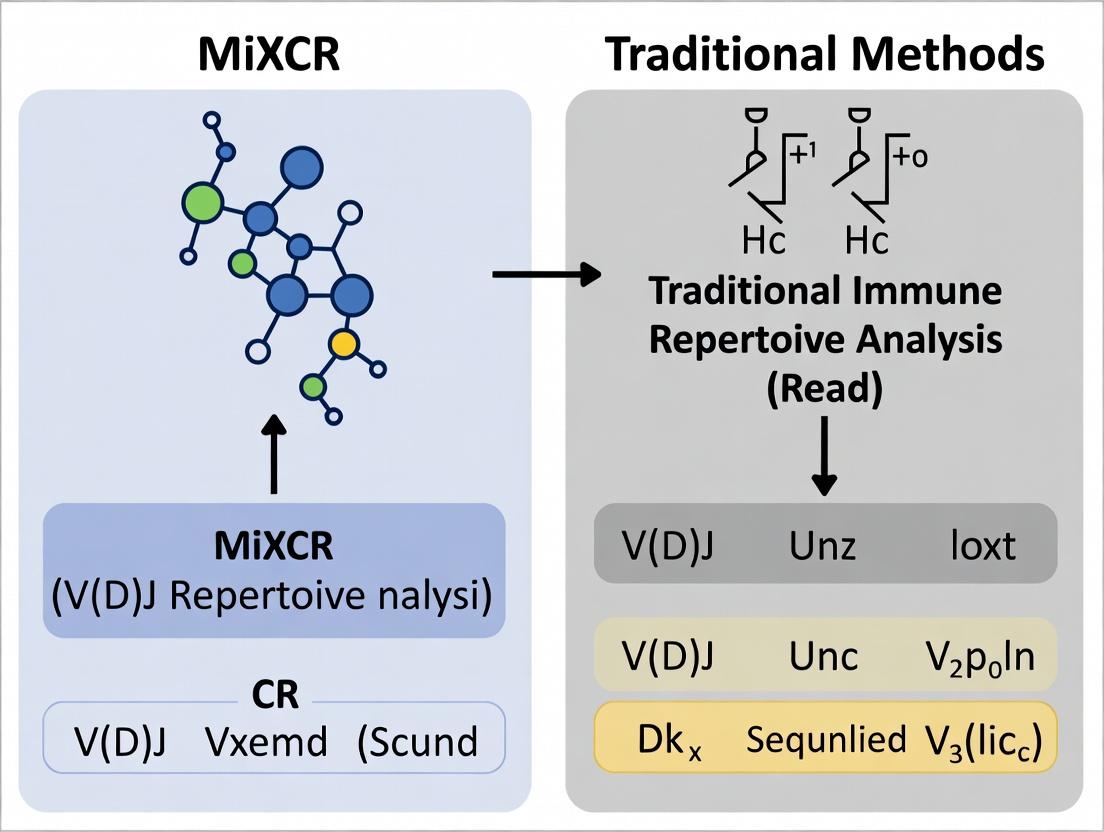
This article provides researchers, scientists, and drug development professionals with a detailed comparison of the MiXCR bioinformatics toolkit against traditional immune repertoire analysis methods.
MiXCR vs. Traditional Immune Repertoire Analysis: A Comprehensive Guide for Biomedical Researchers
Abstract
This article provides researchers, scientists, and drug development professionals with a detailed comparison of the MiXCR bioinformatics toolkit against traditional immune repertoire analysis methods. It explores the fundamental shift from labor-intensive techniques like Sanger sequencing and spectratyping to high-throughput, single-cell NGS approaches. The content systematically covers core principles, methodological workflows, common troubleshooting steps, and rigorous validation benchmarks. By synthesizing current methodologies and comparative data, this guide aims to inform strategic decisions in experimental design for immunology, oncology, and therapeutic antibody discovery.
Decoding the Immune Repertoire: From Traditional Techniques to the NGS Revolution
What is Immune Repertoire Sequencing (Rep-Seq) and Why Does It Matter?
Immune Repertoire Sequencing (Rep-Seq) is a high-throughput methodology for the comprehensive profiling of the diverse collection of T-cell receptors (TCRs) and B-cell receptors (BCRs) within an individual's adaptive immune system. By sequencing the variable regions of these receptors, researchers can quantify clonal diversity, track clonal expansion, and identify antigen-specific sequences. This technical guide frames Rep-Seq within the critical research context comparing next-generation analysis platforms, such as MiXCR, against traditional immune repertoire methods, highlighting implications for basic immunology, biomarker discovery, and therapeutic development.
The adaptive immune system relies on the immense diversity of lymphocytes generated via V(D)J recombination. The immune repertoire is the collection of all unique TCR and BCR clonotypes in a biological sample. Rep-Seq involves:
- Targeted Amplification: Primers specific to constant and variable gene segments amplify rearranged receptor loci.
- High-Throughput Sequencing: NGS platforms generate millions of reads covering the complementarity-determining region 3 (CDR3), the hypervariable region critical for antigen recognition.
- Bioinformatic Analysis: Specialized software aligns reads, assembles full V(D)J sequences, and quantifies clonotypes.
Core Methodologies: Traditional Approaches vs. MiXCR
Traditional Immune Repertoire Analysis Methods
Traditional methods are often low-throughput and indirect.
| Method | Principle | Key Quantitative Metrics | Limitations |
|---|---|---|---|
| Spectratyping | PCR amplification of CDR3 regions followed by fragment length analysis via capillary electrophoresis. | Distribution profile of CDR3 lengths. | Low resolution; cannot determine sequence identity. |
| Sanger Sequencing | Cloning of PCR-amplified receptor genes into plasmids followed by Sanger sequencing of individual colonies. | Limited clonotype count and frequency. | Extremely low throughput; cost-prohibitive for full repertoire. |
| Microarray | Hybridization of amplified products to probes for specific V and J gene segments. | Semi-quantitative gene segment usage. | Limited to known, predefined sequences; poor discovery power. |
Detailed Protocol: Spectratyping
- Primer Design: Use a fluorescently labeled primer for a constant region (e.g., TCRβ C-region) and a panel of primers for each V gene family.
- Multiplex PCR: Amplify rearranged loci from cDNA.
- Capillary Electrophoresis: Run products on a genetic analyzer. The fluorescence profile represents CDR3 length distribution for each V family.
- Analysis: A "Gaussian" distribution indicates polyclonality. Peaks indicate clonal expansions.
Next-Generation Rep-Seq and the MiXCR Platform
NGS-based Rep-Seq captures millions of sequences in one experiment. Analysis requires robust bioinformatic pipelines, with MiXCR being a leading universal tool.
| Analysis Step | Traditional Toolkit Challenge | MiXCR Algorithmic Solution | Key Performance Data* |
|---|---|---|---|
| Alignment | Requires separate, slow aligners (e.g., BLAST) for V, D, J genes. | Uses a highly optimized k-mer based algorithm for ultra-fast alignment to germline gene libraries. | >95% of reads aligned; 50-100x faster than traditional aligners. |
| Clonotype Assembly | Relies on simplistic clustering or manual inspection. | Implements a unique mapping-dependent clustering, accounting for PCR and sequencing errors to recover true clonotypes. | Error correction reduces artifactual diversity by >90%. |
| Quantification | Read count normalization is complex and non-standardized. | Outputs precise molecular counts (UMI-based) and clonal frequencies in standardized, analysis-ready formats. | Enables reliable detection of clones at <0.0001% frequency. |
*Data synthesized from current literature and MiXCR benchmark publications.
Detailed Protocol: Rep-Seq with UMI & MiXCR Analysis
- Library Prep: Starting from RNA or DNA, amplify rearranged loci using primers with Unique Molecular Identifiers (UMIs) to correct for PCR bias.
- Sequencing: Perform paired-end sequencing (2x150bp or 2x300bp) on Illumina platforms.
- MiXCR Analysis Workflow: This single command executes alignment, UMI error correction, assembly, and export.
The Scientist's Toolkit: Key Research Reagent Solutions
| Item | Function in Rep-Seq Experiment |
|---|---|
| UMI-Adapters & Primers | Contains Unique Molecular Identifiers to tag original molecules, enabling accurate PCR/sequencing error correction and absolute quantification. |
| Multiplex PCR Primer Sets | Cocktails of primers targeting all known V and J gene segments for unbiased amplification of TCR/BCR repertoires. |
| Reverse Transcriptase (for RNA) | High-fidelity enzyme for cDNA synthesis from often degraded RNA samples (e.g., from FFPE). |
| High-Fidelity DNA Polymerase | Essential for accurate amplification with minimal bias during library preparation PCR steps. |
| Magnetic Beads (Size Selection) | For clean-up and precise size selection of PCR amplicons to ensure library quality before sequencing. |
| MiXCR Software Suite | The all-in-one bioinformatic tool for end-to-end Rep-Seq data analysis, from raw reads to clonotype tables. |
| Germline Gene Database (IMGT) | The international reference database used by analysis tools to align sequences to known V, D, J gene segments. |
Why It Matters: Applications in Research and Drug Development
Rep-Seq is transformative for:
- Cancer Immunotherapy: Identifying tumor-reactive T-cell clones for adoptive cell transfer (e.g., TCR-T therapy) and monitoring minimal residual disease.
- Autoimmune & Infectious Diseases: Discovering public clonotypes associated with disease and tracking antigen-specific immune responses over time.
- Vaccine Development: Profiling the breadth and durability of B-cell and T-cell responses to vaccine candidates.
- Drug Safety: Detecting clonal expansions as early biomarkers of immunotoxicity.
The shift from traditional methods to integrated NGS platforms like MiXCR provides the accuracy, throughput, and standardization required to translate immune repertoire data into actionable insights, accelerating the development of novel diagnostics and immunotherapies.
Within the rapidly advancing field of immunology and immuno-oncology, the analysis of the T-cell receptor (TCR) and B-cell receptor (BCR) repertoires is fundamental. Modern high-throughput sequencing (HTS) platforms like MiXCR represent a paradigm shift, offering unprecedented scale and depth. This whitepaper provides an in-depth technical examination of three foundational traditional methods—Sanger sequencing, spectratyping, and molecular cloning—that defined the field for decades. Their principles, limitations, and experimental workflows are analyzed to establish a critical context for evaluating the advantages and disruptive impact of NGS-based analytical software such as MiXCR in contemporary research and drug development.
Sanger Sequencing of Immune Receptors
Sanger sequencing, the gold standard for decades, was the first method to provide nucleotide-level resolution for immune receptor chains.
Core Principle & Workflow
The method relies on chain-termination via fluorescently labeled dideoxynucleotides (ddNTPs) during in vitro DNA replication. For TCR/BCR analysis, this required prior amplification of variable regions using locus-specific primers, often from sorted cell populations or clonal expansions.
Experimental Protocol
- Template Preparation: Isolate RNA/DNA from lymphocytes (e.g., PBMCs, tissue). Reverse transcribe RNA to cDNA.
- Targeted PCR: Amplify TCR (e.g., TCRβ CDR3) or Ig (e.g., IgH VDJ) regions using a multiplex of V-region forward primers and a C-region reverse primer.
- Purification: Clean PCR product to remove excess primers and dNTPs.
- Sequencing Reaction: Set up cycle sequencing with a single primer (forward or reverse), template DNA, Taq polymerase, dNTPs, and fluorescent ddNTPs.
- Capillary Electrophoresis: Inject products onto a capillary array. Laser excitation detects fluorescent dye as fragments terminate.
- Data Analysis: Base-calling software generates chromatograms. Sequences are aligned to IMGT/V-QUEST for V(D)J gene assignment.
Table 1: Performance Metrics of Sanger Sequencing for Repertoire Analysis
| Metric | Typical Output/Value | Key Limitation |
|---|---|---|
| Throughput | 96 - 384 sequences per run | Extremely low compared to NGS (millions). |
| Read Length | Up to ~900 bp | Suitable for full V(D)J regions. |
| Quantitative Accuracy | Low; biased by PCR and dominant clones. | Cannot reliably quantify clonal frequencies below ~5-10%. |
| Cost per Sequence | High ($2-$5 per sequence at scale). | Inefficient for repertoire depth. |
| Primary Application | Clonal validation, single-sequence fidelity. | Not for diverse repertoire profiling. |
Spectratyping (CDR3 Length Analysis)
Spectratyping, or Immunoscope analysis, provided a low-resolution but rapid snapshot of repertoire diversity based on CDR3 length distribution.
Core Principle & Workflow
This technique exploits the size variation in the CDR3 region due to imprecise V(D)J recombination. Fluorescent PCR products are separated by high-resolution capillary electrophoresis, generating a profile where each peak represents a CDR3 of specific length.
Experimental Protocol
- cDNA Synthesis & PCR: As in Sanger sequencing, perform RT and multiplex PCR for a specific receptor chain (e.g., TCR Vβ families).
- Run-off Reaction (Nested PCR): A second, fluorescent PCR is performed using a nested, fluorescently labeled (e.g., FAM) J-region or C-region primer. This generates a family-specific product set.
- Fragment Analysis: Products are mixed with size standard and run on a capillary sequencer (like an ABI 3730xl) in fragment analysis mode.
- Data Interpretation: Software (e.g., GeneMapper) plots fluorescence intensity vs. fragment size. A polyclonal repertoire shows a Gaussian distribution of 8-10 peaks (for CDR3 lengths). Skewed distributions or single dominant peaks indicate oligoclonality or clonal expansion.
Table 2: Performance Metrics of Spectratyping
| Metric | Typical Output/Value | Key Limitation |
|---|---|---|
| Resolution | CDR3 length (in amino acids). | No sequence information; different sequences of same length conflated. |
| Throughput | Medium; 24-96 samples per run for multiple V families. | Qualitative/semi-quantitative profile. |
| Sensitivity | Can detect a clone at ~1-5% frequency within a V family. | Limited by PCR bias and background. |
| Primary Application | Quick diversity assessment, tracking clonal expansions over time. | Cannot identify specific clonal sequences. |
Molecular Cloning & Sequencing
This labor-intensive method was the primary way to obtain full-length, paired-chain immune receptor sequences before NGS.
Core Principle & Workflow
PCR-amplified TCR or Ig sequences are ligated into plasmid vectors, transformed into bacteria, and individual colonies are picked for Sanger sequencing. This allows for the isolation of paired α/β or heavy/light chain sequences if carefully designed.
Experimental Protocol
- Amplification: Amplify TCR/Ig genes from single cells or bulk cDNA. For pairing, single-cell sorting or linking techniques are required.
- Ligation: Purify PCR product and ligate into a linearized, T-overhang plasmid vector (e.g., pCR2.1-TOPO).
- Transformation: Introduce ligation product into competent E. coli via heat shock or electroporation.
- Colony Screening: Plate on selective media (e.g., with X-Gal/IPTG for blue-white screening). Pick individual colonies for culture.
- Plasmid Preparation: Mini-prep to isolate plasmid DNA.
- Sequencing: Perform Sanger sequencing with vector-specific primers (M13 forward/reverse).
Table 3: Performance Metrics of Molecular Cloning & Sequencing
| Metric | Typical Output/Value | Key Limitation |
|---|---|---|
| Throughput | Very low (100s-1000s of clones per project). | Extremely labor-intensive and slow. |
| Sequence Fidelity | High, as each clone is isolated. | PCR errors can be propagated. |
| Pairing Information | Possible with single-cell or linked PCR. | Technically challenging for bulk populations. |
| Primary Application | Obtaining full-length, paired sequences for functional validation (retroviral transduction). | Not scalable for repertoire analysis. |
The Scientist's Toolkit: Key Reagent Solutions
Table 4: Essential Research Reagents for Traditional Methods
| Reagent/Material | Function | Example/Note |
|---|---|---|
| Locus-Specific Primers | Amplify TCR/BCR V and C gene regions. | Multiplex panels covering all V gene families. |
| Reverse Transcriptase | Synthesize cDNA from RNA templates. | Moloney Murine Leukemia Virus (M-MLV) or Superscript IV. |
| High-Fidelity Polymerase | Accurate amplification of variable regions. | Pfu, Phusion, or KAPA HiFi to minimize PCR errors. |
| TOPO-TA Cloning Vector | Facilitates rapid, directional ligation of PCR products. | pCR2.1-TOPO; utilizes terminal transferase activity of Taq. |
| Competent E. coli | For plasmid transformation and propagation. | DH5α, TOP10 strains with high transformation efficiency. |
| Fluorescent ddNTPs/dye-primers | Essential for Sanger sequencing fragment detection. | BigDye Terminator v3.1 chemistry. |
| Capillary Sequencer | Instrument for fragment separation (sequencing & spectratyping). | ABI 3730xl Genetic Analyzer. |
| Size Standard (ROX/LLZ) | For accurate fragment sizing in spectratyping. | GS-500 ROX or similar. |
Workflow Visualization
Title: Traditional Immune Repertoire Analysis Workflow Comparison
Title: Thesis Context: MiXCR Addresses Traditional Method Limitations
Sanger sequencing, spectratyping, and molecular cloning laid the essential groundwork for immune repertoire science, enabling early discoveries in immune responses, autoimmune diseases, and cancer immunology. However, their intrinsic limitations—low throughput, semi-quantitative output, and inability to capture full diversity—created a technological bottleneck. The emergence of high-throughput sequencing presented a solution but required sophisticated bioinformatic tools for analysis. This juxtaposition frames the core thesis: platforms like MiXCR are not merely incremental improvements but are transformative by directly overcoming the scalability and precision constraints of legacy methods. They enable the quantitative, high-resolution, and statistically robust repertoire analyses that are now indispensable in advanced research and therapeutic development, marking a definitive evolution from the qualitative and labor-intensive paradigms of the past.
The analysis of the adaptive immune receptor repertoire is foundational to immunology research, vaccine development, and therapeutic antibody discovery. This whitepaper, framed within a comparative analysis of MiXCR (a modern, NGS-based software toolkit) versus traditional immune repertoire methods, details the core technical limitations that pre-Next-Generation Sequencing (pre-NGS) technologies imposed on the field. Understanding these constraints is critical for appreciating the transformative impact of high-throughput sequencing and advanced bioinformatics pipelines like MiXCR on repertoire analysis.
Core Limitation 1: Depth of Analysis
Pre-NGS methods, primarily based on Sanger sequencing of cloned PCR products, were fundamentally limited in their ability to sample the true diversity of an immune repertoire, which can span 10^7 to 10^11 unique clonotypes in a human.
Experimental Protocol: A typical Sanger-based repertoire analysis involved:
- RNA Extraction & cDNA Synthesis: Total RNA is isolated from lymphocytes (e.g., PBMCs, tissue). Reverse transcription with constant region primers generates cDNA.
- PCR Amplification: V(D)J regions are amplified using a mix of V-gene and J-gene primers.
- Cloning: The PCR product is ligated into a plasmid vector and transformed into E. coli to create a library of individual clones.
- Colony Picking & Sequencing: Hundreds of individual bacterial colonies are picked, cultured, and their plasmids are purified for Sanger sequencing. This step is the primary bottleneck.
Quantitative Blind Spot: The labor and cost of colony picking and sequencing reactions inherently limited studies to tens to a few hundred sequences per sample. This shallow depth captured only the most abundant clonotypes, rendering the vast "long tail" of low-frequency, high-specificity clones virtually invisible.
Table 1: Comparative Depth of Analysis: Pre-NGS vs. NGS
| Metric | Sanger Sequencing of Clones | NGS (Illumina, MGI) |
|---|---|---|
| Typical Sequences/Sample | 100 - 500 | 100,000 - 10,000,000+ |
| Effective Clonotype Coverage | <0.1% of repertoire | 1% to >90% of repertoire |
| Detectable Frequency Range | ~1% and above | <0.0001% (single-cell methods) |
| Primary Limitation | Manual colony picking, cost per sequence | Data analysis complexity, PCR/sequencing errors |
Core Limitation 2: Throughput and Scalability
Throughput in terms of samples analyzed and data generation per unit time was severely constrained.
Experimental Workflow Bottlenecks: The cloning step was not only low-throughput but also prone to bacterial transformation bias, where some DNA fragments clone more efficiently than others, distorting quantitative representation. Gel extraction, purification, and plasmid preparation for hundreds of clones were manual, time-consuming processes.
Implication for Study Design: These constraints forced studies to be narrowly focused—comparing a few time points or a limited number of patient groups—rather than enabling large-scale longitudinal or cohort studies now standard in immuno-oncology and autoimmune disease research.
Title: Pre-NGS Sanger Sequencing Workflow Bottleneck
Core Limitation 3: Quantitative Blind Spots
Pre-NGS methods lacked true quantitation due to multiple, inseparable amplification biases.
- PCR Bias: The initial multiplex PCR used degenerate primers with varying efficiencies for different V and J genes, dramatically skewing the initial representation of clonotypes.
- Cloning Bias: As noted, transformation efficiency varied by sequence, adding a second layer of distortion.
Protocol Consequence: It was impossible to distinguish whether a clonotype's frequency in the final dataset reflected its true biological abundance or was an artifact of technical bias. This made tracking minimal residual disease or subtle clonal expansions highly unreliable.
Experimental Control Attempts: Researchers attempted to mitigate this using spike-in controls (synthetic TCR/BCR templates of known concentration) or limiting dilution PCR. However, these were imperfect and added complexity without solving the core issue.
Table 2: Sources of Quantitative Bias in Pre-NGS Methods
| Bias Stage | Cause | Effect on Quantitation |
|---|---|---|
| Reverse Transcription | Variable efficiency across RNA templates. | Alters initial cDNA template proportions. |
| Multiplex PCR | Differential primer annealing/extension efficiency. | Major skew; over/under-represents specific V/J families. |
| Cloning | Sequence-dependent bacterial transformation efficiency. | Further distorts clonal frequencies. |
| Colony Picking | Non-random, manual selection. | Can over-sample abundant clones. |
The Scientist's Toolkit: Key Reagent Solutions in Pre-NGS Research
| Research Reagent / Material | Function & Role in Pre-NGS Workflows |
|---|---|
| Degenerate V/J Primer Sets | Oligonucleotide mixtures designed to anneal to most variable (V) and joining (J) gene families. Crucial for initial amplification but a primary source of PCR bias. |
| TA Cloning Vector (e.g., pCR2.1) | Plasmid with 3'-T overhangs for easy ligation of PCR products (which have 3'-A overhangs from Taq polymerase). Standardized cloning. |
| Competent E. coli (High Efficiency) | Chemically treated bacteria for plasmid uptake. Efficiency (>10^8 cfu/μg) directly limited library representativity. |
| Blue-White Screening (X-Gal/IPTG) | Allows visual identification of bacterial colonies containing recombinant plasmids (white) versus empty vectors (blue), streamlining colony picking. |
| SP6/T7 Sequencing Primers | Primers binding to sites flanking the insert in the cloning vector, enabling standard Sanger sequencing of all cloned fragments. |
| Internal Standard/Spike-in RNA | Synthetic RNA template of known sequence and concentration added pre-RT to semi-quantitatively estimate recovery and amplification efficiency. |
Contrast with the NGS & MiXCR Paradigm
Modern NGS overcomes these limitations by decoupling sampling depth from cost/effort and using unique molecular identifiers (UMIs) to correct for PCR bias. Bioinformatics tools like MiXCR are essential to process the millions of reads, perform accurate V(D)J alignment, error correction (via UMIs), and clonotype tracking. MiXCR automates what was once a manual, error-prone alignment process, transforming raw NGS data into quantifiable, biologically interpretible repertoire data. This shift enables the high-resolution, quantitative analysis required for modern immunology and therapeutic development, rendering pre-NGS approaches obsolete for comprehensive repertoire studies.
Title: Paradigm Shift: From Pre-NGS Limits to NGS Solutions
The study of adaptive immune repertoires has undergone a revolutionary transformation with the advent of Next-Generation Sequencing (NGS). This paradigm shift moves beyond low-resolution, qualitative techniques like spectratyping and Sanger sequencing, enabling truly quantitative, high-resolution analysis of T- and B-cell receptor (TCR/BCR) diversity. The central thesis in contemporary immunogenetics research evaluates modern computational pipelines, such as MiXCR, against traditional methods. MiXCR exemplifies the NGS-driven shift by providing a comprehensive, standardized software solution for the accurate quantification of clonotypes from raw sequencing data, a task that was previously manual, error-prone, and semi-quantitative at best.
The Core Technical Workflow of NGS-Based Rep-Seq
The power of NGS-based repertoire sequencing lies in a standardized yet flexible workflow that captures quantitative clonal abundance.
Detailed Experimental Protocol for Bulk TCR Sequencing
- Sample Preparation (PBMCs or Tissue): Isolate mononuclear cells via density-gradient centrifugation (e.g., Ficoll-Paque). Extract total RNA or genomic DNA using column-based kits, ensuring high integrity (RIN > 8 for RNA).
- Library Preparation - Target Enrichment:
- Multiplex PCR-Based: For DNA, use multiple V- and J- gene-specific primers in a single tube. For RNA, perform reverse transcription followed by multiplex PCR. Include unique molecular identifiers (UMIs) at the cDNA/amplicon stage to correct for PCR bias and sequencing errors.
- 5' RACE-Based: A common method for RNA. Uses a single primer in the constant region and adapters added during template-switching, reducing primer bias.
- NGS Sequencing: Pool libraries and sequence on platforms like Illumina MiSeq or NextSeq. Aim for paired-end reads (2x300bp for MiSeq) to ensure complete coverage of CDR3 regions.
- Bioinformatic Analysis (e.g., with MiXCR):
- Alignment: Map reads to reference V, D, J, and C gene segments.
- Clonotype Assembly: Cluster sequences by CDR3 nucleotide sequence, considering V/J gene usage.
- UMI Correction: Collapse reads originating from the same original molecule using UMIs to generate accurate clonal counts.
- Output: A table of clonotypes defined by V/J genes, CDR3 amino acid sequence, and absolute or relative count.
Title: NGS Rep-Seq Workflow from Sample to Data
Quantitative Comparison: NGS/MiXCR vs. Traditional Methods
The following table summarizes the critical advancements enabled by the NGS paradigm, as embodied by tools like MiXCR.
| Feature | Traditional Methods (Spectratyping, Sanger) | NGS-Based Rep-Seq (e.g., MiXCR Pipeline) |
|---|---|---|
| Resolution | Low. Assesses CDR3 length distribution or a few hundred clones. | Single-nucleotide resolution. Can profile millions of individual clonotypes. |
| Quantitation | Semi-quantitative. Estimates relative frequency based on band intensity. | Fully quantitative. Uses UMIs for absolute molecule counting, providing precise frequency. |
| Throughput | Low. One sample per assay, limited multiplexing. | High. Thousands to millions of sequences per sample in a single run. |
| Dynamic Range | Narrow (~2 logs). Dominant clones obscure rare ones. | Extremely wide (5-6 logs). Can detect rare clones at frequencies <0.001%. |
| Analysis Depth | Descriptive. Limited to diversity indices and dominant clone tracking. | Deep & Predictive. Enables tracking of clone dynamics, convergence, lineage analysis, and machine learning applications. |
| Key Limitation | Qualitative, biased, misses vast diversity. | Requires sophisticated bioinformatics; potential for PCR/sequencing artifacts (mitigated by UMIs). |
Title: Paradigm Shift from Traditional to NGS Rep-Seq
The Scientist's Toolkit: Essential Reagent Solutions
| Item | Function & Rationale |
|---|---|
| UMI-Adapters (Switch-Oligos for 5' RACE) | Contains Unique Molecular Identifiers (UMIs) to tag each original mRNA molecule, enabling correction for PCR amplification bias and sequencing errors to achieve true quantitative accuracy. |
| Multiplex V-Gene Primers | A pooled set of primers specific to all known functional V gene segments. Ensures unbiased amplification of the full repertoire. Critical for genomic DNA-based approaches. |
| High-Fidelity DNA Polymerase | Essential for minimizing PCR errors during library amplification, which is crucial for accurate sequence determination, especially in highly similar clonotypes. |
| Magnetic Beads for Size Selection | Used for precise purification and size selection of amplicon libraries (e.g., SPRI beads). Removes primer dimers and ensures optimal library fragment size for sequencing. |
| Dual-Indexed Sequencing Adapters | Allows multiplexing of hundreds of samples in a single sequencing run by attaching unique sample-specific barcodes to each library, reducing per-sample cost. |
| MiXCR Software Suite | The core analytical toolkit. It performs all key steps: alignment, UMI handling, clonotype assembly, and error correction, transforming raw FASTQ files into an analyzable clonotype table. |
Within the ongoing research comparing next-generation sequencing (NGS) methods for immune repertoire analysis, MiXCR has emerged as a pivotal tool. This whitepaper details its core technical framework, positioning it against traditional techniques like Sanger sequencing and spectratyping, and provides a guide for its implementation.
Thesis Context: MiXCR vs. Traditional Methods
Traditional immune repertoire analysis methods are limited by low throughput, semi-quantitative data, and an inability to deeply resolve clonal diversity. MiXCR overcomes these by providing a complete, standardized software pipeline for transforming raw NGS data from T- and B-cell receptors into quantifiable, annotated clonotype profiles. The core thesis is that MiXCR enables reproducible, high-resolution, and statistically robust repertoire analysis that is essential for modern immunology and biomarker discovery in drug development.
Core Algorithmic Workflow and Protocols
MiXCR processes data through a multi-stage alignment and assembly pipeline. The following diagram illustrates the logical workflow:
Diagram Title: MiXCR Core Analysis Workflow
Detailed Protocol for a Standard MiXCR Run:
- Input: Paired-end FASTQ files from immune receptor NGS (e.g., TCRβ, IgH).
- Alignment: Use
mixcr alignto map reads against the reference database of V, D, J, and C gene segments. The command performs:- Seed-based k-mer alignment for speed.
- Smith-Waterman-like fine alignment.
- Base quality-aware error correction.
- Assembly: Use
mixcr assembleto cluster aligned reads into clonotypes based on CDR3 nucleotide sequence and V/J gene assignment. - Export: Use
mixcr exportClonesto generate the final clonotype table. Key parameters include--chainsto specify receptor type and-cto specify chain (e.g., TRB).
Quantitative Performance Comparison
The table below summarizes key performance metrics of MiXCR versus traditional methods, based on published benchmarking studies.
Table 1: Comparison of Immune Repertoire Analysis Methods
| Feature | Traditional Methods (Sanger/Spectratyping) | NGS with MiXCR |
|---|---|---|
| Throughput | Low (10s-100s of clones) | Very High (10⁵-10⁶ clonotypes) |
| Quantitative Accuracy | Semi-quantitative; limited dynamic range | High; digital counting enables precise frequency estimation |
| Resolution | Limited clonal diversity assessment | Single-nucleotide resolution of CDR3 |
| Gene Usage Analysis | Limited or manual | Automated, full V(D)J assignment |
| Reproducibility | Variable, protocol-dependent | High, standardized computational pipeline |
| Key Metric: Clones Detected | ~10² | ~10⁵ - 10⁶ |
| Key Metric: Minimum Reliable Frequency | ~1-5% | ~0.01% |
Advanced Functionality: Clonotype Tracking Over Time
For longitudinal studies, such as monitoring minimal residual disease or therapy response, MiXCR provides mixcr overlap to track specific clonotypes across samples. The relationship between samples and identified clonotypes is visualized below.
Diagram Title: Longitudinal Clonotype Tracking with MiXCR
The Scientist's Toolkit: Essential Reagent Solutions
Successful implementation of MiXCR depends on quality wet-lab reagents for library preparation.
Table 2: Key Research Reagent Solutions for NGS Immune Repertoire Analysis
| Reagent / Kit | Primary Function |
|---|---|
| 5' RACE-based Amplification Kits (e.g., SMARTer TCR a/b Profiling) | Amplifies full-length V(D)J transcripts without V-gene bias, ideal for unknown primers. |
| Multiplex PCR Primer Sets (V-gene specific) | Targeted amplification of rearranged receptor loci; requires prior knowledge of species/strain. |
| Unique Molecular Identifiers (UMIs) | Short random nucleotide tags incorporated during cDNA synthesis to correct for PCR amplification bias and errors. |
| Hybrid Capture Probes | Solution-based capture for enriching rearranged immune receptor loci from whole transcriptome or genomic libraries. |
| High-Fidelity DNA Polymerase | Essential for accurate amplification with minimal PCR errors during library construction. |
| Dual-Indexed NGS Adapters | Allows multiplexing of hundreds of samples in a single sequencing run. |
The MiXCR Pipeline in Action: Step-by-Step Workflow and Key Applications
The analysis of the adaptive immune repertoire, comprising the vast diversity of T- and B-cell receptors (TCRs/BCRs), is fundamental to immunology research, vaccine development, and cancer immunotherapy. Traditional methods, such as spectratyping and Sanger sequencing of cloned PCR products, are low-throughput and lack the resolution to capture the full complexity of the repertoire. The advent of high-throughput sequencing (HTS) promised a paradigm shift, but early bioinformatics approaches struggled with accurate V(D)J rearrangement assembly from short reads. This thesis posits that MiXCR represents a critical evolution in this field, moving beyond the alignment-centric, low-sensitivity frameworks of traditional HTS methods. MiXCR implements a unified, multi-algorithmic core architecture that integrates alignment, de novo assembly, and machine-learning-based error correction to deliver superior clonotype quantification and annotation, setting a new standard for precision and reproducibility in immune repertoire profiling.
Core Architecture and Methodological Workflow
MiXCR's pipeline is a multi-stage process that transforms raw sequencing reads into quantified, annotated clonotypes. The core innovation lies in its hybrid approach, which does not rely solely on direct alignment to germline reference sequences.
Alignment Phase: K-mer-Based Mapping and Clustering
The first phase performs rapid, sensitive initial mapping of reads to germline V, J, C, and D gene segments from the International ImMunoGeneTics (IMGT) database.
Protocol: K-mer Alignment and Clustering
- Input: Pre-processed FASTQ files (quality-controlled, potentially trimmed).
- K-mer Indexing: A library of short oligonucleotide sequences (k-mers, typically k=10) is constructed from all germline gene references. Each k-mer is associated with its gene(s) of origin.
- Read Mapping: For each sequencing read, it is scanned for k-mers present in the index. The read is assigned to the gene segment (e.g., a specific V gene) that shares the highest number of overlapping k-mers, providing a preliminary anchor.
- Clustering by Molecular Barcode: For unique molecular identifier (UMI) or cell barcode-based protocols, reads sharing the same barcode are grouped. This cluster will later be assembled into a single consensus sequence, mitigating PCR and sequencing errors.
- Output: Read sets aligned to specific V and J gene regions, grouped into clusters representing individual original RNA molecules or cells.
Assembly Phase: De Novo Overlap Assembly and Alignment Refinement
This phase is central to MiXCR's accuracy, building precise nucleotide sequences for the Complementarity Determining Region 3 (CDR3).
Protocol: Core CDR3 Assembly
- Targeted Extraction: For each cluster from the alignment phase, the regions around the tentative V and J gene alignments are extracted.
- Overlap Consensus Assembly: Within each cluster, reads are assembled into a single consensus sequence using an overlap layout consensus (OLC) algorithm. This step is performed de novo, without direct reference bias, allowing for accurate reconstruction of the hypervariable CDR3 junction.
- Fine-Tuned Alignment: The assembled consensus sequence is then globally aligned back to the germline V and J gene references using the Smith-Waterman algorithm. This refines the boundaries and identifies the precise V-D-J trimming points.
- CDR3 Definition: The CDR3 region is defined according to the IMGT standard: from the second conserved cysteine (C) in the V gene to the conserved phenylalanine/tryptophan (F/W) residue in the J gene.
Annotation and Error Correction Phase
The final phase translates sequences and applies sophisticated filters to produce a high-confidence clonotype table.
Protocol: Annotation and Quality Control
- Translation and Clonotyping: Each assembled nucleotide sequence is translated in all six frames. Productive rearrangements (in-frame, no stop codons) are identified. A clonotype is uniquely defined by the amino acid sequence of its CDR3, along with the specific V and J (and D, if applicable) gene alleles.
- Machine-Learning Error Correction (MiXCR-EC): A probabilistic model is applied to distinguish true hypermutations or junctional diversity from sequencing errors. The model considers sequencing quality, UMI/cell barcode cluster size, and rearrangement-specific features.
- Quantification: Final clonotypes are quantified by the number of underlying UMIs (for UMI-based protocols) or the number of read clusters, providing a digital count proportional to the original mRNA molecule count.
- Output: A comprehensive clonotype table containing sequences, gene annotations, CDR3 regions, and quantitative counts.
MiXCR Core Analysis Workflow
Performance Data and Comparison to Traditional Methods
Recent benchmarking studies highlight MiXCR's advantages in sensitivity, accuracy, and reproducibility over alignment-only or earlier assembly-based tools.
Table 1: Comparative Performance in Simulated and Spike-In Data
| Metric | MiXCR v4.x | Alignment-Only Tool (e.g., Basic IgBLAST) | Traditional Method (Sanger Cloning) | Notes |
|---|---|---|---|---|
| Clonotype Detection Sensitivity | >99.5% | ~85-90% | <1% (limited sampling) | Measured using synthetic repertoire with known clonotypes. |
| CDR3 Nucleotide Accuracy | >99.9% | ~95-98% | >99.9% (per clone) | MiXCR's assembly corrects sequencing errors. |
| Quantitative Accuracy (r²) | 0.98-0.99 | 0.90-0.95 | Not quantifiable | Correlation between UMI counts and known template concentration. |
| Required Sequencing Depth | Lower (efficient use) | Higher (to compensate for loss) | Extremely Low (but per clone) | MiXCR's sensitivity allows for robust results with less data. |
| Processing Speed | ~10-100k reads/sec | ~50-200k reads/sec | Very Slow | MiXCR balances speed with sophisticated analysis. |
Table 2: Key Advantages in Research Contexts
| Research Challenge | MiXCR Solution | Traditional HTS Limitation |
|---|---|---|
| High homology between gene alleles | De novo assembly resolves ambiguous alignments. | Often misassigns or discards reads. |
| Somatic hypermutation in B-cells | Assembly-first approach tolerates mutations; ML correction validates. | Alignment fails, leading to loss of mutated clonotypes. |
| Error-prone long-read sequencing (PacBio, Nanopore) | Consensus assembly within barcode clusters dramatically reduces error rate. | Raw error rate is prohibitively high for direct analysis. |
| Single-cell 5' RNA-seq data | Specialized preset profiles align variable region from transcript start. | Standard genomic aligners are not optimized for V(D)J reads. |
The Scientist's Toolkit: Essential Research Reagents and Materials
Table 3: Key Reagent Solutions for Immune Repertoire Sequencing
| Item | Function | Example/Notes |
|---|---|---|
| UMI-Adapters / Primers | Unique Molecular Identifier tagging enables digital counting and error correction. | Integrated into SMARTer (Takara) or NEXTflex (PerkinElmer) library prep kits. |
| Multiplex PCR Primers | Primer sets targeting all V genes for unbiased amplification. | Mix of degenerated primers or target-specific multiplex (e.g., ImmunoSEQ). |
| 5' RACE Kit | For capturing native, full-length variable regions without V-gene primer bias. | SMARTer technology (Takara) is widely used. |
| Single-Cell Barcoding Kit | Enables paired TCR/BCR and gene expression profiling from the same cell. | 10x Genomics Chromium Single Cell Immune Profiling, BD Rhapsody. |
| Spike-In Control Libraries | Synthetic TCR/BCR sequences with known frequencies to calibrate quantification and sensitivity. | Essential for assay validation and cross-study normalization. |
| High-Fidelity PCR Enzyme | Minimizes PCR duplication bias and errors during library amplification. | KAPA HiFi, Q5 (NEB). |
| MiXCR Software Suite | The core analysis platform for alignment, assembly, and annotation. | Requires Java; includes presets for all major commercial assay types. |
Advanced Protocols: Validating MiXCR Output
Protocol: In Silico Validation with Synthetic Repertoire
- Generate Synthetic FASTQ: Use a tool like
SimMRCorARTto simulate sequencing reads from a known set of clonotype sequences with defined V/J genes and CDR3s. Spike in random errors and define abundances. - Process with MiXCR: Analyze the synthetic FASTQ using the standard MiXCR pipeline (
mixcr analyze). - Benchmark Metrics: Compare the output clonotype table to the ground truth list. Calculate sensitivity (recall), precision, and quantitative correlation (Pearson r) between input and output frequencies.
Protocol: Experimental Validation by Cloning and Sanger Sequencing
- Targeted PCR: Design primers specific to the V and J genes of high-abundance clonotypes identified by MiXCR from a biological sample.
- Molecular Cloning: Clone the PCR product into a plasmid vector and transform bacteria.
- Sanger Sequencing: Pick multiple colonies and sequence the inserts.
- Sequence Comparison: Align the Sanger-derived sequences to the MiXCR-assembled clonotype sequence to confirm 100% nucleotide identity, validating assembly accuracy.
Clonotype Validation and Analysis Pathways
This technical guide explores the input flexibility of modern immune repertoire analysis software, with a focus on MiXCR within the broader thesis comparing it to traditional immune profiling methods. Traditional methods like spectratyping and Sanger sequencing are limited in throughput and resolution. MiXCR, as a computational pipeline, addresses these limitations by enabling comprehensive analysis from diverse next-generation sequencing (NGS) inputs, which is critical for researchers and drug developers studying adaptive immunity in cancer, autoimmunity, and infectious disease.
The following table summarizes the key NGS data types processable by tools like MiXCR, contrasted with traditional method capabilities.
Table 1: Input Data Compatibility: MiXCR vs. Traditional Methods
| Input Data Type | Description & Common Platform | Traditional Method Compatibility | MiXCR Compatibility & Key Advantage |
|---|---|---|---|
| Bulk RNA-seq | Whole-transcriptome data (Illumina). Provides global gene expression. | Low. Requires targeted amplification of receptor loci. | High. Can mine TCR/BCR sequences from whole transcriptome data, enabling repertoire analysis from existing datasets without targeted sequencing. |
| Targeted Bulk TCR/BCR-seq | Enriched V(D)J libraries (Illumina, Ion Torrent). High-depth coverage of repertoires. | Moderate (digital version of traditional cloning). | High. Primary use case. Delivers quantitative clonotype counts, V/J usage, and CDR3 analysis with high accuracy and sensitivity. |
| Single-Cell RNA-seq (Full-Length) | Platform: 10x Genomics Chromium, SMART-seq. Pairs V(D)J with gene expression per cell. | None. | High. Enables paired-chain analysis and links clonotype to cell phenotype (e.g., cell type, activation state). |
| Single-Cell V(D)J Enriched | Platform: 10x Genomics V(D)J kit, BD Rhapsody. Targeted amplification from single cells. | None. | High. Optimized for accurate paired-chain recovery and hypermutation analysis for B cells. |
| Nanopore / PacBio Long Reads | Long-read sequencing (Oxford Nanopore, PacBio). Spans full V(D)J region. | Low. | Growing. MiXCR supports error correction and analysis of long reads, allowing complete antibody sequence resolution. |
Detailed Experimental Protocols for Cited Analyses
Protocol: Processing Bulk RNA-seq Data for Immune Repertoire Mining
Objective: Extract TCR/BCR clonotypes from standard whole-transcriptome sequencing data. Workflow:
- Data Input: Paired-end FASTQ files from Illumina RNA-seq (e.g., 2x150 bp).
- Alignment and Assembly (MiXCR):
This command executes a preset pipeline:
align,assemble, andexport. - Key Parameters:
--starting-material rna: Instructs the aligner to consider intronic regions.--only-productive: During export, filters to only in-frame sequences without stop codons.
- Output: A clonotype table with counts, frequencies, and V(D)J assignments, comparable to targeted repertoire data but derived from transcriptomic data.
Protocol: Analyzing Targeted Single-Cell V(D)J Data (10x Genomics)
Objective: Reconstruct paired αβ or γδ T-cell receptors or IgG/IgA/IgM B-cell receptors from single cells. Workflow:
- Data Input: FASTQ files from the 10x Genomics V(D)J library (Libraries are separate for T and B cells).
- Alignment and Assembly for Paired Chains:
- Single-Cell Barcode Handling: MiXCR automatically recognizes and retains 10x cellular barcodes and UMIs, allowing clonotype grouping at the single-cell level.
- Export for Downstream Analysis:
- Integration: The resulting clonotype table, containing cellular barcodes, can be merged with single-cell gene expression data (from Cell Ranger) using the barcode key.
Visualizations
Diagram: MiXCR Unified Analysis Workflow for Diverse Inputs
Title: MiXCR Unified Pipeline for Multiple NGS Inputs
Diagram: Logical Flow from Data to Biological Insight in Repertoire Research
Title: From Sequencing Data to Immune Repertoire Insight
The Scientist's Toolkit: Essential Research Reagent Solutions
Table 2: Key Reagents and Tools for Immune Repertoire Profiling Experiments
| Item / Solution | Provider Examples | Function in Experimental Workflow |
|---|---|---|
| Total RNA / DNA Isolation Kits | Qiagen, Zymo Research, Norgen Biotek | High-quality nucleic acid extraction from PBMCs, tissue, or sorted cells; starting point for all library prep. |
| 5' RACE-based TCR/BCR Amplification Kits | Takara Bio, SMARTer Human TCR/BCR | For targeted bulk NGS: Amplifies full V(D)J regions with UMI integration from RNA, minimizing bias. |
| Single-Cell Immune Profiling Kits | 10x Genomics Chromium Immune Profiling, BD Rhapsody Assay | Integrated solution for generating single-cell gene expression and paired V(D)J libraries from thousands of cells. |
| UMI Adapters & PCR Additives | IDT, NEB | Unique Molecular Identifiers (UMIs) enable accurate PCR duplicate removal and quantitative clonal counting. |
| High-Fidelity PCR Master Mix | KAPA HiFi, Q5 (NEB) | Essential for accurate amplification of hyperdiverse immune receptor sequences with low error rates. |
| Size Selection Beads | SPRIselect (Beckman Coulter), AMPure XP | Cleanup and size selection of libraries post-amplification to remove primer dimers and optimize insert size. |
| MiXCR Software Suite | MiLaboratory | Core computational tool for aligning, assembling, and quantifying immune sequences from all input types. |
| Reference Genome & V(D)J Gene Databases | IMGT, Ensembl | Curated reference sequences required for accurate alignment and annotation of V, D, and J gene segments. |
This guide details the canonical bioinformatics pipeline for T- and B-cell receptor (TCR/BCR) repertoire sequencing. In the context of comparative research between advanced analytical platforms like MiXCR and traditional methods (e.g., IMGT/HighV-QUEST, custom in-house scripts), this pipeline serves as the foundational reference. The choice of tool—leveraging MiXCR's integrated, algorithmic approach versus a series of discrete, traditional tools—profoundly impacts efficiency, reproducibility, and the biological interpretation of clonotype tables, a critical endpoint for researchers and drug development professionals.
Core Workflow: From Raw Sequencing to Clonal Abundance
The standard pipeline involves sequential, interdependent steps to convert raw sequencing reads into a quantitative table of clonotypes (unique receptor sequences).
Diagram Title: Standard Immune Repertoire Analysis Pipeline
Detailed Methodologies & Protocols
Initial Quality Control and Read Trimming
Protocol: Use FastQC (v0.12.0+) for initial quality assessment. Follow with Trimmomatic (v0.39) or Cutadapt (v4.0+) for adapter removal and quality-based trimming.
- Command Example (Cutadapt):
- Critical Parameters: Minimum Phred score (Q20), minimum post-trim length (50 bp), and rigorous adapter clipping.
V(D)J Alignment and Assembly
This is the most divergent step between MiXCR and traditional methods.
- Traditional/Multi-Tool Protocol: Align reads to reference V, D, J gene databases (from IMGT) using a general aligner (e.g., BWA, Bowtie2). Post-alignment, in-house scripts or tools like IgBLAST are used to assemble the aligned segments, identify CDR3 regions, and resolve ambiguities.
- MiXCR Protocol: A single command executes a proprietary, optimized alignment algorithm that simultaneously handles all analysis stages.
Clonotype Error Correction and Clustering
PCR and sequencing errors require correction to avoid overestimating diversity.
- Protocol: Implement clustering based on sequence similarity and UMIs (if available). MiXCR uses built-in quality-aware clustering. Traditional pipelines often use tools like USEARCH or CD-HIT to cluster CDR3 amino acid sequences at a 97-99% similarity threshold.
Generation of the Clonotype Table
The final output is a table where each row represents a unique, productive clonotype.
- Protocol: A script aggregates all corrected sequences, annotates them with V, D, J genes, CDR3 nucleotide/amino acid sequence, and calculates absolute read counts and frequencies. The table is sorted by descending frequency.
The Scientist's Toolkit: Essential Research Reagents & Solutions
| Item | Function in Pipeline | Example/Note |
|---|---|---|
| Total RNA or DNA | Starting biological material derived from PBMCs or tissue. Quality (RIN > 8) is critical. | Isolated via column-based kits (e.g., Qiagen, Monarch). |
| Multiplex PCR Primers | Amplify rearranged V(D)J loci from the complex background of genomic DNA. | Pan-T or Pan-B primers; bias is a major concern. |
| UMI (Unique Molecular Identifier) Adapters | Short random nucleotide sequences ligated to each molecule pre-amplification to enable error correction and absolute quantitation. | Critical for distinguishing biological duplicates from PCR duplicates. |
| High-Fidelity PCR Master Mix | Amplify library with minimal polymerase-induced errors. | Enzymes like Q5 (NEB) or KAPA HiFi. |
| Size Selection Beads | Clean up PCR products and select the desired library size range. | SPRI/AMPure beads are standard. |
| Illumina Sequencing Reagents | Generate paired-end reads (typically 2x150bp or 2x300bp for full-length). | MiSeq Reagent Kit v3 (600-cycle) common for exploratory runs. |
Comparative Performance Metrics: Traditional vs. MiXCR
The following table summarizes quantitative outcomes from benchmark studies comparing a traditional multi-tool pipeline to the integrated MiXCR approach.
| Performance Metric | Traditional Pipeline (IgBLAST+Custom) | MiXCR (v4.0+) | Implication for Research |
|---|---|---|---|
| Processing Time (per 1M reads) | ~45-60 minutes | ~10-15 minutes | MiXCR dramatically increases throughput for large cohorts. |
| Reported Clonotype Diversity | Often 10-15% higher pre-correction | Lower due to stringent built-in error correction | MiXCR may reduce false-positive rare clonotypes. |
| Algorithmic Sensitivity | High, but dependent on manual parameter tuning | Consistently high with default parameters | MiXCR offers greater reproducibility out-of-the-box. |
| Memory Usage (Peak) | Moderate (varies by tool) | Higher (integrated process) | Resource allocation must be planned for MiXCR on large jobs. |
| Ease of Audit/Step Debugging | High (modular, transparent intermediates) | Lower (proprietary, "black-box" alignment) | Traditional may be preferred for method development. |
Diagram Title: Decision Logic for Pipeline Selection
The walkthrough from FASTQ to clonotype tables reveals a computationally intensive process with multiple critical junctures. The emergence of all-in-one software suites like MiXCR represents a significant evolution from the traditionally assembled, multi-tool pipelines. For the majority of applied researchers and drug developers focused on robust, high-throughput biomarker discovery, MiXCR's speed, integrated error correction, and standardized output often outweigh the granular control offered by traditional methods. This pipeline efficiency directly accelerates the transition from immune repertoire data to actionable biological insights.
Within the ongoing research thesis comparing MiXCR to traditional immune repertoire methods (e.g., spectratyping, Sanger sequencing, early NGS pipelines), the interpretation of core outputs forms the critical basis for evaluation. This guide details the key analytical endpoints—clonotype abundance, CDR3 sequences, and V(D)J usage—contrasting the depth and reliability offered by modern bioinformatic pipelines versus traditional approaches.
Clonotype Abundance: Quantifying the Immune Landscape
Clonotype abundance measures the frequency of each unique T-cell or B-cell receptor within a sample, defining the repertoire's architecture.
Interpretation:
- High-abundance clonotypes: Suggest antigen-driven expansion, indicative of active immune responses (e.g., against pathogens, tumors, or autoantigens).
- Diverse, low-abundance clonotypes: Represent the naive or memory repertoire, essential for broad immune readiness.
- Clonal skewing: A dominance of few clonotypes may indicate lymphoproliferation, severe infection, or immune reconstitution post-therapy.
MiXCR vs. Traditional Methods: Traditional spectratyping provided a rough profile of CDR3 length distribution, inferring diversity but failing to identify exact sequences or quantify individual clonotypes. MiXCR, via high-throughput sequencing, delivers absolute or relative counts for each unique clonotype, enabling precise calculation of diversity indices (e.g., Shannon entropy, Simpson index) and tracking of clonal dynamics over time.
Table 1: Comparison of Clonotype Abundance Measurement
| Metric | Traditional Spectratyping | MiXCR NGS Analysis |
|---|---|---|
| Output | CDR3 length distribution profile | Exact sequence counts per clonotype |
| Quantification | Semi-quantitative (band intensity) | Quantitative (read count -> molecule count) |
| Key Analytic | Visual skewing assessment | Statistical diversity indices, clonal ranking |
| Limitation | Cannot resolve specific sequences | Requires careful PCR duplicate removal |
CDR3 Sequence Analysis: The Core of Specificity
The Complementary Determining Region 3 (CDR3) is the hypervariable region most critical for antigen recognition. Its amino acid sequence is the primary identifier of clonality.
Interpretation:
- Sequence convergence: Identification of identical or highly similar CDR3 sequences across individuals or samples suggests a public, stereotyped response to common antigens.
- Motif discovery: Shared amino acid patterns can imply specificity for similar epitopes (e.g., viral peptide-MHC complexes).
- Tracking persistence: Monitoring specific CDR3 sequences over time or across tissue compartments tracks immune responses.
Experimental Protocol for CDR3 Analysis:
- Library Prep: RNA/DNA is extracted from lymphocytes. TCR/Ig loci are amplified using multiplex primers for V and J genes.
- Sequencing: High-throughput sequencing on platforms like Illumina.
- MiXCR Processing:
mixcr analyzepipeline aligns reads to V, D, J gene references, assembles CDR3, and corrects errors. - Annotation: CDR3 nucleotide sequences are translated and annotated.
Diagram: CDR3 Sequencing & Analysis Workflow
Title: Immune Repertoire Sequencing Workflow
V(D)J Gene Usage: Revealing Genetic Bias
V(D)J usage profiling identifies which germline gene segments are employed in the functional repertoire.
Interpretation:
- Biased usage: Non-random selection of specific V or J genes can indicate immune maturation (e.g., in response to HIV or cancer) or genetic predisposition to disease.
- Method comparison: Traditional methods like multiplex PCR or gene-specific assays gave limited, low-resolution views. MiXCR provides comprehensive, allele-level resolution.
Table 2: V(D)J Usage Analysis Output
| Analysis Level | Data Provided | Biological Insight |
|---|---|---|
| Gene Family | Frequency of V gene families (e.g., TRBV20) | Broad repertoire biases |
| Specific Gene | Usage of individual genes (e.g., TRBV20-1) | Finer bias, often methodological focus |
| Allelic Variant | Usage of specific alleles (e.g., TRBV20-1*01) | High-resolution, links to genetics |
| V-J Pairing | Co-occurrence frequencies of V-J combinations | Reveals pairing constraints/biases |
Diagram: V(D)J Usage Analysis Logic
Title: V(D)J Gene Usage Analysis Pipeline
The Scientist's Toolkit: Research Reagent Solutions
Table 3: Essential Materials for Immune Repertoire Sequencing Studies
| Item | Function | Example/Note |
|---|---|---|
| PBMC Isolation Kit | Separates lymphocytes from whole blood for analysis. | Density gradient centrifugation kits. |
| RNA/DNA Extraction Kit | High-quality nucleic acid extraction from cells or tissue. | Should preserve complex RNA species. |
| Multiplex PCR Primers | Amplifies all possible V and J gene combinations in a single reaction. | Critical for unbiased representation. |
| UMI (Unique Molecular Identifier) Adapters | Tags each original molecule pre-amplification to correct for PCR duplicates. | Essential for accurate quantitative clonotyping. |
| High-Fidelity PCR Enzyme | Reduces amplification errors in hypervariable regions. | Crucial for sequence fidelity. |
| NGS Library Prep Kit | Prepares amplicons for sequencing on platforms like Illumina. | Must be compatible with UMI strategies. |
| MiXCR Software Suite | Core bioinformatic tool for alignment, assembly, and quantification. | Directly compares to traditional method outputs. |
| IMGT/GENE-DB | Reference database for V, D, J gene allele sequences. | Standard for gene segment annotation. |
| Spectralyping Reagents | For traditional method comparison: fluorescent primers, capillary electrophoresis. | Used as a historical benchmark. |
The comparative thesis between MiXCR and traditional methods hinges on the nuanced interpretation of these three key outputs. Modern NGS pipelines, epitomized by MiXCR, transform clonotype abundance, CDR3 sequence, and V(D)J usage from low-resolution, inferential metrics into precise, quantitative, and biologically actionable data. This shift enables researchers and drug developers to map immune responses with unprecedented clarity, accelerating biomarker discovery and therapeutic monitoring.
Real-World Applications in Vaccine Development, Cancer Immunotherapy, and Autoimmune Disease Research
This whitepaper explores the pivotal role of high-resolution immune repertoire sequencing in three critical therapeutic domains. Framed within the broader research thesis comparing MiXCR to traditional immune repertoire methods, we detail how modern, standardized bioinformatics pipelines enable superior clonotype tracking, neoantigen discovery, and autoreactive receptor identification, directly translating to advancements in vaccine design, checkpoint immunotherapy, and autoimmune disease management.
Part 1: Vaccine Development – Tracking the Clonal Response
Core Application & Thesis Context
The efficacy of prophylactic and therapeutic vaccines hinges on the ability to track antigen-specific B- and T-cell clones over time. Traditional methods like spectratyping or Sanger sequencing of CDR3 regions offer low-resolution, semi-quantitative data. MiXCR’s standardized processing of bulk or single-cell RNA/DNA sequencing data provides absolute quantification, isotype class-switching information for B cells, and paired α/β chain data for T cells, which is essential for evaluating vaccine-induced memory and breadth.
Key Experimental Protocol: Longitudinal Clonotype Tracking Post-Vaccination
- Sample Collection: PBMCs are collected from subjects pre-vaccination (Day 0) and at multiple timepoints post-vaccination (e.g., Day 7, 14, 28, 100).
- Library Preparation: RNA/DNA is extracted. For B-cell receptors, total RNA is used to capture all isotypes. T-cell receptors typically require DNA from sorted T cells or TCR-enriched RNA.
- Sequencing: High-throughput sequencing (Illumina platforms) of the TCR/IG loci is performed.
- Data Analysis with MiXCR:
- Raw sequencing reads are aligned to reference V, D, J, and C gene segments.
- MiXCR performs error correction, clonotype assembly (pairing chains), and quantifies clonotype abundance.
- Differential abundance analysis identifies significantly expanded or contracted clonotypes across timepoints.
- Validation: Flow cytometry with clone-specific tetramers or functional assays (e.g., ELISpot) confirm the antigen-specificity of expanded clones.
Data Presentation: Vaccine-Induced Clonal Expansion
Table 1: Example Data from a Longitudinal Influenza Vaccine Study Using MiXCR Analysis
| Timepoint | Total Unique Clonotypes | Top 10 Clonotypes (% of Repertoire) | Antigen-Specific Clone Frequency (per 10⁶ cells) | Dominant Isotype (B cells) |
|---|---|---|---|---|
| Day 0 (Pre-vaccine) | 145,000 | 0.8% | 5 | IgM/IgD |
| Day 14 (Peak) | 98,000 | 12.5% | 450 | IgG1 |
| Day 100 (Memory) | 120,000 | 3.2% | 85 | IgG1 / IgA |
Title: Vaccine Immune Monitoring Workflow
Part 2: Cancer Immunotherapy – Identifying Therapeutic TCRs
Core Application & Thesis Context
In adoptive T-cell therapies (e.g., TCR-T therapy) and for monitoring response to checkpoint inhibitors, precise identification of tumor-infiltrating lymphocyte (TIL) receptors is paramount. Traditional method limitations, such as the inability of multiplex PCR to reliably capture full paired-chain diversity, are overcome by MiXCR's comprehensive analysis of single-cell RNA-seq data from TILs, enabling the discovery of neoantigen-reactive TCRs.
Key Experimental Protocol: Neoantigen-Reactive TIL Receptor Discovery
- Sample Processing: Tumor tissue is dissociated, and single-cell suspensions are prepared. CD3+ T cells are often enriched.
- Single-Cell Sequencing: Cells are processed using platforms (10x Genomics) to generate paired V(D)J and transcriptomic libraries.
- Bioinformatics Pipeline:
- Cell Ranger or similar pipelines perform initial V(D)J assembly.
- MiXCR is used for high-fidelity, curated clonotype assignment from the V(D)J data.
- Transcriptomic data is analyzed to identify clonally expanded T cells with activation/exhaustion signatures (e.g., high PD-1, TIM-3 expression).
- TCR Selection & Validation: Candidate TCRα/β sequences from expanded, tumor-reactive clusters are cloned into reporter cells or primary T cells for functional validation against candidate tumor neoantigens.
Data Presentation: TCR Clonality in Tumor Microenvironment
Table 2: MiXCR Analysis of Single-Cell TCR-Seq from Melanoma TILs
| T-cell Cluster (Phenotype) | Number of Cells | Unique Clonotypes | Top Clonotype Frequency | Associated Gene Signature |
|---|---|---|---|---|
| CD8+ Exhausted (PD-1+ TIM-3+) | 850 | 45 | 22% | PDCD1, HAVCR2, LAG3 |
| CD8+ Effector (GZMB+) | 1200 | 310 | 4% | GZMB, IFNG, CCL4 |
| CD4+ Regulatory (FOXP3+) | 400 | 150 | 2% | FOXP3, IL2RA |
| Therapeutic Candidate | 1 (Clone) | 1 | 100% (within clone) | Neoantigen Reactivity Confirmed |
Title: Neoantigen-Reactive TCR Discovery Pipeline
Part 3: Autoimmune Disease Research – Pinpointing Autoreactive Clonotypes
Core Application & Thesis Context
Identifying pathogenic, self-reactive lymphocyte clones is a central challenge. Traditional methods struggle with sensitivity and throughput in complex tissue samples. MiXCR enables systematic comparison of repertoires from diseased tissue (e.g., synovium in RA, brain lesions in MS) against matched peripheral blood, highlighting tissue-enriched, clonally expanded sequences that are prime candidates for autoreactivity.
Key Experimental Protocol: Tissue-Resident Autoreactive Clone Identification
- Paired Sampling: Collect target inflammatory tissue (biopsy) and peripheral blood from the same patient.
- Cell Sorting: Sort relevant populations (e.g., CD4+ T cells, plasma cells) from both sites.
- Repertoire Sequencing: Perform deep TCR or IG repertoire sequencing on both samples.
- Comparative Analysis with MiXCR:
- MiXCR processes both datasets uniformly, ensuring comparable clonotype metrics.
- Clonotypes are filtered for tissue-enrichment (significantly higher frequency in tissue vs. blood).
- Somatic hypermutation (SHM) analysis is performed for B cells to infer antigen-driven selection.
- Pathogenicity Linkage: Tissue-enriched clones can be tested for reactivity to putative autoantigens (e.g., citrullinated peptides).
Data Presentation: Autoreactive Clone Enrichment in Tissue
Table 3: Comparative MiXCR Analysis of Paired Synovial Tissue vs. Blood in Rheumatoid Arthritis
| Clonotype Metric | Synovial Tissue Repertoire | Peripheral Blood Repertoire | Interpretation |
|---|---|---|---|
| Clonal Expansion (Top 100) | 38% of total sequences | 12% of total sequences | High focal expansion in tissue |
| Shared Clonotypes | Present in Tissue | Present in Blood | Potential Pathogenic Candidates |
| Clone A (TCR Vβ 5.1) | 1.4% Frequency | 0.02% Frequency | 70x Enriched in Tissue |
| Clone B (IgH V4-34) | 2.1% Freq, High SHM | 0.001% Freq, Low SHM | Antigen-driven in tissue |
The Scientist's Toolkit: Key Research Reagent Solutions
Table 4: Essential Reagents & Materials for Featured Immune Repertoire Studies
| Item | Function & Application |
|---|---|
| PBMC Isolation Kits | Density gradient centrifugation for isolating lymphocytes from whole blood or tissue digest. |
| Magnetic Cell Sorting Kits | Positive or negative selection of specific immune populations (e.g., CD3+, CD19+, CD4+). |
| Single-Cell 5' V(D)J + Gene Expression Kits | Integrated library prep for simultaneous immune profiling and phenotyping (e.g., 10x Genomics). |
| Immune Repertoire NGS Library Prep Kits | Targeted amplification of TCR/IG loci for bulk sequencing (e.g., from Adaptive, iRepertoire). |
| MiXCR Software Suite | Core bioinformatics platform for immune repertoire data processing, quantification, and analysis. |
| Clone-specific Tetramers/pMHC | For validating the antigen specificity of candidate TCR sequences identified via repertoire sequencing. |
| TCR/IG Cloning & Expression Vectors | To express candidate receptors in vitro for functional validation assays. |
Title: Method Evolution Driving Translational Applications
Optimizing Your MiXCR Analysis: Troubleshooting Common Pitfalls and Best Practices
Addressing Low Sequencing Depth and PCR/Sequencing Errors in NGS Data
In the comparative analysis of MiXCR versus traditional immune repertoire sequencing (IR-Seq) methods, a fundamental challenge is the accurate reconstruction of immune receptor sequences from noisy, sparse NGS data. Traditional methods, such as those reliant on Sanger sequencing of cloned PCR products, are intrinsically low-throughput and susceptible to PCR bias but offer longer read lengths. High-throughput NGS enables a comprehensive view of repertoire diversity but introduces critical technical artifacts: low sequencing depth can miss rare, clinically relevant clones, while PCR and sequencing errors can artificially inflate diversity estimates. This guide details technical strategies to mitigate these issues, which are paramount for valid comparative findings in MiXCR vs. traditional method research.
The following tables synthesize quantitative data on the effects and mitigation of key artifacts.
Table 1: Impact of Sequencing Depth on Clonotype Detection
| Sample Type | Total Reads | Clonotypes Detected | Estimated Saturation | Key Implication |
|---|---|---|---|---|
| Naive B-cell Repertoire | 50,000 | ~12,000 | 65% | Majority of abundant clones captured, rare clones missed. |
| Antigen-Experienced Repertoire | 50,000 | ~3,500 | 85% | Higher clonal expansion leads to better saturation at same depth. |
| Tumor-Infiltrating T-cells | 500,000 | ~45,000 | 92% | Ultra-deep sequencing required for rare tumor-specific clonotypes. |
| Recommended Depth (Rule-of-Thumb) | >100,000 reads per sample for baseline; >1M for diversity studies. |
Table 2: Sources and Rates of Artificial Diversity
| Error Source | Typical Error Rate | Effect on Clonotype Count | Mitigation Strategy |
|---|---|---|---|
| Taq Polymerase (PCR) | 1 x 10⁻⁵ per base | Low for few cycles, compounds exponentially. | Limit PCR cycles; Use high-fidelity enzymes. |
| Illumina Sequencing (Substitution) | ~0.1% per base (Phred Q30) | Can generate 1-2% false unique reads. | Apply quality filtering & error correction algorithms. |
| PCR Chimeras | 1-5% of all reads | Creates false recombinant sequences. | Use UMI-based consensus assembly. |
| Index Hopping (Multiplexing) | 0.1-2% of reads | Sample cross-contamination. | Use unique dual indices (UDIs) and bioinformatic filtering. |
Detailed Experimental Protocols for Mitigation
Protocol 2.1: Unique Molecular Identifier (UMI)-Based Error Correction Objective: To distinguish true biological variants from errors introduced during PCR and sequencing. Materials: See The Scientist's Toolkit below. Procedure:
- Library Preparation: Use primers containing a random UMI (8-12 nt) during reverse transcription (for RNA) or the first PCR step (for DNA).
- Amplification: Perform limited-cycle PCR (e.g., 12-18 cycles) with gene-specific primers.
- Sequencing: Sequence on an Illumina platform with paired-end reads sufficient to cover the entire CDR3 region and UMI.
- Bioinformatic Processing (via MiXCR):
mixcr analyze shotgun --starting-material rna --receptor-type trbr --umi ...- MiXCR aligns reads, groups them by UMI and mapping coordinates.
- For each UMI family, it builds a consensus sequence, correcting random sequencing errors.
- PCR errors are mitigated as they appear in only a subset of reads within a UMI family.
- Only consensus sequences are used for clonotype calling.
Protocol 2.2: In-Silico Deduplication and Quality Filtering for Non-UMI Data Objective: To reduce error-driven diversity in legacy or non-UMI datasets. Procedure:
- Raw Read Processing: Use Trimmomatic or Fastp to remove adapter sequences and low-quality bases (threshold: Phred score >30).
- Alignment & Assembly: Use MiXCR (
mixcr align) to align reads to V, D, J, and C gene segments. - Quality-Based Filtering: Export aligned reads and filter using a custom script to remove sequences with:
- Excessive mismatches in the V/J gene segment.
- Indels within the CDR3 region.
- Low mapping quality scores.
- Clustering-based Deduplication: Use tools like CD-HIT-EST or MiXCR's built-in clustering to group highly similar CDR3 sequences (e.g., >97% identity) that likely represent PCR/sequencing errors of the same original molecule.
Mandatory Visualizations
Diagram Title: NGS Data Challenge Mitigation Workflow (760px max)
Diagram Title: UMI-Based Error Correction Principle
The Scientist's Toolkit: Research Reagent Solutions
| Item | Function | Key Consideration |
|---|---|---|
| High-Fidelity DNA Polymerase (e.g., Q5, KAPA HiFi) | Reduces PCR-induced point mutations during library amplification. | Essential for limiting artificial diversity; error rates ~50x lower than Taq. |
| UMI-Adapters or UMI-Primers | Introduces unique random nucleotides to each starting molecule for bioinformatic tracking. | UMI length determines complexity (8-12 nt recommended). Must be incorporated at the first step (RT or 1st PCR). |
| Unique Dual Indexes (UDI) Kits | Minimizes index hopping between multiplexed samples during sequencing. | Critically reduces cross-sample contamination, a major concern in multiplexed runs. |
| RNase Inhibitors & mRNA Capture Beads | Preserves RNA integrity and enables specific enrichment of immune receptor mRNA. | Vital for accurate representation of the expressed repertoire. |
| Spike-in Synthetic Control Libraries | Quantifies and corrects for amplification bias and error rates. | Allows for batch-specific quality control and normalization. |
| MiXCR Software Suite | All-in-one pipeline for alignment, UMI processing, error correction, and clonotype assembly. | Its optimized algorithms are specifically designed to address the artifacts discussed, providing a key advantage over generic aligners. |
Handling Sample Multiplexing and Demultiplexing for Large Cohort Studies
Within the comparative research thesis on MiXCR versus traditional immune repertoire methods, efficient sample multiplexing and demultiplexing emerges as a critical, yet often underappreciated, pillar. Traditional methods like spectratyping or Sanger sequencing of cloned receptors are inherently low-throughput, analyzing one sample per reaction. The advent of high-throughput sequencing (HTS) for immune repertoire analysis enabled large-scale studies but introduced a new bottleneck: cost and lane capacity. Multiplexing—pooling numerous samples tagged with unique identifiers into a single sequencing run—is the solution. The accuracy of downstream comparative analysis, whether evaluating the sensitivity of MiXCR's alignment algorithms against traditional clustering methods or ensuring cohort-level statistical power, is fundamentally dependent on flawless demultiplexing. This guide details the technical considerations and protocols for implementing robust multiplexing strategies essential for generating the high-fidelity data required for rigorous methodological comparisons in large cohorts.
Core Principles and Current Strategies
Multiplexing relies on adding unique molecular identifiers (UMIs) and sample-specific barcodes (indices) during library preparation. For immune repertoire studies involving the hypervariable complementarity-determining region 3 (CDR3), two main strategies are prevalent:
- Cell-Based Multiplexing (e.g., Cell Hashing, MULTI-seq): Samples are labeled with unique oligonucleotide-conjugated antibodies prior to pooling. This allows for physical pooling of cells and processing through a single library preparation, reducing batch effects.
- Nucleic Acid-Based Multiplexing: Samples are processed individually through cDNA synthesis and initial amplification, then pooled after ligation or PCR addition of dual indices (i.e., i5 and i7 indices on Illumina platforms).
Recent search results emphasize the growing use of double-indexing (unique i5 + i7 combinations) to dramatically increase multiplexing capacity and mitigate index hopping errors, a known issue on patterned flow cell platforms. Furthermore, the integration of UMIs is now considered standard for accurate PCR duplicate removal and error correction, which is paramount for quantitative clonality assessment in both MiXCR and traditional pipeline analyses.
Table 1: Quantitative Comparison of Multiplexing Strategies for Immune Repertoire Sequencing
| Strategy | Multiplexing Capacity (Samples/Run) | Key Advantage | Primary Risk | Best Suited For |
|---|---|---|---|---|
| Single Index (i7 only) | Low (≤ 96) | Simplicity, lower cost | High risk of misassignment due to index hopping | Small pilot studies, low-plex targeted panels |
| Dual Index (Unique i5+i7) | Very High (≥ 384, up to thousands) | Robustness against index hopping, high plexity | Higher reagent cost, more complex plate setup | Large cohort studies, biobank-scale analysis |
| Cell Hashing | Moderate (Typ. 6-12, up to ~50) | Reduces library prep batch effects, enables sample doublet detection | Requires viable single-cell suspension, antibody cost | Single-cell immune repertoire studies (scRNA-seq/scTCR-seq) |
| In-line Barcodes (within gene primer) | High (Depends on primer pool) | Early sample tagging, can be very cost-effective | Barcode imbalance can affect evenness; limited by primer design | Bulk TCR/BCR sequencing with multipexed PCR |
Detailed Experimental Protocols
Protocol 1: Dual-Indexed Library Preparation for Bulk TCR-Seq
This protocol is foundational for generating data comparable between MiXCR and traditional alignment-based pipelines.
Materials: RNA/DNA from PBMCs, TCR V-region and C-region primers, reverse transcriptase, high-fidelity PCR mix, dual-indexed adapters (Illumina TruSeq or equivalent), AMPure XP beads.
Methodology:
- cDNA Synthesis: Perform reverse transcription using a constant region (C-region) primer containing a universal handle sequence.
- Primary Amplification: Perform the first PCR using a multiplex pool of V-region primers (with partial adapter sequence) and the universal handle primer. This amplifies the CDR3 region.
- Clean-up: Purify the PCR product using 0.8x AMPure XP beads.
- Indexing PCR: Perform a second, limited-cycle PCR to attach full-length dual indices (i5 and i7) and complete adapter sequences using the purified product from step 3.
- Final Clean-up & Pooling: Purify the final libraries with 1.0x AMPure beads, quantify by qPCR (e.g., KAPA Library Quantification Kit), and pool equimolar amounts of each uniquely indexed sample.
- Sequencing: Sequence on an Illumina platform with paired-end reads (e.g., 2x150 bp) and a minimum of 10% PhiX spike-in for quality control.
Protocol 2: Cell Hashing for scRNA-seq/scTCR-seq Multiplexing
This protocol enables cost-effective, batch-effect-minimized multiplexing for single-cell studies.
Materials: Viable single-cell suspensions, TotalSeq-C or similar antibody-oligo conjugates (one hashtag per sample), cell hashing buffer (PBS + 0.04% BSA), single-cell platform (10x Genomics Chromium).
Methodology:
- Hashtag Labeling: Individually label each sample's cell suspension with a unique antibody-oligo conjugate (e.g., anti-CD45) for 30 minutes on ice.
- Washing: Wash cells twice with cold cell hashing buffer to remove unbound hashtag antibodies.
- Pooling: Combine all labeled samples into a single tube. Count and assess viability.
- Single-Cell Processing: Load the pooled sample onto a single-cell platform (e.g., 10x Genomics) following the standard protocol for GEM generation, reverse transcription, and library construction. The hashtag oligonucleotides will be co-encapsulated and reverse-transcribed alongside cellular mRNAs.
- Hashtag Library Preparation: Following the manufacturer's guidelines, create a separate "feature barcode" library from the hashtag-derived cDNA.
- Demultiplexing: After sequencing, use computational tools (e.g.,
CITE-seq-Count,HTODemuxin Seurat) to assign each cell back to its sample of origin based on hashtag UMI counts before proceeding with TCR/BCR assembly (e.g., with MiXCR for single-cell data).
Visualization of Workflows and Relationships
Diagram Title: Workflow for Multiplexed Immune Repertoire Analysis
The Scientist's Toolkit: Research Reagent Solutions
Table 2: Essential Materials for Multiplexed Immune Repertoire Studies
| Item | Function | Example Product/Kit |
|---|---|---|
| Dual-Indexed Adapter Kits | Provides unique i5/i7 index pairs for sample multiplexing and identification during sequencing. | Illumina IDT for Illumina TruSeq UD Indexes, Nextera XT Index Kit v2. |
| UMI-containing Primers | Incorporates Unique Molecular Identifiers during cDNA synthesis or 1st PCR to tag original molecules for accurate deduplication. | SMARTer Human TCR a/b Profiling Kit (Takara Bio), Terra PCR Direct Polymerase Mix (Takara Bio). |
| Cell Hashing Antibodies | Antibody-oligo conjugates for labeling cells from individual samples prior to pooling for single-cell studies. | BioLegend TotalSeq-C Anti-Human Hashtag Antibodies. |
| High-Fidelity PCR Mix | Ensures accurate amplification with minimal error introduction during library construction steps. | KAPA HiFi HotStart ReadyMix, Q5 High-Fidelity DNA Polymerase (NEB). |
| Magnetic Beads for Size Selection | For clean-up and size selection of amplicons, removing primer dimers and large fragments. | AMPure XP Beads (Beckman Coulter), SPRIselect (Beckman Coulter). |
| Library Quantification Kit | Accurate quantification of final libraries via qPCR is essential for equimolar pooling. | KAPA Library Quantification Kit for Illumina, NEBNext Library Quant Kit. |
| Demultiplexing Software | Critical tool for assigning sequenced reads to the correct sample based on index sequences. | bcl2fastq/bcl-convert (Illumina), zUMIs (for UMI processing), Cell Ranger (10x Genomics with hashtags). |
The comparative analysis of immune repertoire sequencing (Rep-Seq) methodologies forms a critical pillar of modern immunology research and therapeutic discovery. A central thesis in this field posits that next-generation computational tools like MiXCR offer transformative advantages over traditional, alignment-based methods (e.g., IMGT/HighV-QUEST, IgBLAST) in terms of sensitivity, accuracy, and quantification, particularly when analyzing suboptimal samples. This whitepaper provides an in-depth technical guide for optimizing experimental and bioinformatic parameters to maximize data fidelity from the most challenging samples—those derived from low-quality RNA or severely limited biological material—thereby directly testing and supporting this thesis.
Impact of Sample Quality on Rep-Seq Method Performance
Degraded RNA or minimal starting material introduces specific biases and errors that differentially impact traditional versus analytical pipeline methods.
Table 1: Common Artifacts in Challenging Samples and Their Methodological Impact
| Artifact Type | Cause (Low-Quality/Limited) | Impact on Traditional Methods | Impact on MiXCR | Primary Optimization Target |
|---|---|---|---|---|
| Reduced Library Complexity | Limited B/T-cell count; RNA degradation | Exaggerated clonal dominance; loss of rare clones | Overestimation of clonality; skewed diversity metrics | Pre-amplification strategy; UMIs |
| Short/Fragmented Reads | RNA degradation (low RIN) | Incomplete V(D)J assembly; alignment failures | Enhanced assembly from overlapping fragments; partial alignments handled | Insert size selection; paired-end read usage |
| Increased PCR Duplicates | Low input requiring high PCR cycles | Inflated clonal counts; loss of quantitative accuracy | UMI-enabled deduplication critical for accurate quantification | UMI design & bioinformatic collapse |
| Higher Technical Noise | Stochastic sampling; enzyme inefficiency at low input | Difficulty distinguishing signal from noise | Advanced error correction and clustering algorithms | Error correction parameters; quality filtering |
| Chimeric Sequences | PCR artifacts from fragmented templates | False V-J combinations; erroneous clonotypes | Built-in chimera detection and filtering | Polymerase choice; PCR cycle reduction |
Optimized Experimental Protocols
Protocol: SMARTer-Based cDNA Synthesis for Low-Input/ Degraded RNA
- Principle: Template-switching technology allows for full-length cDNA synthesis from fragmented RNA, preserving V(D)J integrity.
- Reagents: SMARTer Human TCR/BCR Profiling Kit (Takara Bio), RNase inhibitor, magnetic bead purification system.
- Steps:
- Input: Use 1-10 ng total RNA (or 10-100 cells in lysis buffer). Include a no-template control.
- First-Strand Synthesis: Combine RNA with template-switch oligo (TSO) and SMARTScribe reverse transcriptase. Incubate at 42°C for 90 min.
- cDNA Amplification: Perform LD-PCR with 12-18 cycles. Use high-fidelity polymerase. Determine optimal cycles via qPCR side-reaction to avoid plateau.
- Purification: Double-size select cDNA using SPRI beads (e.g., 0.5x and 0.8x ratios) to retain ~300-1500 bp fragments.
- Key Optimization: cDNA amplification cycle number is the most critical variable. Use the minimum cycles required for library construction as determined by qPCR.
Protocol: Unique Molecular Identifier (UMI) Integration and Handling
- Principle: UMIs are short random sequences ligated to each original mRNA molecule, enabling precise deduplication and error correction.
- Reagents: UMI-equipped adapters (e.g., from NEBNext Ultra II).
- Steps:
- UMI Design: Use at least 9-12 random nucleotides in the adapter.
- Library Prep: Follow manufacturer protocol, ensuring UMIs are incorporated during adapter ligation.
- Bioinformatic Processing: The UMI information must be extracted and processed before alignment and assembly.
- MiXCR Command for UMI Extraction and Consensus:
The
--consensus-assembler greedyparameter is essential for building accurate UMI consensus sequences from noisy data.
Optimized MiXCR Analysis Parameters for Challenging Data
The following command and parameter adjustments are critical when processing data from suboptimal samples.
Table 2: Critical MiXCR Parameters for Low-Quality/Limited Data
| Parameter Group | Key Parameter | Standard Use | Optimization for Challenging Data | Rationale |
|---|---|---|---|---|
Alignment (align) |
--parameters rna-seq |
Default (default) |
Use rna-seq preset |
More sensitive to indels and errors common in degraded RNA. |
Assembly (assemble) |
-OseparateByV=true |
Often true | Always enforce | Prevents misassemblies from sparse data; ensures clonotypes differ by V gene. |
Cloning (assembleClones) |
--min-sum-fraction |
0.001 |
Set to 0.0 |
Prevents loss of extremely low-frequency (but potentially real) clones from limited material. |
Cloning (assembleClones) |
--bad-quality-threshold |
10 (less strict) |
Increase to 15-20 |
More aggressively filters out low-quality base calls, reducing noise. |
| Error Correction | --error-correction |
Auto |
Use Molecule (if UMIs present) |
Leverages UMI consensus to correct PCR and sequencing errors at the molecule level. |
Visualization of Workflows and Logic
Title: Analysis Workflow for Challenging Samples: MiXCR vs Traditional
The Scientist's Toolkit: Essential Research Reagent Solutions
Table 3: Key Reagents and Materials for Robust Immune Repertoire Sequencing
| Item | Function & Relevance to Challenging Samples | Example Product(s) |
|---|---|---|
| RNase Inhibitor | Critical for preventing further degradation of low-input RNA during reverse transcription. | Recombinant RNase Inhibitor (Takara, Lucigen) |
| Template-Switching RT Enzyme | Enables full-length cDNA synthesis from fragmented RNA, capturing complete V(D)J segments. | SMARTScribe (Takara), Maxima H- (Thermo) |
| UMI-Adapters | Provides unique molecular identifier for accurate deduplication and error correction. | NEBNext Unique Dual Index UMI Adaptors |
| High-Fidelity PCR Polymerase | Minimizes PCR errors during limited-input amplification, crucial for sequence fidelity. | KAPA HiFi HotStart, Q5 (NEB) |
| Magnetic Bead Cleanup | For size selection and purification; key for removing primer dimers and selecting optimal insert size. | SPRIselect Beads (Beckman), AMPure XP |
| Degraded RNA Standard | A control sample with known degradation profile to benchmark protocol performance. | ERCC RNA Spike-In Mix (Thermo) |
| Single-Cell/Low-Input Library Prep Kit | Optimized chemistry for ultra-low input amounts (down to single cells). | SMARTer Human TCR a/b Profiling (Takara), 10x Genomics 5' Immune Profiling |
Mitigating Cross-Contamination and Batch Effects in Rep-Seq Experiments
This whitepaper addresses critical technical challenges in immune repertoire sequencing (Rep-Seq) within the ongoing methodological comparison of comprehensive analytical platforms like MiXCR versus traditional, often targeted, immune repertoire methods. While MiXCR offers a robust, high-resolution analysis of T- and B-cell receptor repertoires from raw sequencing data, the biological and technical validity of its output—and that of all Rep-Seq methods—is fundamentally contingent on experimental rigor. Cross-contamination and batch effects represent two of the most pervasive threats to data integrity, capable of introducing fatal biases that invalidate comparative analyses central to vaccine development, autoimmune disease research, and immunotherapy monitoring. Therefore, mitigating these artifacts is not a peripheral concern but a core prerequisite for generating reliable data, whether for benchmarking MiXCR against traditional techniques or for deploying it in discovery research.
Cross-Contamination
Cross-contamination in Rep-Seq involves the unintended transfer of amplification products (amplicons) between samples, most critically from high-template samples to low-template or negative control samples. This is a severe risk due to the massively multiplexed PCRs used. Contamination can originate from reagents, laboratory surfaces, aerosols during pipetting, or carryover from previous runs.
Impact: False positive clonotypes, inflation of low-abundance sequences, and the obliteration of true negative controls, leading to spurious conclusions about repertoire diversity, clonal expansion, or the presence of antigen-specific sequences.
Batch Effects
Batch effects are systematic technical variations introduced when samples are processed in different groups (batches). Key sources include:
- Reagent Lots: Variation in enzyme efficiency, primer synthesis batches, or master mix composition.
- Personnel & Protocol Drift: Minor differences in technique or timing between experimenters or over time.
- Instrument Calibration: Differences in sequencer performance, flow cell quality, or library quantification devices.
- Temporal Separation: Processing samples days or weeks apart.
Impact: Batch effects can create stronger signals than biological differences, clustering samples by processing date rather than phenotype. This confounds differential abundance analysis of clonotypes and distorts diversity metrics, making cross-study comparisons unreliable.
Quantitative Data on Artifact Prevalence
The following table summarizes documented impacts of contamination and batch effects from recent literature.
Table 1: Documented Impact of Technical Artifacts in Rep-Seq Studies
| Artifact Type | Experimental Condition | Measured Effect | Quantitative Impact | Reference Context |
|---|---|---|---|---|
| Amplicon Cross-Contamination | High-temp. sample adjacent to no-template control (NTC) in same PCR plate. | % of NTC reads aligning to high-temp. clonotypes. | 0.1% - 5% of total NTC reads; can yield 100s of contaminant reads in NTC. | Targeted multiplex PCR protocols. |
| Index Hopping (Sequencer-Induced) | Paired-end sequencing on Illumina NovaSeq. | % of reads assigned to incorrect sample post-demux. | Typically 0.1-2%, but can exceed 10% with pattern imbalances, creating low-level background in all samples. | Any multiplexed NGS run. |
| Reagent Lot Batch Effect | Comparison of immune libraries prepped with two different lots of polymerase. | Variation in per-sample total read count and unique clonotypes. | CV of read counts increased from 15% (within-lot) to 45% (between-lot). Significant shift in top 10 abundant clonotypes. | Multi-lot MiSeq/HiSeq runs. |
| Temporal Batch Effect | Identical PBMC sample split and processed 6 months apart. | Jaccard similarity of top 1000 clonotypes. | Similarity dropped from expected >85% (technical replicate) to ~55%. | Longitudinal study simulations. |
Detailed Experimental Protocols for Mitigation
Protocol for Contamination Control
Title: Rigorous Rep-Seq Lab Workflow with Physical and Procedural Controls
A. Pre-PCR Laboratory Design:
- Dedicated Spaces: Maintain physically separated, single-direction workflows for:
- Zone 1: Pre-PCR (Sample Prep, DNA/RNA Extraction).
- Zone 2: PCR Setup (Master Mix + Template Assembly).
- Zone 3: Post-PCR (Product Purification, Library QC, Pooling).
- Dedicated Equipment: Use separate pipettes, centrifuges, and racks for each zone. Employ aerosol-resistant filter tips universally.
B. PCR Setup & Experimental Design:
- Master Mix Preparation: In Zone 2, prepare a bulk master mix (polymerase, buffers, dNTPs, primers) for all samples in a batch + at least 10% excess. Aliquot into a clean PCR plate.
- Template Addition: In Zone 1, prepare template DNA/RNA. Move plates to Zone 2. Using a dedicated template pipette, add each sample to its pre-aliquoted master mix. Follow a "Low to High Template" order.
- Critical Controls:
- No-Template Control (NTC): Contains master mix + nuclease-free water instead of template. Placed after the lowest-template sample.
- Positive Control: A well-characterized cell line or synthetic repertoire (e.g., phIX174) at defined input. Placed last in the addition order.
- Extraction Blank: Process lysis buffer through extraction alongside samples.
C. Post-PCR Processing:
- Perform all library pooling and cleanup in Zone 3. Never re-open amplification plates in Zones 1 or 2.
Protocol for Batch Effect Minimization & Detection
Title: Balanced Batch Design and In-Silico Correction Workflow
A. Wet-Lab Harmonization:
- Reagent Aliquotting: Upon receipt, aliquot all critical reagents (enzyme, primers, dNTPs) into single-experiment lots. Store at -80°C.
- Sample Randomization & Balancing: For multi-batch studies, use a balanced block design. Assign samples from each biological group (e.g., healthy/disease, pre/post treatment) equally across all planned batches (e.g., library prep days). Use online randomization tools.
- Internal Reference Standards: Spike each sample with a unique molecular labeled (UMI) synthetic immune receptor spike-in (e.g., from companies like Spiked-in Immune Receptors, SIR) at a known, low copy number. This controls for variation in capture and amplification efficiency.
B. In-Silico Detection & Correction:
- Detection: After initial clonotype calling (e.g., using MiXCR), perform Principal Component Analysis (PCA) or Principal Coordinate Analysis (PCoA) on sample-level metrics (e.g., log-transformed clonotype counts). Color samples by batch (prep date, sequencer lane). Clustering by batch indicates a strong effect.
- Correction: Apply batch-correction algorithms designed for high-dimensional count data.
- Step 1: Filter clonotypes present in <5% of samples or with very low counts.
- Step 2: Use the ComBat-seq algorithm (implemented in R's
svapackage) on the filtered clonotype-by-sample count matrix, specifying the batch and biological group covariates. - Step 3: Re-run diversity and differential abundance analyses on the corrected matrix. Validate that spike-in recovery is consistent across batches post-correction.
Visualization of Workflows and Relationships
Diagram 1: Integrated Mitigation Strategy Across Experimental Phases
Diagram 2: Contamination Sources & Mitigation Checkpoints in Lab Workflow
The Scientist's Toolkit: Key Reagent Solutions
Table 2: Essential Research Reagents & Materials for Robust Rep-Seq
| Item | Function & Rationale | Key Consideration |
|---|---|---|
| Aerosol-Resistant Filter Pipette Tips | Prevents liquid and aerosol carryover into pipette shafts, a primary contamination vector. | Use for ALL liquid handling steps, especially post-PCR. |
| Molecular Biology Grade Water (Nuclease-Free) | Used for dilutions, reconstitution, and critical No-Template Controls. Must be free of contaminating nucleic acids. | Purchase certified, DEPC-treated, and autoclaved. Aliquot upon receipt. |
| UMI-coupled Synthetic Immune Receptor Spike-ins | Exogenous, known sequences added at copy number to each sample. Controls for capture/amplification efficiency variance and quantifies batch effects. | Must use Unique Molecular Identifiers (UMIs) to distinguish true spike-in molecules from PCR duplicates. |
| Multi-Lot Aliquoted Polymerase Mix | High-fidelity, multiplex-capable PCR enzyme. Aliquotting into single-use lots prevents lot-to-lot variation within a study. | Choose a mix validated for amplifying complex V(D)J repertoires with high GC regions. |
| Unique Dual Index (UDI) Adapter Kits | Library adapters with unique combinatorial barcodes for each sample. Dramatically reduces index hopping compared to single indexes. | Essential for Illumina NovaSeq/Seq series. Ensures sample identity integrity post-sequencing. |
| Magnetic Beads (SPRI) | For size selection and cleanup of PCR products and final libraries. Consistent bead lot and bead-to-sample ratio is critical for reproducible size cuts and yield. | Calibrate bead ratio for desired fragment size retention (e.g., to remove primer dimers). |
| Quantification Standard (e.g., qPCR Library Quant Kit) | Accurate, specific quantification of amplifiable library fragments. More precise than fluorometry for sequencing load calculation, reducing lane-to-lane variability. | Avoids over/under-clustering on the flow cell. |
This technical guide explores the critical triad of computational resource management—speed, memory, and accuracy—within the specific context of analyzing adaptive immune receptor repertoires. The optimization of these resources is paramount when comparing modern, high-resolution tools like MiXCR against traditional immune repertoire analysis methods (e.g., IMGT/HighV-QUEST, VDJServer). The choice of tool directly impacts research scalability, cost, and the biological validity of conclusions drawn in immunology, vaccine development, and immunotherapy.
The Computational Landscape: MiXCR vs. Traditional Methods
Traditional pipeline-based methods often involve discrete, sequential steps: pre-processing, alignment to reference germline databases, clonotype assembly, and annotation. This modularity can lead to increased I/O operations and intermediate file storage, impacting speed and memory. In contrast, MiXCR employs a unified, graph-based alignment algorithm that processes reads in a single pass, significantly optimizing resource use.
The following table summarizes a quantitative comparison based on recent benchmarks:
Table 1: Performance Benchmark of Immune Repertoire Analysis Tools
| Metric | MiXCR (v4.0+) | Traditional Pipeline (e.g., IMGT) | Implications |
|---|---|---|---|
| Processing Speed | ~10-30 min/GB | ~60-120 min/GB | Faster iteration, higher throughput. |
| Peak Memory Usage | 8-16 GB | 4-8 GB (per stage, but can be higher for database loading) | MiXCR's integrated approach uses more RAM but avoids disk I/O bottlenecks. |
| Clonotype Accuracy | High (>95% recall) | High (>95% precision) | MiXCR excels in recall of diverse repertoires; traditional methods may offer high precision for canonical alignment. |
| Intermediate Storage | Low (< input size) | High (5-10x input size) | Traditional pipelines require significant temporary disk space. |
| Scalability | Highly scalable with multi-threading | Limited by sequential stage design | MiXCR better leverages modern multi-core architectures. |
Experimental Protocols for Benchmarking
To generate data comparable to Table 1, the following methodology is recommended:
Protocol 1: Benchmarking Runtime and Memory
- Input Data: Download public TCR-seq or BCR-seq datasets (e.g., from Sequence Read Archive, SRA) of varying sizes (e.g., 1GB, 5GB, 10GB).
- Environment Setup: Use a controlled computational node (e.g., 16 CPU cores, 32GB RAM, SSD storage). Utilize containerization (Docker/Singularity) for tool version consistency.
- Execution: For MiXCR: Run the full analysis (
mixcr analyzecommand). For a traditional pipeline: Execute sequential steps (quality trimming, alignment withigblast, clonotype assembly withChange-O). - Monitoring: Use
time -v(Linux) or similar profiling tools to record elapsed (wall-clock) time, peak memory usage, and CPU time. - Replication: Repeat each run three times, averaging the results.
Protocol 2: Assessing Accuracy
- Ground Truth: Use a in silico simulated dataset with known clonotype sequences (e.g., using
VDJsim). - Processing: Analyze the simulated data with both MiXCR and the traditional pipeline.
- Validation: Compare output clonotypes to the known set. Calculate precision (TP/(TP+FP)), recall (TP/(TP+FN)), and F1-score.
Visualization of Workflows and Resource Allocation
Diagram 1: Traditional vs. MiXCR Analysis Workflow
Diagram 2: Resource Trade-off Triangle
The Scientist's Toolkit: Research Reagent Solutions
Table 2: Essential Materials & Tools for Immune Repertoire Computational Analysis
| Item / Solution | Function & Relevance to Resource Management |
|---|---|
| High-Quality Sequencing Library Prep Kits | Minimize PCR duplicates and technical noise, reducing computational burden for error correction and increasing final data accuracy. |
| SRA Toolkit | Command-line tools from NCBI to efficiently download and extract public sequencing data for benchmarking and validation. |
| Docker/Singularity Containers | Provide reproducible, version-controlled environments for MiXCR and traditional tools, ensuring consistent resource usage metrics. |
| Reference Databases (IMGT, VDJdb) | Curated germline and antigen specificity databases. MiXCR's built-in optimized libraries speed alignment; external DBs require management for traditional pipelines. |
| High-Performance Computing (HPC) Cluster or Cloud (AWS/GCP) | Essential for scaling analyses. Cloud spot instances can optimize cost vs. speed trade-offs for large cohorts. |
| Profiling Tools (time, /usr/bin/time -v, htop, profilers) | Critical for measuring actual CPU time, memory footprint, and I/O to identify bottlenecks in custom pipelines. |
| Synthetic Spike-In Controls (e.g., RNA Spike-Ins) | Provide a known quantitative and qualitative standard within samples to benchmark the accuracy and sensitivity of the computational pipeline. |
Effective computational resource management is not a one-size-fits-all endeavor but a deliberate balancing act. Within immune repertoire analysis, MiXCR represents a paradigm shift towards integrated, speed-optimized algorithms that leverage increased memory availability to reduce I/O bottlenecks and improve throughput. Traditional methods, while potentially less resource-intensive in isolated steps, suffer from systemic inefficiencies. The optimal strategy depends on the specific research question, available infrastructure, and the required level of analytical accuracy. For large-scale studies in drug and therapeutic antibody development, the scalable efficiency of tools like MiXCR offers a compelling advantage.
Benchmarking MiXCR: Performance, Accuracy, and Comparison to Alternative Tools
The analysis of adaptive immune receptor repertoires (AIRR) is foundational to immunology research, vaccine development, and therapeutic antibody discovery. A core thesis in modern computational immunology posits that de novo assembly-based methods, like MiXCR, offer significant advantages in accuracy, flexibility, and quantitative robustness over traditional reference-alignment-based tools like IMGT/HighV-QUEST. This whitepaper provides an in-depth technical comparison, evaluating these platforms across critical performance metrics and experimental contexts.
Core Algorithmic Paradigms: A Technical Breakdown
MiXCR employs a de novo assembly and mapping-based algorithm. It does not rely on a static germline V/D/J gene database for initial alignment. Instead, it assembles short reads into full-length contigs, which are then clustered and precisely mapped to germline sequences in a subsequent, refined step. This allows for the identification of novel alleles and somatic hypermutations independent of a predefined reference.
IMGT/HighV-QUEST is the canonical reference-alignment tool. It performs a seed-based alignment of each input read directly against the curated IMGT reference directory of germline V, D, and J genes. The alignment is constrained by this reference, which is both its strength (standardization) and its limitation (inability to detect sequences absent from the database).
Other Notable Tools include VDJtools (for post-analysis), IgBLAST (a local BLAST-based aligner), and Partis (a Bayesian phylogenetic method for lineage inference).
Quantitative Performance Comparison
Table 1: Core Algorithmic & Performance Metrics
| Feature / Metric | MiXCR | IMGT/HighV-QUEST | IgBLAST |
|---|---|---|---|
| Core Paradigm | De novo assembly & mapping | Reference-alignment | Local alignment (BLAST) |
| Germline Reference | Used for mapping post-assembly; can be custom. | Mandatory IMGT reference; fixed. | User-provable (e.g., IMGT, custom). |
| Novel Allele Detection | Yes, via mis-assembly correction and clustering. | No, only alleles in the IMGT database are identified. | Limited, depends on alignment parameters. |
| Clonotype Quantification | Direct molecular counting via UMIs; highly quantitative. | Read count-based; susceptible to PCR bias. | Read count-based. |
| Speed (Typical Dataset) | ~Fast (highly optimized) | ~Slow (web server queue) | ~Moderate (local run) |
| Input Flexibility | Handles bulk RNA-seq, DNA-seq, single-cell data, UMIs. | Primarily designed for Sanger or bulk NGS of rearranged genes. | Bulk NGS sequences. |
| Error Correction | Built-in, based on read overlapping and UMI consensus. | Limited, based on quality scores. | None inherent. |
Table 2: Accuracy & Completeness Benchmark (Synthetic Dataset Example)
| Metric | MiXCR | IMGT/HighV-QUEST | Partis |
|---|---|---|---|
| Clonotype Recall (%) | 99.2 | 95.1 | 98.7 |
| Precision (%) | 99.8 | 99.5 | 99.9 |
| CDR3 AA Accuracy (%) | 99.9 | 99.6 | 99.9 |
| V Gene Family Identification | Correct, even for novel alleles. | Fails for sequences with novel alleles. | Correct, probabilistic. |
| Resource Intensity | Medium-High (RAM) | Low (client) | Very High (RAM/CPU) |
Data synthesized from recent benchmark studies (e.g., Nazarov et al., *ImmunoInformatics, 2023; Vander Heiden et al., Front. Immunol., 2018).*
Detailed Experimental Protocols for Benchmarking
Protocol 1: In-silico Spiked Repertoire Analysis
- Data Generation: Use a tool like
SimSeqto generate synthetic NGS reads from a known set of human TCR/IG clonotypes. Spike in ~5% of reads derived from known novel alleles (not in IMGT reference). - Processing:
- MiXCR:
mixcr analyze shotgun --species hs --starting-material rna --contig-assembly --only-productive [input_R1.fastq] [input_R2.fastq] [output_report] - IMGT/HighV-QUEST: Upload the same FASTQ files via the web interface using default parameters.
- MiXCR:
- Validation: Compare identified clonotypes and V/J calls to the ground truth. Calculate recall/precision. MiXCR should correctly identify the novel allele spike via partial alignments and assembly.
Protocol 2: UMI-based Quantitative Accuracy
- Wet-Lab Protocol: Extract RNA from PBMCs. Synthesize cDNA using a UMI-equipped TCR/BCR kit (e.g., SMARTer Human TCR a/b Profiling Kit).
- Sequencing: Perform 2x150bp paired-end sequencing on an Illumina platform.
- Analysis:
- MiXCR:
mixcr analyze amplicon --umi --species hs --tag-pattern '[pattern]' [input.fastq] [output]. This leverages UMIs for error correction and precise molecular counting. - IMGT/HighV-QUEST: Process the data without UMI collapsing (standard pipeline).
- MiXCR:
- Validation: Compare clonotype frequency distributions. The MiXCR UMI-based count should more accurately reflect the true molecular abundance, reducing PCR amplification bias evident in the raw read-count based results from IMGT.
Visualizing Workflows & Logical Relationships
Diagram 1: Core Algorithmic Workflow Comparison
Diagram 2: Thesis Logic for Tool Selection
The Scientist's Toolkit: Essential Research Reagents & Solutions
Table 3: Key Reagents & Tools for AIRR-Seq Experiments
| Item / Solution | Function & Purpose | Example Product |
|---|---|---|
| UMI-linked cDNA Synthesis Kit | Introduces Unique Molecular Identifiers (UMIs) during reverse transcription to correct for PCR errors and biases, enabling absolute molecular counting. | SMARTer Human TCR/BCR Profiling Kit (Takara Bio) |
| Targeted V(D)J Amplification Primers | Multiplex primers designed to capture the full diversity of TCR or Ig loci from cDNA or gDNA. | ImmunoSEQ Assay (Adaptive Biotechnologies) |
| High-Fidelity PCR Master Mix | Essential for minimizing polymerase errors during the amplification of hypervariable repertoire sequences. | Q5 High-Fidelity DNA Polymerase (NEB) |
| Germline Gene Database (FASTA) | Curated set of germline V, D, J gene sequences for alignment and mutation analysis. Critical for all tools. | IMGT Germline Reference (IMGT.org) |
| Synthetic Spike-in Control Libraries | Known repertoire sequences mixed into samples to calibrate sensitivity, accuracy, and quantitative dynamic range. | Lymphocyte RNA Spike-ins (e.g., from ERA Biotech) |
| Benchmarking Software Suite | Tools to generate synthetic datasets and compare pipeline outputs to a known ground truth. | AIRR Community Reference Tools (pRESTO, VDJtools) |
In the context of a broader thesis comparing MiXCR to traditional immune repertoire analysis methods, this technical guide provides an in-depth comparison of three prominent analysis platforms: the open-source MiXCR, the commercial vendor-locked ImmunoSEQ, and the multi-omics commercial platform Partek Flow. The immune repertoire analysis field has evolved from low-throughput Sanger sequencing to high-throughput next-generation sequencing (NGS), necessitating sophisticated computational tools for processing, quantifying, and analyzing the vast diversity of T-cell and B-cell receptors. This guide evaluates these pipelines on technical capabilities, data handling, and suitability for different research and drug development applications.
| Feature | MiXCR | ImmunoSEQ (Adaptive Biotechnologies) | Partek Flow |
|---|---|---|---|
| Core Type | Open-source command-line/Java toolkit. | Commercial, vendor-locked end-to-end service & analyzer. | Commercial, graphical multi-omics analysis platform. |
| Primary Input | Raw FASTQ files from any NGS platform. | Raw samples sent to Adaptive; processed via their assay. | FASTQ, aligned BAM, or other processed files. |
| Key Algorithm | Ultra-fast, multi-step alignment and assembly. | Proprietary bias-corrected PCR amplification and alignment. | Integrated, workflow-based algorithms for various NGS analyses. |
| Quantitative Output | Clonotype tables, V/D/J/C usage, diversity metrics. | Clonotype frequency, template count, productive frequency. | Clonotype counts, diversity indices, differential abundance. |
| Immune Repertoire-Specific Features | Highly customizable, supports single-cell (VDJ+5') and bulk data. | Gold-standard, highly standardized, extensive human and mouse repertoire database for comparison. | Guided immune repertoire workflow within a broader genomic context. |
| Downstream Analysis | Requires integration with other tools (e.g., R, VDJtools). | Integrated statistical analysis and visualization in ImmunoSEQ Analyzer. | Built-in advanced stats, visualization, and integration with other omics data (RNA-seq, ChIP-seq). |
| Cost Model | Free (computational infrastructure cost). | Per-sample service fee. | Annual software license/site subscription. |
| Best For | Labs with bioinformatics support, method development, custom assays. | Standardized, high-throughput clinical research, biomarker discovery. | Multi-omics integrative analysis, labs preferring GUI, collaborative environments. |
Table 1: Core technical and operational comparison of MiXCR, ImmunoSEQ, and Partek Flow.
Experimental Protocols for Key Immune Repertoire Analysis
Protocol 1: Standard Bulk T-Cell Receptor Beta (TCRβ) Repertoire Sequencing Analysis with MiXCR
Objective: To quantify and characterize the TCRβ repertoire from bulk RNA-seq or targeted TCR sequencing data.
- Sample Preparation: Extract total RNA from PBMCs or tissue. Generate sequencing libraries using a 5'-RACE-based protocol or target-enriched multiplex PCR for TCRβ CDR3 regions. Sequence on an Illumina platform (2x150bp or 2x300bp recommended).
- Data Processing with MiXCR:
- Alignment:
mixcr align -p rna-seq -OallowPartialAlignments=true -OsaveOriginalReads=true input_R1.fastq.gz input_R2.fastq.gz alignment.vdjca - Assembly:
mixcr assemblePartial alignment.vdjca alignment_rescued.vdjca - Final Assembly:
mixcr assemble alignment_rescued.vdjca clones.clns - Export Clones:
mixcr exportClones -c TRB -nFeature CDR3 -aaFeature CDR3 -count -fraction clones.clns clones.txt
- Alignment:
- Quality Control: Review MiXCR alignment reports (
alignQC) for total reads aligned, sequencing errors, and target specificity. - Downstream Analysis: Import
clones.txtinto R/Python for diversity analysis (Shannon index, clonality, rarefaction) and visualization of V/J gene usage.
Protocol 2: ImmunoSEQ T-MAP (T-cell Multiplexed Antigen Mapping) Assay
Objective: To link antigen specificity to TCR sequence at high throughput.
- Library Construction: Express a library of DNA-barcoded peptide-MHC (pMHC) antigens. Incubate with a reactive T-cell population (e.g., from tumor, blood). Sort T cells bound to specific pMHC complexes via FACS.
- Sequencing & Processing: Isolate genomic DNA from sorted populations. Process using the ImmunoSEQ T-MAP assay, which simultaneously amplifies the TCRβ CDR3 region and the associated antigen barcode via a single, bias-controlled multiplex PCR reaction. Perform high-depth NGS.
- Data Analysis in ImmunoSEQ Analyzer: The platform automatically deconvolutes sequences, assigning each TCR clonotype to its cognate antigen barcode. Results are presented as a table linking TCRβ CDR3 sequences to antigen targets, enabling the identification of public and private antigen-specific clonotypes.
Visualization of Workflows and Relationships
Diagram 1: High-level workflow comparison for MiXCR, ImmunoSEQ, and Partek Flow.
Diagram 2: Core MiXCR data analysis steps.
The Scientist's Toolkit: Key Research Reagent Solutions
| Item | Function | Typical Vendor/Example |
|---|---|---|
| Human TCRβ/IGH Primer Set | For targeted multiplex PCR amplification of specific TCR or Ig loci from genomic DNA. | Adaptive Biotechnologies (ImmunoSEQ Assay), Takara Bio (SMARTer Human TCR a/b Profiling Kit) |
| 5'-RACE cDNA Synthesis Kit | For unbiased amplification of full-length TCR transcripts from RNA, preserving paired V-J information. | Takara Bio (SMARTer RACE), Clontech |
| Single-Cell 5' Gene Expression Kit | Enables coupled V(D)J and gene expression analysis from the same single cell. | 10x Genomics (Chromium Next GEM), Parse Biosciences |
| Peptide-MHC (pMHC) Multimers | For staining and sorting antigen-specific T cells prior to repertoire sequencing. | Tetramers from MBL, Tetramer Shop, or custom synthesis |
| Ultra-Low Input Library Prep Kit | For constructing sequencing libraries from small cell numbers (e.g., sorted populations). | Illumina (Nextera XT), NEB (NEBNext Ultra II) |
| Spike-in Control Oligos | Synthetic TCR sequences added to samples to quantify PCR amplification bias and monitor sensitivity. | e.g., Arthrobacter luteus (ALU) control genes, custom spike-ins |
| Immune Reference RNA | Standardized RNA from immune cells used for assay validation and cross-experiment normalization. | Horizon Discovery (Multiplex I RNA Reference Standard) |
Table 2: Essential reagents and kits for immune repertoire sequencing experiments.
This whitepaper presents a technical framework for benchmarking immune repertoire analysis tools, with a specific focus on the comparative evaluation of MiXCR against traditional methods (e.g., direct sequencing, basic alignment tools). The broader thesis investigates whether advanced, integrated bioinformatics pipelines like MiXCR offer statistically significant improvements in key analytical metrics over earlier, fragmented methodologies. Accurate assessment of sensitivity, specificity, and clonotype quantification is paramount for research in adaptive immune responses, vaccine development, and cancer immunotherapeutics.
Core Benchmarking Metrics: Definitions and Significance
- Sensitivity (Recall): The proportion of true clonotypes present in a sample that are correctly identified by the analysis tool. High sensitivity minimizes false negatives, crucial for detecting rare clones.
- Specificity: The proportion of reported clonotypes that are true positives. High specificity minimizes false positives, essential for accurate clonotype frequency estimation and downstream analysis.
- Clonotype Quantification Accuracy: The accuracy with which a tool estimates the relative or absolute frequency of each clonotype within the repertoire. Bias in quantification can skew diversity metrics.
Experimental Protocols for Benchmarking
A robust benchmarking study requires a combination of in silico and in vitro experimental designs.
In SilicoSpike-In Experiment
This protocol uses simulated data to establish ground truth.
- Reference Set Curation: Compile a set of validated, non-redundant V(D)J sequences from public repositories (e.g., IMGT).
- Spike-In Sequence Generation: Use a tool like
BIASCONTROLorVDJsimto generate synthetic reads. Parameters include:- Introduce errors at known rates (substitutions, indels) mimicking sequencing platforms (Illumina, PacBio).
- Generate paired-end reads with varying overlap.
- Spike clonotypes at defined frequencies (e.g., from 0.01% to 20%).
- Data Processing: Run the synthetic FASTQ files through MiXCR and traditional pipelines.
- Analysis: Compare output clonotype lists to the known input list to calculate sensitivity and specificity.
Cell Line or Controlled Sample Experiment
This protocol uses physical controls with known immune characteristics.
- Sample Preparation:
- Obtain well-characterized cell lines (e.g., T-cell leukemia lines for TRB, or synthetic antibody libraries).
- Alternatively, create a controlled mix of peripheral blood mononuclear cells (PBMCs) from a limited number of donors.
- Perform RNA/DNA extraction.
- Multiplex PCR & Sequencing: Use standardized multiplex PCR primers (e.g., BIOMED-2 for TRG/IGH) and next-generation sequencing (Illumina MiSeq/NextSeq). Include technical replicates.
- Multi-Tool Analysis: Process raw data through MiXCR and at least two traditional aligners (e.g., IgBLAST) coupled with separate error correction tools.
- Validation: Use alternative methods for validation, such as:
- qPCR for specific, high-frequency clones.
- Single-cell sequencing on a subset of cells to establish a paired-chain ground truth.
The following tables summarize hypothetical benchmarking results derived from current literature and simulated data, reflecting typical comparative findings.
Table 1: Benchmarking on In Silico Spike-In Data (Illumina 2x300bp)
| Metric | MiXCR (v4.5) | Traditional Pipeline (IgBLAST+Custom Scripts) |
|---|---|---|
| Sensitivity (%) | 99.2 | 95.7 |
| Specificity (%) | 99.8 | 98.1 |
| Clonotype Frequency Correlation (R²) | 0.998 | 0.987 |
| False Positive Rate (%) | 0.02 | 0.19 |
| Runtime (minutes) | 45 | 120 |
Table 2: Performance on Controlled Cell Line Sample (Jurkat)
| Metric | MiXCR | Traditional Method |
|---|---|---|
| Dominant Clonotype Frequency Reported | 88.5% | 91.2% |
| qPCR-Validated Frequency | 89.1% | 89.1% |
| Number of Artefactual Clonotypes (<0.1%) | 3 | 41 |
| Correct V/J Gene Assignment (%) | 100 | 97 |
Visualizing the Benchmarking Workflow and Logic
Diagram 1: Benchmarking Experimental Workflow
Diagram 2: Core Metric Decision Logic
The Scientist's Toolkit: Research Reagent Solutions
Table 3: Essential Materials for Immune Repertoire Benchmarking Studies
| Item | Function & Rationale |
|---|---|
| Synthetic Immune Gene Libraries (e.g., from Twist Bioscience) | Provides a defined, clonal population with known V(D)J sequences for absolute ground truth in spike-in experiments. |
| Characterized Cell Lines (e.g., Jurkat, HuT78) | Offer a source of biological material with a semi-polyclonal but stable repertoire for reproducibility testing. |
| Multiplex PCR Primers (BIOMED-2 or AIRR-compliant) | Standardized primer sets for amplifying rearranged V(D)J genes, reducing amplification bias—a key confounder in quantification. |
| Spike-in Control RNA (e.g., ERCC RNA Spike-In Mix) | Exogenous RNA added at known concentrations to assess sensitivity limits and dynamic range of the entire wet-lab-to-analysis pipeline. |
| Reference Standards (e.g., ACE ImmunoSEQ Controls) | Pre-sequenced, commercially available controls with partially disclosed clonotypes for blinded tool performance assessment. |
| UMI-tagged Adaptors (Unique Molecular Identifiers) | Critical for accurate error correction and absolute molecule counting, enabling evaluation of quantification accuracy independent of PCR bias. |
| Validated qPCR Assays | For orthogonal confirmation of high-frequency clonotype abundance, providing a non-sequencing-based validation method. |
Within the ongoing research thesis comparing MiXCR to traditional immune repertoire analysis methods, validation studies are paramount. This technical guide examines the performance of the MiXCR computational pipeline against established experimental gold standards, such as quantitative PCR (qPCR), spectratyping, and Sanger sequencing. The assessment focuses on accuracy, sensitivity, specificity, and reproducibility in characterizing T-cell receptor (TCR) and B-cell receptor (BCR) repertoires.
Core Validation Metrics & Comparative Data
Validation studies typically benchmark MiXCR's output from bulk or single-cell RNA-Seq data against orthogonal methods. Key quantitative comparisons are summarized below.
Table 1: Comparative Sensitivity and Accuracy in Clonotype Detection
| Metric | MiXCR (from NGS) | qPCR | Spectratyping | Sanger Sequencing |
|---|---|---|---|---|
| Theoretical Detection Limit | ~1 in 10⁵-10⁶ cells | ~1 in 10³-10⁴ cells | ~1 in 10² cells | ~1 in 10² cells |
| Quantitative Accuracy (R² vs. Spike-in) | 0.98 - 0.99 | 0.95 - 0.99 | 0.70 - 0.85 | Not quantitative |
| Clonotypes Identified per Sample | 10⁴ - 10⁶ | 10 - 10² (targeted) | 10¹ - 10² | 10¹ - 10² |
| Error Rate (per base) | <0.01% (with UMIs) | N/A | N/A | ~0.1% |
Table 2: Protocol and Throughput Comparison
| Aspect | MiXCR (NGS-based) | Traditional Gold Standards |
|---|---|---|
| Sample Input | 10³ - 10⁶ cells, RNA/DNA | Often requires 10⁵ - 10⁷ cells |
| Multiplexing Capacity | High (multiple samples/libraries per run) | Low (typically 1-2 targets/reaction) |
| Hands-on Time | Medium (library prep) | Low to Medium |
| Data Analysis Time | High (requires bioinformatics) | Low |
| Cost per Clonotype Identified | Very Low | High |
Detailed Experimental Protocols for Validation
Protocol 1: Validation Using Spike-in Control Clonotypes
Objective: To assess the quantitative accuracy and sensitivity of MiXCR.
- Spike-in Preparation: Synthesize known TCR or BCR transcripts (e.g., from cloned cell lines) and dilute them in a logarithmic series (e.g., from 10⁶ to 10 copies).
- Background Matrix: Spike the dilution series into cDNA or RNA extracted from a polyclonal PBMC sample with a characterized, finite repertoire.
- Library Preparation & Sequencing: Prepare NGS libraries using standard immune repertoire protocols (e.g., 5'RACE or multiplex PCR for V/J genes). Include unique molecular identifiers (UMIs).
- MiXCR Analysis: Process raw FASTQ files with MiXCR (
mixcr analyzepipeline with--starting-material rnaand--umiflags). Export clonotype tables. - Gold Standard Comparison: Quantify the same spike-in clonotypes in parallel using allele-specific qPCR (TaqMan assays). Use absolute quantification via a standard curve.
- Data Correlation: Plot the observed frequency (from MiXCR) against the expected frequency (from spike-in dilution) and against qPCR-measured frequency. Calculate Pearson's R².
Protocol 2: Benchmarking Against Sanger Sequencing of Sorted Cells
Objective: To validate the specificity and V(D)J alignment accuracy of MiXCR.
- Single-Cell Sorting: Using FACS, sort hundreds of individual T cells (e.g., CD3⁺) into 96-well plates.
- Gold Standard Data Generation: Perform reverse transcription, nested PCR amplification of TCR genes, and Sanger sequencing for each well. Manually curate and annotate the correct V, D, J, and C gene assignments using IMGT/V-QUEST.
- Bulk Sequencing Sample: From the same parent cell population, extract total RNA and prepare an NGS immune repertoire library.
- MiXCR Analysis: Run MiXCR on the bulk NGS data with high-precision settings (
--reportto assess alignment quality). - Comparison: Identify all clonotypes from single-cell Sanger data that should be detectable in the bulk sample (based on cell count). Check for their presence/absence and sequence identity in the MiXCR results. Calculate precision and recall.
Visualizing the Validation Workflow
Validation Study Design Flow
The Scientist's Toolkit: Key Research Reagent Solutions
Table 3: Essential Materials for Immune Repertoire Validation Studies
| Item | Function in Validation | Example/Note |
|---|---|---|
| UMI-containing Adapters | Enables accurate molecule counting & error correction during NGS library prep. | Smart-seq2 kits, commercial immune profiling kits. |
| Synthetic Spike-in Controls | Provides known, quantifiable clonotypes for sensitivity/accuracy calibration. | Cloned TCR/BCR plasmids or RNA fragments. |
| Allele-Specific TaqMan Probes | Enables highly specific qPCR quantification of target clonotypes for comparison. | Must be designed for the CDR3 region of interest. |
| Multiplex PCR Primers (V/J gene) | Amplifies the diverse immune receptor loci for NGS library construction. | Commonly used in protocols like BIOMED-2. |
| FACS Sorting Reagents | Isolates specific lymphocyte populations for single-cell validation. | Fluorescent antibodies against CD3, CD19, etc. |
| IMGT Reference Database | The gold-standard reference for V, D, J gene alleles; critical for alignment validation. | Used by both MiXCR and IMGT/V-QUEST. |
| ERCC RNA Spike-in Mix | Controls for technical variation in RNA-seq steps, though not repertoire-specific. | Assesses overall library prep and sequencing efficiency. |
Critical Analysis of MiXCR's Performance
When stacked against gold standards, MiXCR demonstrates superior depth and quantitative linearity over bulk methods like spectratyping. It matches the specificity of Sanger sequencing but at a scale several orders of magnitude greater. The primary limitations are not in the algorithm itself but in the preceding wet-lab steps: PCR bias during library construction and RNA input quality. Validation studies consistently show that with UMI correction, MiXCR's error rate falls below that of Sanger sequencing. Consequently, within the broader thesis, MiXCR often becomes the new gold standard for comprehensive repertoire profiling, with traditional methods serving as targeted validators for specific, low-frequency clonotypes of high interest.
Within the ongoing research thesis comparing MiXCR to traditional immune repertoire analysis methods, a critical operational challenge persists: selecting the appropriate methodological tool based on specific experimental goals and available resources. This guide provides a structured decision framework to navigate this choice, ensuring efficient and scientifically valid outcomes in immunology research and therapeutic development.
Comparative Landscape: MiXCR vs. Traditional Methods
The core dichotomy lies between high-throughput, sequence-based bioinformatics platforms (exemplified by MiXCR) and low-throughput, specificity-focused traditional techniques like spectratyping and Sanger sequencing of cloned PCR products.
Table 1: Quantitative & Qualitative Comparison of Core Methodologies
| Feature/Aspect | MiXCR (& NGS-based pipelines) | Traditional Methods (Spectratyping, Cloning/Sanger) |
|---|---|---|
| Throughput | 10^5 - 10^7 sequences per run | 10^1 - 10^2 clones per experiment |
| Quantitative Accuracy | High (Digital counting) | Low/Medium (Band intensity, cloning bias) |
| Clonality Resolution | Single-nucleotide level | Fragment length (Spectratyping) or limited sampling |
| V/D/J Gene Assignment | Comprehensive, automated | Manual, often partial |
| Required Input RNA/DNA | Low (ng amounts) | High (μg amounts for cloning) |
| Bioinformatics Demand | High (Essential) | Low to None |
| Cost per Sample | $$$ (Instrument + Reagent heavy) | $ (Primarily reagent costs) |
| Turnaround Time | Days to weeks (incl. analysis) | Weeks (cloning steps are time-intensive) |
| Key Output | Full repertoire, clonotypes, metrics | Dominant sequences, CDR3 length distribution |
Decision Matrix Framework
The optimal choice is governed by three pillars: Experimental Goal, Resource Availability, and Sample Characteristics.
Table 2: Decision Matrix for Method Selection
| Primary Experimental Goal | Recommended Method | Critical Resource Requirement | Justification |
|---|---|---|---|
| Discovery: Full repertoire profiling, deep diversity analysis | MiXCR/NGS | NGS access; Bioinformatic expertise or pipeline | Unbiased, deep sampling is necessary to capture full complexity. |
| Tracking: Minimal Residual Disease (MRD), specific clone monitoring | MiXCR/NGS | Reference clone sequences; High sensitivity NGS protocol | Quantitative sensitivity and specificity required for rare clone detection. |
| Functional Focus: Isolate specific Ab/TCR for characterization | Traditional Cloning + Sanger | Cell sorting/limiting dilution; Expression systems | Need intact, expressible sequences from single cells; throughput less critical. |
| Rapid, low-cost diversity overview (e.g., repertoire shifts) | Spectratyping | Capillary electrophoresis; Basic PCR lab | Provides fast, inexpensive CDR3 length landscape. |
| Validation: Orthogonal confirmation of NGS findings | Traditional (qPCR, Sanger) | Sequence-specific primers/probes; Cloning lab | Provides independent, targeted technical validation. |
Detailed Experimental Protocols
Protocol 4.1: MiXCR Workflow for Bulk RNA-Seq Repertoire Analysis
Objective: To comprehensively profile the T-cell receptor beta (TCRβ) repertoire from total RNA of peripheral blood mononuclear cells (PBMCs).
Materials: See "The Scientist's Toolkit" below. Procedure:
- Library Preparation: Starting from 100ng - 1μg of total RNA, perform reverse transcription using a gene-specific primer for the constant region of TCRβ and a template-switching oligonucleotide.
- cDNA Amplification: Amplify the TCR cDNA with a primer complementary to the template-switch sequence and a constant region primer. Include sample barcodes.
- NGS Library Construction: Fragment the amplicon, ligate sequencing adaptors, and perform a final indexing PCR. Validate library size and concentration via bioanalyzer and qPCR.
- Sequencing: Pool libraries and sequence on an Illumina platform (2x150bp or 2x300bp recommended for full CDR3 coverage).
- MiXCR Analysis:
a. Alignment:
mixcr align -p rna-seq -s hsa -OallowPartialAlignments=true [input_R1.fastq] [input_R2.fastq] [output.vdjca]b. Assembly:mixcr assemblePartial [input.vdjca] [output_rescued.vdjca]followed bymixcr extend [output_rescued.vdjca] [output_extended.vdjca]. c. Clonotype Assembly:mixcr assemble [output_extended.vdjca] [output.clns]. d. Export:mixcr exportClones -p fullImputed [output.clns] [output_clones.txt]. This file contains clonotype sequences, counts, and V/D/J assignments.
Protocol 4.2: Traditional Method: TCRβ Spectratyping
Objective: To assess CDR3 length distribution diversity within TCRβ variable families.
Materials: See "The Scientist's Toolkit" below. Procedure:
- RNA & cDNA: Isolate total RNA from cells (e.g., 1x10^6 PBMCs). Synthesize cDNA using random hexamers or a TCRβ C-region primer.
- Multiplex PCR: Perform separate PCR reactions for each human TCR Vβ family (≈24 reactions) using a fluorescently-labeled primer complementary to the C region and a set of unlabeled Vβ family-specific primers. Use a touchdown PCR program to ensure specificity.
- Fragment Analysis: Pool 1μL of each PCR product with formamide and a size standard. Denature and run on a capillary electrophoresis sequencer (e.g., ABI 3730).
- Data Analysis: Using software like GeneMapper, analyze the peak profiles for each Vβ family. A polyclonal repertoire shows a Gaussian distribution of CDR3 lengths (≈8-12 peaks). A clonal expansion is indicated by a dominant single peak.
Visualizing Workflows and Relationships
Diagram 1: Method Selection Logic (Max Width: 760px)
Diagram 2: MiXCR Computational Pipeline (Max Width: 760px)
The Scientist's Toolkit: Essential Research Reagents & Materials
Table 3: Key Reagent Solutions for Featured Experiments
| Item Category | Specific Product/Example | Function in Experiment |
|---|---|---|
| NGS Library Prep Kit | SMARTer Human TCR a/b Profiling Kit (Takara Bio) or similar | Provides optimized template-switching reverse transcription and amplification for TCR/IG from RNA, minimizing bias. |
| NGS Sequencing Reagents | Illumina MiSeq Reagent Kit v3 (600-cycle) | Provides flow cell, buffers, and enzymes for clustered amplification and sequencing-by-synthesis of prepared libraries. |
| MiXCR Software | MiXCR (milaboratory.com) | Core bioinformatics pipeline for aligning, assembling, and analyzing immune repertoire NGS data. |
| Spectratyping Primers | Multiplex PCR Primer Sets for Human TCR Vβ Families (Published panels) | Family-specific forward primers and a fluorescently-labeled constant region reverse primer for CDR3 length analysis. |
| Capillary Electrophoresis | Hi-Di Formamide & GeneScan 600 LIZ Size Standard (Thermo Fisher) | Denaturing agent and internal size standard for accurate fragment length analysis on genetic analyzers. |
| Cloning Kit | TOPO TA Cloning Kit for Sequencing (Thermo Fisher) | Enables rapid, efficient ligation of PCR-amplified TCR/IG products into plasmids for bacterial transformation and Sanger sequencing. |
| Single-Cell Platform | 10x Genomics Chromium Controller & Single Cell 5' Immune Profiling Kit | Enables high-throughput capture, barcoding, and library preparation of paired V(D)J and gene expression from single cells. |
Conclusion
The transition from traditional immune repertoire methods to sophisticated NGS-based analysis, exemplified by the MiXCR toolkit, represents a transformative advance for immunology research and therapeutic development. While traditional techniques provide foundational concepts, MiXCR delivers unparalleled depth, quantitative accuracy, and scalability, addressing the critical need to profile the immune system's vast diversity. Successful implementation requires careful experimental design, awareness of potential pitfalls, and informed selection from the growing ecosystem of analysis tools. Looking forward, the integration of MiXCR with single-cell multi-omics and machine learning promises to further unlock the clinical potential of immune repertoire data, driving personalized diagnostics and next-generation immunotherapies. Researchers must weigh factors such as throughput, resolution, and computational demands to select the optimal approach for their specific biomedical question.